Reading a novel and its film adaptation together works best when you treat it as a two-part method rather than a verdict. Read the book first, write down its spine, then watch the film with those notes open and log every cut, rearrangement, merge and addition as it happens. Allow two evenings: one for the novel, one for the film and the comparison. Anyone can do it, including people who have already seen the film and think the damage is done.
That last case is more common than it should be. You watch an adaptation, enjoy it, and then a friend hands you the novel and you cannot get past chapter four because your head is full of the casting. This guide is built to fix that, and to give you something better than an argument you have already had with yourself: a repeatable way of reading both works and saying precisely what each one does.
It also helps to settle one thing before you start. When a novel is turned into a film, the result is called an adaptation, more specifically a screen adaptation or book-to-movie adaptation. It is a translation of one artistic medium into another, not a photocopy of the source novel. Once you accept that, most of the frustration disappears, because a translation is judged on whether it works in its own language.
Table of Contents
- What You Need
- How to Read a Novel and Its Film Adaptation Together: Step by Step
- 1. Read the novel before watching the film
- 2. Identify the adaptation’s central differences
- 3. Compare how each version tells the story
- 4. Track characters, conflicts, and relationships
- 5. Read setting, mood, and visual storytelling
- 6. Compare themes, symbols, and interpretation
- 7. Write your final comparison and decide what each version offers
- Common Mistakes
- Frequently Asked Questions
- Should I read the novel before watching its film adaptation?
- What should I compare first when reading a novel and film together?
- Does a film adaptation have to stay faithful to the novel?
- How many differences should I look for in a book-to-film adaptation?
- Can a movie adaptation be better than the novel?
- What is it called when a novel is turned into a movie?
- What should I write about after comparing a novel and its film?
- Conclusion: Where to Start
What You Need
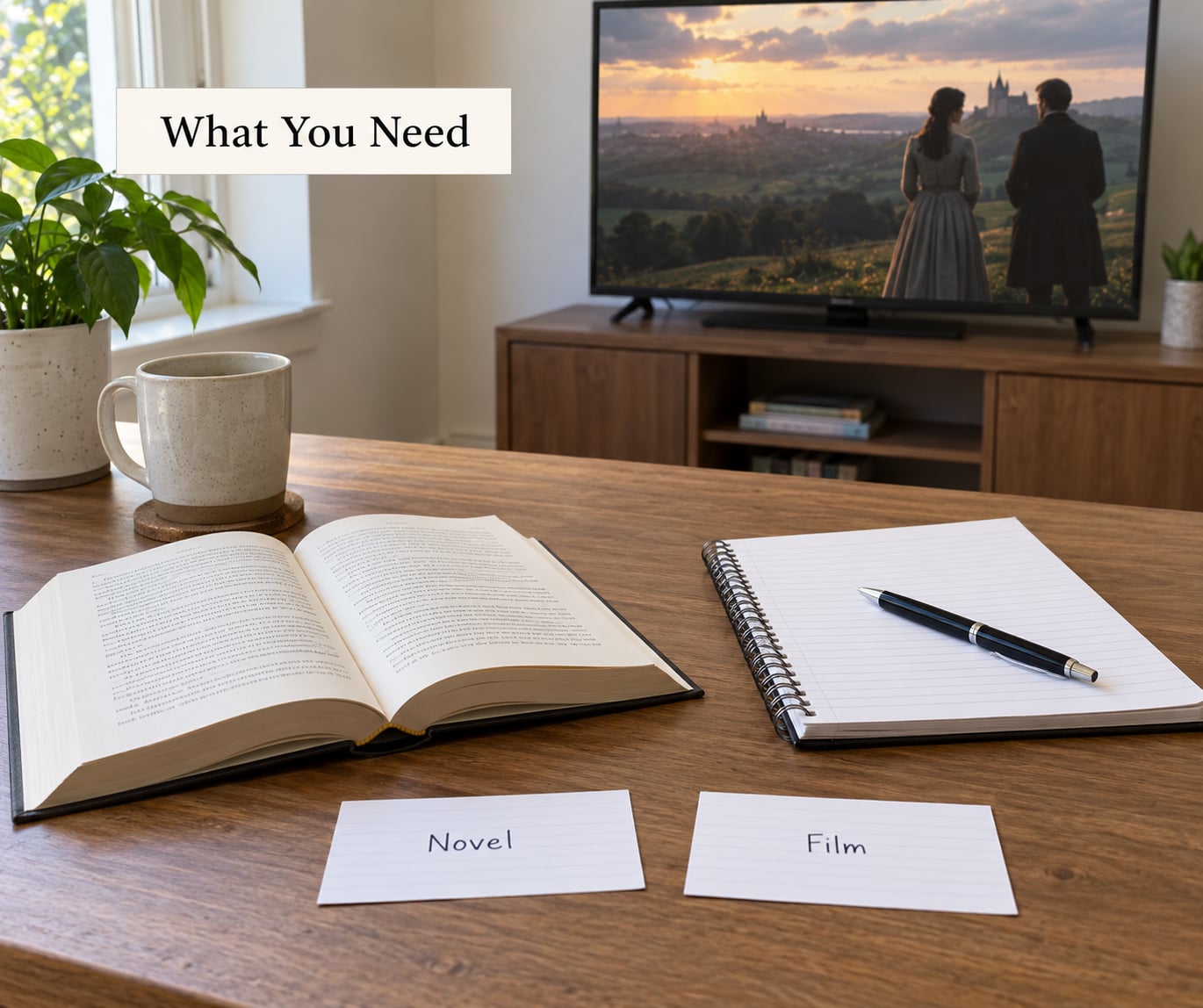
Not much, and none of it expensive. But the order of assembly matters, because the whole method collapses if you start the film before you have the baseline in your head.
- The novel itself. Not an audiobook, not a summary, and ideally not a screen tie-in edition. You need the narrator’s actual sentences, because a large part of what a film changes happens inside the prose.
- The specific film version. Extended cuts, director’s cuts and different international edits exist for a reason, and the changes between them are sometimes larger than the changes between the book and any of them. Decide which cut you are judging before you start judging.
- A notebook or document with five columns. A single page of paper works. The columns are: element, what the novel does, what the film does, why it probably changed, and what the change gained or lost.
- A pen and a way to pause. If you are comparing while watching, you will need to stop. Nobody catches twenty differences in one sitting, and trying produces a vague impression rather than notes.
- One control against spoilers. The simplest is a rule you set in advance: read to the point where the film leaves off, then stop. See step three for how that maps onto a novel with no chapter breaks.
- A little time for the second viewing. A second pass through the film, after you have read the book, is where most of the interesting observations turn up.
One thing you do not need is a view on which version is better. Set that aside. You will have a view at the end, and it will be a more useful one, but the method stops working the moment you are scoring points for a side.
How to Read a Novel and Its Film Adaptation Together: Step by Step
Seven stages, in order. The method assumes you read the book first, which is the order most people find useful, though the film-first camp has a fair argument and I will come back to it in the mistakes section. If the film already ruined the book for you, skip to step seven and work backwards.
1. Read the novel before watching the film
Read the whole thing first. Not a summary, not the first three chapters with the film waiting in the wings, and definitely not a version where you are skimming for the differences. The point of this stage is to build a baseline you can actually check the film against.
While reading, note five things in one page: who narrates and how close that narrator is to the action, the order of the major events, how the story ends, who the central characters are and what each one wants, and the two or three themes the novel keeps pressing. If you do nothing else in this article, do this. It is the single page that makes every later step possible.
Write it in your own words. If you copy a plot summary from a website, you are comparing a summary to a film, and the film will win on every count because summaries are already compressed.
While you are in there, mark the moments you expect a film to struggle with: long internal monologues, sections where nothing visible happens but the meaning shifts, heavy world-building, unreliable narrators, and dialogue that carries subtext rather than information. Those pages become your checklist later, and they are usually where the most interesting adaptation decisions live.
2. Identify the adaptation’s central differences
Now find out what changed at the most obvious level, before you get into the film itself. Runtime versus page count is the fastest clue, and a 300-page novel becoming a 118-minute film is already telling you something about compression. A 700-page fantasy becoming a two-hour film is a different conversation entirely.
Then separate the kinds of change, because they mean different things. Adaptation criticism has a few recurring categories and once you can name them, the arguments get much shorter and much fairer.
- Compression. Subplots, chapters or scenes folded into minutes. Often the right call.
- Omission. Material simply left out, sometimes with no trace at all.
- Reordering. Events moved in time so the audience gets information in a different sequence.
- Merging. Two or more source characters combined into one, which changes the dynamics of every scene they share.
- Expansion. New material invented for the screen, including characters who do not exist in the book.
- Transposition. A whole setting or period moved somewhere more practical or more profitable.
- Retelling. The premise kept, the story rewritten.
When you name a change, describe it before you judge it. “They cut the second case” is a fact. “They ruined it” is a verdict that closes the conversation. The fact is the beginning of the analysis; the verdict ends it.
From this point on, the useful question is never whether the film kept the book’s details. It is what the film does with the same material. Details are evidence, effects are the point.
3. Compare how each version tells the story
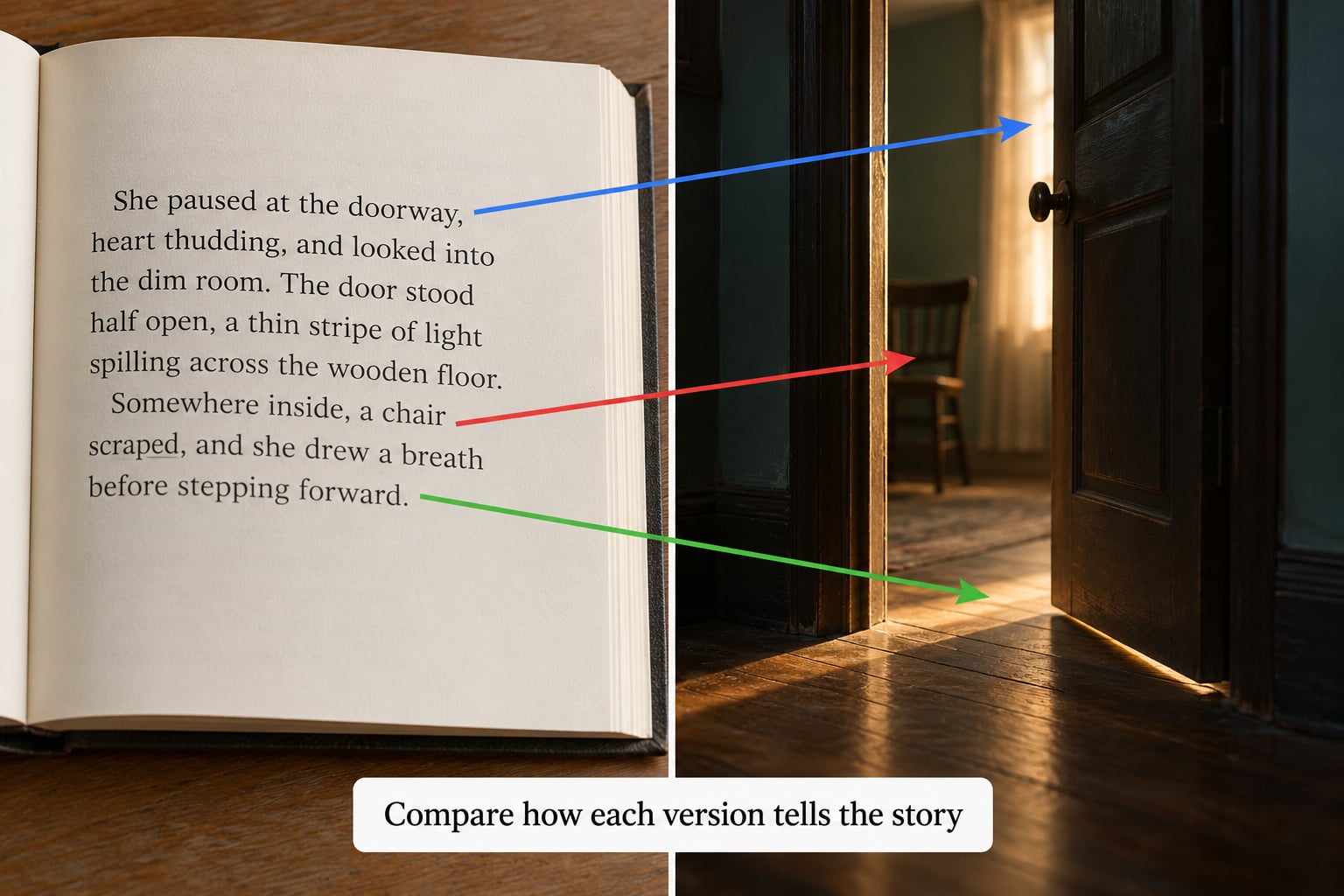
This is the stage where learning how to read a novel and its film adaptation together actually pays off. You are comparing structure: which events the film keeps, in what order, and how it handles the things prose can do and film cannot.
Start with the opening. Prose can open on a thought, a smell, a memory or a line of weather. Film has to open on something moving and visible, so adaptations frequently start later in the story and let the audience arrive already inside the situation. Compare who is on screen in the first five minutes versus whose head you were inside on page one.
Then look at the three things prose is best at: interior monologue, texture, and unlimited time. A narrator can tell you what a character is thinking for forty pages. A film has to replace that with a look, a pause, a piece of music, a voiceover or nothing at all, and each of those solutions changes the meaning of the scene. When a film uses voiceover to carry the book’s narration, ask yourself what is gained and what is lost, and the answer usually is: immediacy gained, ambiguity lost.
Pacing is the next comparison. Novels are allowed to be slow on purpose. Films have a fixed runtime, so quiet stretches get compressed, and a scene that takes twelve pages in a book may take ninety seconds. Watch whether the compression preserved the reason the scene existed or only its plot function. That distinction is the single most useful thing a comparison reader can develop.
For spoiler control, match the film to the book by event rather than by page. Keep a marker where the film first arrives at a point you remember, then read the novel back to the point where that same event happens, and stop there. For a novel with no chapter breaks, a rough rule that saves a lot of accidental spoilers: the film normally reaches about a third of the way through the book in its first act, so pause around the twentieth percent mark of the book before your first watch.
The pacing rule of thumb that circulates for adaptations is the two-and-a-half rule: give a film about two and a half hours before deciding whether it is working for you. A slow opening in a novel is a different creature from a slow opening in a film, and cutting out at thirty minutes usually means you judged the setup.
4. Track characters, conflicts, and relationships
Character is where adaptation changes are most visible, because a performer gives you a face, a body and a voice where a page gave you a name and a description. Almost every film casting is a change, and a useful one to examine even when the actor resembles the book.
Work through your main characters one at a time and ask four questions. What does this person want at the start and what do they want by the end? How much of their inner life does the reader get? Whom do they trust, and does the film keep that relationship? And what do they do in the last twenty pages that you did not expect?
Then look at the merges. When two source characters become one, the usual casualty is a relationship, because a merged character inherits the plot function of both and often loses whatever tension came from their being separate people. If a film has fewer significant characters than the book and the cast is fighting you emotionally, that is often why. Crime and noir adaptations feel this most, because in that genre a suspect, an accomplice and a partner each carry a different kind of information, and folding them together leaves the audience with a person who knows too much too early.
The reverse happens too. Films frequently invent a character to carry a theme, sometimes almost transparently, so that a theme can be discussed out loud by someone who does not have to be the protagonist. Noticing an added character and asking what job the invention does is one of the more satisfying things about paired reading.
Watch performance the second time through. Now that you know what the novel says about a character’s interiority, you can see the choices: where an actor adds a hesitation the book did not ask for, where a line of dialogue has been rewritten to sound less literary, and where silence is doing work that the book did with a paragraph.
5. Read setting, mood, and visual storytelling
Setting is the most under-comparison and most rewarding area. A novel can describe a city over thirty pages of accumulated detail. A film has to communicate that city in establishing shots, production design, weather, light and the way people move through the frame, and it has to do it in whatever location it could afford.
Compare the two versions on atmosphere first. What does the place feel like in the prose, and how did the film get you that feeling? Often the answer is texture rather than accuracy: a book might describe damp stone and a particular kind of quiet, while the film delivers the same feeling with sodium streetlight and constant rain. Different tools, same result. This is where adaptation arguments go wrong most often, because people are comparing accuracy of description when they should be comparing effect.
Note the locations the film adds. A production designer who grew the city outward to fill frame is telling you something about the story’s reach, and sometimes about its themes. Note too the places the book emphasises that the film treats as background, because those tend to be the details a reader misses most once the film is over.
Sound, score and silence are the film-only columns and they are worth their own row in your notes. A score can carry emotion a novel lets you supply yourself, and that is either a generous assist or an intrusion depending on your taste. Recording your reaction in one line now saves you from arguing about it later.
For a fair test, ask what each version would lose if you stripped one tool away. Remove the narration and the film loses half its access to interiority. Remove the visual design and it might read like a stage play. Neither is a failure of medium. It is just the shape of the thing.
6. Compare themes, symbols, and interpretation
Themes are where the largest, quietest changes live, and they rarely show up in a list of cut scenes. A film can keep every plot beat and still argue something different from the novel, because theme is built from emphasis, and emphasis is built from cut and repeated lines, framing, casting, score and ending.
Ask three questions here. Which theme does the novel press hardest? Which theme does the film press hardest? Where are they identical, and where does one of them dominate? An adaptation that adds a subplot about a character not present in the book is usually reaching for a theme the novel left implicit.
Symbols are the easiest evidence. A recurring object, colour, sound or gesture can carry different weight in the two versions, and if it disappears from the film, ask whether the theme went with it or simply got stated instead of shown. When a film makes a theme explicit in dialogue that the novel kept ambiguous, the ending usually pays for it, often less interestingly.
The ending deserves its own pass. How the story closes is the single change readers argue about hardest, and it is where adaptation is most obviously a negotiation rather than a translation. A bleak book ending that becomes hopeful on screen may be a studio decision, a test-screening decision, or a genuine artistic choice by a filmmaker who thought hope was the honest version. You will not always be able to tell which from the finished film, and admitting that is a sign of a careful reader rather than a weak one.
Write down your two readings side by side, each in three sentences, without judging. Which is more defensible is a separate question, and it comes at the end.
7. Write your final comparison and decide what each version offers
Now the payoff, and it is not a score. Use a structure that forces you to be specific. Name the three biggest changes. For each, state what the novel did, what the film did, and what the change gained or lost. Then identify one thing the film does better and one thing only the novel can do.
The last part is the one people skip, and it is where the method pays. A novel can spend four pages inside a character’s hesitation. A film can hold a two-second look and leave the audience to do the work. Those are different achievements, not competing ones, and being able to name both is what separates a comparison from a complaint.
Then give a recommendation rather than a verdict. This version suits a reader who wants pace and performance. The novel suits a reader who wants interiority and time. Both are worth your evening, and the pairing is worth more than either alone, which is the real answer to how to read a novel and its film adaptation together.
Common Mistakes
Judging the film only on fidelity. Fidelity is a measure of copying, and copying is not the goal. A novel with a first-person narrator reading a dead man’s case file cannot be filmed as that narration; it can only be rebuilt. Ask instead whether the reconstruction works.
Treating every missing book detail as a failure. A subplot cut to protect the runtime is not a betrayal. Ask what the cut was doing and whether the film found another way to do it.
Ignoring what the medium can do. Half of adaptation judgement is technical ignorance. A film cannot reproduce a paragraph of internal monologue; it can only substitute something else. Know the substitutions before you call them failures.
Comparing details instead of effects. This is the big one. The book names the street, the film shows the light on it. Both can produce the same dread. Compare what the reader and viewer feel, not what they are told.
Overlooking changes that improve things. Some of the most praised adaptations are the least faithful. Cutting a distracting subplot, casting against the obvious choice, or ending on an image instead of a speech are decisions, not oversights.
Auditing like a checklist instead of reading. If your notes are a list of missing scenes, you are grading, not reading. Add a column for what each version is doing, or at least write one paragraph on something you liked before you write about anything you did not.
Letting the film spoil the book. Read-first, or pause at the matching point. If the film has already been seen, deal with it directly: the expectancy gap is a habit of attention, and it loosens once you deliberately compare instead of checking.
Expecting one order to be correct. There is a real camp that prefers the film first, and their reasoning holds: you meet the characters as a viewer, then read the novel as a second, separate work rather than a text to be audited. Others read first so nothing is spoiled. Both orders work if you stay honest about which experience you are having.
A few smaller notes. If you are working through a series, keep a release-order list and a reading-order list side by side, because they often diverge, and the order you watch can quietly change the story you think you are reading. And if you want the sharpest version of any adaptation question, the screenplay is the middle layer most people skip: comparing the script to the book shows you what the filmmakers chose, and comparing the script to the finished film shows you what the studio chose.
Frequently Asked Questions
Should I read the novel before watching its film adaptation?
Usually yes. Reading first protects the book from spoilers and gives you a baseline to compare against, which is what makes the comparison interesting. Watch-first works well too, especially if you want to meet the characters as a viewer and treat the film as its own work. The order matters less than staying in one of them long enough to notice what it is doing.
What should I compare first when reading a novel and film together?
Start with the opening and the narrator, because those change most and everything else follows from them. Note who is on screen in the first five minutes versus whose head you were inside on page one. Then move to pacing, then to character, then to theme. Comparing the ending first is the most common habit and the least useful, since it encourages the argument rather than the analysis.
Does a film adaptation have to stay faithful to the novel?
No. Fidelity is a measure of copying, and a screenplay is already a translation. A first-person narrator reading a dead man’s case file cannot be filmed as that narration at all, so the film has to rebuild the effect with different tools. Judge an adaptation on whether its solution works, not on how closely it reproduces the source. Plenty of excellent adaptations changed the ending on purpose.
How many differences should I look for in a book-to-film adaptation?
Enough to fill one notebook page, not a spreadsheet. Most adaptations of a full novel show fifteen to thirty meaningful changes once you start counting deliberately, and the rest are set dressing. Chase the first ten that change meaning, then stop. A long list of missing scenes tells you very little, whereas three changes analysed properly will keep you talking for an hour.
Can a movie adaptation be better than the novel?
It can be better at something, which is more useful than better overall. Films often pace better, cast better, and land an ending more cleanly. Novels usually stay inside a character’s head longer and build a world with more texture than a two-hour runtime can hold. Plenty of people say the film is the better work and plenty say the reverse, and both camps are usually describing different strengths.
What is it called when a novel is turned into a movie?
It is called an adaptation, or more specifically a screen adaptation or book-to-movie adaptation. Scholars write about adaptation fidelity, which means how closely a film follows its source novel, but most critics now treat the film as a work in its own right rather than a translation to be graded. Related terms you will meet include screenplay, source novel, compression and unfilmable book.
What should I write about after comparing a novel and its film?
Name the three biggest changes and give each one a full treatment: what the novel did, what the film did, and what the change gained or lost. Then add one thing the film does better and one thing only the novel can do, and finish with a recommendation for a particular reader. That structure produces a comparison rather than a review, and it holds up when someone disagrees with you.
Conclusion: Where to Start
The method is short enough to remember: read the novel and record its narrator, plot spine, ending, main characters and themes. Watch the film with those notes beside you, pausing to log every change by category. Then compare story, character, setting and theme in that order, and finish with what each version is good at rather than which one won.
Start tonight with one page. Pick the adaptation you argue about most, read the book, and write down the five things you would want to check. That page is the whole method, and the rest is just attention applied consistently. Updated for October 2026.