Out-of-print crime novels are usually a lot easier to track down than their reputation suggests. Most were never scarce; a publisher simply stopped reprinting them, which is a supply problem rather than a rarity problem. The method that works is an order of moves: pin down the exact edition, check whether a reprint is already scheduled, search the aggregators that query hundreds of used sellers in one go, then widen out to crime specialists, auction records and reader communities.
Here is the short version:
- Write down the exact title, author, publisher and edition you are hunting.
- Confirm the title is genuinely out of print rather than merely absent from a retailer’s range.
- Check the reissue radar, so you do not pay collector money for a book that is about to be reprinted.
- Search the aggregators: BookFinder, viaLibri, Alibris, BookScouter, AbeBooks.
- Go direct to crime-specific used bookshops and their searchable stockrooms.
- Use library catalogs, interlibrary loan and used-book sales as the fallback.
- Hunt in person, then set an alert and join the communities that post finds.
One word of vocabulary first, because it decides everything that follows. Out of print means the rights holder is not producing new copies and no current edition exists. It does not mean the book is unobtainable, and it does not mean it is valuable. A title can be out of print in the UK while a US edition is still printing, and a common out-of-print paperback can be sitting in a charity shop for pocket change.
Table of Contents
- What You Need
- How to Find Out of Print Crime Novels: Step-by-Step
- Start with the exact title, author, and edition
- Search library catalogs and shared-library networks
- Use bookseller catalogs and specialist crime sellers
- Check dealer archives, fixed-price stores, and want lists
- Search auction catalogs and sold-listing databases
- Search author, publisher, and reader communities
- Verify condition, edition, authenticity, and price before buying
- Track leads and follow up when a book surfaces
- Common Mistakes
- Frequently Asked Questions
- Can a library get me an out-of-print crime novel?
- How do I tell whether a crime paperback is a first edition?
- Is out of print the same as rare?
- Where can I read detective novels online for free?
- How much should I pay for an out-of-print crime novel?
- Why did my book disappear from Amazon?
- Conclusion
What You Need
Before you open a single search box, five things make the hunt dramatically faster. Most of the wasted hours collectors report come from searching too vaguely, not from searching in the wrong places.
- Exact edition details. Title, author, publisher, year, format, and the ISBN or OCLC number if you can find one. An ISBN-10 and its ISBN-13 equivalent are the same edition, and searching both catches more stock.
- A shortlist of acceptable editions. Decide in advance which printings you would actually take: any edition, a hardcover with a jacket, a specific first printing. Without this rule you will talk yourself into a bad purchase.
- Catalog access. WorldCat, your national or state library system, and LibraryThing all let you see whether an edition is recorded, how many libraries hold it, and whether anyone has flagged it as wanted.
- A way to contact sellers directly. Most independent booksellers answer a short, polite question about stock and condition faster than you expect.
- A tracking sheet. A spreadsheet with columns for title, edition, source, asking price, condition, date checked and follow-up status. Once you are chasing four or five missing books at once, memory fails fast.
How to Find Out of Print Crime Novels: Step-by-Step
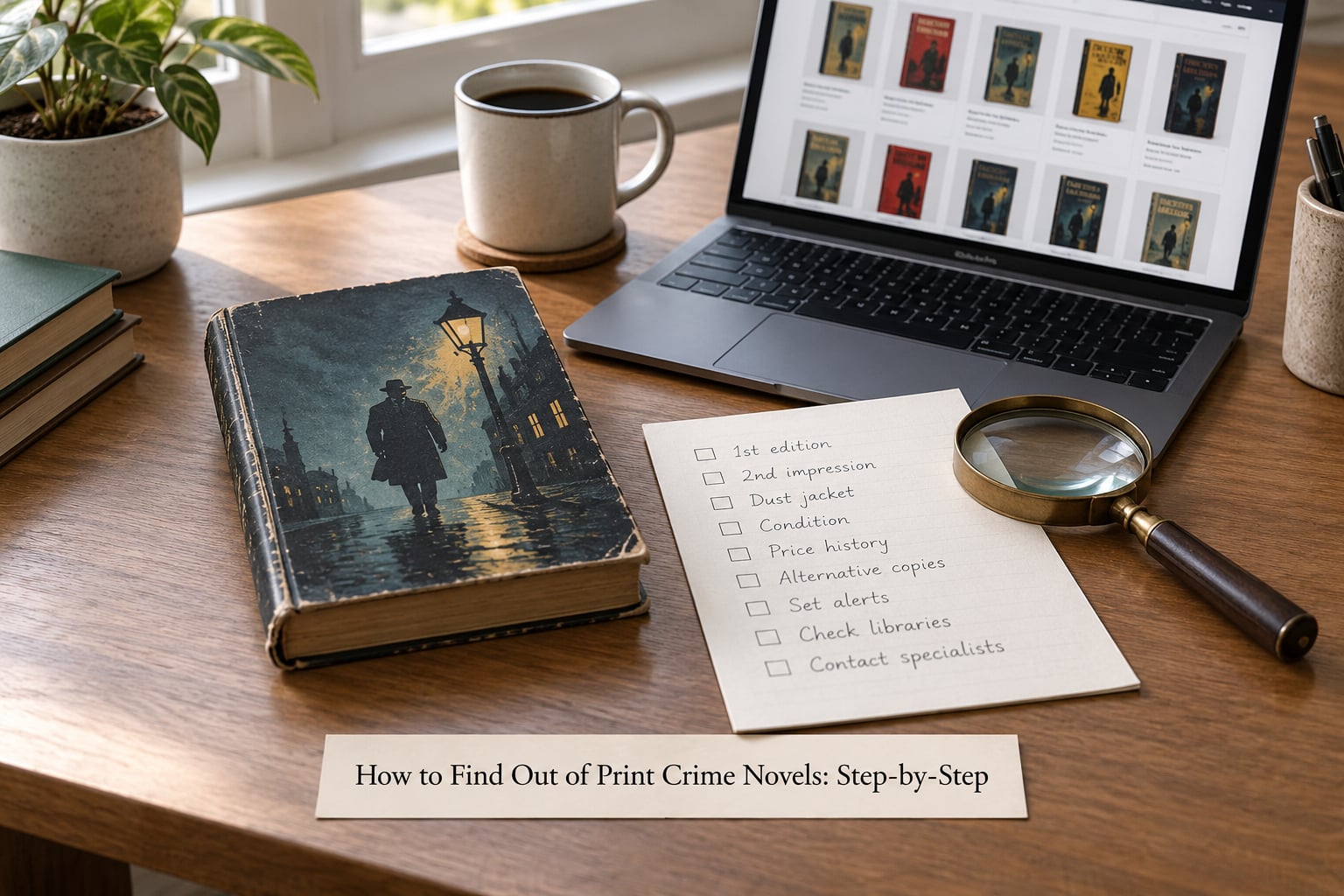
The seven stages below run from broad identification to increasingly specialist sources. Work them in order. Jumping to the auction stage first is how people end up paying for the wrong printing.
Start with the exact title, author, and edition
Build a record for each missing novel before you search. Note alternate titles and the author’s spelling as printed on the book, because pseudonyms are the norm in Golden Age and pulp crime fiction and a lot of searching fails purely on an author’s name.
Then read the copyright page of any copy you already own or can see. The last line of printing information tells you the most recent printing, and the edition statement tells you which printing you are holding. This is the same two-minute check that answers the dating question readers ask most often on book-identification forums, where people post images of a book with no date and no comparable listings.
Search library catalogs and shared-library networks
WorldCat is the starting point. Search by title and author, then look at the edition records: how many libraries hold each one, and which catalogue numbers are attached to it. A title held by twelve libraries in a single country has almost certainly been reprinted, even if no retailer lists it.
Your own library is the next stop. Many readers do not realize that a title can sit on the shelf as “not available for loan” and still be obtainable through interlibrary loan, a branch request, or a regional shared-library network. If you only need to read the novel once, a loan costs you nothing and takes minutes to request.
For free digital access, check Libby or your library’s OverDrive catalogue first, then the Internet Archive lending collection. HathiTrust holds scans of many older printings, and Golden Age detective fiction from the first half of the twentieth century includes a large public-domain share that any library will lend you without a request.
Use bookseller catalogs and specialist crime sellers
Aggregators are the highest-yield single tool. BookFinder queries dozens of used-book sites at once and sorts results by total cost, which matters more than the sticker price once international shipping is added. viaLibri covers a large European network, Alibris indexes a huge slice of independent sellers, and BookScouter is useful for the long tail of dealers who list a handful of titles each. AbeBooks and ThriftBooks sit alongside them, and Better World Books is a good option when you want a donation included in the price.
Then go crime-specific, because this is where general book sites go thin. Murder Ink in New York and Aunt Agatha’s in Chicago both maintain specialist inventories of mystery, detection and true crime, and Aunt Agatha’s has a standing reputation in the field that predates most of the online shops. Smaller names worth searching by name include The Book Rack and dealers who post stock through Mystery File and the long-running crime blog Past Offences.
Filter where the shop allows it: binding, dust jacket present, publisher, edition and year. A jacketless copy and a copy in its original jacket are different products, and the search filters are the only reliable way to separate them at scale.
Before you pay a serious sum, check whether a small press has already brought the book back. Valancourt, Tartarus Press, Mongoose, Galileo Books and Hard Case Crime all reprint out-of-print crime and mystery, and Crime Reads keeps a running reissue category that tracks new editions as they appear. A reprint-pending title is the single most expensive mistake in this whole process.
Check dealer archives, fixed-price stores, and want lists
Independent dealers sell from stockrooms that rarely reach a website search box. Some keep searchable inventory pages with several thousand titles; others will search their back room if you email a title and an edition. It costs nothing to ask, and the answer is usually within a day.
Dealer catalogues and warehouse sales are the other quiet channel. Fixed-price shops and clearance tables move out-of-print stock cheaply because nobody is grading it carefully, which suits readers who want a copy to read rather than a copy to grade. Register on a few dealer want lists at the same time. A standing want list costs nothing and means a dealer contacts you when something walks in, which is how a lot of collections get completed without any active hunting at all.
Always confirm a listing is live. Backroom inventory and clearance pages are rarely dated, and an archived catalogue page is not an offer.
Search auction catalogs and sold-listing databases
Completed auction records are the most honest price guide available, because they show what a copy actually fetched rather than what somebody hoped. Bidding platforms and specialist crime-book auction houses both publish sold results, and crime specialists often hold whole estates of a single writer, which is exactly the material that never reaches a normal search.
Read hammer prices carefully. A record figure usually excludes shipping, tax and any condition adjustment, and an international buyer can find the delivered cost runs to double the headline. Compare at least five sold records of the same edition before treating any number as a market rate.
One timing warning. When a crime novel is adapted for film or television, secondhand prices spike hard, sometimes within weeks, and readers report copies becoming unaffordable almost overnight. If a title you want has just been announced for adaptation, set a price alert and wait rather than bidding into the first surge. Adaptation interest fades, and so does most of the markup.
Search author, publisher, and reader communities
Community sourcing is the primary discovery channel in this niche, and it costs nothing to join. Search r/booksuggestions, r/mysterybooks, r/rarebooks and r/BookCollecting for the title plus out of print, first edition, or dust jacket. Posts of that shape get answered quickly by people who have already solved the same problem.
Goodreads runs a long-lived list of books that should go back in print, and the comments under those titles are effectively a live want-list exchange. KBoards threads and specialist Facebook groups behave the same way. A named member of the BookCollectorz group has said they built roughly ninety-five percent of their true crime shelves from thrift stores, preferring out-of-print copies over anything else, at about three dollars a book. That is the honest baseline: secondhand is usually cheap.
Verify condition, edition, authenticity, and price before buying
Ask for photographs of the copyright page, the spine, the jacket and any flaws before you commit, especially on an international order. Confirm the printing statement, publisher, binding, page count, and whether there is a bookplate, inscription or ex-library marking. Check the return policy in writing, and see whether the seller combines shipping if you are buying more than one book.
| Grade | What it means on a crime novel | Buy it if | Walk away if |
|---|---|---|---|
| Near fine | Light shelf wear, jacket present, no markings | You are collecting | You only want to read it |
| Very good | Some foxing or spine wear, jacket creased or lightly chipped | You want a good-looking shelf copy | Price is near the first-edition band |
| Acceptable | Reading copy; spine faded, edges bumped, no jacket | You intend to read it | You need a presentable copy |
| Jacketless or ex-library | Original jacket missing, or stamps and labels removed from the boards | Price is low and you value the text | A collector grade is what you are after |
Set a maximum price for yourself before you search, and derive it from sold records rather than asking prices. A first printing with an intact jacket sits in a completely different band from a common out-of-print paperback, and sellers regularly price the second as if it were the first. The copyright-page check is what keeps those two apart.
Track leads and follow up when a book surfaces
Keep the tracking sheet current, and set yourself rules for each lead. Email a dealer once, join the want list, file the interlibrary loan request, set the alert. Then stop revisiting the same unreliable listing every evening; a listing that has sat unchanged for months is usually a photograph of a book that no longer exists.
The cheapest long-term system is unglamorous: one Goodreads list, one subreddit, one dealer’s want list, and saved searches on BookFinder and AbeBooks. Leave them running and let the books arrive.
Common Mistakes
- Searching by title alone. You end up with a different edition, a foreign printing, or a book with a similar name. Fix: search title plus author plus publisher, then add the ISBN when you have it.
- Ignoring edition differences. A reprint of a hardboiled classic can be a tenth of the price of the first printing with jacket. Fix: decide your acceptable editions before you search, and read the printing statement on every copy you consider.
- Assuming out of print means unobtainable. Most such titles turn up within days on an aggregator. Fix: check the catalogs first so you know what you are actually hunting, then search the sellers.
- Paying a reprint-pending price. A small press edition on the way makes an expensive used copy pointless. Fix: check the reissue radar and the publisher’s catalogue before bidding.
- Trusting photographs without details. Stock images hide spine wear, inscriptions and repairs. Fix: ask for dated photographs of the copyright page and any flaws, and check the return policy.
- Overpaying for a common paperback. Marketed as rare, sold on the assumption that out of print equals scarce. Fix: compare five sold records of the same edition before you commit to any figure.
- Forgetting delivery cost. An overseas bargain can cost more delivered than a local copy priced higher. Fix: sort by total cost, not sticker price, and ask about combined shipping.
Frequently Asked Questions
Can a library get me an out-of-print crime novel?
Often, yes. If the edition is catalogued, your library can usually request it through interlibrary loan, a branch request, or a regional shared-library network. A title that shows as unavailable for loan on the catalog is often still obtainable that way. If you only need to read it, a loan is free and takes minutes to request, and it is far cheaper than any used copy.
How do I tell whether a crime paperback is a first edition?
Look at the copyright page and find the printing statement on the last line. It names the edition and the year of the most recent printing, so the lowest number you see is the printing you are holding. A first edition also shows a first-printing code such as a number line on the copyright page. If there is no date at all, compare publisher and binding against WorldCat records.
Is out of print the same as rare?
No, and the difference matters more than any other in this hobby. Out of print means no new copies are being produced, which describes a great many ordinary paperbacks. Rare means very few copies survive, which is a different and much narrower category. A r/stephenking thread put it plainly: people post such finds daily, so treat any out-of-print label as neutral until you check sold records.
Where can I read detective novels online for free?
Start with your library’s digital lending through Libby or OverDrive, which often hold licences for older mystery titles. The Internet Archive lending collection has a large back catalogue available to borrow. For public-domain detective fiction from the first half of the twentieth century, HathiTrust and ordinary library digital collections hold scans. If a title is neither, the interlibrary loan request is still your best free route.
How much should I pay for an out-of-print crime novel?
It depends almost entirely on edition and condition, not on being out of print. A common out-of-print paperback is often a few dollars, and collectors report thrift store shelves full of them. A first printing with an intact dust jacket sits in a far higher band, driven by genuine scarcity. Use sold auction records for the same edition as your benchmark, and add shipping before deciding whether a price is fair.
Why did my book disappear from Amazon?
Listings are pulled when a rights holder withdraws a title or when stock runs out and nobody replenishes it, and the page often just vanishes rather than saying out of print. That is a listing problem, not a statement about availability. Search the same title on BookFinder, AbeBooks, Alibris and your library catalog, which index independent sellers and holding institutions that the retailer does not.
Conclusion
Start with the record, not the search. Write down the exact edition you want, confirm the title really is out of print rather than simply missing from a retailer’s range, and check whether a small press reprint is already announced. Then run the sources in order: library catalogs and interlibrary loan, the aggregators, crime-specific used bookshops, then auction and dealer records for the harder titles. Most of what you are missing is sitting in one of those four places right now, and the only genuinely scarce books are the ones worth waiting on.