Adaptations cut the detective inner monologue because a camera cannot record thought. A novel can print whatever the detective is thinking at any length, in any order, and the reader accepts it. Screen has to convert that reasoning into something a viewer sees or hears: a choice, a clue, a reaction, a line said out loud. Everything a script cannot externalize gets cut, and the inner monologue is the least externalizable thing on the page.
That is the whole answer in fifty words. The seven reasons below are the mechanics behind it: how the two media differ, what screen doctrine says about telling, why the detective puzzle punishes interiority hardest, and what competent adaptations actually put in the hole.
Table of Contents
- Why Do Adaptations Remove a Detective’s Inner Monologue?
- The Seven Main Reasons
- 1. Prose is interior by design, screen is exterior by default
- 2. Show-don’t-tell is treated as a law of screenwriting
- 3. The detective puzzle needs evidence, and thought is not evidence
- 4. Thought slows pace, and pace is the product
- 5. A performer can carry the thought without narrating it
- 6. Commerce adds voice-over, then takes it away
- 7. The format and the tone have both moved on
- How Does Visual Storytelling Replace Inner Monologue?
- Why Pacing and Screen Time Matter
- Why Performers Must Make Inner Life Visible
- What Changes When Noir Moves Into Film or Television?
- Which Kinds of Detective Monologue Are Most Likely to Survive?
- What Do Adaptations Risk When They Cut the Inner Monologue?
- How Can Writers Adapt Detective Interiority Effectively?
- Frequently Asked Questions
- Why do film adaptations cut inner monologue?
- What is voice-over narration in film?
- Which movies and series feature detective voice-over?
- Why is film noir called film noir, and what qualifies as it?
- How do I write inner monologue in a screenplay?
- Does cutting the inner monologue make the detective less interesting?
- Conclusion
Why Do Adaptations Remove a Detective’s Inner Monologue?
They remove it because interiority is the one thing the medium cannot hold. Prose has free indirect discourse, internal focalisation, stream of consciousness. A screenplay has a frame, a lens, a microphone and roughly ninety minutes of running time, and none of those four things can carry a paragraph of private reasoning without becoming a voice-over or a subtitle card.
It is worth separating two things that get mixed together. Cutting the monologue is not the same as losing the character. Plenty of adaptations keep a detective’s personality, moral discomfort and even their verbal tics intact while removing every sentence of interior narration. What disappears is the reader’s seat inside the deduction, not the detective.
Some loss is real. A book detective who narrates their own case gives the reader a running commentary on their own reasoning, and that commentary is often funny, often self-serving, and sometimes a lie. Screen usually keeps the sound of the personality and drops the self-justification.
Two terms get used interchangeably here and should not be. An inner monologue is any rendering of a character’s private thought, including the prose technique where the character’s voice slides into the narration without quotation marks. Voice-over narration is a specific film device: speech the audience hears that other characters in the scene do not, distinguished as non-diegetic when no source exists on screen at all.
So the inner monologue is the material; voice-over is one possible container for it. When an adaptation loses the material, the usual outcome is not that the voice-over disappears but that nothing replaces it, and the detective turns into a face that arrives at conclusions.
The Seven Main Reasons
Writers who cut it usually land on the same small set of reasons, whether or not they can name them. Here they are in the order that matters during an actual adaptation.
1. Prose is interior by design, screen is exterior by default
A novel is a machine for reporting consciousness. Raymond Chandler and Dashiell Hammett used first-person hard-boiled voice the way other authors used scenery: to tell you how the narrator wants to be seen while showing you a world that mostly disagrees with him. Dashiell Hammett’s Sam Spade in The Maltese Falcon narrates because the voice is the characterisation.
Screen has no equivalent structural advantage. Every shot is a fact about the visible world, and the camera cannot be inside a skull. Adaptation studies call this the point-of-view translation problem, and researchers looking at first-person fiction such as Kazuo Ishiguro’s report that the deeper the narration sits, the harder the transfer. Depth is what novels have most of.
2. Show-don’t-tell is treated as a law of screenwriting
Script advice has spent decades pushing writers toward visible behaviour, and a detective’s inner monologue is the single most obvious telling in the room. The consensus on r/Screenwriting is blunt about it: only use voice-over when there is a genuine story-driven need, because it breaks the prime directive of show-don’t-tell.
That doctrine is a blunt instrument, but a real production will not fight it. A script that leans on narration is easy to read as lazy in a pitch meeting, and it is the first thing a showrunner trims when an episode runs long.
3. The detective puzzle needs evidence, and thought is not evidence
This is the reason crime fiction cares about more than craft fashion. Classical detective fiction runs on a fairness contract, the argument Dorothy L. Sayers and later John Dickson Carr made explicit: the reader must receive every clue the detective received, in time to use it. The Golden Age forum debates still circle the same point, applying a fairness test to the narration itself rather than only to the crime.
Prose can hand the reader a thought and a fact in the same sentence. Screen often has to choose. If a runtime spends ninety seconds on a detective privately assembling a theory, it spends no seconds showing the torn photograph, the wrong shoe, or the car that was never garaged. Cut the thought and the deduction chain survives. Cut the clue and the audience cannot follow. So the clue wins, every time.
4. Thought slows pace, and pace is the product
A procedural is a machine that runs on momentum. Episodes have minutes to spend, and minutes spent watching a man think are minutes not spent on a suspect, a threat, or a body. Studio rhythm pushes everything toward the next event, and interior narration is the only narrative element that does not visibly move the plot forward.
The counter-argument is that slowness builds dread. It does, in the films built for it. It is expensive, and expensive choices need a champion, which is a whole different fight from the craft one.
5. A performer can carry the thought without narrating it
Once a detective has a face, an actor takes over the explanatory work. A pause that runs half a second long, a look that lands on the wrong person, a hand that goes to a pocket instead of a door. Audiences read all of that as thinking, and they read it faster than they read words.
The bargain is that the performance has to be specific enough to be readable. A face that registers nothing reads as dumb rather than calculating, and lazy interiority on screen looks exactly like lazy writing.
6. Commerce adds voice-over, then takes it away
Adaptation is not a one-way loss, which is the part most essays about this topic leave out. Studios have added detective narration for comprehension and it has been removed again. Blade Runner is the clean example: the 1982 theatrical cut carried Roy Batty’s voice-over, and Ridley Scott’s later cut took it out, arguing on camera that the images carried the meaning and the narration was an apology for them.
That means a voice-over on a detective film is sometimes a marketing and comprehension decision rather than an aesthetic one, and sometimes a director overruling a studio. Forum threads on the various cuts split hard on whether the Final Cut lost or gained the picture, which tells you the change is felt rather than neutral.
7. The format and the tone have both moved on
A hard-boiled first person novel becoming a prestige television series is two changes at once. The book is long, interior and free in its timing. The series is episodic, external and has to end on an act break. Lee Child’s Reacher and Michael Connelly’s Bosch both solve this by turning prose physicality into choreography, which is a large tonal shift from a narrating private eye into a man who acts first and thinks later.
Where noir voice-over once signalled the genre, it now reads as a period marker. A 1945 retrospective detective owes the audience an explanation because nobody else in the room is going to give them one. In 2026, the same device tends to signal a production that could not find another way in.
How Does Visual Storytelling Replace Inner Monologue?
Screen replaces thought with evidence of thought. The tools below are the working set, and each one carries a different weight of interiority.
| Device in the novel | What it does | What happens on screen |
|---|---|---|
| First-person narration | Sustains a voice across the whole book | Usually cut; the personality survives in dialogue and behaviour |
| Free indirect discourse | Blends the detective’s voice with the narrator’s | No direct equivalent; replaced by selective sound design and third-party observation |
| Dedicated deduction passages | Distributes evidence under the fairness contract | Externalised as a board, a document, a reconstructed scene, or a suspect’s mistake made visible |
| Stream of consciousness | Tracks thought as it happens | Rare; usually reserved for altered states or a single held moment |
| Thought expressed as action | Shows the detective deciding | Kept nearly intact; the easiest thing to transfer |
| Flashback | Reframes a past event through present knowledge | Kept, though often shortened or restaged |
| Non-diegetic voice-over | Comments from outside the story world | Contested; survives when it carries a plot function, not atmosphere |
| Diegetic detail | Foreshadows through setting | Expanded, since the camera can linger on props longer than prose does |
The pattern in that table is simple: devices tied to evidence survive, devices tied to atmosphere get cut or thinned. Flashbacks are physical events with a start and an end, so they travel. A mood of unease has no such handle, so it has to be rebuilt from weather, lighting and the sound of a room.
Three techniques carry most of the load. Withholding lets the camera stay on the detective while the audience watches him notice something we cannot yet interpret. Subjective sound narrows what the viewer hears until the detective’s hearing becomes the scene’s hearing. Behaviour under pressure shows a value: a detective who checks a doorway every time he enters one is telling us what he learned in the last forty minutes, without a word of narration.
Why Pacing and Screen Time Matter
Screen time is the hardest constraint nobody argues with. A page of interior narration can expand into three minutes of voice-over and a scene that exists only to hold it, and that scene has nowhere to cut to. Cut the page and the sequence plays straight through.
There is a pacing price to cutting, too. Prose thought creates suspense through withheld interpretation: the reader knows something is wrong before the detective names it. When a film jumps straight to the conclusion, the audience gets the answer without the dread, and the reveal flattens. Good adaptations buy the dread back with delay, framing, and the sound of something off-screen.
Why Performers Must Make Inner Life Visible
An actor’s job is to make the invisible legible, and the tools are physical: gaze, breath, the timing of a reach for a door handle. A detective deciding whether to trust someone can be played entirely in who he looks at first and how long he holds it.
Two limits are worth naming. First, a face can only sell what the audience already suspects; performance intensifies an idea, it cannot supply a missing one. Second, acting out thought too hard produces the artificial register audiences read as a character explaining himself to camera. The best of them stay almost still, which is why the most memorable detectives read as tired rather than as expositors.
What Changes When Noir Moves Into Film or Television?
Literary noir is a voice with a plot attached. Screen noir is a world with a voice imposed on it, and that imposition used to be part of the deal. Retrospective voice-over in the 1940s studio cycle, including Murder, My Sweet, functioned as an address to the audience: it told you this was a story being told back, and it smoothed a plot that could not be shown cleanly.
The revisionist films of the 1970s broke that contract. Ambiguity, non-linear time and an unsympathetic protagonist all depend on the audience not being told what to feel, which is close to impossible if a narrator keeps explaining. Later crime series worked the same seam from the other side, using interviews, case-board graphics and third-party observation to carry exposition instead of a first-person voice.
Television makes one further demand. A detective who reasons privately suits a self-contained story. In an episodic series, the reasoning has to reset for the audience every week, which pushes it toward short functional bursts and away from the long interior passages a novel can carry for forty pages.
Which Kinds of Detective Monologue Are Most Likely to Survive?
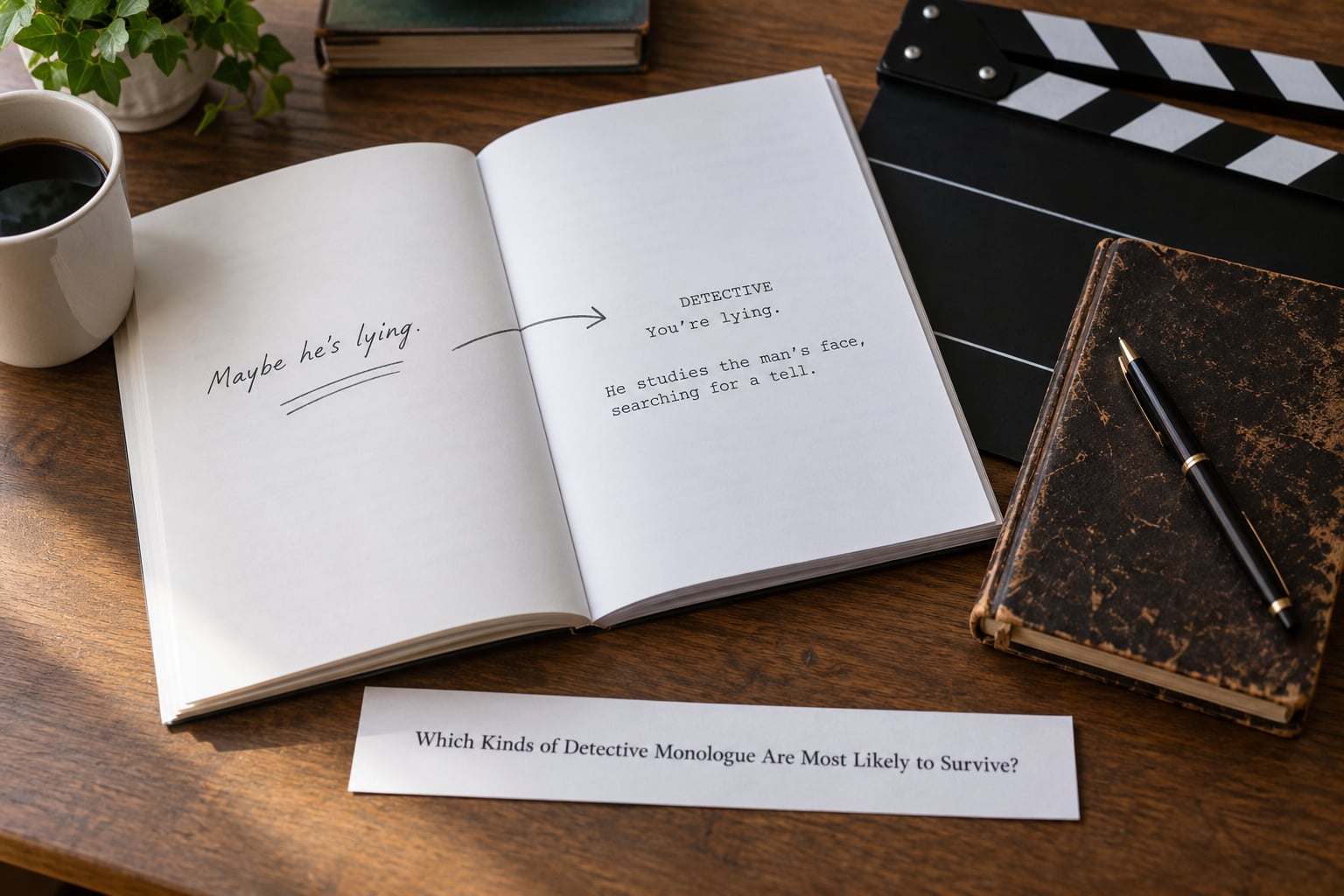
The monologue that survives is the one doing a job the camera cannot do itself.
Short deductions that name an object. A page of reasoning becomes one line of dialogue when the detective says what the shoe proves. Say it, show the shoe, move.
Voice that defines the detective. Distinctive obsessions, moral verdicts and put-downs often survive as speech rather than narration, because the personality, not the reasoning, is what was worth keeping.
Fragments carrying a plot function. Blade Runner is the reference case in both directions: studio-mandated narration for comprehension, and a director’s cut without it. The lesson is conditional, not absolute. Voice-over earns its place when the information cannot reach the audience any other way and the delivery itself means something.
Direct address and second person. An investigator talking to a partner, an interrogator talking to a suspect, a narrator addressing the reader, all read as confrontation rather than commentary. That is a scene, and scenes survive adaptation.
Memories with consequences. A remembered conversation that changes what the detective does next becomes a flashback or a line of dialogue. A remembered afternoon nobody needs becomes a cut.
What Do Adaptations Risk When They Cut the Inner Monologue?
The risks are real and they are the reason readers complain. Depth flattens: a detective who reasons on screen can look decisive rather than doubtful, and doubt is usually the interesting part of a private mind.
Ambiguity goes first. Narration can hint at a motive without confirming it; a performance has to pick. Subtext weakens, because the gap between what a character says and what they mean is much easier to hold when the text can underline the difference.
And audiences lose the reasoning, which can leave them stuck on why the detective did what they just saw. Forums about book-to-screen plot changes keep returning to the same complaint: not that the show changed things, but that it changed them without giving anyone a reason to accept them. Naming the specific scene and the specific cut does more for reader trust than any fidelity claim.
How Can Writers Adapt Detective Interiority Effectively?
For screenwriters and novelists planning for the jump, the work happens at the desk, not in the meeting where someone asks for it back.
Find the load-bearing thought. In any interior passage, ask which sentence changes what the detective does next. That sentence is plot. Everything around it is texture, and texture is what gets cut. Keep the plot.
Convert the thought into a choice or a clue. A private realisation becomes visible when it produces an action: the detective pockets the matchbook, checks the tyre, asks the one question nobody wanted. Write the action and drop the reasoning behind it.
Spread the information across the scene. Rather than one explanation, let three characters hold three pieces of the same picture. The audience assembles it, which is what they were doing with the book anyway.
Keep ambiguity where it earns its place. Show the detective looking at two things and saying nothing. Withholding that you cannot play on screen is usually a script problem.
Earn any voice-over. If you use it, give it a function a camera cannot perform: a deliberate address, an unreliable account, a structural device. Save the pensive narration, and if you want the noir register anyway, use audiobooks and radio drama, where the first-person detective has never lost his voice.
Frequently Asked Questions
Why do film adaptations cut inner monologue?
Prose can report consciousness directly at almost no cost in reading time. Screen has to spend minutes on anything it shows, and a camera cannot photograph a thought. So the interior passage has to be converted into something visible or audible: a choice, a clue, a reaction, a line of dialogue. Every conversion loses something, which makes the monologue the first thing cut when a script runs long.
What is voice-over narration in film?
Voice-over narration is speech heard by the audience but not by other characters in the scene, sometimes distinguished as non-diegetic when no on-screen source exists. Detective films used it for retrospective address and for explanation. In the 1982 theatrical cut of Blade Runner, Roy Batty narrates; Ridley Scott’s later cut removes him and lets the images carry the meaning.
Which movies and series feature detective voice-over?
Classic examples include the 1940s retrospective detective narrations of the studio noir cycle, Murder, My Sweet among them, and the 1982 theatrical cut of Blade Runner. Modern detective series rarely use it. Bosch draws on confessional interviews and case material instead, and Reacher externalises the books’ interiority into action and physicality.
Why is film noir called film noir, and what qualifies as it?
The label combines French film, meaning movie, with noir, meaning black, and describes a Hollywood cycle rather than one country’s output. Common features include low-key lighting and Venetian blind shadows, urban night settings, a protagonist usually flawed or compromised, a femme fatale, and corrupt or indifferent authority. What distinguishes it from the books is that noir is at heart a look, not a voice.
How do I write inner monologue in a screenplay?
Decide first whether the thought must be heard or only felt. If it must be heard, use voice-over sparingly and give it a story function. Otherwise put it into action, physical reaction, or a line said to another character. Screenplays can also show written text, split screen, thought flashes and narrative interludes. Check each passage by asking what it changes.
Does cutting the inner monologue make the detective less interesting?
Not automatically. Losing the reasoning costs you doubt, ambiguity and subtext, but a detective can still be written as complex through behaviour, contradiction and the company they keep. Reacher reads as a distinct person with no narration at all. What genuinely suffers is the audience’s ability to see why a choice was made, so supply that through action, clues and other characters.
Conclusion
The monologue gets cut because a camera cannot hold a thought, and it gets cut first because thought is the least physical thing a script contains. What a good adaptation replaces it with is not decoration: it is the action the thought produces, the clue it turns on, and the doubt the performance can carry. Start your own version by finding the single sentence of private thought that changes what your detective does next, and build the scene around that one.