
To review a book you did not like fairly, separate your personal reaction from the book’s actual weaknesses, then back every criticism with a specific scene, line or structural choice from the text. A fair negative review does not soften the verdict or praise the author instead of judging the work. It gives readers evidence they can use, and it treats the writer as someone who made choices rather than someone to be humiliated.
That matters more than most reviewers think. Readers say the middle ratings are the ones they trust most, precisely because a three-star review that names real problems tells them more than a five-star review that says everything was wonderful. An all-positive profile stops being useful quickly, including to the reviewer who writes it.
What follows is the process I use, and the one I have watched other reviewers use, for turning a genuine disappointment into a review that is honest without being personal.
Table of Contents
- What You Need
- How to Review a Book You Did Not Like Fairly: Step-by-Step
- Step 1: Separate Dislike From Poor Execution
- Step 2: Identify the Book’s Intended Experience
- Step 3: Gather Specific Evidence
- Step 4: Explain the Effect on the Reader
- Step 5: Balance and State the Verdict
- Common Mistakes
- Frequently Asked Questions
- How do I review a book I disliked without sounding rude?
- Is it fair to criticize a book because it did not meet my expectations?
- How specific should evidence be when reviewing a novel?
- Can I include spoilers in a negative book review?
- How much praise should a mixed or negative review include?
- What if other readers loved a book I did not like?
- Conclusion
What You Need
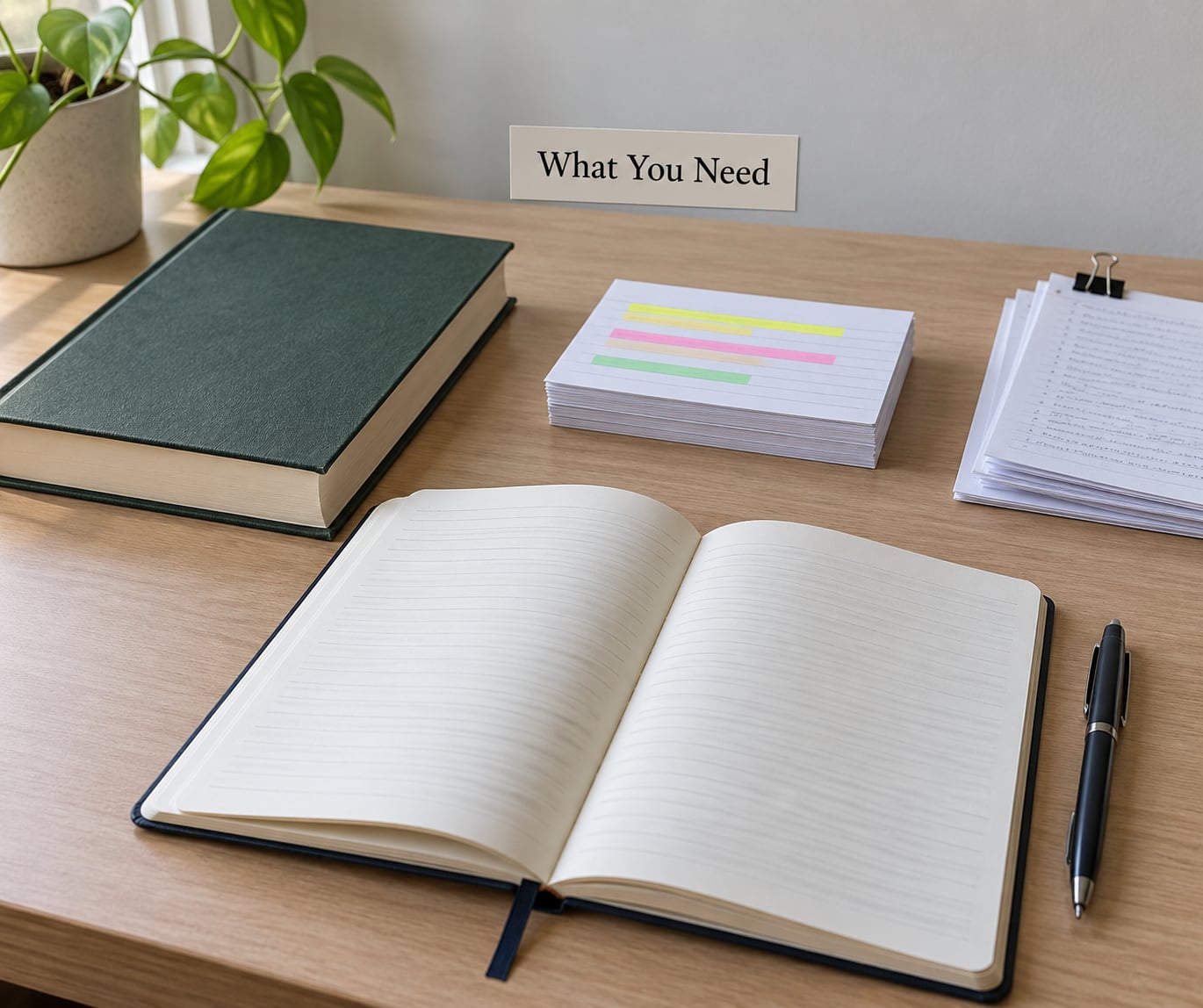
Six things. Most of them take ten minutes, and skipping any one of them is what turns a fair review into a rant.
- The finished book. If you stopped at page 90, decide what you are reviewing before you start writing, because a partial reading has its own rules.
- Reading notes. Whatever system you use, a flagged passage, a margin scrawl or a photo of the note you sent your friend. Reconstructing evidence from memory three weeks later is where reviews start going wrong.
- One central objection. Not five complaints. A single sentence naming the main thing that failed: the plot stalls at the halfway mark, the narrator’s secret is impossible to hide and hurts the tension, the ending undoes ninety percent of what came before.
- The specific passages behind it. Two or three moments where a reader could point and say yes, I noticed that too.
- The book’s own promise. The blurb, the jacket copy, the first fifty pages telling you what kind of experience to expect.
- The venue’s rules. Where the review is going, how long it can be, and whether you received an advance copy you need to disclose. Reviewers who disclose an ARC copy as a matter of course are read as more credible, not less.
How to Review a Book You Did Not Like Fairly: Step-by-Step
Step 1: Separate Dislike From Poor Execution
This is the step people skip, and skipping it is why so many negative reviews read as vague grumbling. Start by asking which of your complaints would survive if the book were exactly what you hoped for on page one.
If you wanted a slow, atmospheric literary novel and got a fast procedural, that is preference. Nothing in the book failed; it simply is not the thing you asked to read. If you wanted a competent procedural and the detective’s deductions depend on information she could not have had, that is execution. The book promised a closed-circle puzzle and handed you an omniscient narrator, so the puzzle cannot be solved on its own terms.
A useful test: write your complaint, then ask whether a reader who loved this genre would consider it a reason to put the book down. Slow does not qualify if slow is what crime fiction fans signed up for. Unexplained does, if the genre is built on explanation.
Step 2: Identify the Book’s Intended Experience
Before you can judge whether a book succeeds, you have to say what success looked like from the inside. Genre conventions are the clearest place to start. A noir novel owes you a narrator you should distrust, a world that corrodes its own ideals, and an ending that explains the case and the damage. A cosy mystery owes you fewer deaths, a closed circle and a puzzle with a real answer.
Tone and perspective matter too. An author writing in the second person is making a deliberate choice that can feel strange for twenty pages and then settle into something powerful. Decide whether it settled, and say so either way.
Then check the promise. If the jacket copy promised a smart examination of grief and the book is a competent murder puzzle with a sad widower in it, you have a fair point about the bait and switch. That is not a matter of taste.
Step 3: Gather Specific Evidence
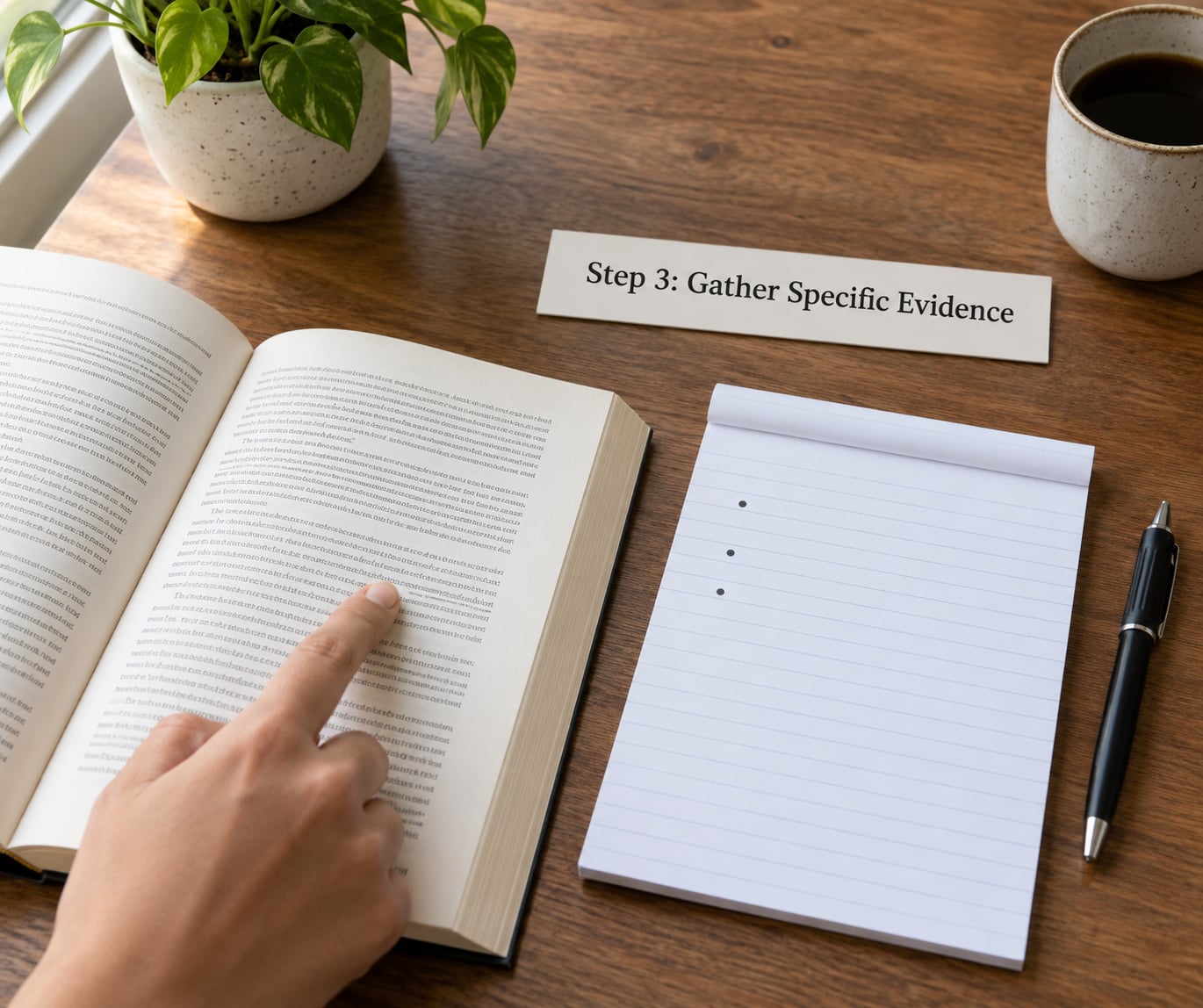
Evidence is what separates criticism from opinion. Labels like boring, badly written or predictable tell a reader nothing they could not have written themselves after twenty pages.
Point at the thing instead. Naming the scene where the second half repeats the first half’s beats, or the chapter where a character explains her own motivation twice to a listener who already knows it, takes ten words and does more work than a paragraph of adjectives.
Three kinds of evidence work best:
- A scene. Where it happens, roughly how far in, and what goes wrong. A detective who identifies the killer by a detail introduced in that same scene has not solved anything, and the reader felt the cheat.
- A pattern. One odd moment is noise. The same habit across eleven chapters is a craft decision: the prose keeps telling you how to feel instead of letting the scene carry it.
- A structural choice. Two timelines that overlap without ever meeting, a chapter break that skips the moment the whole plot turns on, a narrator who knows something and then forgets it for forty pages.
Keep the evidence proportionate. A review that quotes six lines and explains each one usually has a point to make. A review quoting six lines is usually settling an argument.
Step 4: Explain the Effect on the Reader
Evidence alone is a list. Add the effect and it becomes review: this is what the problem did to your reading experience. Pacing that stalls in the second act made you start checking the chapter headings to see how much was left. A narrator whose motives shift without explanation made you reread a chapter to check whether you had missed a scene.
Be careful with the pronoun. Your experience is yours, and it is worth reporting, but it is not a verdict on the book. Nobody wants to read that a book’s prose is lifeless because it failed to give you goosebumps on a Tuesday. Say what you felt and let other readers decide whether that feeling is diagnostic.
The strongest version of this sentence does two things at once: it describes your reaction honestly and it marks itself as personal. Reviewers say the reviews that admit bias outright, that say this might simply not be my genre, are the ones they act on.
Step 5: Balance and State the Verdict
Balance does not mean the sandwich method of compliment, complaint, compliment. That structure gets mocked for a reason: the praise usually has no evidence behind it, so it reads as damage control. Credit the specific things the book genuinely does well, and only those.
One or two real strengths is plenty. The two-hander dialogue in the first third was sharp enough that I read the interrogation scene aloud. The map of the city during the flood sequence is the clearest thing I have read on the subject in years. That kind of sentence gives the review balance that a perfunctory line about nice prose never does.
Then name your audience. This is the most useful line in any negative review, and it is the one most often left out: readers who loved procedural orthodoxy may find this exactly what they wanted, and anyone put off by multiple unresolved timelines should know that before buying.
Finish with a verdict, not a shrug. Two stars with a clear reason is more useful to a reader than four stars with vague misgivings, and it is far fairer to the writer than a rating that contradicts every sentence you wrote.
Common Mistakes
Most unfair negative reviews fall into a handful of patterns, and each has a fix you can apply before you hit publish.
- Attacking the person. The fix: describe the book, not the author’s intelligence, motives or effort. Nobody needed to hear that the writer wasted your money.
- Judging against a book you did not order. The fix: state the book’s promise first, then measure it against that. If you are writing for a different audience, say so and stop scoring.
- Summarising the plot instead of reviewing it. The fix: cut any paragraph a reader could get from the blurb. If a passage survives only because it explains what happened, it does not belong.
- Using unexplained standards. The fix: connect every standard to a convention of the genre or to the book’s own stated aims.
- Claiming your reaction is universal. The fix: switch from everyone hates to I found myself checking the time.
- Spoiling without warning. The fix: mark the spoilers, or write about the effect of the reveal rather than its contents.
- Hiding a conflict of interest. The fix: disclose review copies, friendships and grudges in one line at the top.
- Ranking the author’s whole career off one book. The fix: review this book. This is the one people notice most, because it turns a reading experience into a verdict on someone.
| Say this | Not that |
|---|---|
| Around the two-thirds mark the case restarts rather than deepens. | The plot gets boring. |
| The narrator’s connection to the victim is revealed too early, so the middle third has no tension left. | The author has no idea what they are doing. |
| I am not a fan of dual timelines, so this was not the read for me. | Nobody writes dual timelines any more. |
| The dialogue is sharp enough that I read the interrogation scene out loud. | The writing was actually pretty good though. |
| I finished it and it left me cold, though the descriptions of the harbour are worth the cover price. | I could not even finish this waste of time. |
| Content note for the violence in chapters 9 and 14. | Do not read this if you are sensitive. |
One more practical check before publishing: read it back and ask whether you would be comfortable if the author read it. Not comfortable about the verdict, which they should hear, but comfortable about the tone. Guilt is a poor reason to inflate a rating. If the criticism is specific and evidence-based, it is worth the discomfort of delivering it.
If the author responds badly, you are not obliged to engage. Reviewers who reply briefly and factually, or not at all, are the ones who keep their standing. Do not argue about taste in public threads, and do not soften your review afterwards under pressure either.
Frequently Asked Questions
How do I review a book I disliked without sounding rude?
Keep every sentence pointed at the book rather than the writer. Name what failed, show the scene or line where it failed, and describe what it did to your reading. Fairness comes from the specificity, not from softening the verdict. A reader who disagrees with your conclusion should still be able to see exactly what you saw.
Is it fair to criticize a book because it did not meet my expectations?
Only if the expectations were reasonably set by the book itself. A blurb promising a razor-sharp examination of grief and a book delivering a routine murder puzzle is a legitimate complaint about the promise. Preferring one subgenre to another is not. State the book’s own promise first, then judge it against that promise rather than your ideal version of it.
How specific should evidence be when reviewing a novel?
Specific enough that a reader could find the same moment in the text. Two or three scenes, described by where they occur and what goes wrong, usually carry a review. Broader patterns, such as the same habit appearing across many chapters, are worth naming too. Once you have enough evidence to convince a skeptic, stop; extra quotations turn criticism into an argument.
Can I include spoilers in a negative book review?
Yes, but label them, and consider whether the detail helps. A spoiler warning costs readers nothing and keeps the review usable by someone deciding whether to read the book. Often you can describe the effect of a reveal without describing the reveal: that the central twist is telegraphed from chapter four is more useful than the contents of the twist itself.
How much praise should a mixed or negative review include?
Enough to be accurate, no more. Name the specific things that genuinely worked, such as a stand-out sequence or a distinctive setting, and leave out the vague filler that softens a verdict without informing anyone. A perfunctory compliment reads as obligation rather than assessment, and reviewers can tell the difference. One or two well-evidenced strengths are better than a paragraph of hedging.
What if other readers loved a book I did not like?
Then name the audience your criticism points at and let readers sort themselves. Readers who loved it can tell whether your objection was a dealbreaker for them or simply not their preference, and that is exactly the information a review exists to provide. Plenty of reviewers post honest mixed ratings on one platform and only high-star reviews on their own blog, which is a legitimate way to separate personal record from public recommendation.
Conclusion
Start with the one sentence naming your central disappointment, then attach two or three moments from the text that prove it, then explain what those moments did to your reading. Credit what genuinely worked, name who the book will suit, and state your verdict plainly. That sequence is the whole of how to review a book you did not like fairly, and it takes about as long as writing the review badly would have.