Because the studios did not invent most noir plots, they bought them. The story supply chain ran from pulp magazines to cheap 1940s paperback originals, and Hollywood’s B-picture slots were built to absorb exactly that material. Hard-boiled fiction was urban, first-person and plot-driven, which made it unusually easy to film and unusually easy to reshape for censorship. Emigre directors arriving from Europe had no American properties of their own, so borrowed pulp was the natural fit.
The result is that the classic era of film noir, roughly 1940 to 1958, is unusually dense with novel-based pictures. Here is how that happened, what it looked like in practice, and where the pattern stopped holding.
Table of Contents
- Why Do Noir Stories Make Filmable Material?
- How Common Are Noir Movie Adaptations?
- 7 Reasons Noir Movies Are Often Based on Novels
- 1. Novels Already Supply a Complete Noir World
- 2. Noir Puts Inner Conflict at the Center
- 3. Crime Fiction Offers Strong Built-In Structures
- 4. A Successful Novel Provides a Built-In Audience
- 5. Filmmakers Can Expand the Novel’s Suggestive Spaces
- 6. Noir Literature Carries a Recognizable Visual Identity
- 7. Book Adaptations Help Films Navigate Difficult Themes
- What Changes When a Noir Novel Becomes a Movie?
- Why Aren’t All Noir Novels Successful Movies?
- Frequently Asked Questions
- Why are most movies based on books?
- Where did the genre of film noir originate?
- What was film noir influenced by?
- What is it called when books are turned into movies?
- What are the main challenges when adapting a noir novel for film?
- Are there noir films that are not based on any book?
- Conclusion
Why Do Noir Stories Make Filmable Material?
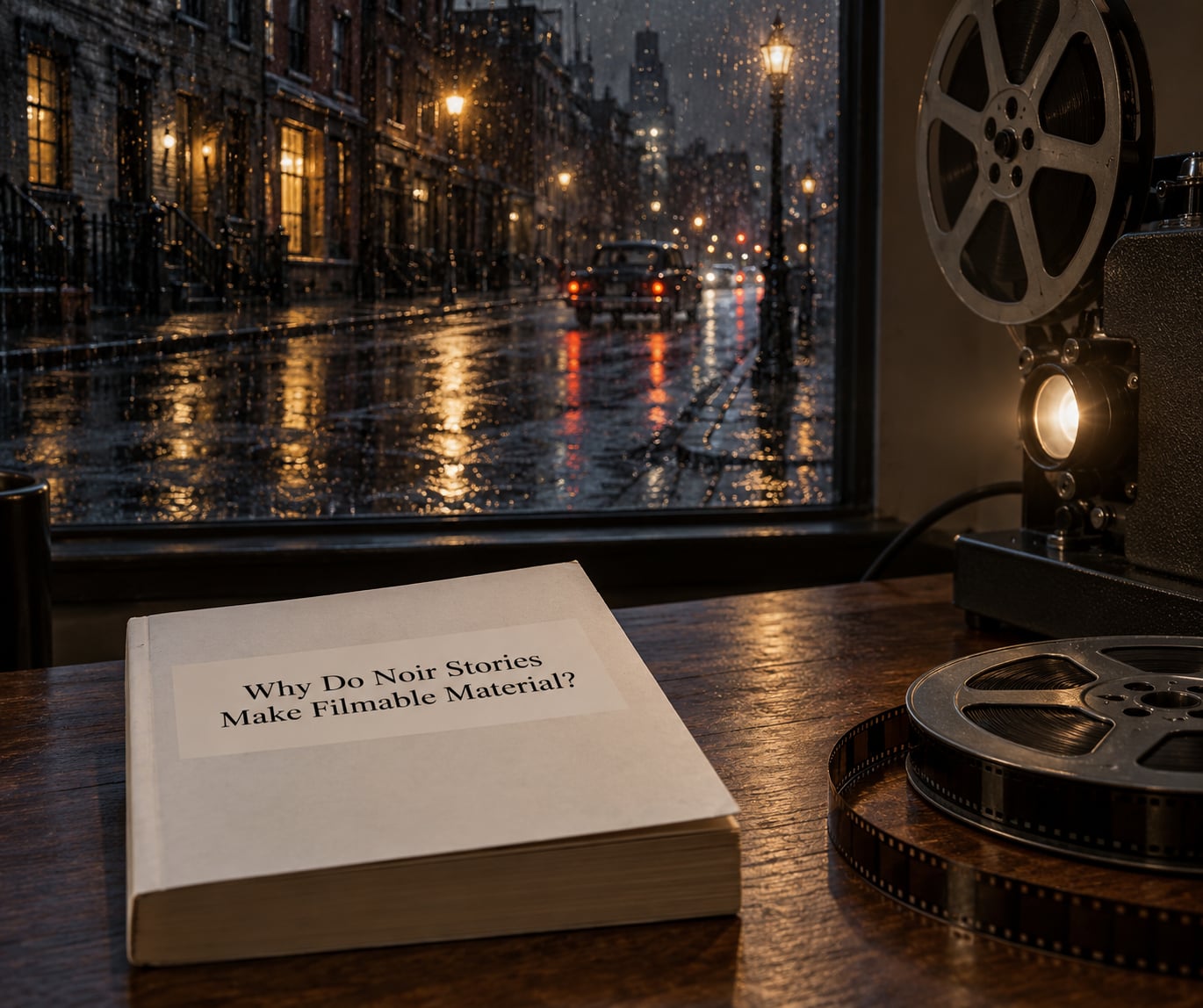
Noir novels are built out of things a camera can hold: a city, a corpse, a nightclub, a rain-soaked street, a police captain who takes the bribe. The prose is atmospheric, but it is atmosphere wrapped around a plot with real forward motion. That combination is rare, and it survives translation.
The authors were not only readable, they were industry-adjacent. Raymond Chandler wrote an original screenplay for The Blue Dahlia in 1946. Dashiell Hammett worked in Hollywood before he ever published The Maltese Falcon. Cornell Woolrich was a ghostwriter for the pulps long before he sold novels outright. These were writers who understood that a story gets rewritten, and the films made under them benefit from it.
There is a second reason that shows up on screen: noir prose is already cinematographic. A hard-boiled first person tends to describe rooms, light and the exact moment a decision turns bad. Read a page of The Big Sleep and you are being handed a shot list.
How Common Are Noir Movie Adaptations?
Common enough that readers on the r/noir forum and in other noir communities keep running into the same collision: they loved the novel, then went to the film and found someone else’s book. But the honest answer to how many noir films come from novels is most of the famous ones, not all of them, and there is a reason the distinction matters.
Film noir is a retrospective label. The French critic Nino Frank coined the term in 1946 in a review of four Hollywood films, two of them Hitchcock’s Rebecca and Otto Preminger’s Laura, and no studio ever produced a picture to a brief that read film noir. The label was applied afterwards to a set of films the industry had made for ordinary commercial reasons. Which is the whole argument: the studios were not manufacturing a genre, they were chasing demand.
Original-screenplay noirs do exist and they are worth naming, because they show the pattern was a habit, not a law. Out of the Past (1947, Jacques Tourneur) was written for the screen. The Woman in the Window (1944) came from a Nunnally Johnson script. Touch of Evil (1958) was written by Orson Welles and then rewritten for him by another writer. Raw Deal (1948, Anthony Mann) was built for the screen from the start. What links them is that none was a best-seller sitting on a shelf with a ready-made audience.
| Film | Year | Director | Source novel | Author | What changed |
|---|---|---|---|---|---|
| The Thin Man | 1934 | W. S. Van Dyke | The Thin Man | Dashiell Hammett | Reversed the genre: the detectives are the suspects |
| The Maltese Falcon | 1941 | John Huston | The Maltese Falcon (1929) | Dashiell Hammett | Close, though the McGurk thread was trimmed for length |
| Double Indemnity | 1944 | Billy Wilder | Double Indemnity (first in Dime Detective, 1936) | James M. Cain | Protagonist made an insurance agent, not a store manager; ending changed from a locked room to a gas chamber; confession added |
| Laura | 1944 | Otto Preminger | Laura | Vera Caspary | Hitchcock wrote and was shunted aside; a revolver-carrying guardian was replaced by the older, colder Dane |
| Farewell, My Lovely | 1944 | Dick Powell | Farewell, My Lovely | Raymond Chandler | Marlowe aged, lost weight and became mournful rather than sardonic |
| The Woman in the Window | 1944 | Fritz Lang | None, original screenplay | Nunnally Johnson | The exception that shows the rule: no book, no audience |
| Scarlet Street | 1945 | Fritz Lang | <tdTherese RaquinGeorges de La Fouchardiere | A French novel relocated to New York and stripped of its ending | |
| The Postman Always Rings Twice | 1946 | Luchino Visconti and Tay Garnett | The Postman Always Rings Twice | James M. Cain | Retaken after the first version was shelved as too bleak |
| The Big Sleep | 1946 | Howard Hawks | The Big Sleep | Raymond Chandler | The ending was changed twice; Chandler rewrote dialogue that was then cut anyway |
| The Asphalt Jungle | 1950 | John Huston | The Asphalt Jungle | W. R. Burnett | Kept close; the heist mechanics carried over intact |
| The Long Goodbye | 1973 | Robert Altman | The Long Goodbye | Raymond Chandler | Deliberately anti-noir: colour, loose framing, no glamour |
7 Reasons Noir Movies Are Often Based on Novels
1. Novels Already Supply a Complete Noir World
A crime novel does the expensive world-building work before a single foot of film is shot. Chandler had already worked out what postwar Los Angeles looked like, who fixed what, and how a tired neighbourhood bar functioned as a clearing house. W. R. Burnett’s The Asphalt Jungle hands over a whole submerged economy of numbers runners, fences and small-time bosses in one book.
A screenwriter adapting that material starts at character and incident instead of at atmosphere. That saves screenwriting time, and screenwriting time was the constraint that decided what got made at all.
2. Noir Puts Inner Conflict at the Center
Hard-boiled fiction is built on first-person guilt, paranoia, obsession and moral compromise. The plot is nearly a delivery system for a mind arguing with itself. That interior weather is the genre’s real subject, and it is the part that survives adaptation best, because noir films could carry it in dialogue, in voice-over and in performance rather than in prose alone.
The famous consequence is the confessional narrator. Double Indemnity and The Postman Always Rings Twice both moved a first-person voice almost intact into the picture, which is rare anywhere in the studio era.
3. Crime Fiction Offers Strong Built-In Structures
Investigations, blackmail, insurance fraud, escapes and double crosses give an adaptation a working engine before a script exists. The structure is already engineered to resolve.
And unlike literary fiction, it can be reshaped freely without destroying itself. You can tighten a hard-boiled plot, change a character’s occupation, cut a sequence entirely, and the remaining story still functions. That tolerance for surgery is exactly what a studio with censorship to satisfy and a release date to hit needs.
4. A Successful Novel Provides a Built-In Audience
This is the plain commercial answer. A published novel with sales behind it is a pre-sold property. The studio knows an audience already exists, which lowers the risk of an unproven story, and the publicity department gets a hook that is not just a star’s face.
Be clear about the limits of this. A known audience raises the odds; it does not deliver a hit. Warner’s Maltese Falcon (1941) was not a blockbuster in 1941. The reprint house Falcon Books brought the novel out in paperback in 1943 and rode the film’s reputation instead, which is a reminder that the relationship between book and film runs in both directions.
5. Filmmakers Can Expand the Novel’s Suggestive Spaces
Prose can gesture at a place. Film has to build it. That is where noir got its most transferable material: the recurring bar, the hotel corridor, the office at night with one lamp on, the stairwell, the corner where someone waits. A novel that keeps returning to the same three rooms gives a cinematographer and art director an entire visual argument to work on, and gives the film its sense that a world continues beyond the frame.
6. Noir Literature Carries a Recognizable Visual Identity
Low-key lighting, venetian blinds, shallow focus, rain on a windscreen, a neon sign reflected in a puddle, smoke hanging in a shaft of light. Noir is frequently described as a look, and the look was described in the books first.
That matters commercially as well as aesthetically. A studio could buy a script that already promised its own production design, then market it with images that were already validated by readers. Chandler’s descriptions of heat, haze and cheap neon became the picture’s lighting plan.
7. Book Adaptations Help Films Navigate Difficult Themes
A publisher had already put violence, corruption and moral ambiguity into print and survived it. A studio facing the Production Code needed material that could be reshaped on the page before it was expensive to reshape on the set. An established novel gave the Code something to negotiate with.
It also gave filmmakers permission to go further than a censor would otherwise allow. If the corruption is documented in print, the studio can argue that it is being illustrated, not invented. Noir’s bleakness was, in part, a publishing achievement being laundered into a film.
What Changes When a Noir Novel Becomes a Movie?
Reading and watching noir are different experiences, and the gap is where the frustration readers report comes from. A novel gives you a private mind. A film gives you a body in a room and a voice explaining things.
Double Indemnity is the cleanest case study because the changes were forced rather than chosen. James M. Cain’s Walter Huff was a department store manager in Los Angeles; Billy Wilder made him an insurance agent, which is the reason the entire plot works. Cain staged the murder as a staged car crash in a canyon; the film used a gas chamber. Cain’s Walter dies in prison letting a false confession stand; the film’s Walter confesses outright and is hanged. The famous first line survives, and Chandler, who took the screenplay credit, spent the rest of his life treating the finished picture as somebody else’s work.
Elsewhere the shift shows up as pacing. Prose can hold on a thought for a page; film cannot. Pacing compresses, dialogue is rewritten to sound like speech, and the first-person voice-over that carries the novel’s ambiguity is often cut because audiences did not want to be told what to think. Occasionally, as in Altman’s The Long Goodbye (1973), the filmmaker keeps the first person and refuses everything else, and the result divides readers into two camps that never fully reconcile.
Other recurring problems are tonal. A novel’s comedy sits next to its cruelty and the reader balances them; a film plays one note louder. A casting choice can swing a whole picture, because a hard-boiled narrator’s voice is tied to a specific kind of worn-out intelligence, and casting someone younger and harder changes what the book was about.
Why Aren’t All Noir Novels Successful Movies?
Because a good adaptation needs more than a good book. It needs a script that understands what the book was doing, and that was often the missing piece.
Rushed scripts were the norm in B-picture units working against a schedule. A source novel was often bought as raw material, handed to a writer who had never read pulp, and turned into a script that kept the plot and dropped the voice. The result has the architecture of the novel and none of its temperature.
Tonal mismatch follows from that. Directors who came out of European cinema often pushed toward psychological realism, while the material was being sold as action, and the two pulled in opposite directions. Castings could undo the rest. And when a book had already been filmed once, the second version had to compete with an audience’s memory, which is the problem behind the recurring forum argument about which adaptation of a twice-filmed novel is the real one.
Then the supply ran out. Television took the audience for procedural crime, the blacklist and the easing of Production Code pressure loosened the constraints that had kept noir grim, location shooting and colour replaced black-and-white studio interiors, and noir stopped being a product and became a retrospective style. Modern neo-noir illustrates the point: Chinatown (1974) came from Robert Towne’s own novel and L.A. Confidential (1997) adapted James Ellroy, but Body Double (1984) and many others did not, because by then noir was a look you could buy with a screenplay instead of a property. The supply chain from pulp to studio has not entirely disappeared, and you can still trace it in 2026, but it is no longer the default.
Frequently Asked Questions
Why are most movies based on books?
Studios buy published fiction because it arrives with a plot, characters and a demonstrated audience already attached. That lowers the risk of an unproven story and gives publicity something to sell. Producers can also alter a purchased story before filming begins, which matters when censorship rules limit what can be shown on screen.
Where did the genre of film noir originate?
The term came from France. In 1946 the critic Nino Frank used film noir to describe four Hollywood films in a review, including Rebecca and Laura. The style itself has earlier roots in German Expressionism, in French poetic realism, and in American hard-boiled detective fiction. No studio ever produced films to a film noir brief; the label was applied afterwards.
What was film noir influenced by?
Three main sources. German Expressionism, brought by directors such as Fritz Lang and Robert Siodmak, supplied the low-key lighting and psychological framing. French poetic realism supplied lyrical urban melancholy. American hard-boiled fiction, from Dashiell Hammett, Raymond Chandler and James M. Cain, supplied the voice, the plots and most of the material that was adapted.
What is it called when books are turned into movies?
It is called an adaptation, or more specifically a screen adaptation. The word covers everything from a faithful rendering of a novel to a film that keeps only the title and the general idea. Noir films sit at the loose end of that range, since studios routinely bought a property for its plot and rewrote everything else.
What are the main challenges when adapting a noir novel for film?
Internal monologue does not transfer cleanly, since a first-person voice that reads as wry on the page can sound like a lecture on screen. Prose can hold on an image; film cannot, so pacing compresses. Production Code rules forced changes to violence and moral ambiguity. Double Indemnity is the standard example: the protagonist’s job, the murder method and the ending were all rewritten.
Are there noir films that are not based on any book?
Yes, and they are worth watching as a control case. Out of the Past, The Woman in the Window and Touch of Evil were written for the screen rather than adapted. They tend to be described as noir by critics while sitting outside the commercial pipeline, which is useful evidence that the label covers style rather than production method.
Conclusion
Classic film noir was adaptation by default. Pulp magazines and cheap paperback originals produced a steady supply of plot-ready crime stories, the studios needed properties they could afford and reshape, and the writers who could supply them were already writing for Hollywood. Novels won on cost, on risk and on the fact that somebody had already tested the story on readers.
Short answer, if you want the quotable version: noir films were usually based on novels because the novels were cheaper, safer and easier to sell than anything a screenwriter could invent from scratch on a B-picture schedule.
Here is what to do with that. Pick one pair from the table above, read the novel first, watch the adaptation second, and keep notes on what each medium did better. The novels usually win on interiority and voice. The films usually win on atmosphere, sound and the way a single frame can carry what a page needed three hundred words for. Knowing which one you are in the middle of makes the differences much easier to see.