You tell by watching what the characters actually do, not by how the story feels. Nine checks do most of the work: response times, role separation, lab turnaround, forensic limits, offender behaviour, interrogation, evidence handling, jurisdiction, and consequences. A show that passes most of them is doing its research.
Run the checks scene by scene. A single realistic sequence in a loud, impossible episode tells you nothing about the episode as a whole, and a whole season of competent procedure punctuated by one lab miracle tells you plenty.
Table of Contents
- What You Need
- Step-by-Step: How to Tell If a Crime Show Is Realistic
- How to Tell If a Crime Show Is Realistic: Start With the Police Response
- Examine the Forensic Science
- Look for Plausible Criminal Behavior and Motives
- Test the Dialogue and Interrogation Scenes
- Compare the Crime Scene and Evidence Chain
- Check Geography, Jurisdiction, and Local Knowledge
- Consider the Legal and Court Process
- Look for Realistic Consequences and Injuries
- Separate Realism from Deliberate Compression
- Common Mistakes When Judging Crime Show Realism
- Frequently Asked Questions
- Which crime show is considered the most realistic?
- How accurate are crime TV shows?
- What is the CSI effect in criminology?
- What are the criticisms of the CSI effect?
- How can I fact-check a crime show scene myself?
- Which crime show is the least realistic?
- Conclusion
What You Need
Three things, and none of them expensive.
First, two or three consecutive episodes from a single season. Procedural shows often start accurate and drift once the writers start stacking arcs, so sampling one episode of season three tells you almost nothing about the pilot.
Second, a reference point you trust. A state or local police department’s public-facing explainer on evidence handling, or a court site’s plain-language description of how a case actually ends, will do more for you than a fan wiki arguing about a technicality.
Third, a habit of separating what a show got right from what it chose. Both matter, but only one of them is a fair criticism of the writing.
One thing to sort out first, because most arguments about realism never resolve: realism is not one thing. Procedural realism asks whether the policing works like real policing. Forensic realism asks whether the science and the lab timeline hold up. Tonal realism asks whether the institution feels like the place it is depicting. A show can score badly on one and still be worth watching.
Step-by-Step: How to Tell If a Crime Show Is Realistic
Nine checks, in the order that surfaces the biggest problems first. If a show fails the first two, the rest usually confirms it.
How to Tell If a Crime Show Is Realistic: Start With the Police Response
Watch how long the police take to do anything, and who does what when they arrive. Real first response means a call is dispatched, dispatched means a beat officer or a detective, and dispatch is not instantaneous.
Then look at the scene itself. Evidence gets logged, packaged, and labelled before it moves, and people walk in paths that avoid stepping where they need to step. On most procedurals you will instead see a character crouch in the middle of a room, pick something up with a gloved hand, and put it in a pocket.
Interview practice is a fast tell too. Suspects are often Mirandised on television within a sentence or two of sitting down. In practice the caution, the waiver conversation, and the voluntary nature of the interview are handled deliberately, and a good show makes that look boring rather than skipping it.
The clearest single number to check: a working homicide sergeant in Charlotte put arrest-to-trial at roughly five years for his caseload. Any show that moves from first call to arraignment inside two episodes is compressing by an order of magnitude.
Examine the Forensic Science
Forensic realism is mostly about time and about limits. DNA processing is not a plot device that produces an answer during a coffee break. A retired lieutenant and crime scene investigator quoted on this topic put lab work at fifty hours and up before results are usable, plus database search time on top.
Watch for three tells: an instant result, a result that is always conclusive, and a specialist who explains exactly what the evidence means. Real forensic conclusions come with ranges, exclusion percentages, and language about what the sample cannot rule out.
Role collapse is the biggest forensic red flag. Crime scene technicians collect, document, and process. Detectives investigate. When a technician starts running the case, or a detective starts reading a lab report aloud like a specialist, the show has picked entertainment over procedure. That collapse is the origin of the whole problem this genre is known for, and CSI: Crime Scene Investigation is where it became a template rather than a choice.
Look for Plausible Criminal Behavior and Motives
Offenders in real cases are often clumsy, inconsistent, and careless about the details they thought they hid. They miss a payment, reuse a phrase from a news bulletin, or fail to account for twenty minutes that nobody asked about.
Good shows use that. The suspect’s plan has a shape: an access route, a time window, an assumption about who would be where. When an arrest happens because someone checked a bus timetable or a work roster, the show is doing research rather than invention.
The failure mode is behaviour that exists only to move the plot. A suspect who monologues because the story needs forty more minutes, an offender who returns to a scene for no reason at all, or a killer whose motive is tidier than anything that survives contact with a courtroom. Look also at what the offender believes about detection. Real people overestimate how much evidence exists and underestimate how much investigators can reconstruct.
Test the Dialogue and Interrogation Scenes
Interrogation scenes fail in a specific, recognisable way: the suspect talks in complete, revealing sentences because the script needs information to move. Real interviews are messier, with denials that narrow over time rather than collapse in one speech.
Listen for rights being handled properly, and listen for whether police use pressure that is aggressive but lawful rather than pressure that would be excluded. Look for a lawyer arriving at exactly the dramatic moment rather than at any other moment.
Two subtler things worth tracking. Ordinary interview rooms are cramped, recorded, and often fluorescent, so a sleek private room reads as a statement. And interview transcripts run far longer than dialogue on screen, which means a well-researched show lets a conversation wander past the point where it would cut for a time jump.
Compare the Crime Scene and Evidence Chain
Chain of custody is the least glamorous test and one of the most reliable. Evidence should move through documented hands, get logged each time, and stay sealed and cool until processed. Watch whether the bag gets labelled at collection or much later, and whether the same item appears in two places at once.
Then test internal consistency. Descriptions of a room, a wound, or a time of death should not shift across episodes without an explanation. Later discoveries should fit the original timeline rather than replacing it.
Compare what the show calls a scene with what departments actually do. Many departments apply thresholds: routine burglaries with small losses may get a report and a follow-up call rather than a full scene unit, which is why crime shows show far more complete processing than a mid-sized city actually performs.
Check Geography, Jurisdiction, and Local Knowledge
Ask three quick questions. Who has jurisdiction here, and are they the right agency? How far apart are the places the characters move between in the time the story allows? Does anyone know a detail they should not?
Wrong-agency errors are common because they are invisible to writers who have not done the paperwork. Detectives do not routinely cross state lines without a formal process, and local police rarely handle major cases the way a federal agency would, or the reverse.
Travel distance is the easiest check because you can do it yourself. A drive of forty minutes shown as a two-minute scene is harmless. A half-day’s journey treated as a coffee stop is a geography problem the audience can count, and countries with different policing structures, or Nordic noir built on social services rather than detective work, will use entirely different institutions from a US police procedural. Judge those against their own model, not against yours.
Consider the Legal and Court Process
This is where most shows fail hardest, because trial is expensive to shoot and plea bargaining is not. The criminal justice system resolves most cases by negotiated plea, and most defendants never see a courtroom. Shows routinely invert this, giving us a dramatic trial for cases that would have ended at a hearing.
Check the sequence: arrest, booking, initial appearance, charging decision, discovery, suppression motions, then trial. When a show skips from arrest straight to a confident courtroom speech with no discovery exchange, it has removed the part where cases are actually won and lost.
Sentencing drama deserves the same scrutiny. Real sentences vary widely with jurisdiction and prior record, and a single dramatic punishment on screen usually says nothing about the range a real judge had.
Look for Realistic Consequences and Injuries
Injuries in crime fiction tend to heal at cinematic speed. A deep laceration becomes a bandage within an episode, and a serious abdominal wound becomes a held-over shoulder for a week.
Real recovery is measured in stages, and real investigators accumulate damage over a career: sleep disruption after tough calls, scepticism about every scene, the slow work of family and colleagues pulling away after a bad one. Shows that show this cost are usually shows whose procedural details also check out.
There is a financial layer too. Investigations cost money in overtime, lab fees, and analyst time, which is one reason departments triage cases by the numbers.
Separate Realism from Deliberate Compression
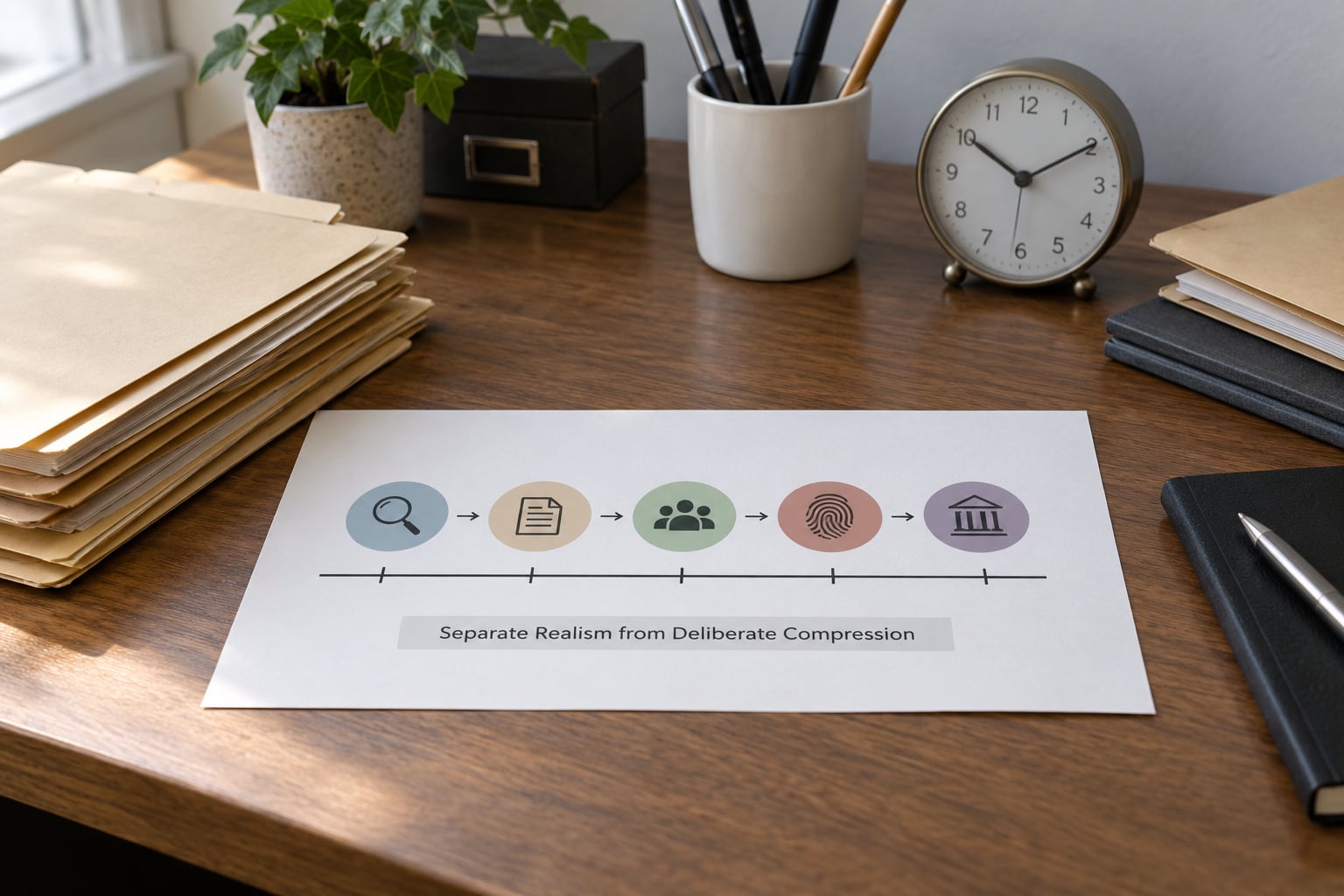
Some things you will see are editing, not error. Conversation scenes are cut. Days are skipped. Paperwork is implied. A case running through forty commercial-free minutes cannot also run through real discovery motions, and pretending otherwise is not a failure of research.
The useful distinction is between compression and contradiction. Compression removes steps. Contradiction adds steps that could not happen: evidence appearing with no collection, a suspect knowing a detail never released, a lab producing a result no method could produce, an arrest that would not survive the first hearing.
Judging by that line, on-set consultants are not a guarantee. Consultants correct what they notice during production, which is rarely the plot problem a critic cares about. The shows that hold up tend to have someone who researched the case before shooting, not someone on set for the duration.
Common Mistakes When Judging Crime Show Realism
Most disagreements about crime shows are disagreements about the wrong thing. Here are the mistakes that keep coming up.
Demanding documentary accuracy. Nobody is claiming these are documentaries. A show that gets the arrest, the caution, the evidence bag, and the slow lab timeline right has met a higher bar than one that shows an accurate case, because accuracy has to survive a format built for closure.
Treating stylization as a factual error. Rain-soaked streets, blue-tinted night exteriors, and low lighting applied to every scene signal genre, not error. Judge what the camera is showing, not the colour grade.
Ignoring regional differences. A Nordic police drama built around social services and a US detective procedural are describing different systems. Scoring one against the other’s rules produces a verdict that means nothing.
Letting one scene condemn a series. A role collapse in one episode does not make an entire show unrealistic any more than one comic scene makes a police drama unserious. Score per episode, then average across the season.
Conflating tonal and procedural realism. This is the big one, and it is a live argument among viewers. Bosch and The Wire come up constantly as the realism benchmark, and both sides of that argument have a point: The Wire is praised for institutional accuracy and criticised by some viewers precisely because its plot threads resolve too tidily. Forum threads capture both claims in the same breath. A show can be procedurally exact and still feel false, and that is a tone problem, not an accuracy problem.
Assuming a consultant equals a correct show. Corrections happen on set. What reaches the script about case structure rarely gets the same scrutiny.
Frequently Asked Questions
Which crime show is considered the most realistic?
Bosch and The Wire are the two titles that come up most often, and they are realistic in different ways. Bosch tends to hold up on procedural detail, with realistic case pacing and role boundaries. The Wire is usually credited with institutional and tonal accuracy rather than with clean case mechanics. No single show is authoritative, so judge each against the nine checks rather than a ranking.
How accurate are crime TV shows?
Accurate in structure, wrong in speed. Most shows handle the shape of an investigation plausibly: a call, a scene, an interview, a lab request, a court appearance. They rarely get the duration right. A single homicide can take months or years of real investigative work, and lab processing alone runs into dozens of hours. Judge on time and limits rather than on whether the framework looks familiar.
What is the CSI effect in criminology?
The CSI effect is the belief, shaped by television forensic dramas, that forensic science is fast, conclusive, and central to solving every case. Because the name came from the TV franchise, the term doubles as a label for the cultural myth itself. Researchers use it to describe how media portrayals change public expectations about what evidence a real case should produce.
What are the criticisms of the CSI effect?
Critics argue the concept oversimplifies. Many studies find jurors are not systematically pro-science, and the idea rests on early, small samples. Others say the effect is uneven and shaped by how confident the presenting expert sounds. The strongest version of the criticism is that the phrase has outgrown its evidence and now gets used to dismiss any concern about media and juries.
How can I fact-check a crime show scene myself?
Pick one scene and check three things: the timeline, the role, and the process. Compare the elapsed time against how long the same steps take in practice. Check whether the person doing the work is the job title the show assigns them. Then read a plain-language explainer from a police department or a court about that specific step, which usually settles the question faster than a forum argument.
Which crime show is the least realistic?
CSI: Crime Scene Investigation is the usual answer, and not only because it is the most famous. Its crime scene technicians conduct their own investigations, results arrive within the episode, and almost every scene gets a complete forensic response. It is less a bad show than the template the genre stopped questioning, which is why the name of its central mistake became the term for the effect itself.
Conclusion
Start with one episode and run the first two checks. Ask who is doing the work and how long it is taking, because those two answers usually reveal everything else about whether the rest of the procedure holds up.
Then keep the three kinds of realism apart as you go. A show can be procedurally exact and tonally false, or beautifully acted and scientifically absurd, and both of those are worth watching once you know which one you are grading.