
Writing a book review for a crime novel is mostly an editing problem: you have to be specific about craft without handing the reader the solution. The reviews people trust are the ones that name the pacing, the detective, the clue planting and the ending in plain language, then say who the book is for. Budget an evening to read with a notebook, a second pass to collect evidence, and about 400 to 700 words to write it up.
Crime fiction has one hard rule that literary reviewing does not: the person reading your review may not have opened the book yet, and one sentence can wreck their evening. Everything below is built around holding that line.
Table of Contents
- What You Need
- Step-by-Step: How to Write a Book Review for a Crime Novel
- Step 1: Read the novel actively
- Step 2: Identify the review’s central argument
- Step 3: Analyze the crime plot and its reveal
- Step 4: Examine characters, setting, and noir conventions
- Step 5: Support the review with specific evidence
- Step 6: Write a fair, balanced assessment
- Step 7: Revise for clarity, flow, and genre fit
- Common Mistakes
- Frequently Asked Questions
- How long should a book review be?
- How do you write a book review for a crime novel without spoilers?
- How do you rate a crime novel out of five stars?
- How do I review a novel in a series without spoiling books I have not read?
- Should I put content warnings in a crime novel review?
- What are the five parts of a crime novel review?
- Conclusion
What You Need
Four things, none of them expensive. Start with the novel in the edition you are actually reviewing — if you are covering an audiobook, the narrator is half the review.
- The book, plus context. For a series, note which instalment you are reviewing and where the box set begins.
- A notes surface. Paper suits long novels; a scratch document suits anything you will copy from later. Keep it separate from the draft.
- A little genre context. One or 2 comparable titles in the same subgenre give you a baseline for what this book owes the reader.
- An editorial brief. Word cap, rating scale, whether the platform permits spoilers, and whether content notes are required.
Add a timer for the first hour. Active reading and relaxed reading are different jobs, and mixing them is how reviewers end up with 40 pages of notes and no argument to make.
Step-by-Step: How to Write a Book Review for a Crime Novel
Read actively with notes, decide what 1 thing the review is about, analyse the plot structure and the genre conventions without revealing the solution, back every claim with evidence from the text, write an honest verdict, then edit for length, tone and spoilers. Seven passes over your notes, most of the time spent on the first 1.
Step 1: Read the novel actively
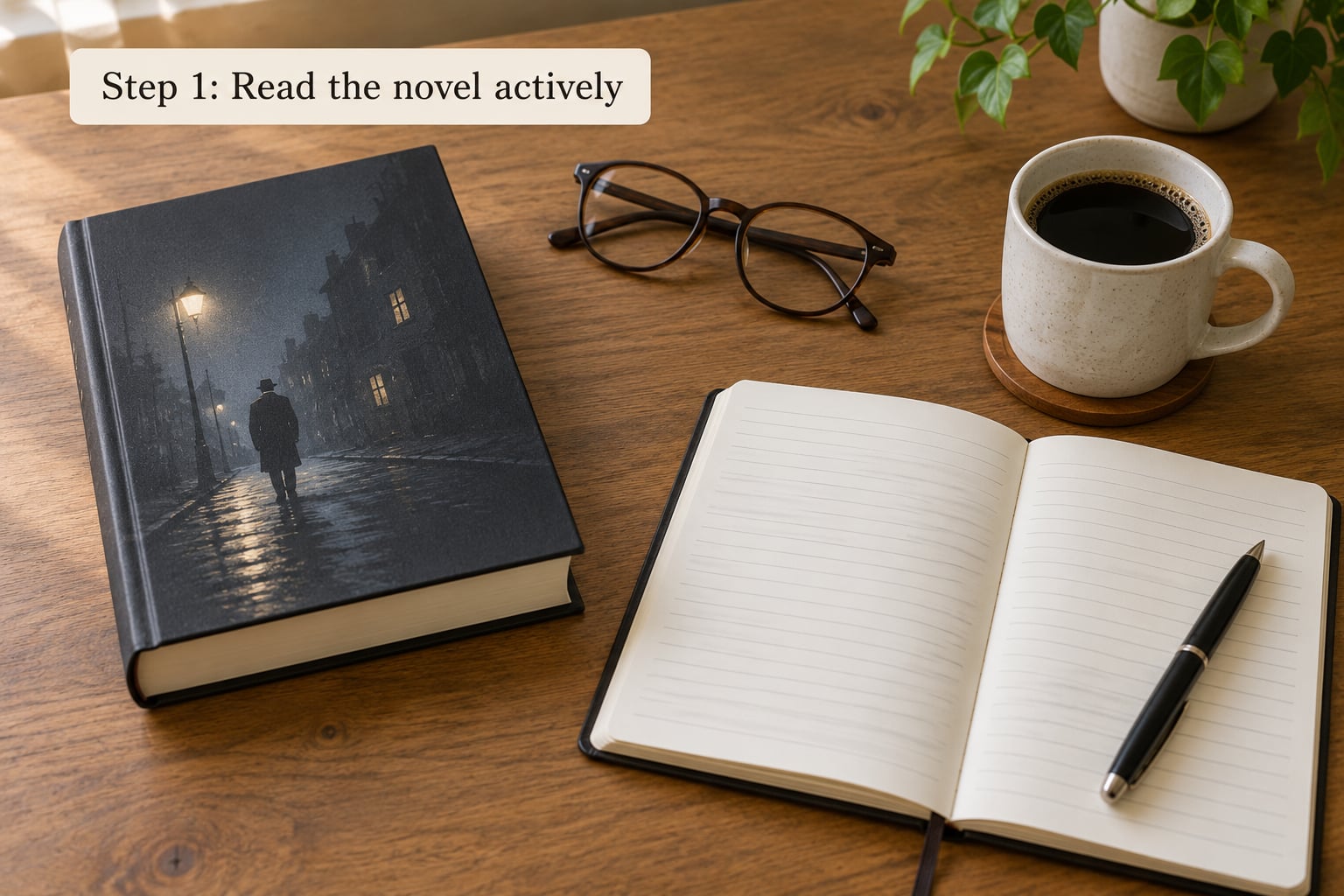
While you read, record the question the book is asking. Who did it, why, and will the protagonist get there in time. Note every clue and where it sits, because that is the material you will need later.
Mark the passages that reveal character rather than plot: the moment a detective lies, the scene where an interview goes wrong, the line of dialogue that sounds like a person rather than a plot device. Mark them too if they fail.
Notice where you skimmed. Skimming is data. If you sped up through pages 140 to 200, that stretch will not hold the review, and saying so is more useful than praising the book as a whole.
When you close the cover, write 1 sentence about the effect it left. Do not review yet. Read, then react, then analyse.
Step 2: Identify the review’s central argument
Decide what this review is about before you write a word of it. A crime novel gives you 6 or 7 possible arguments: the portrayal of violence, the structure of the mystery, the moral viewpoint, the quality of the prose, the relationship to noir tradition, the credibility of the police work, or the ending.
Pick 1. Write it as a single sentence — the book’s investigation is tighter than its character work, or the violence stays observational where a thriller would reach for shock — and make every paragraph after that either support it, complicate it, or get cut.
If you cannot state the argument in 1 sentence, you are about to write a plot summary. That is a different article, and nobody asked for it.
Step 3: Analyze the crime plot and its reveal
Plot analysis is not retelling. The reader has the book; you have opinions about its construction. Work through 4 questions while your notes are still fresh.
- Were the clues fair? A whodunit that withholds a fact only the murderer knows has broken the contract with the reader. Check whether the solution was available in the text.
- Did the red herrings feel planted or arbitrary? A red herring is a false lead that seems to earn its place. If a suspect appears twice and vanishes with no follow-up, that is a structural note, not a matter of taste.
- Did the tension hold? Look for the stretch where the reader already knows more than the detective, and for a middle third that repeats a confrontation instead of escalating it.
- Did the ending reframe or merely add? The best reveals change the meaning of scenes you have already read. The weakest bolt new information onto the front and ask you to care.
None of that requires naming the culprit, the method, or the final scene. Describe your confidence in the solution instead. A reader who trusts your judgement will read the book; a reader who knows the twist will not.
Step 4: Examine characters, setting, and noir conventions
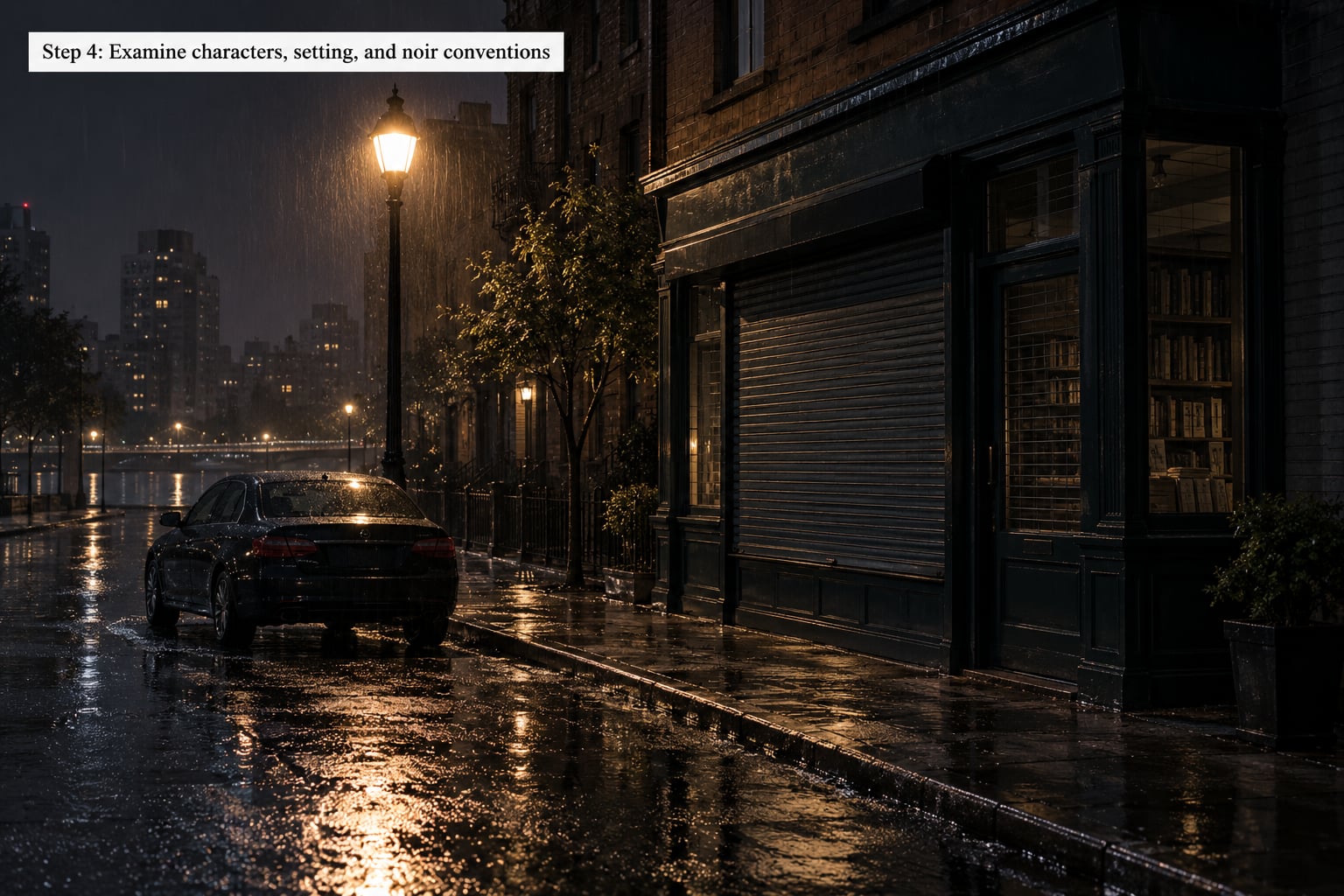
The investigation only matters because of who runs it. Ask what the detective wants at the start, what they want by the end, and whether the case forces them to change. A protagonist with no private stake can carry a plot but rarely a reader.
Setting has to do some work. Note whether the city, the town or the weather shapes the plot, or whether the book could be lifted out and dropped into any other place without leaving a seam. Crime fiction is unusually exposed here: readers notice invented geography, and a street that exists only to be somewhere dark gets picked apart.
Then check the conventions, because they vary by subgenre. Noir expects moral ambiguity, corruption at an institutional level, violence that costs the protagonist something, and an ending that may refuse resolution on purpose. If the book refuses it and you wanted closure, say that you wanted closure — not that the book failed.
Three things decide whether a reader passes a crime novel on to a friend: pacing, whether the detective is credible, and whether the false leads felt planted. Give those three the most space in your review.
Step 5: Support the review with specific evidence
Every claim needs a handle. A short quotation, a paraphrased scene with a chapter or page reference, or a concrete observation about structure — something the reader could check against their own copy.
The difference sounds small and is not. Vague praise: great characters, tense atmosphere, a twist you did not see coming. Supported praise: the second interview lands because she contradicts herself on a detail nobody thought to follow, and you can follow it too, once you know where to look.
Where you criticise, do the same. Not boring; the same 3 conversations play out across 40 pages with no new information. Not predictable; the suspect introduced in chapter 4 is the only 1 the detective never interviews.
Keep quotations short, in quotation marks, and few. 2 or 3 across a 600-word review is plenty; a wall of quoted dialogue reads as unfinished notes.
Step 6: Write a fair, balanced assessment
State what the book is trying to do before you judge whether it does it. That sentence is the difference between criticism and gatekeeping, and it costs you 12 words.
Separate taste from craft. Not liking ambiguity is taste. Not giving the detective a motive is craft, and it is fair game. Not enjoying violence in fiction is taste; writing violence that exists only to shock is craft.
Avoid the reveal in every sentence, including the ones that feel generous. “The ending is devastating” costs a reader the moment they wanted, and readers notice when someone spoils a book and calls it a compliment.
Then give the verdict and make the rating match it. A 4-star review should contain a real reservation. A 5 should contain a specific reason. If your prose is lukewarm, the number is probably wrong.
Step 7: Revise for clarity, flow, and genre fit
Put the draft down for an hour, then read it once for the reader you wrote it for, a crime reader who has not bought the book yet.
- Cut any paragraph that only retells events.
- Tighten the opening. Your verdict should be visible in the first 2 sentences, not the last.
- Search your draft for the ending, the killer’s name and the method. Delete anything a reader could not already know.
- Replace every vague verdict with a specific 1.
- Check that your rating matches your tone and that your criticism lands on the text, not the author.
- Add the content note if the book warrants 1.
- Close with the reader call-out: who finishes this book glad they started.
- Proofread aloud. Sentence fragments read fine on screen and stumble in the ear.
Common Mistakes
Most weak crime reviews fail in 1 of 8 predictable ways, and each has a straightforward fix.
- The plot-summary trap. Chapter-by-chapter retelling turns a review into a synopsis. Fix: cap plot description at 2 sentences, then analyse.
- Vague criticism. Boring, slow, predictable. Fix: diagnose the beat that failed, not the mood it gave you.
- Rewarding or leaking the twist. Even positive spoilers cost readers the ending. Fix: judge confidence, not outcome.
- Rating-text mismatch. 5 stars over lukewarm prose reads as a mistake and buries the book. Fix: find the sentence that justifies your number, or change the number.
- Tone policing. Fear of being rude produces reviews that praise everything and criticise nothing. Fix: aim every comment at the text.
- Reviewing expectations instead of the book. Disliking horror and rating a horror novel badly, or wanting a tidy resolution in a noir. Fix: name the expectation, then judge against the book’s own promise.
- Ignoring genre conventions. Calling an ambiguous ending a failure in a novel where ambiguity is the point. Fix: check the subgenre first.
- Writing nothing for the author. A review that only reacts helps nobody write the next 1. Fix: name the specific beat that worked or broke, in craft terms.
Frequently Asked Questions
How long should a book review be?
Match the length to the platform: 40 to 60 words for a retailer page, 150 to 250 words for a newsletter or a shelf note, 400 to 700 words for a blog or column, and 900 words or more for long-form criticism. A short review is not a wasted review. Most readers read the first sentence and the last paragraph, so put your judgement at both ends.
How do you write a book review for a crime novel without spoilers?
Describe escalation, not outcome. You can say the stakes rise, that the investigation turns over new evidence, or that a mid-point revelation reframes the opening, without naming the culprit, the method or the final scene. Put a clear spoiler warning above any section that goes further, and never rely on a warning to excuse giving away the ending.
How do you rate a crime novel out of five stars?
Tie the stars to the text. Five means the book delivers its premise with craft to spare. Four means strong, with one real weakness you can name. Three means the pleasure is intermittent and the middle sags. Two means the premise outruns the writing. Whatever the number, a reader should be able to find the sentence in your review that justifies it.
How do I review a novel in a series without spoiling books I have not read?
Review only the volume in front of you and say so early: this review covers book three. Resist the urge to explain a character’s arc using the fourth instalment. Where an earlier book is needed for context, describe it in one clause at most. Readers who want the rest of the series can go and read it themselves, which is the better outcome anyway.
Should I put content warnings in a crime novel review?
Yes, briefly and factually. Name what appears — graphic violence, sexual violence, abuse, substance use, animal cruelty, the death of a child — in one plain sentence, then move on. Warnings help someone decide whether to start tonight. They are not a verdict on the book, and padding them with adjectives turns a practical note into a label.
What are the five parts of a crime novel review?
A hook with your overall impression, a spoiler-light setup of the premise and stakes, craft analysis backed by evidence from the text, a verdict with a star rating that matches your words, and a note on who should read it. Reviews that fall flat are usually missing one of those moves, most often the evidence or the reader call-out at the end.
Conclusion
A crime review works when the reader can trust your judgement without knowing the ending. Start tonight with the simplest version of the job: finish the novel, write down the single effect it left on you and the 1 craft choice that earned it, then build everything else around those 2 sentences.