
If you have been searching for how to join a mystery book club, the honest version is simpler than most guides make it sound. You need three things: a group that meets somewhere you can get to, a signup or RSVP, and a copy of the monthly selection before the meeting. Most library clubs are free and most welcome beginners, so the hard part is rarely permission. It is knowing where to look and what to say once you are there.
I have watched a lot of people talk themselves out of joining one. The fear is nearly always the same: walking into a room where everyone has clearly read the book, and being the one person who has not finished it. In six years of attending and running these groups, the opposite has been true more often than not. People want someone to talk to about a plot that kept them up on Tuesday night.
Here is the whole process, start to finish.
Table of Contents
- What You Need
- Step-by-Step: How to Join a Mystery Book Club
- 1. Decide Whether You Want In-Person, Hybrid, or Online Discussion
- 2. Search for Mystery Book Clubs
- 3. Check the Club’s Schedule, Selection Process, and Discussion Style
- 4. Contact the Organizer or Complete the Signup
- 5. Read the Assigned Book and Take Notes
- 6. Attend the First Discussion and Join the Conversation
- Common Mistakes
- Frequently Asked Questions
- Do I need to be an expert in mystery novels to join a mystery book club?
- How much does it usually cost to join a mystery book club?
- Can I join an online mystery book club if I do not live near a library?
- What if I cannot finish the selected book before the meeting?
- How do I find mystery book clubs that welcome beginners?
- Should I buy the book or is a library copy enough?
- Conclusion
What You Need
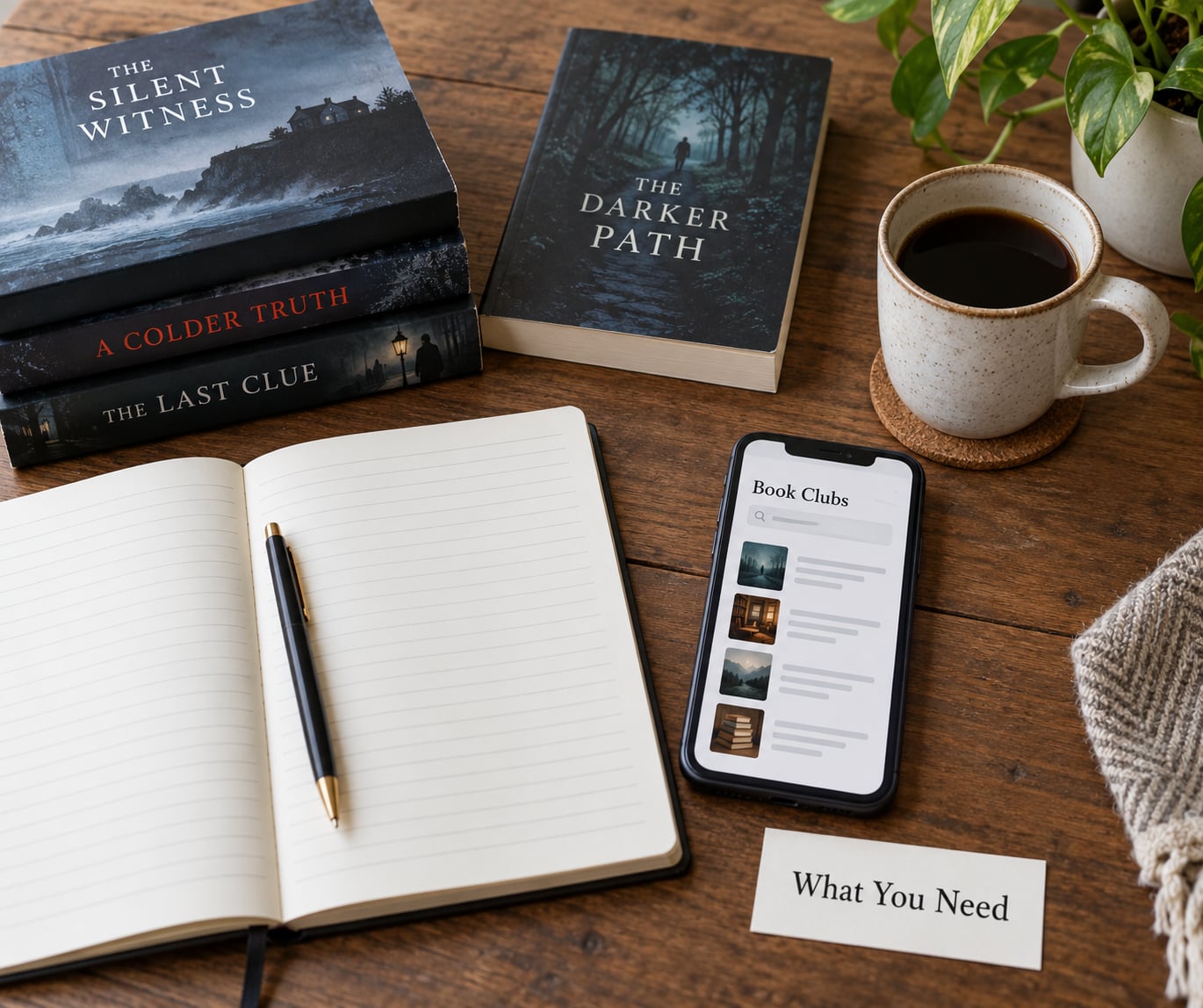
You need very little. A way to search for groups, which means a phone or laptop and the name of your city or library system. Most clubs live on a public library events calendar, so knowing your branch is genuinely useful. If your library has a card, that is also handy, because borrowing the club selection usually runs through it.
A notebook or a notes app is the second thing. Mystery discussions reward people who can say, without scrolling, who was actually lying and why. You do not need to be an essayist about it. Two or three lines per chapter is plenty.
Beyond that, it helps to know a little about how discussion etiquette works, which takes about four minutes to learn. Most clubs open with a spoiler round and then move to craft, theme, and character. Spoilers are almost always gated behind the point where you finished reading, so nobody will fire a twist at you in the first ten minutes. That convention is why spoiler anxiety mostly disappears once you have been to a single meeting.
Here is what you do not need. You do not need a large personal library. You do not need to have read the author before, or the series, or anything else in crime fiction. You do not need a mystery-reading background. And you rarely need to buy the book, because most of these selections sit in public library collections, in Libby or Hoopla for eBooks and audiobooks.
Step-by-Step: How to Join a Mystery Book Club
1. Decide Whether You Want In-Person, Hybrid, or Online Discussion
The format decides how the rest of this goes, so pick it first. Library groups are usually monthly, on a fixed weekday, and often 45 to 90 minutes. They are also the easiest place to get a physical copy of the selection on the hold shelf.
Hybrid clubs meet in a room and open a Zoom link at the same time. A lot of public libraries run their mystery club exactly this way, with registration required only for people joining online. That distinction matters, because it means you can walk in without a form if you would rather not fill one out.
Pure online groups run on Discord, Reddit, Meetup, Facebook, or Goodreads. Members of r/booksuggestions describe small two-person thriller clubs, and the same pattern shows up on Meetup as monthly meets in bars and cafes. Discord tends to dominate for newer virtual mystery and horror clubs, usually one title a month plus a scheduled voice call.
Text-only spaces suit readers who find a live call draining. They also suit anyone who moves often, since the group travels with you. Pick the format you will actually keep showing up for, not the one that sounds most convenient on paper.
2. Search for Mystery Book Clubs
Search your library system’s events calendar first. Filter for book clubs, then read the listings for mystery, crime, or adult fiction groups, because a club titled Adult Mystery Book Group is exactly what you are after. Branch calendars often go a full season ahead, which means you can see several months of selections and spot a schedule you can live with before contacting anyone.
Local bookstores run the second-biggest channel. Independent shops frequently host a monthly crime night with wine and a rotating selection. Search the shop’s event page along with the word mystery, and call them if the listing is thin. A bookseller who hosts a group is usually delighted to have one more person in the room.
Online, work through the platforms separately, because each behaves differently.
- Reddit — r/mysterybooks and r/BookDiscussions run ongoing threads. Read a month of posts before you post anything.
- Facebook — search crime book club, cozy mystery book club, and your town or county name inside the group search. Local community groups are where most readers recruit new members for small local clubs.
- Discord — server invites for mystery, thriller, and horror reading communities are shared through Meetup and Reddit. Never join a server through an unsolicited direct message; use a public invite link.
- Meetup — searchable by city and group size, and it is the easiest platform for starting something yourself.
- Goodreads — groups by genre with discussion threads, quieter and less time-committing.
Type the exact phrase how to join a mystery book club plus your city, then widen to the terms Bing groups with this topic: mystery book club meeting schedule, adult mystery book group, online mystery book club. Listings are genuinely fragmented across these platforms. That is the single biggest friction point, and it is why most people assume nothing exists near them.
3. Check the Club’s Schedule, Selection Process, and Discussion Style
Before you send a message, check the details that decide whether you can keep attending. Meeting frequency and time, whether it is weekly, monthly, or quarterly. Location, or the platform if it is online. Whether there is a fee, which is rare for library and community groups but does happen with independent clubs. Whether registration is required, and what it actually gets you.
Then look at the selection process. Some clubs pick by host choice. Others vote, and a book you dislike can win. A few run a rotation through cozy, classic detective, noir, true crime, and serial-killer titles, which is a useful signal that the group likes variety.
Pay attention to spoiler rules. Groups that wait until everyone finishes before naming twists are the most comfortable to join as a beginner. Groups that discuss freely in a spoiler channel are fine too, but you have to commit to finishing on time or stay silent that night.
Check accessibility, because it is often unstated. If you listen to audiobooks or need large print, ask whether anyone in the group discusses those formats, and whether a screen reader can navigate any required online materials. Also check for drop-in groups that need no registration at all, since several libraries run those.
4. Contact the Organizer or Complete the Signup
If the listing has a form, fill it out. Registration is frequently required only for online attendees, because the host needs to email a Zoom link to people who will not be in the room. Some libraries also take signups at the service desk, by phone, or by email, so if a form looks closed, call rather than giving up.
If there is no form, write a short message. Keep it to four sentences. Something like: My name is [your name] and I am in [your area]. I read mystery and thriller fiction, mostly [two or three names or subgenres], and I am interested in joining your mystery book club. Could you tell me whether there is space, and what I should read first or do before the next meeting?
Named hosts and librarians make joining feel approachable, so ask for a name. A librarian will usually reply with the current selection, the meeting time, and whether the copy is on the shelf or needs a hold. That single reply removes most of the remaining uncertainty.
When you do join, block the date before anything else. Mystery clubs that meet monthly on a Thursday at 11:30 in the morning do not move for people who forgot. If the club runs on a mailing list, give them your email and confirm that you actually received the first message.
5. Read the Assigned Book and Take Notes
Read it for pleasure first, and treat the notes as a tool for your own memory. The goal is not to be ready with an essay. It is to have one or two specific things you can point at when your turn comes.
Note the characters and who had motive. Note the setting, since mystery fiction uses place heavily and atmosphere comes up constantly in good discussions. Note the clues you missed on first pass, which is a safe and surprisingly popular thing to admit. Note the timeline questions you still have, because those are excellent questions to ask the group.
Leave the interpretation open. People who fixate on a theory in the first fifty pages tend to spend the meeting arguing rather than talking. If you want a quick self-check on whether the book is worth finishing, try the five-finger test: if your hand has been on the page for the last five minutes, the writing is not working for you, and that is fine information to have before a monthly meeting.
6. Attend the First Discussion and Join the Conversation
Arrive five minutes early. That is the single best advice here, because people sit in awkward clusters until someone arrives and then the room breaks apart naturally.
Introduce yourself in one sentence, say how many meetings you are new to, and mention that you read the selection. Nobody needs your life story. Many groups do a quick round of introductions anyway, so be ready to name an author or two you like.
Then plan to make two contributions rather than fifty. Bring one observation about craft, and one question you are still holding. Craft works because it is harder to argue with than a verdict. Something like noticing that a suspect’s alibi depends on a detail the narrator described differently twice, or that the book kept three timelines going and you could not tell which one was present-tense, gives the group something real to work with.
Ask about a genuine doubt, not a gotcha. What did the early diary entries actually establish? Were you bothered by the second narrator? How much of the setup did you think was misdirection?
Disagreeing is fine. Say the other side first. I once watched a member say, I did not buy the twist at all, then explain precisely why the reordering of chapters made sense to her, and the room handled it gracefully. Disagreement framed as observation never creates a problem.
And if you are a text-based group member, ask your question in the thread, then read the replies the next day. Nobody expects the pace of a live call.
Common Mistakes
Joining the wrong kind of group. A club that meets monthly on Sunday evenings is a different commitment from a weekday-morning library group. Check the schedule before you commit, not after.
Registering for an online link you do not need. Many clubs require registration for Zoom attendance only, and in-person members simply show up. Read the listing language closely; it often says so explicitly.
Skipping the selection. You do not have to read every word to join usefully, but entering a twist-heavy discussion cold means sitting silent. If you are short on time, read the first two thirds and ask for the last chapter after the reveal, or listen to the audiobook at double speed.
Over-preparing for literary references. Groups that ask about allusions and footnotes are rare, and even those rarely demand citations. Being able to say I do not know that, it sounds like a Doyle nod, is a complete answer.
Dominating the conversation. Leave a gap after you speak. In groups of eight, two comments each keeps the floor moving, and quieter members tend to fade out fast otherwise.
Ignoring the spoiler agreement. If the group wants to talk freely about endings, do not reveal them to people who have not finished. Readers have been burned badly by plot reveals in the opening minutes, and one incident can empty a group for a season.
Buying a book you could borrow. Put the title on a library hold through the catalog, or check Libby or Hoopla for an eBook or eAudiobook version. Mystery selections from well-run libraries are usually on the shelf immediately, and even a two-week hold beats paying for a copy used once.
Leaving badly. If you want to stop coming, tell the organizer or host directly, in two sentences, and say you enjoyed it. Ghosting leaves organizers wondering whether they did something wrong, and they often keep a spot open for people who left well.
Frequently Asked Questions
Do I need to be an expert in mystery novels to join a mystery book club?
No. Most groups are built around one book a month, so nobody is expected to know the genre history beforehand. Hosts usually introduce the selection at the start and many clubs open with what each member read, which is a natural place to say you are new to the group. Reading the assigned book is the only real expectation, and beginner-friendly groups say so on their listings.
How much does it usually cost to join a mystery book club?
Library and community-run groups are normally free, and some charge a small materials fee for refreshments. Independent clubs that meet in a bar or cafe may ask you to buy a drink, and private online clubs sometimes run a subscription. You rarely need to buy the book itself: a public library card gets you a print hold, and most systems offer eBooks and audiobooks through Libby or Hoopla.
Can I join an online mystery book club if I do not live near a library?
Yes, and online is often the better fit. Discord servers, r/mysterybooks, Meetup groups, Facebook groups, and Goodreads all run mystery discussions without any local chapter. The trade-off is less live conversation: many of these groups run a monthly thread plus an occasional voice call, which suits readers who dislike being put on the spot. Being a member of a remote group also survives a move.
What if I cannot finish the selected book before the meeting?
Tell the organizer before the meeting, not during it. Many clubs will happily fill you in on the ending, mark a spoiler section in their thread, or let you skip that month entirely. Some hosts simply agree not to discuss the final chapters with unfinished members present. Skipping one book is normal in any club, and nobody keeps a register.
How do I find mystery book clubs that welcome beginners?
Look for language like drop-in, newcomer-friendly, or all skill levels on the listing, and prefer groups that describe the discussion format as questions rather than a spoiler round. Open-ended library clubs attract a wide mix, while long-running circles of regulars can be warm but quieter about newcomers. Sending one polite email to the host asking whether the group welcomes new members answers the question outright.
Should I buy the book or is a library copy enough?
A library copy is enough. Put the title on a hold through your library catalog so it is waiting, and check Libby or Hoopla for an eBook or eAudiobook version if you would rather not wait for print. Mystery club selections are usually circulating heavily, so place the hold as soon as the club announces them rather than at the last minute.
Conclusion
Pick your format first, then search for groups near you or online, and contact one organizer before you commit to anything. That single email will tell you the meeting time, the current selection, and whether anyone is free to explain how the group works. Learning how to join a mystery book club comes down to one conversation you have been putting off.
A good mystery book club runs on shared curiosity, not on knowing which Victorian novel a detective is alluding to. Nobody there is grading you. They want to argue about the twist with someone who was also up at midnight wondering who did it.