Last updated October 2026
Crime fiction in translation means any detective, mystery, noir or thriller novel first written in a language other than English and later published in an English edition, usually with a named translator credited on the title page. Knowing how to find crime fiction in translation takes six repeatable routes rather than a lucky browse, and the books themselves are excellent. They are also genuinely hard to find unless you know which filters to pull.
Here is the short version: work outward from trusted signals rather than browsing shelves. Start with award shortlists, then specialist imprints that buy translations by contract, then monthly roundups that always name the translator, and finish with library catalogues that confirm an English edition actually exists.
One thing worth knowing before you start. Translation flows heavily toward English and hardly at all out of it. A German crime author documented that roughly 9,000 titles were translated into German in 2023, about 14.5 percent of first editions, with 59.1 percent of those coming from English. The reverse direction is a fraction of that. So the good translated crime novel will not surface on an English bestseller chart, which is exactly why a method beats a scroll.
The six routes below are ordered so that each one feeds the next. You can also use them as a checklist whenever someone recommends a title and you want to know what is actually behind it.
Table of Contents
- What You Need Before You Start
- How to Find Crime Fiction in Translation: Six Routes
- 1. Start with crime-fiction publishers and imprints
- 2. Search booksellers and library catalogues to find crime fiction in translation in English
- 3. Use translation and world-literature databases
- 4. Check festivals, awards, and review publications
- 5. Compare the original and translated editions
- 6. Record what you read and follow the trail
- Common Mistakes to Avoid
- Frequently Asked Questions
- What is the easiest way to find crime fiction originally written in another language?
- How do I know whether a crime novel is a translation?
- Where can US readers find translated international crime fiction?
- Should I read the original language or an English translation?
- How can I discover more books by a translated crime writer?
- Are translated crime novels harder to find than English-language books?
- Conclusion
What You Need Before You Start
You need very little, but four things pay for themselves within the first afternoon.
- Translator credit as your baseline filter. If a book gives no translator name on the cover or title page, treat that as a warning rather than a mystery. Readers on translation forums consistently treat a named translator as the single strongest quality signal, in the same way Anglophone readers lean on a favourite publisher.
- Two catalogue tools. WorldCat for confirming an English edition exists and seeing where it was published, plus your own library’s online catalogue for holdable copies. Neither tells you whether the translation is good. They tell you whether the book is real and obtainable.
- A working vocabulary of edition terms. You will meet translated from the Swedish, first published in, paperback original, and and other stories in the copyright page. Those phrases tell you the book’s original language, its first publication year, and whether the edition you are holding is the first English one or a later reprint of it.
- A record. A notebook, a spreadsheet, a reading list on a site you already use. For each title, log four fields: title, original language, translator, edition or imprint. That record is what turns a lucky find into a repeatable route.
None of this needs a subscription or membership. It needs ten minutes of setup and a habit of writing down what you read.
How to Find Crime Fiction in Translation: Six Routes
Each route below answers a different question. Publishers show you what is being bought right now. Catalogues confirm whether a book exists in English. Awards tell you what professionals thought. Editions tell you which version to buy. Used in that order, they eliminate most of the guesswork.
- Specialist crime imprints. Best for new translated titles before reviewers reach them. Seasonal lists plus monthly new releases. On every entry, check the original language and the translator name.
- CWA International Dagger and Petrona shortlists. Best for proven quality, especially Nordic titles. Annual cycle. Check whether you are looking at a longlist or a shortlist, and note the year.
- Monthly international crime roundups. Best for a steady drip of titles across many countries. Monthly. Check the translator credit and the series position.
- WorldCat and library catalogues. Best for confirming an English edition exists. Continuous. Check the publisher, year, format and edition statement.
- Festival programmes and translation prizes. Best for wider cultural reach beyond the crime world. Annual. Check whether the winning title is actually crime or literary.
- Reader communities. Best for translator reputation and series order. Continuous. Ask for the translator, not just the author.
1. Start with crime-fiction publishers and imprints
Publishers acquire translation rights by contract, so their catalogues are the closest thing to an early-warning system. If a title appears on an imprint’s new-releases page, the translation is already contracted and finished, and someone paid for it on the assumption readers would want it.
Several imprints specialise in exactly this material. Orenda Books publishes a heavy translated Nordic and Northern European list. Europa Editions concentrates on European literature with a substantial crime strand. Pushkin Vertigo, Serpent’s Tail and Archipelago Books handle European crime of one kind or another, and MIT Press has a translation imprint with a respected crime catalogue. Grand Central and Vintage republish a lot of acquired European thrillers in paperback. UK imprints like Canongate carry Nordic titles too.
How to tell a translated novel from one originally written in English: the listing will name the translator and the original language, often in the format translated by Name, from the Norwegian. If no translator appears anywhere, that is unusual for a serious crime imprint and worth querying before you buy.
You will know this route worked when you have a shortlist of five or six titles with translators attached, rather than a vague sense that you should try something foreign.
2. Search booksellers and library catalogues to find crime fiction in translation in English
Booksellers are better than anything else for confirming availability, and they reward you for using their filters. Filter by category, then by imprint, then sort by publication date. Add terms like translated from the Swedish, from the German, or international Dagger to the search box rather than browsing the crime frontlist.
Library catalogues answer a different and more useful question: does this book exist in English at all? Search the original title and the author’s name in your own library’s catalogue first, since it costs nothing and takes seconds. If a record shows up, note the publisher and the publication year before you look anywhere else.
Author name variants matter more here than anywhere else in fiction. Diacritics get dropped, surnames get anglicised, and some authors publish under pen names that differ between markets. Search the unaccented version and the accented version of the same name. If you are checking whether a book you read abroad has an English edition, search the original title, then the author, then look for a translator credit in the record notes.
The signal that this step worked: every title on your list now has an edition you can actually order or borrow, with a publisher and a year attached.
3. Use translation and world-literature databases
Translation databases exist because nobody publishes a reliable index of what has been moved from one language into another. They vary enormously in coverage, and the useful ones let you search by original language, by translator, and by subject rather than by bestseller rank.
Read the record fields rather than the blurb. A proper catalogue record tells you the original language, the title as first published, the translator, the first English edition and publisher, and sometimes the date the rights were sold. Those five fields tell you whether the English version you are considering is a first translation, a revision, or a retitled reprint of an older one. Rights-sale dates also give you a rough idea of how fresh the English edition is compared with the original.
Translator name searches are the underrated feature. If you enjoy a particular translator’s handling of police procedure or landscape, searching that name turns their entire catalogue into a reading list you did not have to assemble yourself.
If you want the crime-specific version of this, cross-reference: take a title from an award list and run its translator name through a database to see what else that translator did in the same genre.
4. Check festivals, awards, and review publications
Awards do the most filtering work for you. The CWA International Dagger, run by the Crime Writers’ Association, is the clearest quality marker in English for translated crime, with a longlist and a shortlist each year. The Petrona Award covers Scandinavian crime fiction in translation specifically, so it is the fastest route into Nordic noir. The Martin Beck Award comes from the Swedish crime writers’ association and is watched closely inside Scandinavia. PEN Translates covers literature broadly, including crime, and the International Crime Fiction Association runs a prize of its own.
Outside crime proper, translation prizes from literary festivals surface books that a crime label never touched. That is not wasted effort: a French or Colombian novel with no detective in it can still be a better read than the third Scandinavian procedural you would otherwise have picked.
Review publications do the daily work. Monthly international crime roundups are the single most useful recurring format, because the good ones credit the translator for every title and often note the series position. Magazines covering translated literature and national blogs covering a single country’s crime output both work, provided they tell you where the book came from.
Verify the year before you quote any shortlist. Translation prizes run on their own cycles, and an undated award mention is close to worthless.
5. Compare the original and translated editions
Some novels arrive in more than one English version, and occasionally two different novels share an English title. This is where most reader regret comes from, and it is easy to avoid with two checks.
First, read the copyright page and the translator credit in full. Look for any statement that the edition has been revised, abridged, or reset from a later printing. Look at the series position in the title or the series name, because translated series frequently arrive out of order and sometimes under different publishers, which is the single most common complaint in reader threads about translated series.
Second, compare the reviews, not the covers. Cover art gets redesigned constantly and tells you nothing about text. Reviews that name the translator are more likely to comment on how dialogue, place names, police ranks, and idioms were handled. A translator who has to invent a term for a local police procedure has made an editorial decision that affects the whole book, and a good review will say so.
When two English versions exist, pick the translator whose previous work you have enjoyed, not the one with the longest review count. Translator reputation functions as a brand in translation reading, and readers act on it accordingly.
If you read any language besides English, spot-checking the first chapter in the original is the only real test of fidelity available to you, and it takes about ten minutes.
6. Record what you read and follow the trail
Log four fields per book: title, original language, translator, edition or imprint. Add two optional ones: who recommended it, and whether you finished it.
That record turns each finished book into three new leads. The translator’s name produces their other translated crime titles. The imprint produces the rest of that publisher’s foreign-language list. The original language produces everything the crime world of that country published that year, most of which has never been translated.
Keep a separate watchlist for untranslated titles you want in English. It costs nothing, and it is the list you will consult when an acquisition news story appears. Publishers announce rights deals in their own channels and in industry news, so an existing watchlist gets used.
The habit that makes this last: when you finish a translated book you liked, look up its translator immediately rather than at the end of the year.
Common Mistakes to Avoid
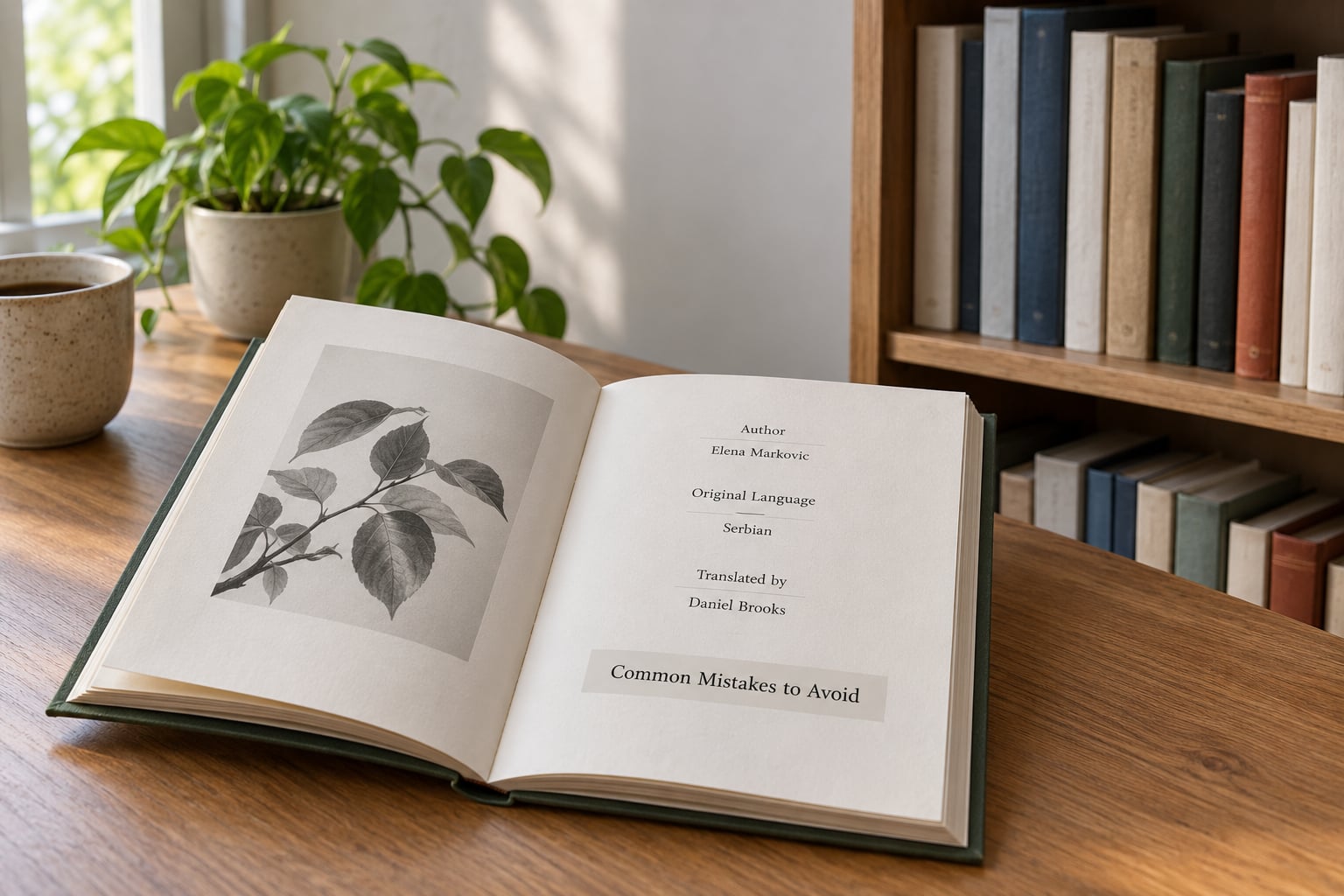
Most disappointing translated crime reads fail at one of a handful of predictable points. Here are the fixes.
- Assuming an international hit has an English edition. It very often does not. Check a catalogue before you plan around a book, and never assume a title listed on a foreign publisher’s site is available to you.
- Skipping the translator credit. The credit is not decoration. No credit at all is your signal to look elsewhere.
- Treating a reissue as a new translation. A new cover, a new paperback line, and a new price band all happen to old translations constantly. Check the copyright page for the year of translation, not the year on the cover.
- Trusting a thin catalogue. Some retail records carry incomplete translator data and even mismatched volume numbers. Cross-check anything important against a library record before you order.
- Choosing by cover. Redesign happens for commercial reasons that have nothing to do with text quality.
- Ignoring series order. Volumes published out of order, or split between publishers, are the most repeated frustration in reader threads. Look up the series sequence before you start, not midway through.
- Accepting machine or AI self-translation without checking. Machine-rendered literary prose shows up in self-published listings now, and authors in the German market have publicly rejected it as unusable for fiction. If an edition has no named human translator, skip it.
- Expecting an English chart to surface these books. It will not. The inflow of translations into English is small enough that you have to go looking.
One more practical note. Library and ebook availability for small-imprint translations is patchier than for mainstream titles, so check your catalogue before building a plan around a book you have to buy outright, and be patient with holds on translated series that arrive one volume at a time.
Frequently Asked Questions
What is the easiest way to find crime fiction originally written in another language?
Start with an award shortlist rather than a bestseller chart. The CWA International Dagger and the Petrona Award both publish longlists and shortlists with translator credits, so every title on them already has a verified English edition. Follow those lists back to the specialist imprints that acquired the rights, and read their backlists rather than only their new-release pages.
How do I know whether a crime novel is a translation?
Three signals, in order of reliability: a translator credited on the title page or copyright page, a phrase such as translated from the Swedish in the catalogue record, and an original title plus original publisher listed alongside the English edition. Search the original title in a library catalogue and the record will usually confirm all three within a minute.
Where can US readers find translated international crime fiction?
Three reliable places. Specialist crime imprints such as Orenda Books, Europa Editions, Pushkin Vertigo, Serpent’s Tail and Archipelago Books publish translation lists you can read end to end. Monthly international crime roundups in review magazines name the translator for every title. And library catalogues such as WorldCat will tell you whether an English edition exists before you spend anything.
Should I read the original language or an English translation?
For most crime fiction, the English translation is the better choice, because it is the version the translator tested against the genre’s English conventions and the editors acquired deliberately. Read the original when you already know the language and want to check how the translator handled dialogue, place names or police ranks. The two together are the most satisfying, not either alone.
How can I discover more books by a translated crime writer?
Search the translator’s name first, then the publisher’s imprint, then the author’s nationality. Translators usually work across several authors in the same language and genre, so their bibliography is a curated list in disguise. Publisher backlists are worth more than new-release pages for this, because a new author you enjoy usually has four or five earlier books behind them.
Are translated crime novels harder to find than English-language books?
Yes, and the reason is structural rather than practical. Translation flows heavily toward English and very little out of it, so translated crime does not appear on English bestseller charts and rarely gets the marketing push a home-market title receives. That is also why a named translator and an award shortlist matter so much: they are the only reliable quality signals a reader gets before buying.
Conclusion
Pick one award shortlist and one specialist imprint today, and that is enough to start. Work through the longlist, note the titles with translators you do not recognise, then check each one against a library catalogue for a real English edition.
From there, keep the four-field record: title, original language, translator, edition. That log is the whole system. In six months it will have produced more translated crime fiction than any chart would have, and you will know which translators to trust with your next read.