To tell a first edition from a reprint, look at the copyright page first: the lowest number still present in the number line tells you which printing you are holding, the copyright date should match the title page, and any later statement about reprints gives the game away. No single feature proves anything on its own, but when three or four of them agree, you have your answer.
Getting this right matters more than most readers expect. Marketplace listings use “first edition” loosely, and a declining printing with the number line 5 6 7 8 9 looks almost identical to a genuine first printing from across a table. People pay first-edition money for a copy that was printed four years after publication, then wonder why it never sold.
Before the checks, four words need untangling because collectors mix them up constantly:
- Edition — a version of the text set from type, plates or digital files. A hardcover and a paperback of the same novel are usually two different editions.
- Printing — one run of copies off that setting. One edition can have many printings.
- Impression — the British and European word for printing, used in a slightly different way.
- First thus — a new edition with no textual changes. It looks like a first edition to the untrained eye and is not one.
A true first means the first edition, first printing, in the country of first publication. When an American novel appeared in Britain months ahead of the US release, the British copy is the first edition and the American one, issued a few months later, is a “second printing before publication”. Confusing those two cost real money before.
Table of Contents
- What You Need
- Step-by-Step: How to Tell a First Edition From a Reprint
- 1. Check the Title Page and Publishing Details
- 2. Read the Copyright Page
- 3. Look for the Colophon or Printer’s Statement
- 4. Examine the Paper and Physical Construction
- 5. Inspect the Binding and Cover
- 6. Identify the Dust Jacket and Its First-Printing Clues
- 7. Compare the Book with Bibliographic Records
- 8. Put All Eight Clues Together
- Common Mistakes
- Frequently Asked Questions
- Does a first edition always mean the book is the most valuable?
- Can a paperback be the first edition of a novel?
- Why can the copyright date be earlier than the publication date?
- Does a dust jacket with a different printing code mean the book is a reprint?
- How should I verify an edition when the book has no dust jacket or colophon?
- Conclusion
What You Need
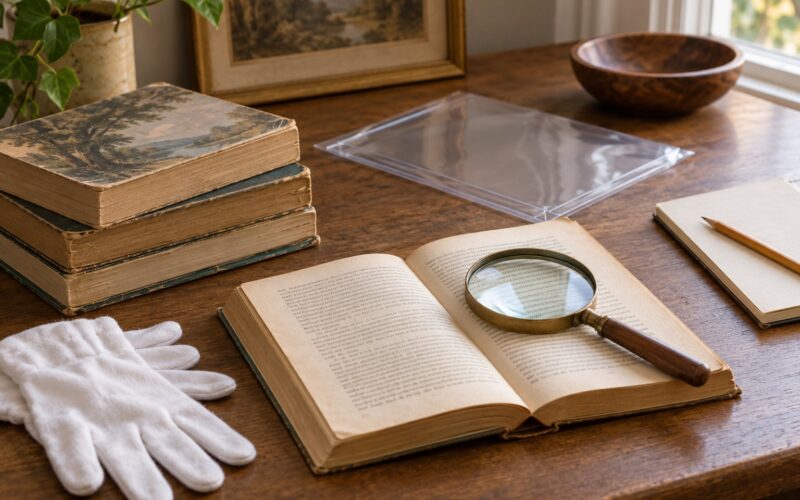
A bright, indirect light matters more than any gadget. A window and a plain white table will show paper tone, foxing and jacket fading far better than a dim bedroom bulb.
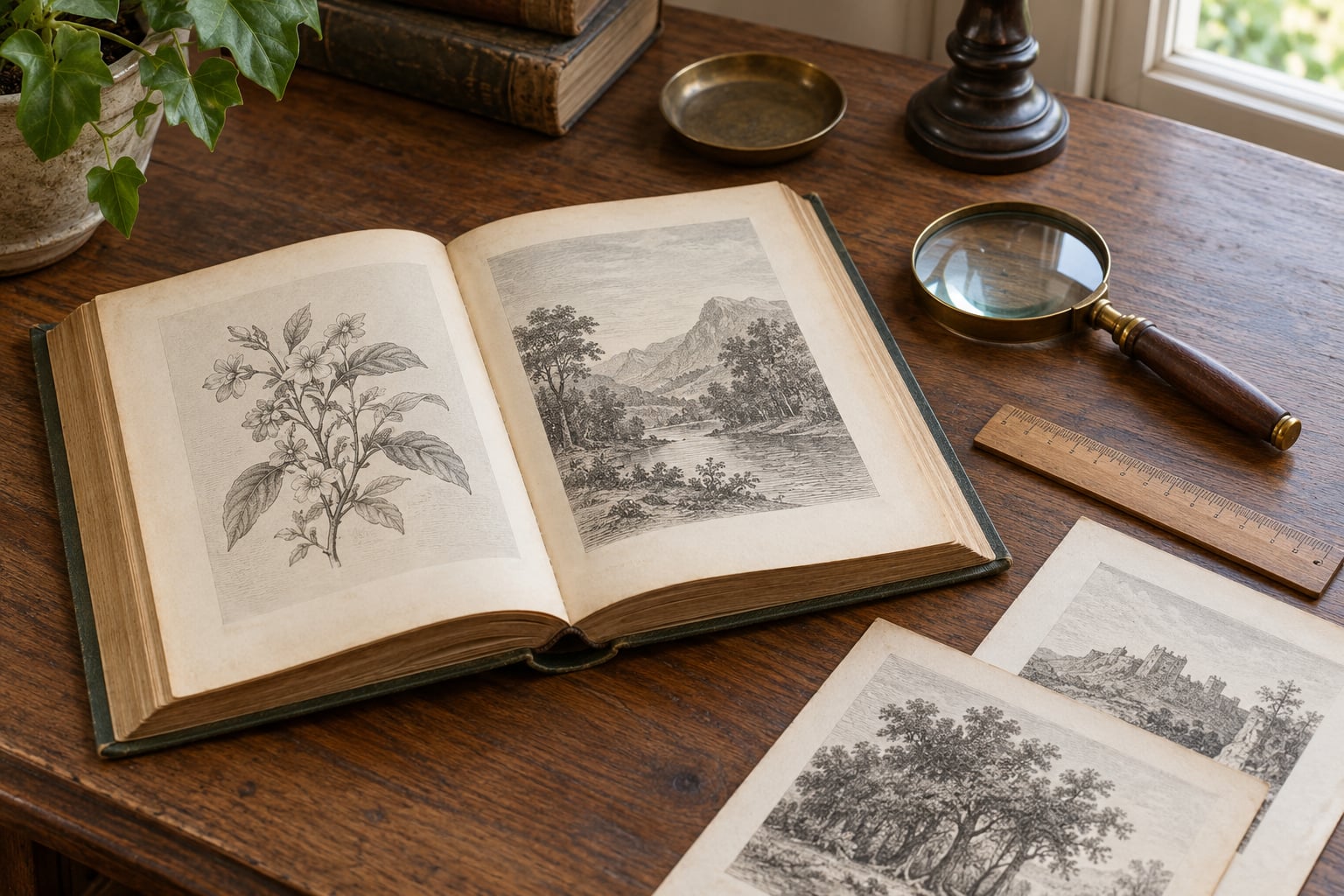
Bring a small magnifier, ideally 5x or 10x. Most edition clues live in a printer’s line set in six-point type at the bottom of the copyright page, and a loupe turns a frustrating squint into a readable line.
A small ruler is useful too. Page count and trim size shift between printings, and a five-page difference tells you something a casual look misses.
Then get the records open. For older American books the standard tools are John McBride’s Pocket Guide to Tracing Used and Rare Books and the ABC for Book Collectors, both readable online through Internet Archive lending. For jacket art and publisher variants, Points of Issue from the Bibliographical Society of America and Chris Chandler’s Book Club Editions fill in the gaps.
If you own another copy of the same book, put it beside the candidate. Differences in page count, typography and endpapers show up immediately side by side and vanish in isolation.
Step-by-Step: How to Tell a First Edition From a Reprint
Run the checks in order. The printed pages come before the physical ones, because paper and boards can mislead you and words cannot. If the book is valuable or the evidence conflicts, stop and get a second opinion from a bookseller who names the specific title.
1. Check the Title Page and Publishing Details
The title page carries three things worth reading: the publisher, the place of publication and any edition or printing statement. “New York: Alfred A. Knopf” versus “London: Hamish Hamilton” tells you which country’s edition you hold, which matters more than most first-time collectors realise.
If the title page carries a date, compare it with the copyright page. A title page dated a year earlier than the copyright usually means an earlier printing. A title page dated later than the copyright usually means a later reprint, or that the book was held back.
Paperback and hardcover transitions are the other common finding. When a hardback first edition is followed years later by the first paperback, that paperback carries its own edition statement — “First Paperback Edition” or nothing at all — and it is a reprint relative to the hardcover.
2. Read the Copyright Page
The copyright page, on the reverse of the title page, holds the highest concentration of evidence. Look for the copyright year, the publisher’s name and address, an ISBN, the printer, and any reprint statement. A line reading “Second Printing, First Edition” settles the question instantly.
Here is where the number line lives. That row of numbers — 10 9 8 7 6 5 4 3 2 1 — appears on the copyright page of most books printed since the 1970s. It is designed to be defaced when a copy is remaindered, which is why surviving full number lines survive at all.
Read it this way: the lowest number still present is the printing you hold. The numbers above it describe printings already sold and destroyed.
| Number line you see | What you are holding |
|---|---|
| 10 9 8 7 6 5 4 3 2 1 | First printing, first edition |
| 10 9 8 7 6 5 4 3 2 | Second printing |
| 10 9 8 7 6 5 4 3 | Third printing |
| 5 4 3 2 1 | Fifth printing — the press run never passed 5,000, so nothing above the 5 was ever printed |
| A full line with the 1 inked out or the flap price erased | Check for a remainder mark before calling it a first printing |
| Number line starting at 2 | Usually a publisher quirk — Random House and some others start their lines at 2, so a full line still means first printing |
Copyright dates also mislead. A publisher often secures copyright before publication, so a 1934 copyright can sit under a title page dated 1939 if the publisher folded it into a series and released it later. The copyright date alone proves nothing.
3. Look for the Colophon or Printer’s Statement
The colophon is the production note, usually on the last page or in the front matter: which printer set the type, how many sheets made each signature, what the press run was, which paper stock was used. It is where dedicated collectors find the confirmation that no other evidence gives.
What you are looking for is a mismatch. If McBride lists a first printing printed by printer A and your colophon names printer B, you are looking at a later printing, whatever the copyright page claims about being a first edition.
A printer’s code establishes less than people hope. A printer reuses a code across unrelated titles, and codes get recycled when equipment changes, so “this code means later printing” is a rule of thumb, not proof.
4. Examine the Paper and Physical Construction
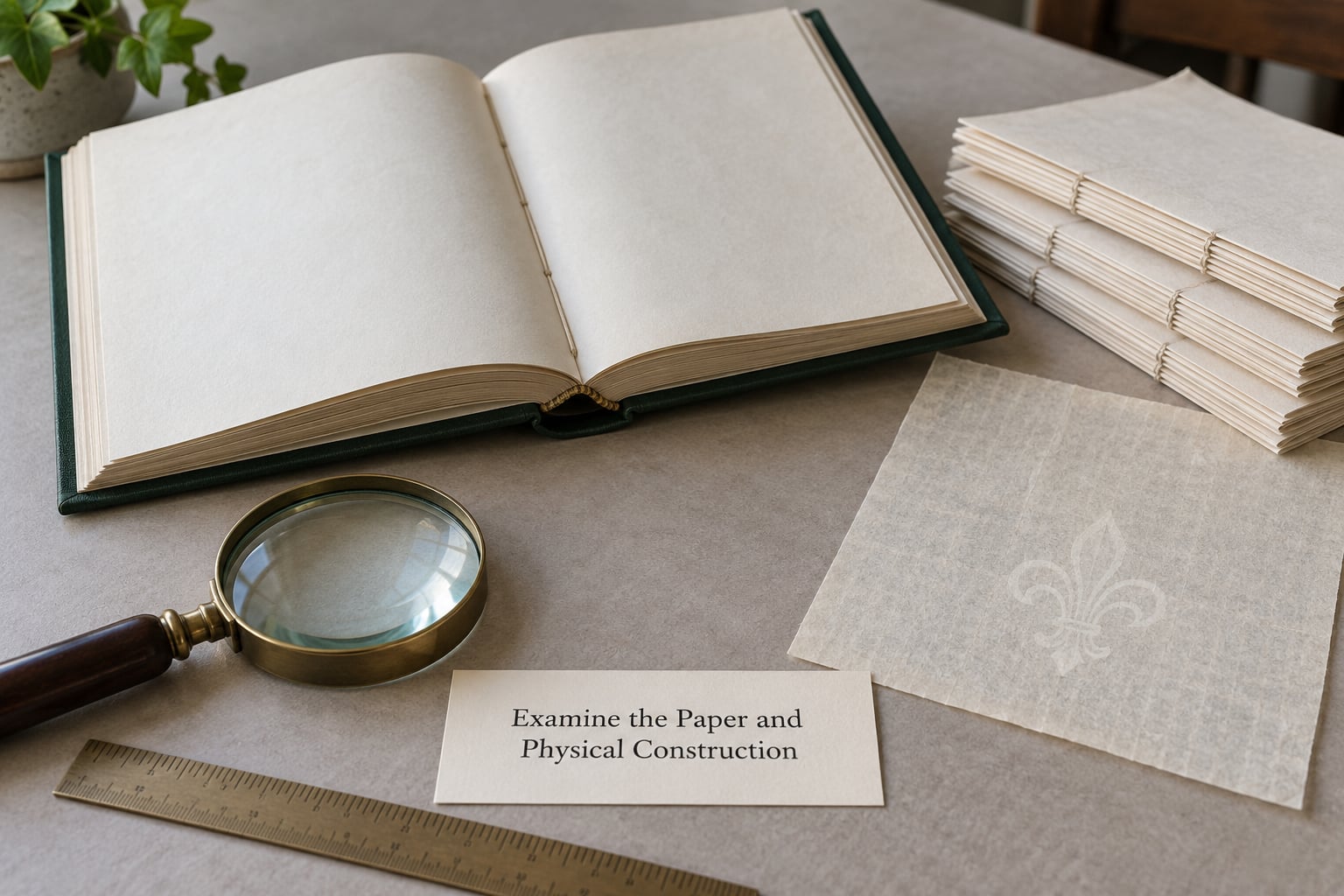
Wood-pulp paper yellows differently from rag stock. A book on high-grade wood-pulp paper from the 1930s goes a warm tan; a later printing on cheaper stock stays whiter or greyer. Compare a copy in daylight against a white background.
Watermarks belong to the paper maker, not the publisher, and change on a published schedule. Hold a page up to the light and read the maker’s mark. Regular gathering patterns — where the folds fall — tell you how the sheets were printed.
The real caution is substitution. Some publishers switch paper stock midway through a run without changing anything printed on the copyright page. Physical evidence supports an identification; it rarely establishes one alone.
5. Inspect the Binding and Cover
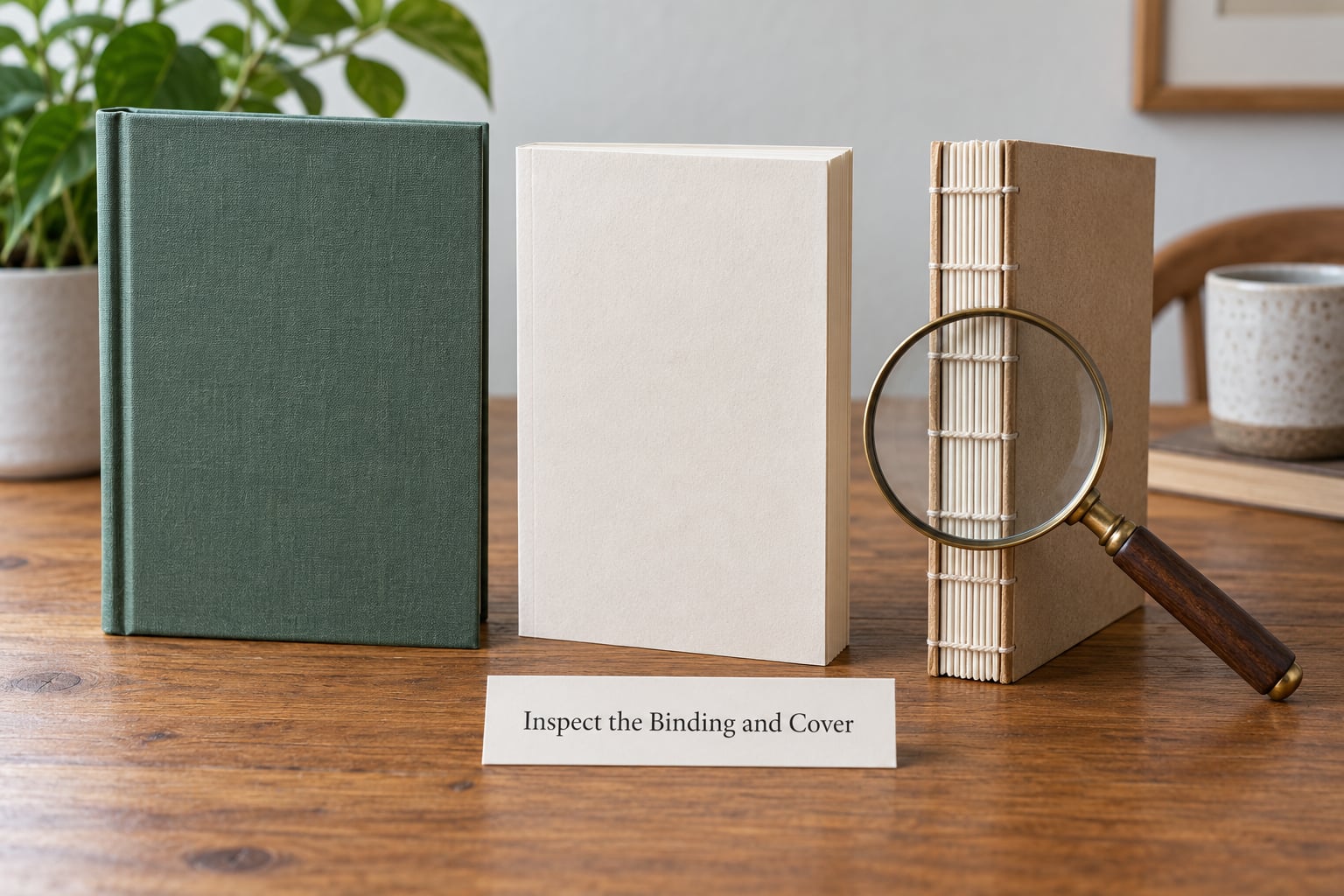
Case-bound books from the 1930s and 40s use cloth over boards with a paper-backed spine and often a headband. Later hardcovers often use a different buckram, thinner boards and no headband. If your “first edition” has no headband and the reference copy for that title does, ask why.
Look at the spine lettering, the endpapers and any blindstamp on the back board. A book club copy usually carries a blindstamp from the club itself — that small embossed device with no ink, often with “Book Club” or the club’s name.
Different covers do not automatically mean a reprint. Publishers change covers between the first and second printing more often than buyers expect, and a much later reprinting can wear an old cover. Judge the binding as supporting evidence, never as the primary signal.
6. Identify the Dust Jacket and Its First-Printing Clues
A first-printing jacket usually carries a price on the back flap, an advertising blurb for the author’s other books, and artwork that matches the period of publication. Crime and noir paperbacks are a good example: the price on the flap, the artist signature, and the blurb text all shift between printings of the same title.
Jackets also fade and clip. Sun-bleached spine lettering and trimmed corners are wear, not proof of a reprint, so judge colour and design rather than condition.
Jackets get replaced constantly, which is the trap. A later printing can be fitted with a first-printing jacket and sold as a first edition, a combination known as a married jacket. Match the jacket’s printer code against the colophon inside. If they disagree, assume the jacket is wrong until proven otherwise.
7. Compare the Book with Bibliographic Records
Now go external. McBride’s pocket guide and the ABC for Book Collectors list publisher, printer, page count and binding for first printings of thousands of titles. Library catalogues give you the publication history, including any later printings entered by a cataloger who checked the number line.
Bookseller listings on major marketplaces are useful too, but treat them as leads rather than proof. Look for listings that photograph the copyright page and name the printer and the number line. Those sellers usually know what they have.
For multi-country firsts, follow the flag: the first edition is the first published anywhere, even if that was a translation, unless the publisher distinguishes an original from a translation. American collectors have paid for American firsts that were published months behind the British edition.
8. Put All Eight Clues Together
Weigh what you have, and record what you cannot determine. A full number line, a matching title page and copyright date, a matching printer, an unaltered jacket and a bibliographic entry that all agree means a first printing.
When they conflict, trust the numbers over the words. Collectors ask constantly what it means when the copyright page says “First Edition” but the number line stops at 3; the answer is that publishers reuse plates and keep the edition wording, so the line reflects the actual printing. Document the conflict rather than resolving it in your own favour.
Get a professional appraisal when the book is signed or inscribed, when a jacket is worth more than the book, or when you are about to spend real money on a description you cannot verify yourself.
Common Mistakes
Judging by the cover price alone. A price on the jacket flap is a good sign, not proof. Later printings keep the jacket, and the number line settles it.
Assuming the earliest copyright equals the first edition. Copyright is filed early and reused for years. Check the title page date against a bibliographic record.
Treating a present dust jacket as original. Jackets are swapped, replaced and married to other printings. Compare the jacket’s printer code with the colophon inside.
Confusing a printing with an edition. Ten printings of the first edition is still the first edition. The second edition is a different text and a different number line.
Ignoring the publisher’s address and history. Publishers moved, renamed and merged. An address on the copyright page dates the book to a narrow window — often the only dating tool when there is no number line at all, as with most pre-1970s British and American printings.
Two more traps worth naming. Book club copies are printed from the same plates as the trade first and sometimes still say “First Edition”, so look for the blindstamp and the absent flap price. And modern “reissues” from reprint houses arrive in new bindings decades later with no printing history worth trusting.
Frequently Asked Questions
Does a first edition always mean the book is the most valuable?
No. Value follows the title, the author and the condition, and plenty of collectors would rather own a clean, readable copy of a lesser-known book than a shelf-worn first edition of a title they already own three copies of. Edition status is one input, not a verdict.
Can a paperback be the first edition of a novel?
Yes. Many books appear first in paperback, especially in the United States during the 1950s and 60s, and the first paperback printing is the first edition of that text. What matters is whether that printing came before any hardcover, not which format you are holding.
Why can the copyright date be earlier than the publication date?
Publishers file for copyright when they acquire or set the book, which can be years before release. Series publication and delayed hardcovers add to the gap. The copyright year tells you when the rights were secured, not when your copy came off the press.
Does a dust jacket with a different printing code mean the book is a reprint?
Not automatically, but treat it as a warning. Jacket printers were often different from text printers even on a first edition, so compare the jacket code against the copyright page and colophon before drawing a conclusion. If they do not fit the pattern in a bibliography, assume a married jacket.
How should I verify an edition when the book has no dust jacket or colophon?
Work with what remains: the number line, the title page date, the copyright page wording, the publisher address and the physical construction. Then confirm against McBride’s pocket guide or a library catalogue record for that title, and check page count against the entry.
Conclusion
Start at the front of the book and work backwards. Title page, then copyright page, then the number line — the lowest number present is the printing in your hands, and it outranks any wording about being a first edition.
Only after the printed evidence do you move to the jacket, the binding and the paper, then check what a bibliographic record says about the printer and page count. When those sources agree, you have an identification you can defend. When they conflict, write down the conflict and ask someone who knows that specific title.