Crime novels become hard to film when their central trick lives in prose rather than plot: a narrator you are not supposed to trust, a puzzle built for readers to solve, a mind the camera simply cannot enter. That is why some crime novels are unfilmable, and it is not the same as saying no film exists. It means the adaptation has to rebuild the effect instead of photographing it.
The pattern shows up in reader forums constantly. Ask why the latest detective adaptation disappointed and you get the same answer: it kept the murders and threw away the thing that made the book work.
Table of Contents
- What Does It Mean for a Crime Novel to Be Unfilmable?
- Why Some Crime Novels Are Unfilmable: The Five Biggest Challenges
- 1. When the Mystery Depends on an Unreliable Narrator
- 2. When the Story Lives Inside a Character’s Head
- 3. When the Timeline Is Too Fragmented to Follow
- 4. When the Clues Refuse to Become a Simple Mystery
- 5. When the World Is Too Large, Strange, or Abstract
- Can Any Unfilmable Crime Novel Be Adapted?
- How to Tell Whether a Crime Novel Will Work on Screen
- Frequently Asked Questions
- Which books are considered unfilmable?
- What crime books have been adapted into movies?
- What are the best books that have never been adapted into movies?
- Can an unreliable narrator work in a movie?
- What is the fair play problem in adaptations?
- Is an unfilmable novel the same as an unmarketable one?
- Wrapping Up
What Does It Mean for a Crime Novel to Be Unfilmable?
An unfilmable novel is one whose essential effect cannot survive the move from printed page to screen without being replaced by something else. The word is often used too loosely, so it helps to split it into three kinds.
Artistic unfilmability. The book depends on sentence-level craft: a stream of consciousness that never resolves, prose rhythm that mimics a character’s panic, an epilogue that reframes everything before it. A camera has no access to any of that.
Technical unfilmability. The story needs two hundred named characters, four time zones, a century of backstory or effects that did not exist when the novel was written. These are solvable with money and craft, but not with craft alone.
Financial unfilmability. Nothing artistic is wrong with the book; it simply costs more than the audience it will reach can justify. A period procedural set in a country with few shootable locations is a budgeting problem wearing a costume.
One more distinction matters. A premise is filmable even when it sounds impossible. A murder in an isolated lighthouse in 1911 is a production challenge. A novel whose subject is whether guilt can ever be established, in which no evidence resolves and no character changes, has no dramatic engine to hang scenes on. That second book resists adaptation for a reason the first one does not.
Why Some Crime Novels Are Unfilmable: The Five Biggest Challenges
Across the crime genre the same five obstacles account for most stalled projects. They range from the technical to the philosophical, and a single novel can trip over three of them at once.
1. When the Mystery Depends on an Unreliable Narrator
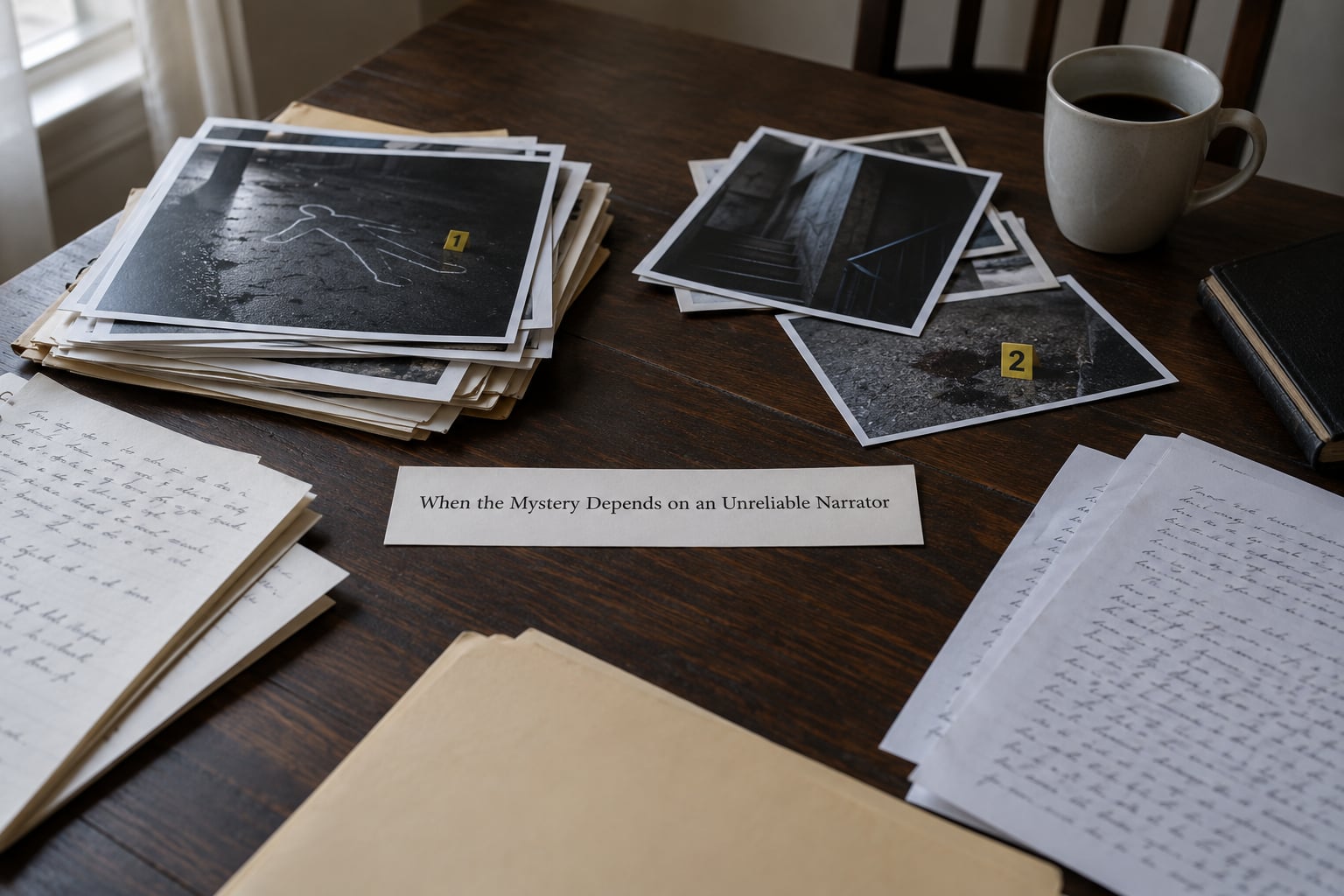
An unreliable narrator works because prose and fact quietly separate. The narrator reports a room as blue when it was green, forgets a phone call that happened, and describes a face as calm when the prose has already told you the jaw was tight. Readers notice the gap. Viewers usually do not.
Film can absolutely mislead an audience, but it does it differently. A narrator’s slip is a sentence; a shot of a green room is a fact on screen, and the camera is under an obligation not to lie about what it shows unless the film has established whose eyes we are sharing.
So an adaptation has three options and none of them are free. Keep the narrator’s account and add visual contradictions, which tests the audience’s patience. Shoot what really happened and let the audience watch a character miss it, which changes the genre into something closer to surveillance drama. Or restructure around a second point of view, which usually means a bigger cast and a colder tone.
Readers notice the third option most sharply. Novelists who spent 300 pages building one skewed consciousness usually get a version with a framing device and a partner who asks the obvious questions.
2. When the Story Lives Inside a Character’s Head
The bluntest sentence about adaptation is that you cannot film thoughts. Interior monologue is the craft crime fiction inherited from hard-boiled detective fiction, where the first-person voice carried the mood, the moral argument and the clues all at once.
Screenwriters put it more plainly: a page of narration has no shot equivalent, so it has to be converted into something visible or spoken, and both conversions cost something.
Voiceover can work, as The Girl with the Dragon Tattoo proved, but it works by borrowing a technique from the radio era and asking a modern audience to accept a device that feels old on purpose. Showing thoughts costs something else: you get a character staring out of a window for two hours. Matching a thought to an action loses the specificity that made the book good, because the prose said one thing and the scene shows another.
Private sensory detail fares worst. A novel can tell you the exact taste of fear in a throat. A film has to fake it with a trembling hand, which is a different and weaker signal.
3. When the Timeline Is Too Fragmented to Follow
Crime fiction loves fractured chronology: a body discovered in 1974, a flashback to the war that explains it, a chapter in the killer’s voice that sits out of order with everything around it. On the page a reader can flip back and hold the structure in their head at once.
On screen, the same structure asks the audience to remember more, at speed, while missing half the dialogue that matters. Non-linear crime films tend to fall into one of two failures. They explain so much up front that the reveal lands flat, or they withhold so much that viewers stop caring and start waiting for the flashbacks to start.
Multiple simultaneous threads make it worse. Eight investigators working four cases in four cities gives a book a chapter of cross-cutting that a two-hour film has to compress into a chase sequence, and compression in this genre usually means dropping the case the audience was closest to.
What often saves it is a physical anchor: one object, one room, one recurring location that the film can return to between time periods. Ambiguity about who is lying survives that. Ambiguity about what year it is does not.
4. When the Clues Refuse to Become a Simple Mystery
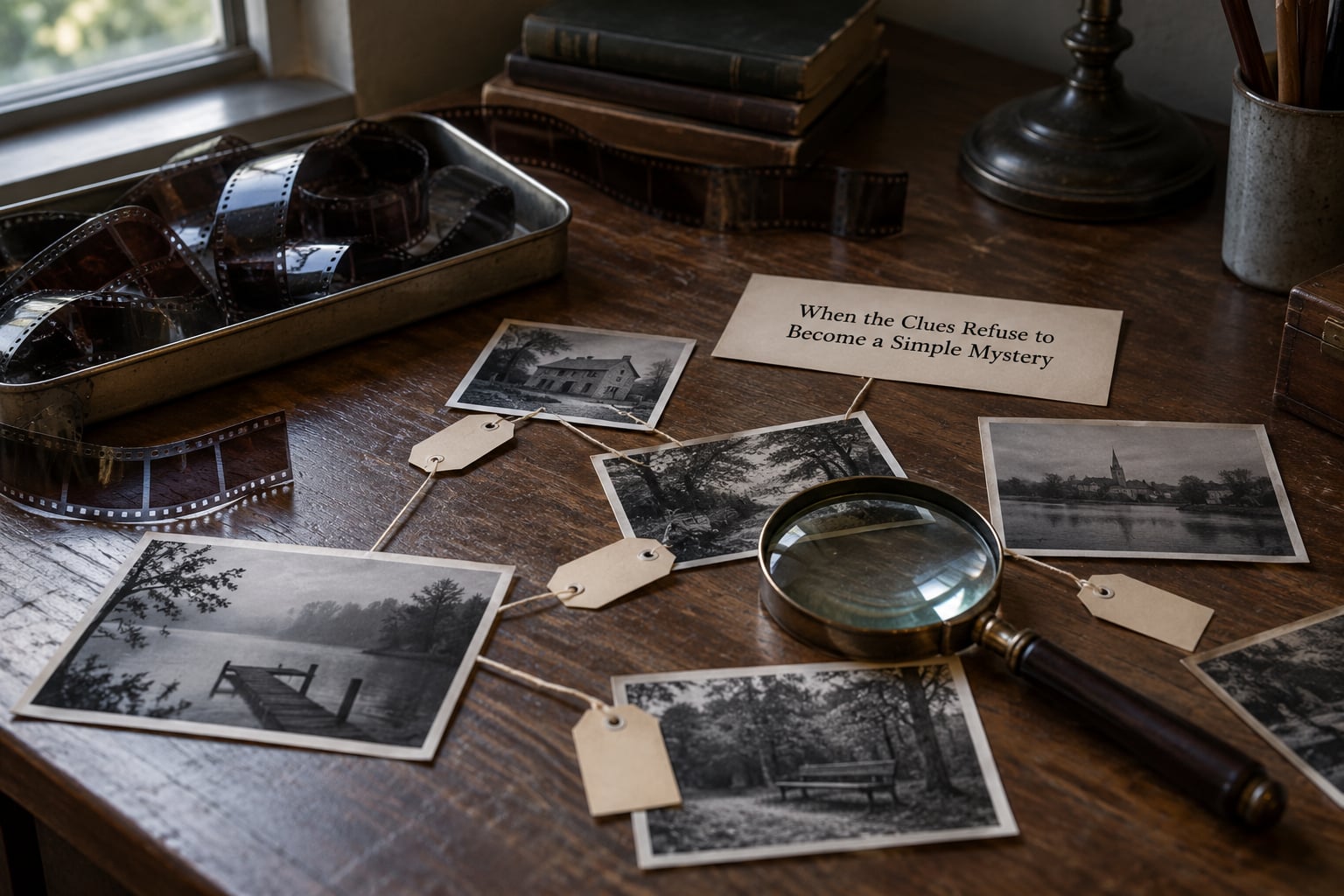
This is the obstacle that matters most in crime fiction and the one general adaptation writing rarely covers. The fair play contract is an agreement: the book gives you every clue you need, in the right order, and the solution follows from reasoning rather than revelation.
That contract is between a reader and a page. A viewer joins a different contract, one based on attention spans, and the terms are not negotiable. Sound in a doorway that a reader registers as the second word of paragraph three becomes, on screen, something a third of the room did not hear.
The result is an information imbalance. Either the film shows less than the book and viewers guess too early, or it shows more and the puzzle collapses at the halfway mark. Clue fairness on screen means re-engineering the clue, not simply photographing it, which is a writing problem dressed up as a production one.
There is a second fair play problem in series books. A detective who remembers a case from book four cannot be re-cast freely, and a series that changes a character’s method or wound every time it restarts breaks fans’ trust in the version that came before.
5. When the World Is Too Large, Strange, or Abstract
Sprawling criminal fiction is a scale problem before it is a content problem. Corleone-style families, institutional corruption across three agencies, criminal economies where money moves through more than a dozen entities: these read fine in a book because a paragraph can compress an organisation into two sentences.
A feature film has to establish roughly a dozen faces and make each one distinguishable without dialogue. Beyond that, the cast stops registering and the plot turns into a queue of people you have met once.
Setting makes it worse. Literary period crime needs research, locations and a design department to sell a world the audience has never seen, and each of those costs money a studio would rather spend on effects. Adaptations with long development histories, from Blood Meridian to The Black Dahlia, all hit some version of this wall.
At the far end of the scale sits the novel about a system rather than a person: bureaucracy as a villain, a legal framework as the mystery. There is very little to point a camera at, which is why such books tend to be quietly dropped rather than loudly failed.
Can Any Unfilmable Crime Novel Be Adapted?
Yes, with a trade. Every adaptation that works is a negotiated exchange, and knowing what filmmakers are allowed to change is more useful than arguing about fidelity.
Point of view. The most common move is shifting from first person to third, or splitting one skewed narrator into two characters who cover different halves of the story. It fixes the unreliability problem and costs you the intimacy of the voice.
Chronology. A film can straighten a nonlinear plot into a clean sequence with reveals placed at chosen moments. That is the easiest trade to make, and the one most likely to be resented by readers who liked the book being hard.
Scale. Networks and studios have learned to merge minor characters and cut subplots. A cast of forty becomes a cast of twelve, and a subplot about an old friend disappears.
Format. The streaming limited series solves more problems than feature films do, simply by adding hours. Readers frustrated that a dense crime novel was compressed into 100 minutes often find the same material at eight episodes works, because the interior voice can be externalised gradually and a fractured timeline can hold itself across a whole season.
What cannot move is the discovery itself. If the book exists to make the reader feel something that only that structure produces, no amount of runtime restores it. The adaptation has to find a different route to the same feeling, and sometimes there is one.
How to Tell Whether a Crime Novel Will Work on Screen
You can assess a book yourself in about ten minutes. Six questions cover most of the ground, and the answers tell you which of the five challenges you are actually facing.
| Check | Good sign for adaptation | Warning sign |
|---|---|---|
| External action | Most scenes can be described in one visible action | The chapter works only as an interior thought |
| Visual storytelling | Clues sit in rooms where the camera can stay | Key evidence is reported rather than shown |
| Character access | The narration reports things the camera could capture | The narration reports feelings, smells and doubts |
| Narrative clarity | One time period, or clear markers between them | Fragmented order with no recurring anchor |
| Thematic transfer | The theme survives without the original structure | The theme only exists in the prose rhythm |
| Essential elements | A few things must stay intact, and you can name them | Every element is load-bearing |
Two extra things worth checking. Count how many clues the reader collects on a page: more than a handful per scene usually means the adaptation will have to invent substitutes. And ask whether the ending is an action or an understanding, because endings built on understanding are far harder to stage.
Frequently Asked Questions
Which books are considered unfilmable?
Mostly books whose effect depends on sentence-level craft rather than plot: stream of consciousness, an unreliable narrator, a puzzle only readers can solve, or a story told across dozens of characters. A separate group is technically unfilmable because of scale or cost, such as a period novel needing several shootable countries and a large ensemble cast.
What crime books have been adapted into movies?
Most major crime novels reach film eventually, usually in altered form. L.A. Confidential changed its ending and condensed years of police politics into a night and a day. The Maltese Falcon, The French Connection and Gone Girl were all fairly direct. Long series like Bosch or Rebus tend to reach television first, since continuity across instalments fits streaming better than features.
What are the best books that have never been adapted into movies?
Among crime and noir titles, Blood Meridian and The Black Dahlia are often cited, along with several decades of unwritten Chandler sequels that never existed to adapt. Readers also point to continental European novels with sparse English-language readership, where rights and finance are the barrier rather than the material. Absence of a film says little about a book’s quality.
Can an unreliable narrator work in a movie?
Yes, but the technique has to shift. The film can contradict the narrator with visual evidence, follow a second viewpoint, or simply withhold what the narrator leaves out. Each choice preserves the misdirection while removing some of the intimacy. The version that photographs the narrator’s account literally tends to confuse viewers instead of deceiving them.
What is the fair play problem in adaptations?
Fair play means the text gives the reader every clue needed to solve the crime. On screen those same clues compete with cuts, music and dialogue, so viewers catch far less than readers do. Fairness has to be rebuilt deliberately, usually by re-staging clues rather than simply showing them. When that fails, films usually start hiding information, which ends the contract entirely.
Is an unfilmable novel the same as an unmarketable one?
No. Unmarketable means too few readers or buyers to justify the spend. Unfilmable means the material resists the medium. A modest, tightly plotted procedural about one room and two people may be unmarketable and trivially filmable, while a dense literary novel with a small but devoted readership can be both popular and genuinely difficult to adapt.
Wrapping Up
Start with the fourth challenge, because it is the one readers feel most. Ask whether the book’s central experience is a clue, a voice, or a revelation, then check whether that thing can exist on screen at all. If it cannot, the project needs a different structure, more hours, or a different story to tell.