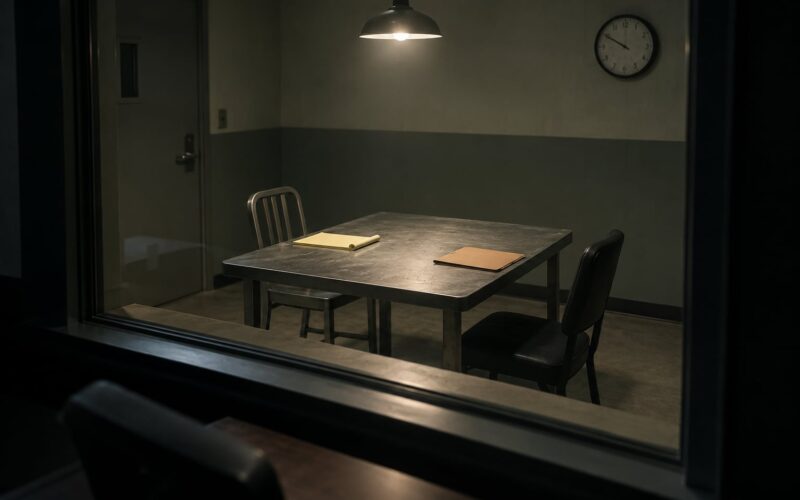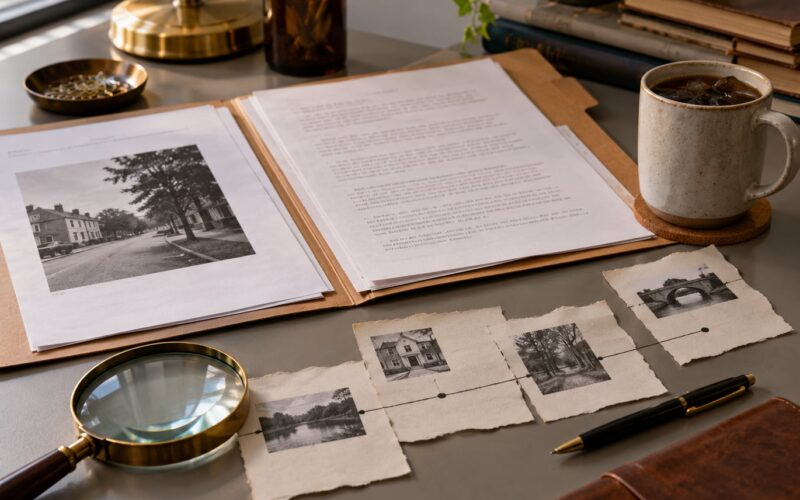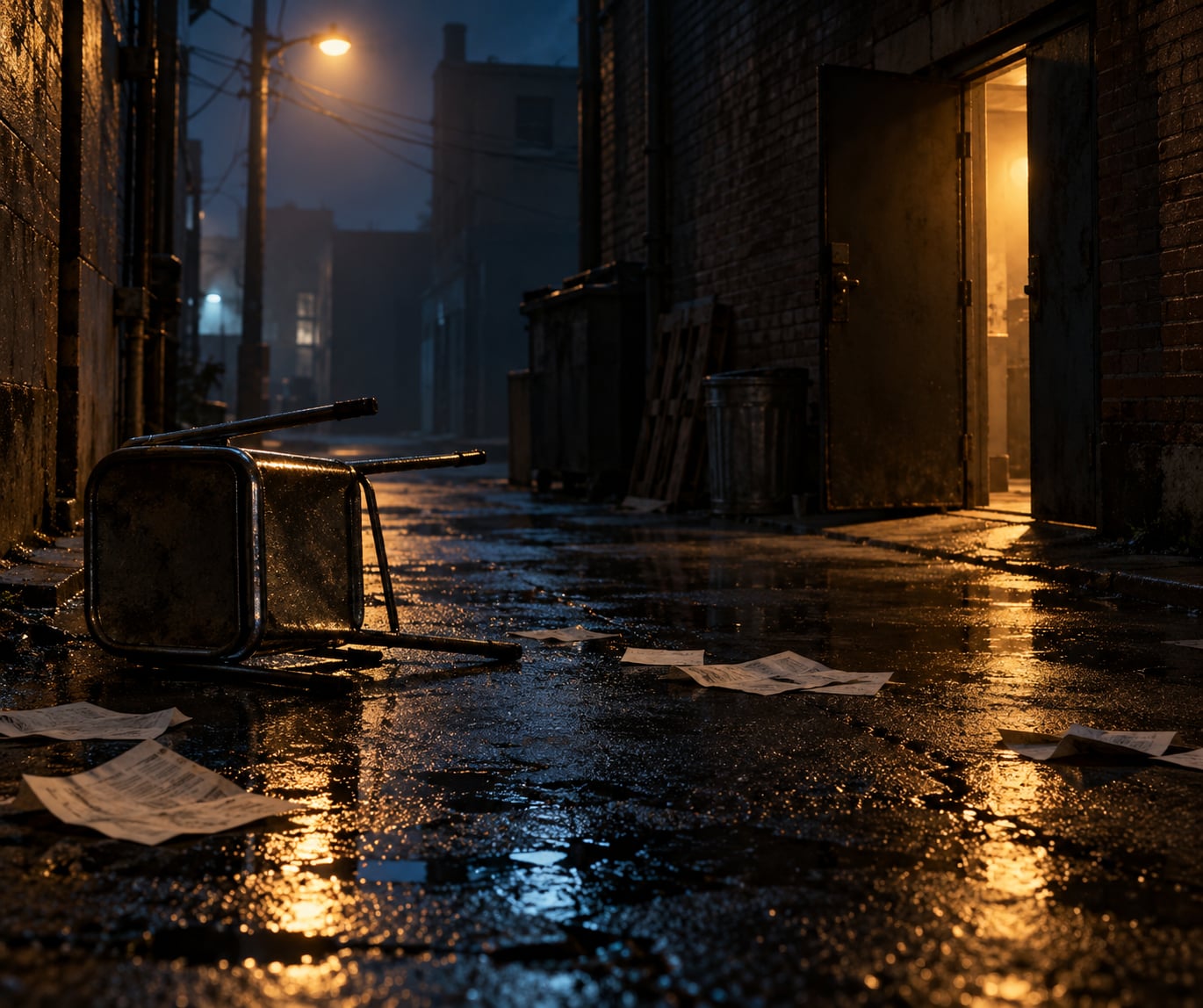
Most fight scenes fail for two reasons: the reader loses track of who is standing where, or nobody cares who wins. Learning how to write a fight scene in crime fiction means fixing both at once, by deciding what the violence changes, mapping the room, and writing every exchange in three beats: intent, action, consequence.
In crime fiction there is a third requirement that other genres can skip. A fight is rarely the point of the scene. It is an evidence generator. The injuries, the broken glass, the transfer marks on a hand and the question of who struck first all feed the investigation that follows, so what happens in the scene decides what your detective can later prove.
This guide works through eight steps, from the dramatic job of the fight to the consequences that follow it, with a short list of revision checks at the end. Most of it applies to any action scene. The forensic and legal sections are specific to the genre.
Table of Contents
- What You Need
- Step-by-Step: How to Write a Fight Scene in Crime Fiction
- 1. Decide What the Fight Must Change
- 2. Establish the Stakes Before the First Blow
- 3. Map the Physical Space and Constraints
- 4. Give Every Combatant a Distinct Fighting Logic
- 5. Write the Fight in Cause-and-Effect Beats
- 6. Control Distance, Rhythm, and Point of View
- 7. Make Violence Reveal Character and Complicate the Plot
- 8. End With Consequences, Not Just a Knockout
- Common Mistakes
- Frequently Asked Questions
- How long should a fight scene be?
- How do I write a realistic fight scene?
- How much violence is too much in a crime novel?
- Should characters talk during a fight scene?
- Do I need to know martial arts to write a fight?
- Should I show the whole fight or cut away from it?
- Conclusion
What You Need
You need decisions before you need prose. Drafting first and discovering halfway through that nobody had a reason to be in the room is the single most common way a fight scene collapses, so spend the planning stage on the following.
- A dramatic job. One sentence on what the fight reveals, destroys or forces a character to admit. If you cannot write that sentence, the scene is decoration.
- A participant list. Who is in the room, who is outside it, and who leaves early. Limit the people actually swinging to two, occasionally three.
- A physical limitation per fighter. Training, injury, age, panic, a shoulder that was dislocated in chapter four. This decides who has an advantage and why.
- A space map. Doorways, furniture, distance between bodies, what is within reach and what is broken along the way.
- Stakes beyond survival. What each person is protecting, hiding, trying to obtain or afraid to lose.
- A beat outline. Four to six exchanges written as a numbered list before you draft a single paragraph of prose.
- An evidence ledger. A short note of what the fight leaves behind, since a crime novel will need it again.
- One realism reference. A single source on the specific thing you are least sure about. More than that is how research turns into an excuse not to write.
Step-by-Step: How to Write a Fight Scene in Crime Fiction
1. Decide What the Fight Must Change
The fight’s job is not entertainment. It is a change of state, and you should name it in a single sentence before you write anything else.
Good jobs sound like this: the detective’s cover is blown and can never be reconstructed. The suspect learns that someone else has the ledger. Two former partners stop being able to pretend they are colleagues. Any of these change what happens in the next chapter.
There is a quick test for whether the scene earns its place. Ask what your book would look like if the fight were deleted and both characters simply walked away. If the answer is broadly the same story, cut it or replace it with a conversation that carries the same revelation more cheaply.
2. Establish the Stakes Before the First Blow
Readers forgive stiff choreography far more readily than they forgive a fight with no reason to exist. Show what each character stands to lose in the paragraph or two before anyone touches anyone.
Threat does the work better than narration. A man who says he is calm while checking a drawer is calm is not calm, and your reader knows it. Timing works the same way: whoever moves second is reacting, and the reader feels the delay.
Withhold one piece of information from the reader for the length of the fight. Someone is dying, someone is bluffing, or someone has a weapon nobody has seen. The gap between what the reader knows and what your viewpoint character knows is the tension engine, and closing it early is how you lose a scene you could have won.
3. Map the Physical Space and Constraints
Block the space in your notes and then show only what the viewpoint character perceives. Distance, obstacles and lighting do more for tension than adjectives ever will.
Sketch the room in three lines: what is behind the viewpoint character, what is in front of them, and what they can reach without moving. Note the exits, because a character who is not cornered behaves very differently from one who is, and the reader will feel that difference even if you never explain it.
Constraints make obstacles. A folding table takes a knee out. Wet stone is a killer on a fire escape and nobody in the book needs to be a martial artist to use it. Whatever the fight breaks should matter afterwards, because in a crime novel a ruined handrail is either a detail that never comes back or the thing that proves the story later.
Show the space before the violence starts, in plain establishing sentences. Once the first blow lands, the reader should already know the room well enough to find the door without hesitating.
4. Give Every Combatant a Distinct Fighting Logic
Two characters should not fight the same fight. Give each one a training background, a physical condition, an emotional motive and a preferred tactic, then let those four things decide what they actually do under pressure.
A former soldier fights in short decisive bursts because stopping was never part of the training. A bookkeeper fights scrappily and badly, because that is all there is, and throws whatever is close because hesitation costs more than a badly aimed swing. A large man who is not a fighter relies on reach and weight and backs off whenever someone gets inside it.
That third example matters for a very common crime-fiction problem: the ordinary protagonist against someone trained. The honest version is that the protagonist loses badly and survives through environment, desperation, numbers or a single cheap surprise. Writers who have never been in a fight worry endlessly about whether their choreography is credible. The fix is usually not more research but smaller claims.
Check every action against that character’s capabilities. If a line of action would not be available to this person in this condition, cut it.
5. Write the Fight in Cause-and-Effect Beats
Choreograph in beats, not moves. Every exchange in a fight scene has three parts, and drafting the beats as a numbered list before you write prose keeps the scene from turning into a transcript of moves.
- Intent. What the viewpoint character wants from this exchange, in a verb: get past, pin down, reach the door, end it.
- Action. The compressed attempt. One clear image, usually the movement of one body or one object.
- Consequence. What it cost and what changed. A wound, a new position, a lost option, a piece of information revealed.
Four to six exchanges usually carry a scene. Beyond that you are writing choreography rather than a story, and the middle is the part readers skim.
The test for whether a beat is working is simple. Ask why the next action happens. If the answer is not “because of the previous one,” you have a sequence of unrelated events, and the reader will feel the seam even if they cannot name it.
Here is the same moment written two ways. Before, with no cause and effect, no limitation and no consequence:
He grabbed her arm. She pulled free. He swung at her and missed. She kicked him. He hit the floor and she ran out of the door.
After, in three beats: intent to leave, action, consequence:
She had four feet of floor between herself and the corridor. She went for the door. His hand closed on her wrist and she felt the grip slide slick with her own blood, so she turned into it rather than away, which put his shoulder past his weight. He went down against the radiator. She did not run. She stood over him listening to his breathing and working out whether she could do it again, and the answer arrived in her knees, which were not going to be hers for some time.
Same fight, same winner, and the difference is not description. The second version gives her a goal, gives her a wound that explains the slick grip, makes the environment do work, and ends on a change in her body rather than a result on the floor.
6. Control Distance, Rhythm, and Point of View
Sentence length is your throttle. Long sentences with subordinate clauses slow everything down and suit the lulls; short declaratives accelerate and suit the peak. If the whole scene runs at the same tempo, the reader has nothing to measure speed against and the fight feels flat no matter how well it is staged.
Stay in one body. Each scene should be written from a single viewpoint character’s perspective only, and a fight makes this harder because the reader is being pulled toward the more dramatic fighter. Resist it. Battles are messy and nobody, least of all your viewpoint character, has a clean overview of what is happening.
Give each exchange one clear image rather than three. Show-don’t-tell is usually sound advice and it works against you in action, because a described room plus an explained blow plus a stated emotion in one sentence produces mush.
Varied distance is the other half of rhythm. Pull back for the room, push in for the hand on the wrist, and cut away entirely for the moment the viewpoint character stops registering detail. When you read the draft, ask whether you can follow who is where without rereading. If not, the problem is geography, not pace.
7. Make Violence Reveal Character and Complicate the Plot
The fight should tell the reader something about the people in it that a quieter scene could not have told them. Who refuses to hit first, who cannot stop once started, who is more afraid of being arrested than of being hurt.
In noir, violence is where a character’s rational self-interest stops working. The private investigator who has spent forty pages managing situations discovers what he is actually like when cornered, and the reader is not supposed to enjoy the discovery. In a police procedural, the same fight creates a problem the officer cannot solve with procedure. In serial killer fiction, the fight is often the first crack in a persona that no one else can see through.
Also consider whether the fight plants or pays off a clue. A wrist grab in chapter four that leaves a bruise on the wrong person is a scene that changes the investigation. The same beat written as generic grappling changes nothing, and you have spent two pages to learn nothing about your plot.
8. End With Consequences, Not Just a Knockout
Do not end the scene when someone hits the floor. End it on a state change, then write the short transition into whatever comes next.
Physical consequence is the easiest and the most commonly skipped. Adrenaline masks injuries for a while and then it does not. A cracked rib hurts when breathing. A concussion is confusion and nausea, not a nap. A dislocated shoulder stops a character doing anything that requires both hands, and if that matters in chapter twenty, it had better still matter on page four hundred.
Forensic consequence is the one that earns you the crime-fiction modifier. What the fight leaves behind will be photographed: spatter patterns and where they originated, blood on clothing that does not belong to the victim, transfer evidence, footwear marks in spilled liquid, broken property with a clear sequence of destruction. Which surface a body landed on and what moved afterwards are questions your detective will be asked at a scene later.
Legal consequence decides the rest of the book. Self-defence, unlawful violence and arrest are not decoration in this genre; they are plot. Rules vary by country and state and change over time, so treat this as research rather than memory, and never present the outline as legal advice. What you do need is the shape of the question: was force used proportionately, was there an imminent threat, was the account of the first strike consistent with the injuries found?
Writers pick up one of the most repeated complaints about action writing when a fight ends and the next chapter opens with everyone fine. Let the hurt follow the characters for a while.
Common Mistakes
Most of these survive revision because they read fluently on the page. Diagnosis is usually easier than fixing, so here is each failure with a specific correction.
Interchangeable punches. When both fighters land the same kind of blow in the same rhythm, the reader cannot tell them apart. Fix it by assigning each character one signature action and one thing they never do.
Unexplained expertise. A bookkeeper performing a competent rear naked choke reads as wish fulfilment. Fix it by letting the protagonist lose, and by making the win depend on the room rather than on skill.
Too much choreography. A full beat-by-blow account of every exchange puts the reader in the position of a spectator at a match. Fix it by cutting the blocks and counters between intent and damage, and keeping the decision, the strike and the result.
Missing viewpoint. The scene slides into the other fighter’s head to explain their plan. Fix it by deleting every sentence that requires a mind you are not in. If you need that information, write a separate scene afterwards.
Arbitrary outcomes. The reader cannot work out why one person won. Fix it by auditing the beats for cause and effect; the answer is usually a consequence that never landed, or an injury that appeared without being earned.
Violence with no consequences. The fight ends and nothing changes. Fix it by writing the evidence and the injury notes before you draft the fight, then letting both limit what the characters can do next.
Mid-swing dialogue. Long speeches during a fight drain tension and slow the reader. Fix it by cutting to at most one or two short lines, an instruction, an accusation or a name, and nothing else.
Then run this as a checklist:
- Can you name the fight’s dramatic job in one sentence?
- Is the viewpoint character’s limitation established before the first blow?
- Does the reader know the layout of the room?
- Does every beat pass the why-did-the-next-thing-happen test?
- Are you still in one head from first line to last?
- Does each sentence carry one clear image rather than three?
- Does sentence length vary, with slower passages at the lulls?
- Is the dialogue during the fight shorter than you think it needs to be?
- Does every injury appear on the page where it is caused?
- Does the final line report a change rather than a result?
- Can you list the evidence the scene leaves behind?
- Will a reader understand why the outcome was fair?
Three practical tips. Cut your fight scene in half and see whether it improved; most drafts gain from losing about a third of the moves. Read a fight scene aloud, because rhythm problems are obvious in the ear and invisible on the page. And give yourself permission to skip the fight entirely, opening on the aftermath instead. It is a legitimate choice in crime fiction, and it hands the reader the tension of imagining what they did not see.
Frequently Asked Questions
How long should a fight scene be?
Most fight scenes work best between four hundred words and two thousand. Anything under three hundred rarely has room to establish stakes, space and consequence, and anything over three thousand usually turns into choreography the reader skims. Length matters less than completeness: a short scene that changes something beats a long one that only moves bodies around.
How do I write a realistic fight scene?
Realism comes from cause and effect rather than technical detail. Give each fighter a training background, a physical limitation and a preferred tactic, then make every action follow from the one before it. Use the room, respect exhaustion, and let injuries show up a beat late. You need one good reference, not twenty.
How much violence is too much in a crime novel?
That depends on your readers, and you cannot control them, so decide what you are willing to write and signal it honestly in a content note at the front of the book. Keep the detail proportionate to what the plot needs. Readers of crime fiction generally want the consequences of violence more than its mechanics.
Should characters talk during a fight scene?
Very little. Dialogue during a fight should be short, clipped and aimed at changing the situation: an instruction, a name, an accusation, a warning. Anything longer pulls the reader out of the pressure, and monologue mid-swing is the most common complaint about action writing. Silence between a few lines usually lands harder.
Do I need to know martial arts to write a fight?
No, and most readers cannot tell. What they notice is whether the action makes sense for the people doing it. Give your protagonist a clear disadvantage and let the environment, numbers or desperation do the work. Plenty of effective fight scenes are simply two frightened people failing at something until one of them stops.
Should I show the whole fight or cut away from it?
Show the whole fight when the reader’s perspective character is the one fighting, and cut away when the violence would strain your viewpoint or your reader. Starting a scene just after the fight, in a car park with a bleeding protagonist and a witness refusing to talk, is a completely legitimate choice and often the stronger one.
Conclusion
The order matters more than the technique. Decide what the fight changes, establish the stakes before anyone moves, map the room, give every fighter a distinct logic, write four to six exchanges in intent, action and consequence beats, control pace with sentence length while staying in one head, let the violence reveal character and complicate the plot, then land it on a consequence rather than a knockout.
Start tonight with the first three steps only. Write one sentence naming what the fight must change, one paragraph on what each character is afraid to lose, and three lines sketching the room. If those three things are not solid, the choreography will not save the scene, and in crime fiction it certainly will not survive contact with the investigation that follows.