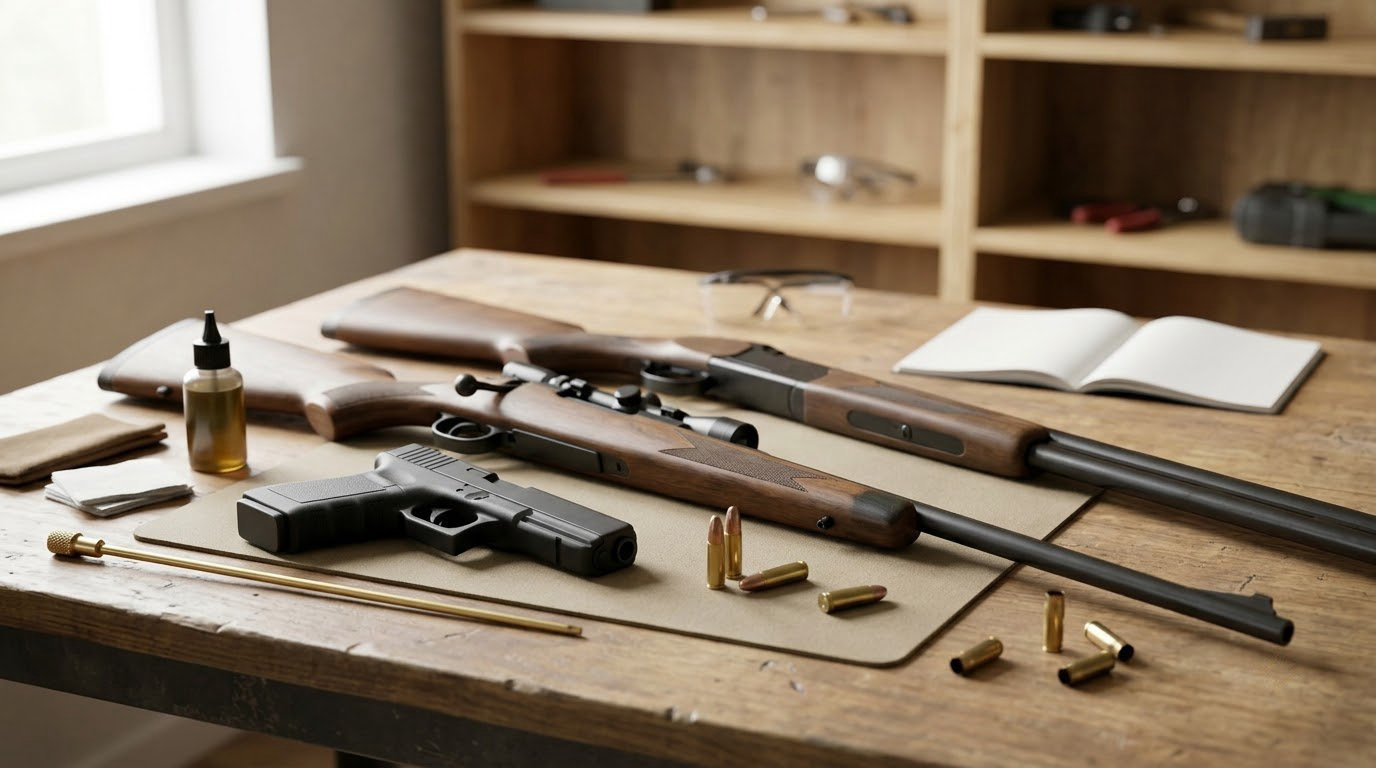
How to write about guns accurately in fiction comes down to three things: correct vocabulary, mechanics that follow from the weapon you chose, and only as much detail as your viewpoint character would actually notice. Miss the first and armed readers file the book away. Miss the third and the scene reads like a manual. Updated for 2026, this guide works through the process step by step.
Before anything else, here is the short version. Seven rules cover most gun scenes:
- Pick the firearm before the scene, then research that one model rather than firearms in general.
- Match your detail level to the viewpoint character, not to what you happen to know.
- Use gun terminology for writers correctly: magazine, not clip; round or cartridge, not bullet; rack the slide, not cock the pistol.
- Let a suppressor reduce sound without silencing it.
- Let people react to a hit instead of dropping instantly, because most shootings leave a person standing long enough to be afraid.
- Keep reloads, magazine capacity and trigger discipline visible when they matter to the action.
- Cut any specification that changes nothing about the character, the plot or the tension.
Table of Contents
- What You Need
- Step-by-Step
- Define What the Character Knows and Needs
- Choose the Right Firearm for the Scene
- Learn How to Write About Guns Accurately in Fiction
- Check Handling, Loading, and Firing Sequences
- Make Ballistics and Damage Believable
- Write Gun Dialogue and Behavior That Fit the Character
- Keep Action Clear and Dramaturgically Useful
- Test the Scene for Accuracy and Story Fit
- Common Mistakes
- Frequently Asked Questions
- How much technical detail should a crime novel include about firearms?
- What is the best way to research firearms for a fictional story?
- Do I need to know how to use a gun to write about one accurately?
- How do I write believable gun dialogue without sounding technical?
- Should I have a firearms expert review my fiction manuscript?
- Conclusion
What You Need
You need a specific firearm, reliable reference material, a knowledgeable reader, a short accuracy checklist and a sense of the legal and ethical ground you are standing on. You do not need to become an expert, and you almost certainly should not try.
One firearm, not a category. A scene where a detective carries a snub-nose revolver is a research job on a snub-nose revolver. Deciding that she carries a .38 snubnie with a five-round cylinder and a hammer that must be cocked once per trigger pull turns a vague scene into a workable one, and it tells you which manual to open.
Sources you can check. A manufacturer manual or the manufacturer’s official page tells you the operating cycle, the safety features, the capacity and the intended ammunition. Training videos from qualified instructors show the handling sequence in a way text does not. Forensic and wound ballistics references tell you what a wound does over the following minutes, which is the part writers most often get wrong.
One informed reader. This is the highest-value item on the list. A shooter, an instructor, a veteran, a police officer or a nurse in an emergency department will spot a mechanical impossibility in about ninety seconds. Ask early, and ask for the specific lines you are unsure about rather than sending a whole chapter.
A scene checklist. Keep a short list for every gun scene: what the weapon is, what ammunition is in it, how many rounds are left, where the character is standing, what they can see, and what they are trying to finish. Most errors are contradictions inside that list rather than missing knowledge.
Legal and ethical context. Rules about carry, purchase and possession differ sharply between countries and change often, and even a well-researched novel lands badly if it implies something plainly unlawful in the reader’s world. This guide covers craft rather than law, so check anything load-bearing for your setting against a current authoritative source.
Step-by-Step
The process runs from the character’s intent down to the last sentence you cut. Each step has a test for whether it worked.
Define What the Character Knows and Needs
Start by writing down what your viewpoint character knows about firearms, how they feel about them, what they want in the next ninety seconds, and what is in their hand. A retired detective, a nervous civilian and a trained shooter look at the same handgun and see three different objects.
That list is the filter. If the character is not an expert and the gun is not the point of the scene, the reader needs no more than “he checked that the safety was off,” and even that may be noise. If the character builds a career on firearms, then the weight, the balance and the cypher cycle are all fair game, because that is what such a person would actually be thinking about.
Writing about guns accurately in fiction starts here, because accuracy for the wrong character is the same error in reverse. The step worked when every remaining detail on the page is something this particular person would have noticed, and nothing else slipped through.
Choose the Right Firearm for the Scene
Weapon choice should follow from the action, the setting, the era and what the character can realistically obtain. A police detective in most of the world carries the service pistol their department standardised on, not something chosen for comfort. A soldier carries standard issue for the same reason. A criminal can obtain almost anything, which is a plot convenience your readers accept without noticing.
Three constraints do most of the work. What the character is doing with it shapes the type: a snub-nose revolver for a concealed civilian carry, a shotgun for a corridor, a rifle for distance. Where the scene happens shapes the details: a vehicle interior, a stairwell and an open field each produce a different weapon in a competent shooter’s hands. And the era fixes everything, because a revolver and a semi-automatic pistol both existed in 1962 but only one of them feels right in a detective’s shoulder holster.
Two things to avoid. First, do not assemble a gun from parts that do not belong to the same firearm or feed from a magazine family the weapon was not designed for; the detail reads as expertise to one reader and as nonsense to a better-informed one. Second, do not give a character a weapon because it looks impressive, unless the story explains where it came from. Ask yourself one thing: could this person have carried it, bought it and used it here, and if the answer needs a paragraph of justification, the weapon is wrong.
Learn How to Write About Guns Accurately in Fiction
Verify the details that a knowledgeable reader would check, in this order: the name and model, the overall dimensions and weight, the operating principle, the ammunition, the safety features, the loading behaviour, and the failures the design is prone to.
Each item has a source. Names, dimensions and capacities come from the manufacturer. Operating principles and loading sequences come from the manual and from training media. Failure modes come from maintenance and gunsmithing references, which is where you find that this particular gun tends to run hot and binds after a high round count, or that a tubular magazine on that shotgun takes time to reload one shell at a time.
Then sort your findings into two piles. Details that would change what happens next belong in the scene: how long the reload takes, whether a suppressor fits, whether the gun can be fired one-handed from that grip. The rest stays in your notes. The pile you are looking for is a page, not a chapter. If you cannot say what a surviving detail does to the action, cut it and keep the source note for the next draft.
Check Handling, Loading, and Firing Sequences
Break the action into stages the viewpoint character would perceive, and keep only the stages that matter in that moment. Typically that means presenting the weapon, preparing it to fire, aiming, firing, and dealing with what happens next.
Most sequences writers copy from film are wrong in a small number of specific ways. A semi-automatic pistol with a visible slide is prepared by pulling the slide back and letting it travel forward, which chambers a round if the chamber is empty, and the phrasing should match that mechanism. A revolver’s cylinder swings out for loading and closes before the hammer can be cocked. A revolver’s hammer is cocked; a pistol’s slide is racked. A shell goes into a shotgun, and a round goes into a magazine or a cylinder.
One useful discipline: write the sequence the first time, then write it again from the viewpoint. If the viewpoint character has never handled this gun, the counting of steps and the naming of parts should be imprecise, because that is how a person actually behaves. Read both versions side by side. The right one is the shorter one, because a character who has done this a hundred times is not narrating it.
Make Ballistics and Damage Believable
A shot is loud, the muzzle rises, and the person on the receiving end usually does not fall immediately. That single sentence fixes the three most common errors in written gunfire.
On sound, an unprotected shot is startlingly loud at the source and still dangerous hundreds of yards away, and indoor spaces make it worse because the sound bounces off hard surfaces. A suppressor reduces the report; it does not remove it, and it does not remove the muzzle flash. On recoil, a heavy round in a large-frame handgun produces a sharp upward push that the shooter must manage, while a small-caliber pistol in a competent hand is more manageable than most fiction suggests.
On wounds, most shootings do not produce instant collapse. A person who is hit in a limb keeps standing and keeps being afraid. Collapse is more often blood loss over minutes, or a hit to a structure that disrupts the brain or the major vessels in the chest. Handgun bullets that pass through a body can exit, and expanding bullets designed to reduce that are restricted in warfare by the Hague and Geneva conventions, which is why a police service ammunition choice is worth a line of dialogue and an unmarked civilian weapon is not.
| Realism question | What the mechanics allow |
|---|---|
| Can someone shoot accurately one-handed? | Yes at close range for an experienced shooter, and it costs accuracy. Written as anything else, it usually reads as a film habit. |
| Does a bigger caliber drop someone faster? | Not reliably. Placement matters more than power, so a small round through the chest can stop a person and a large round through the leg will not. |
| How far does a shotgun pattern spread? | Widens by roughly one inch for every yard of distance, which is why close range matters so much. |
| How far can the sound of a shot carry? | A long way. Sharper cracks from supersonic rounds can reach a listener after the bullet itself has already passed. |
| Does a suppressor make it quiet? | No. It reduces the report and the flash. Quiet enough to hide requires subsonic ammunition as well, and it is never silent. |
| Can someone reload in a fight quickly? | Reloading a magazine is quick in a training hall and slow under stress. Fumbling a reload is more realistic than a smooth one. |
| Do bullets knock a person over? | Rarely on impact. Falling comes from losing muscle function, blood loss, or a hit that disables a leg. |
| Is a revolver more accurate than a pistol? | Per round, in capable hands, often yes. In a hurried scene the practical difference is much smaller than fiction suggests. |
Use this table as a check rather than a script. The point is that dramatic outcomes should follow from the mechanics you have already established, not from what the genre has taught the reader to expect. Run your scene against the rows it touches and change any outcome the mechanics would not allow, even when the genre insists.
Write Gun Dialogue and Behavior That Fit the Character
Vocabulary and habit reveal training faster than description does. An experienced shooter counts, checks, uses specific words, and treats the weapon as a tool with steps. An inexperienced one calls everything a gun, gets the sequence wrong, and either freezes or performs theatre.
Small behaviours do most of that work. A trained shooter checks the chamber, keeps a finger along the frame rather than inside the trigger guard, and handles the gun consistently. A frightened civilian does the opposite, and the difference is readable in a single line. A habitual cleaner wipes their hands before and after, a line of business that opens characterization in nine words.
Watch for the expository trap, where dialogue exists only to deliver specifications to the reader. A character who would never explain their weapon to a stranger should not. If the information matters, put it in action, or let a second character ask the question the reader is asking. Read every line of gun dialogue aloud and ask whether this person would say it to that person, in that mood, with a gun in their hand.
Keep Action Clear and Dramaturgically Useful
A short checklist at scene level covers most of what matters: sight lines, distance, position, cover, trigger control, communication between characters and timing. Work through it once and the scene usually resolves itself.
Sight lines come first. If the character cannot see the target, accuracy is not the issue; awareness is. Distance and position determine whether the weapon is a sensible choice at all. Cover changes what the character does after firing as much as the firing itself. Communication is the most forgotten item, because two people fighting in the same room can end up shooting each other in fiction, and that is usually a bug rather than a twist.
Then combine accuracy with viewpoint discipline. Describe what this character perceives, in this order: what they notice first, what they interpret, what they decide. Cut the specifications that serve the author rather than the viewpoint. The final test is spatial: walk the character from where they enter to where they end up, and delete anything they could not perceive from that path.
Test the Scene for Accuracy and Story Fit
The final pass has four moves. Check every technical claim against a source, note the source next to it so later revisions stay accurate, delete the details that do no work, and read the sequence again from the viewpoint’s position.
Then hand it to your knowledgeable reader with pointed questions: does anything here make you wince, and what is the smallest change that fixes it. Treat the answers as strong evidence and not as final authority, because readers disagree with each other, and the one who emails you most insistently is rarely the one whose scene is best. Fix what they flag, then read the result straight through for pace. Most scenes lose a paragraph in this pass and gain back five pages of tension.
Common Mistakes
Gun errors in fiction fall into a small number of categories, and each has a mechanical fix. Here are the ones that show up most often.
- Interchangeable terminology. “He loaded a clip” and “the bullet went into the chamber” are the two most-cited errors. Rewrite: “he seated a magazine” and “he chambered a round.”
- Cocking a semi-automatic pistol. Only external-hammer designs and revolvers get cocked. Rewrite: “he racked the slide back and let it go forward.”
- Characters knowing details they should not. A civilian who can name the mechanism, or a veteran who cannot, is a viewpoint problem more than a research problem.
- Unexplained proficiency. Accuracy arrives with a history. If the character is a marksman, establish why, early and briefly.
- Instant troubleshooting. Glitches do not resolve themselves mid-fight. A jam is a problem to be solved, and it may cost the character the scene.
- Unrealistic recoil and accuracy. Firing a heavy revolver one-handed and hitting a target across a room is film behaviour. Give the character a reason and a cost, or lower the result.
- Indiscriminate gore. Exit wounds, tissue detail and spraying blood add little and pull the reader out. The aftermath, not the wound, is where the drama lives.
- Cinematic malfunction behaviour. Guns that fire on their own, silencers that silence, and a firefight where both sides pause politely between shots are conventions, not mechanics.
- Excessive specification. A paragraph of specifications is the most reliable way to stall a scene. Keep the two details that matter and cut the rest.
- Ignoring the emotional aftermath. Nobody writes the next morning. A short beat of shock, nausea or flat affect after a shooting costs little and does more for credibility than any mechanical correction.
A practical balance point: if a reader who knows firearms would stop reading over the error, fix it. If only a reader who enjoys arguing about firearms would stop reading over it, decide whether the scene is worth their attention. Accuracy buys trust with a specific audience, and it costs you pace, so spend it where your story is already about guns.
Frequently Asked Questions
How much technical detail should a crime novel include about firearms?
Match the detail to your viewpoint character. If the story is not about guns, a few accurate touches beat a paragraph of specifications, because most readers are checking for competence rather than memorising magazine types. Go precise when a professional handles the weapon, when mechanics drive a plot point, or when a mistake would be obvious to the people who know.
What is the best way to research firearms for a fictional story?
Combine sources. Use the manufacturer’s manual and official pages for specifications and operating sequence, qualified training videos for handling, and forensic or wound ballistics references for what a hit does next. Then have a shooter, instructor or nurse read your scene and answer specific questions. Research one firearm thoroughly rather than skimming ten.
Do I need to know how to use a gun to write about one accurately?
No, and the forum consensus is genuinely split. Handling a firearm teaches you weight, balance and the awkwardness of the sequence, which is difficult to fake. But careful reading, training media and a knowledgeable reader get most scenes most of the way there. Write what the character would notice, and let anything beyond that stay general.
How do I write believable gun dialogue without sounding technical?
Give the vocabulary to the character whose job justifies it and keep everyone else plain. An experienced shooter counts, checks and uses specific words; a civilian says gun and gets the sequence wrong. Let information arrive through argument, instruction or a question from another character rather than through a speaker explaining the mechanism to nobody.
Should I have a firearms expert review my fiction manuscript?
Send the gun scenes, not the whole manuscript, and ask pointed questions about the lines you are unsure of. It is worth doing for any scene where mechanics carry weight in the plot, and it is most valuable before publication, since credibility is hardest to repair afterwards. Treat the feedback as evidence rather than authority, since expert readers disagree.
Conclusion
How to write about guns accurately in fiction reduces to choosing one firearm, learning how that one firearm actually behaves, and then letting your viewpoint character decide how much of it to notice. Verify the mechanical details against reliable sources, cut anything that does not change the outcome, and keep the scene about what the shooting does to the people in it. A reader who knows firearms will forgive an unspecific line and never forgive a visible impossibility, so spend your accuracy where the story is actually about guns.