
The fastest way to learn how to write period slang without confusing readers is to build a short list of sourced terms for one scene, then keep only the words that either reveal a character or carry the plot. Most drafts go wrong in the opposite direction: a writer collects thirty-five period expressions for a chapter and gives the reader no reason to know any of them.
Aim for one clear period term per scene, maybe two, and let sentence rhythm and sentence shape do the rest of the period work. Readers rarely notice syntax consciously, but they feel it immediately as old-fashioned, formal, or clipped. Words announce themselves; rhythm slips past and settles in.
Last updated for 2026.
Table of Contents
- What You Need
- How to Write Period Slang Without Confusing Readers: Step by Step
- 1. Set a Rule: How to Write Period Slang Without Confusing Readers
- 2. Establish the Speaker, Place, and Social Situation
- 3. Build a Small, Source-Based Slang List
- 4. Choose Slang That Performs a Job
- 5. Supply Context Without Interrupting the Scene
- 6. Test for Voice, Meaning, and Readability
- 7. Revise for Rhythm and Restraint
- Common Mistakes
- Frequently Asked Questions
- How much period slang should I use in historical crime fiction?
- How do I show the meaning of unfamiliar slang without stopping the action?
- Should I make every character speak with different slang?
- Is it okay for modern readers not to understand every period expression?
- How can I verify that a slang term is accurate for the time and place?
- When does historical slang make dialogue feel unrealistic rather than authentic?
- Conclusion: Start With Reader Clarity
What You Need
Most of the work happens before you type dialogue. Settle four things first: the year and region of the scene, the viewpoint character, the reader you are writing for, and the kind of document your source material comes from. Without those, a slang list is just a bag of words with no address.
The setting. Write down the year, the city or county, and the decade. Language that reads as casual street speech in one city can read as refined formality three hundred miles away. Most slang trouble traces back to a writer who researched a country and not a county.
The viewpoint character. Age, class, occupation, education, region and ethnicity all determine which words a person reaches for. A veteran detective and a nineteen-year-old witness do not draw on the same vocabulary, and neither of them speaks like a shopkeeper. Decide which character carries the reader’s ear for the whole scene, because that character’s idiom sets the baseline everyone else plays against.
The reader. Genre readers tolerate different amounts of distance. Romance readers tend to bail on dense archaic phrasing. Literary readers will often stay with you through a stranger’s idiom if the surrounding prose gives them something to hold. Decide which reader you are writing for, because it sets your ceiling on difficulty.
A source corpus. Letters, diaries, newspapers, court transcripts, police reports, periodicals, and published dictionaries of the period. Ranked by reliability, primary documents written by people who lived it come first, newspaper and court reporting close behind, and later dictionaries and modern reference works are useful for dating a term but not for judging how ordinary it was.
A style sheet. One page where you record every period term you plan to use, the speaker allowed to use it, the year you verified it, and the page it appears on. Writers working in the long form say repeatedly that the style sheet is what keeps dialect consistent across a hundred thousand words, because memory fails around chapter twenty and the style sheet does not.
How to Write Period Slang Without Confusing Readers: Step by Step
1. Set a Rule: How to Write Period Slang Without Confusing Readers
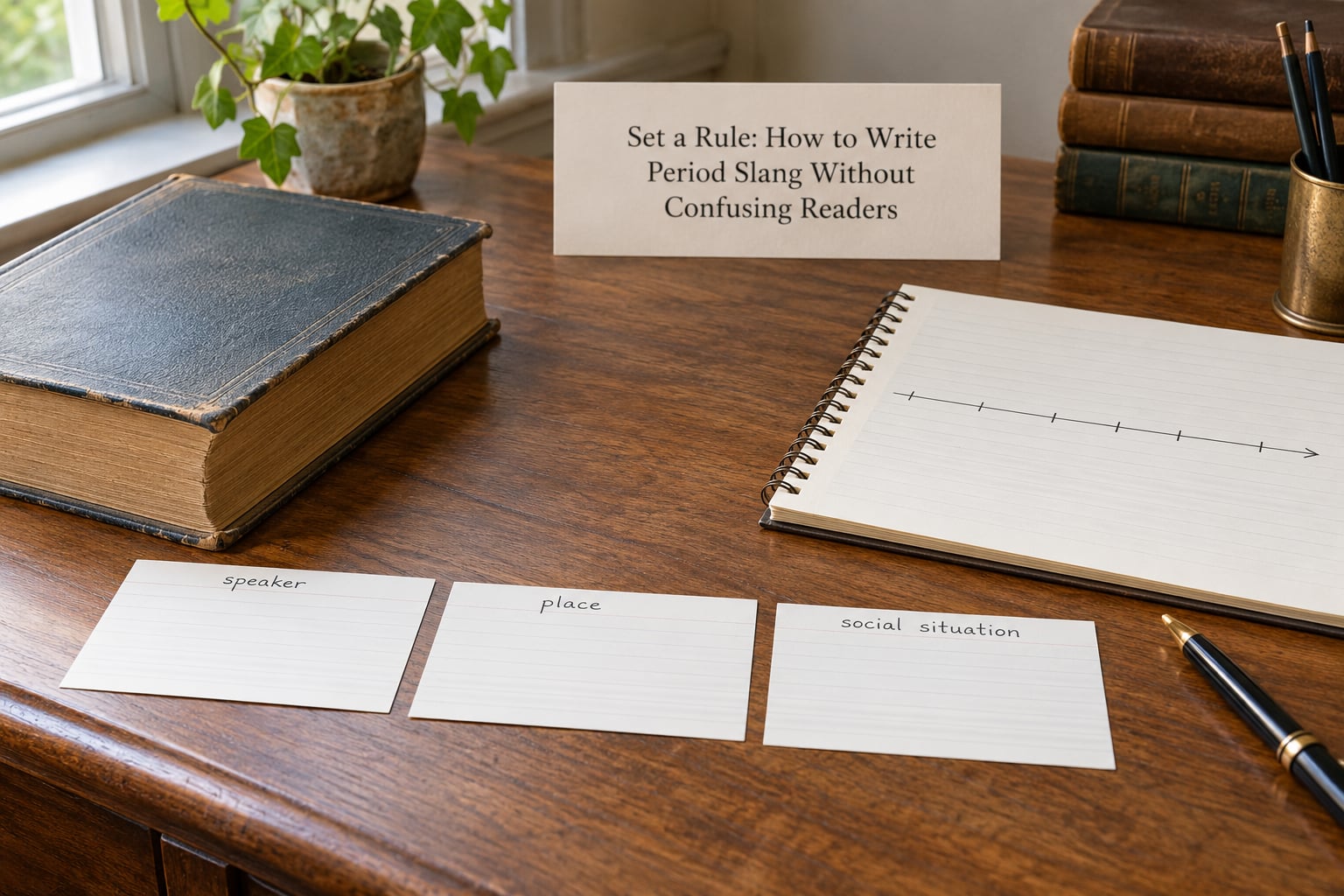
Write your rule before you write a single line of dialogue. Here is mine: a reader should be able to tell who is speaking, why the word suits that person in that year, and what the exchange accomplishes, without needing a glossary or a second read.
That rule does useful work because it kills two failures at once. It stops you from reaching for a term that has nothing to do with the character, and it stops you from keeping a term that works but leaves the reader stuck.
Test any candidate word against three questions. Would this person say it, in this year, in this place? What does it reveal that plain words would hide? Can the reader follow the scene without it? If the answer to the third question is no, the term either needs context or needs to leave.
2. Establish the Speaker, Place, and Social Situation
Before you pick terms, pin down who is talking to whom and under what pressure. The social situation changes the register faster than the calendar does. Two people who use the same slang in a bar will not use it during a funeral, an interrogation, or a meeting with a district attorney.
Build a short profile per character and keep it in the style sheet: age bracket, occupation, class position, education level, where they grew up, how much they respect the person in front of them. Rank and respect matter as much as age. A veteran cop may drop every rank marker when talking to a childhood friend and speak like a textbook when the same friend puts on a uniform.
Then write one line describing the pressure in the room. Two people who have not seen each other in nine years. A suspect who has already decided what he is not going to say. A landlady reminding a tenant that rent is due on Thursday. Pressure is what decides whether the vocabulary is careful, clipped, or careless.
A quick check: if you swapped your viewpoint character’s name for a different character’s and the line still worked unchanged, the line does not have a speaker yet. Period voice lives in that specificity.
3. Build a Small, Source-Based Slang List
Collect ten to fifteen terms for a chapter, not forty. Small lists survive revision. Large lists become a glossary you have to defend, and most of what they contain will be cut anyway.
For each term, record four things: the term itself, the source where you found it, the year and place, and the kind of person who used it. A term that shows up in a memoir written decades later counts for less than the same term in a contemporary newspaper piece, because memoirists reach for words they have since picked up from television.
Watch for three sourcing traps. Films and television sets borrow language from earlier eras and give it a permanent sheen it never had. Novels are the same: dialogue written in one period often borrows from another. And an etymology does not date a word’s popularity, since plenty of terms are old words that only became common later.
One filter that saves time: if you cannot name a primary source, treat the term as flavour and use it lightly, or leave it out. Research that produces four or five solid terms per chapter is research that will hold up to a reader who knows the period.
4. Choose Slang That Performs a Job
Period slang earns its place by doing a job in the scene. There are five jobs worth keeping. It can reveal personality, establish relationship, carry subtext, mark conflict, or create atmosphere. A term that does none of these is decoration, and decoration is where drafts get heavy.
Relationship is the one writers underuse. A word a character never uses with a stranger but uses constantly with an old friend tells the reader about years of shared history in three syllables. That is more efficient than a paragraph of backstory about how they met.
Subtext works the same way. A character who would not say a thing outright can say it sideways in a word that also happens to be period-correct. Conflict runs on vocabulary too: two people using the same term for different things in the same room will hear each other as evasive, and that friction is free plot.
Atmosphere is the weakest job of the five, because atmosphere alone rarely survives a second read. If the only thing a term does is decorate, cut it and keep the sentence.
5. Supply Context Without Interrupting the Scene
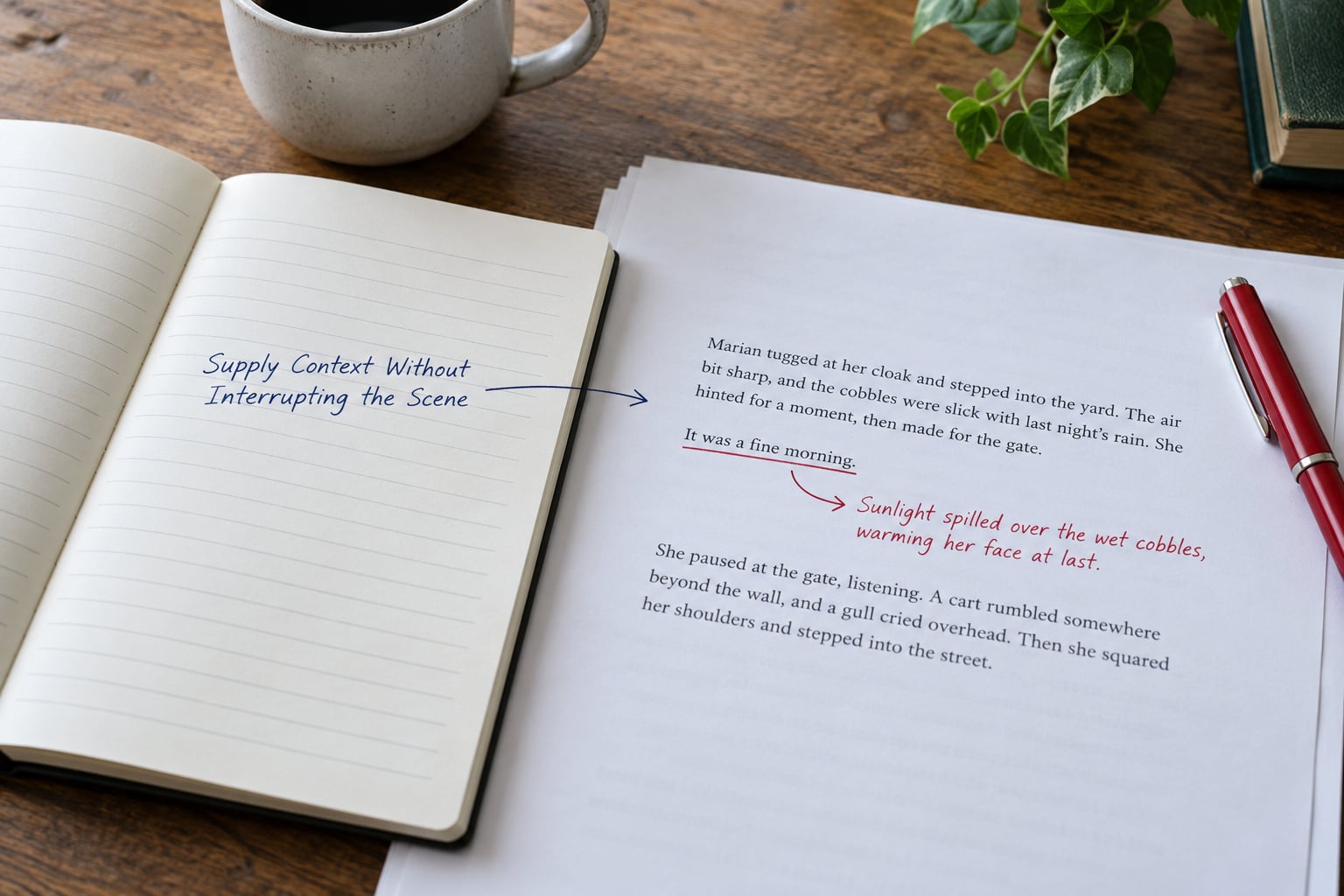
Most reader confusion is not about a hard word. It is about a hard word arriving with no pressure around it. Context is what carries meaning, and there are six ways to deliver it without stopping the action.
Action. Someone reacts physically. If the word lands wrong, the room shows it: a cup set down too hard, a chair pushed back, a hand going to a pocket.
Reaction from another character. A second voice paraphrases what the first one meant, usually flatterly and usually with an edge. “You mean you want it now, before the rain,” works because the paraphrase is a demand.
Repetition. If a character uses an odd phrase twice, the second use carries the sense. Nobody announces a definition; the reader catches up by hearing the pattern.
Indirect explanation. Show the term’s effect rather than its definition. Someone who says a crude word while a woman in the room goes very still has told you the word and its weight in one beat.
Viewpoint interpretation. Let the narrator translate silently. If your viewpoint character is educated and watchful, a line like “That is not a word you use in company” does the work of a footnote.
The listener asking. The oldest and most honest anchor: someone who does not know the word says so. The scene gains friction rather than losing it, and the meaning arrives as dialogue instead of narration. Use it sparingly so it stays a choice instead of a tic.
Here is the same beat written three ways. Before: “He told me he would fix the situation, which in his mouth was not a promise.” After, anchored by action: “He said he would straighten it out. The man said a lot of things in that tone, and none of them had ever once been true.” After, anchored by a listener: “He said he would straighten it out.” “Straighten it out,” she said, flat. “Is that what we’re calling it this week?”
Each version keeps the period voice and drops the explanation. The second one also gives the reader a character worth following.
6. Test for Voice, Meaning, and Readability
Testing a scene is quick and mostly mechanical. Five passes catch nearly everything.
Silent first reading. Read the scene in one go without stopping. Anywhere you slowed down, re-read, or reached for a dictionary is a place to add context or cut the term.
Aloud reading. Say the lines out loud. Audiobooks exist, and any line you stumble over aloud will be stumbled over by a narrator too. Period slang that depends on a single hard consonant is fragile in exactly this way.
Paraphrase check. Retell the scene in plain modern language. If you cannot do it without losing the plot, the slang is carrying information it should not be carrying.
Viewpoint consistency check. Ask of every line: would this viewpoint character actually say this, to this person, today in the story? Second-person narration is where historical voice usually leaks, because it borrows the author’s register rather than the character’s.
Reader test. Give the chapter to two or three readers who did not write it and ask one question: were there words you did not understand, and did it stop you? Note where they paused and why. Do not ask whether they liked it, since that answer tells you nothing about comprehension.
Then leave the worst offenders alone for a day. Confusion that survives a night of sleep is usually built into the plot rather than the vocabulary, and no amount of synonyms will fix it.
7. Revise for Rhythm and Restraint
Final pass is about pressure, not accuracy. Count your period terms per scene and take out the extras. If a chapter has seven, you almost certainly keep two and lose five.
Read the dialogue aloud and listen for clustering. Two period terms in one speech usually land as a performance. Space them across the scene and let ordinary sentences carry the middle, so the distinctive ones have room to register.
Then protect your intentional ambiguity. Not everything needs to be understood on first read. A threat that a reader half understands is more dangerous than one they parse completely, and cutting the last explanation often sharpens the scene.
Watch the narrator too. When explanations start stacking in the prose, the reader can hear the author apologizing. Move that material into dialogue or cut it, and let the viewpoint character carry the commentary in their own voice.
Update the style sheet as you revise, removing anything that did not survive. A style sheet that only holds what is still in the manuscript is a tool. One that lists abandoned terms is clutter.
Common Mistakes
The glossary dump. Opening a chapter with a character reciting unfamiliar words while nobody else reacts. The reader’s first impression is not your world, it is your homework. Fix: distribute terms across the chapter, one per scene at most, and give each one a job.
Modern words projected backward. Contemporary slang, modern idioms, and current brand references dropped into older settings are the anachronism readers notice fastest, because modern usage is the one era every reader knows best. Fix: run a search for contemporary-sounding words and check each against your source list. Words for emotions are usually fine; words for technology, music, and small talk rarely are.
Every character speaking the same way. When five people use the same period vocabulary, the voice belongs to the author rather than to anyone in the room. Fix: cut your cast down to two or three distinct registers and give each a profile in the style sheet.
Over-explaining. Narrators who translate every term create a story about language instead of a story with language in it. Fix: trust one anchor per term and let the rest breathe.
Inconsistent dialect. A character who sounds one way in chapter two and another in chapter twenty will read as an error rather than a development. Fix: keep the style sheet current and check it against the manuscript whenever you return to a chapter after a gap.
Accumulating specialised terms. Professional, nautical, military, and trade jargon can be wonderful, but readers do not parse it as flavour when it arrives in volume. Fix: introduce one term of this kind per scene, and choose terms whose meaning is obvious from the sentence around them.
Treating offensive period language as flavour. Slurs and degrading period terms are not seasoning. Using them without comment reads as endorsement, and readers have been burned by it before. Fix: decide whether the word is required by the viewpoint character’s experience. If it is, let the scene answer for itself through other characters and consequences rather than through narrator approval. Note it in your content warnings, and be honest with yourself about why you are including it.
Four quick revision habits do more than any single rule. Read every dialogue exchange aloud before you move on. Put every unfamiliar word on one page and check it against your sources. Ask a reader to paraphrase a random paragraph back to you. And when a line feels clever rather than true, trust the version that sounds like the character would actually say it while frightened.
Frequently Asked Questions
How much period slang should I use in historical crime fiction?
Enough to mark the period and the speaker, which is usually one clear term per scene. Period work is mostly carried by syntax and rhythm rather than vocabulary, so a chapter with two well-placed period expressions will feel more convincing than a chapter with seven clustered ones. Collect a larger list in research than you use on the page, and cut during revision.
How do I show the meaning of unfamiliar slang without stopping the action?
Anchor the word in the scene rather than the narration. Use physical reaction, another character paraphrasing it flatly, repetition of the phrase, or a listener who admits not knowing it. Indirect explanation works too: show what the word does to the room instead of defining it. Each of these delivers meaning inside the fiction, so the scene keeps moving.
Should I make every character speak with different slang?
No. Most readers register two or three distinct registers in a scene and read the rest as noise. Give your viewpoint character a full profile, one or two supporting characters contrasting profiles, and let everyone else fall into a plain but period-appropriate baseline. What matters is that each speaker has a traceable reason for their vocabulary in that room.
Is it okay for modern readers not to understand every period expression?
Yes, and expecting total comprehension is a mistake. A few opaque lines create atmosphere and let readers feel the distance of the era. The rule is that understanding of the plot must never depend on decoding a single word. If a reader misses a term and still knows who wants what, you have done the job correctly.
How can I verify that a slang term is accurate for the time and place?
Find the term in a primary source written during the period: letters, diaries, newspapers, court transcripts, or police reports. Record the year, the region, and the social profile of the person using it, then log it in your style sheet. Later dictionaries help you date a word, but a memoir written decades afterward can borrow vocabulary the writer picked up from film.
When does historical slang make dialogue feel unrealistic rather than authentic?
It feels false when it arrives in clusters, when every character uses the same register, or when a modern reader has no anchor for a word that matters. It also feels false when a term’s only purpose is decoration. Authentic period language sounds like a person speaking in a specific place under specific pressure, so ask whether your sentence would survive a swap of character names.
Conclusion: Start With Reader Clarity
Open your draft at one exchange that matters, not the whole chapter. Identify who is speaking, to whom, and under what pressure, then test three or four sourced terms against the rule you set in step one and keep only those that reveal a character or carry the plot.
Readers forgive strange words far more readily than they forgive a story that stalls while it explains itself. Get the meaning across through the scene, let syntax do the period work, and the page will read as if it was written by someone who simply belonged to that year.