
To write a crime story with a child narrator, you build the mystery normally and then run every scene through one child’s eyes: keep only what they can see and hear, strip motive down to observable behaviour, and let their honest misreadings do the misdirection for you. It takes a solid week of planning and a longer draft, mostly because the hard part is discipline rather than inspiration.
The reason writers keep coming back to this technique is the gap it opens. The reader knows what happened. The narrator does not. That knowledge gap turns your reader into the detective, and it lets you plant clues honestly instead of withholding them on purpose.
Table of Contents
- What You Need
- Step-by-Step
- Choose the Child Narrator’s Age and Voice
- Limit What the Narrator Knows
- Build Suspicion Through Concrete Observations
- Keep the Crime and Stakes Clear
- Write a Voice That Is Age-Authentic
- Reveal the Truth in Controlled Beats
- Revise for Perspective, Pace, and Fairness
- Common Mistakes
- Frequently Asked Questions
- How do I make a child narrator’s voice sound believable?
- What age should I choose for a child narrator in a crime story?
- Can a child narrator be the protagonist of a noir or mystery story?
- How much violence is appropriate when the narrator is a child?
- How do I create suspense when the child does not understand everything?
- Should a child narrator know the solution before the story begins?
- Conclusion
What You Need
Before you draft a line, seven things need to be settled. Skipping any one of them is where most drafts go wrong, and it is almost always the age.
- The narrator’s exact age. Not “a child”. A number. Ten is a completely different narrator from seven.
- The crime in one plain sentence. “A man was killed in a hotel room in March.” If you cannot say it plainly, the plot is not ready.
- The narrator’s stake. Who do they lose if this stays buried? A sibling, a parent, a friend, their own safety.
- The central question. What single unknown drives the reader past the last chapter.
- Your reason for using a child. Witness, perpetrator’s child, only survivor, unreliable witness, memoir frame. Each one produces a different book.
- A clue ledger. A running list of every detail you plant, where it appears, and what it actually means.
- A research plan. The age band you need to observe, plus a note on how you will handle real cases if you borrow one.
If you want the shorter version, this is the whole method: choose the narrator’s age, cap their knowledge, build the clue chain, then draft each scene as an observation rather than an explanation.
Step-by-Step
Choose the Child Narrator’s Age and Voice
Age decides vocabulary, sentence rhythm, memory, and how much of the event the narrator can hold in mind at once. A seven-year-old narrates in fragments about the present moment. A sixteen-year-old can hold motive, sequence and suspicion in the same sentence.
Pick the youngest age that can carry the plot you need. If your mystery requires an investigator who can theorise, test it with a fourteen-year-old first and see whether it survives. Usually it does not, and the story gets better for the constraint.
Give the narrator one sensory obsession. One child fixates on shoes, another on hands, another on who is in the room versus who is missing. This attention filter is the single most useful thing you can build, because it decides what your narrator sees without you having to explain it.
Here is roughly what each band sounds like on the page.
- Ages 4-6. Sentences run four to nine words, with concrete nouns only and no abstractions. Attention sits on one object, one person, right now.
- Ages 7-9. Six to fourteen words, plain everyday vocabulary and simple connectives. They care about rules, fairness and who broke what.
- Ages 10-12. Eight to twenty words, school vocabulary with some idiom but no irony. Causes, alliances and being excluded start to matter.
- Ages 13-15. Twelve to twenty-five words, an adult register with slang and hedging. Identity, status and what adults hides dominate.
Read a page aloud in each band. If you run out of breath, the sentences are too long for that narrator.
Limit What the Narrator Knows
The core discipline is separating four layers: what the child observes, what they suspect, what they misread, and what they actually know. Mixing these is what turns limited narration into vagueness.
Observation is free. Anyone can see a wet coat on a chair at seven in the morning. Suspicion is inference and belongs to a slightly older narrator who has learned that coats mean something. A misreading is where your misdirection lives, and it has to be honest, not stupid.
Give the narrator an inaccurate rule about the world and let them apply it consistently. A child who believes adults never lie about money will read an adult’s evasiveness as a secret rather than a lie, and will protect the wrong person for the whole book. That misread is fair, plantable and devastating.
The test for fairness is simple. Could the reader, reading only what the narrator reported, solve it? If yes, you have built suspense. If they would need one missing fact you decided not to write, you have cheated, and the complaint in your inbox will be about the ending.
Build Suspicion Through Concrete Observations
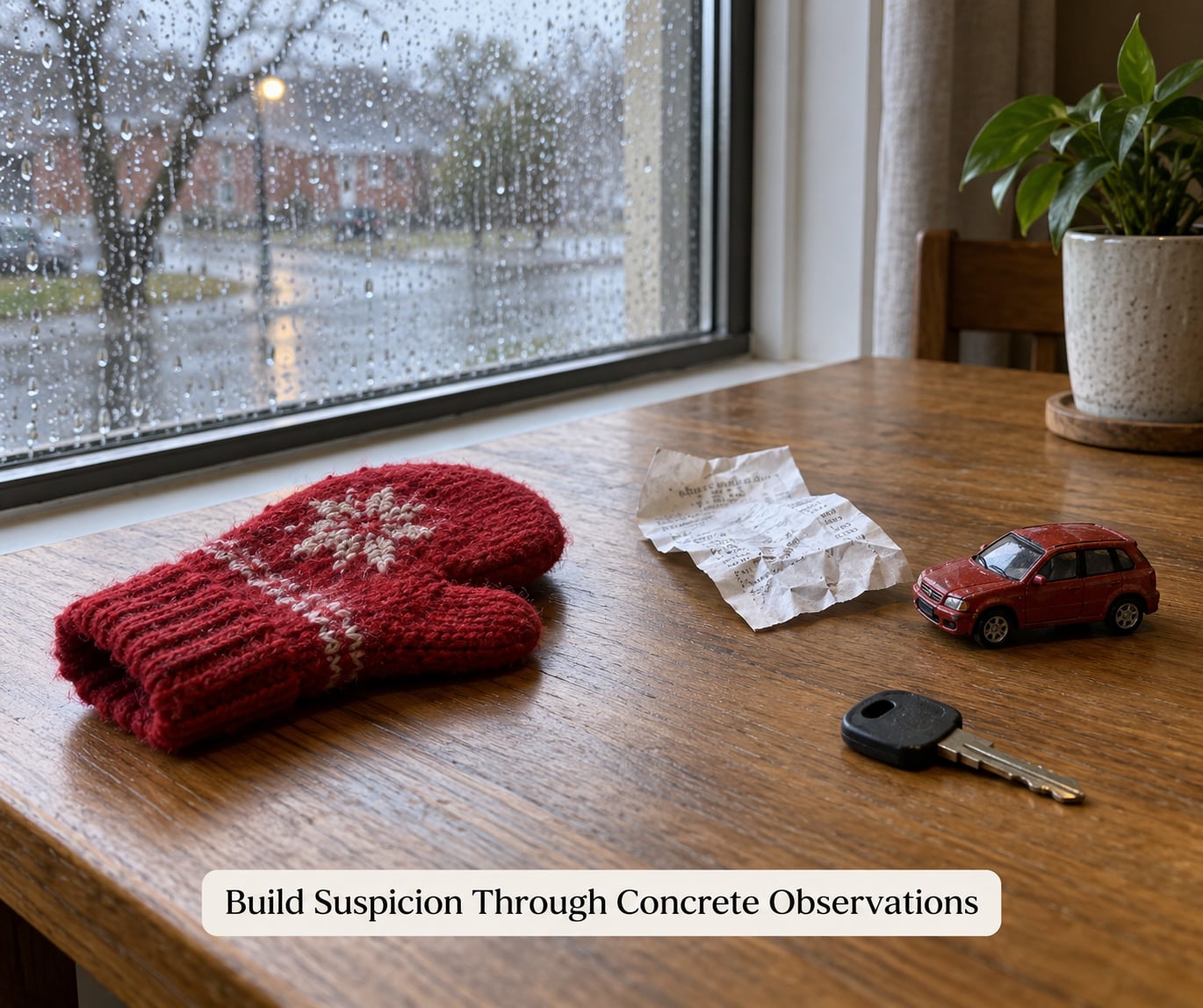
A child narrator notices what adults filter out, because they have not yet learned to filter. Muddy shoes. A missing object from a shelf. An unfamiliar car that stays outside too long. A change in someone’s routine, like a father locking a door he used to leave open.
Convert motive into behaviour and the clue chain builds itself. Instead of “she was lying about her whereabouts”, write “she said she was at the library and her coat smelled like the car park”. The reader does the work. That is the whole game.
Do not make the child unnaturally perceptive. If a seven-year-old names a clue correctly in adult language, the device collapses. Instead, let them record it wrong: they remember the library, they remember the coat, they do not connect the two until much later, or ever.
Keep your ledger honest while you draft. Every ten pages, ask what the narrator has actually reported versus what they have merely felt. Feeling is not evidence.
Keep the Crime and Stakes Clear
Define the crime, the danger and the personal stakes in the first few pages, then adapt the intensity to what the narrator can process. Readers need to know they are in a crime story, and they need to know what the narrator stands to lose.
You can make a threat feel immediate without graphic description by working through routines. Who normally picks the child up from school. Who has the spare key. Whether the telephone in the hallway works. Small logistics of safety read as real danger far more efficiently than anything explicit.
Be honest about what the narrator cannot process. A child can describe a body and describe it flatly, then go back to being hungry. That flatness is not coldness, it is limited vocabulary, and it is one of the most powerful things a crime narrator can do.
Write a Voice That Is Age-Authentic
Voice comes from five things: sentence length, what the narrator perceives, what they return to, which sensory channel dominates, and a small set of words they actually use. Vocabulary alone will not do it, and it is the part most writers overwork.
Build a short recurring thought. The narrator keeps coming back to whether a promise was broken, whether someone lied about the weather. Repetition across chapters does more characterisation than any paragraph of description.
Use free indirect discourse carefully. A few sentences that slide from the child’s register into an older, more abstract diction can suggest that the child is picking up language from somewhere else in the room. Too much of it and the voice splits in two.
Avoid three things: baby talk, constant whimsy, and the miniature adult. The last one is the most common failure, an eleven-year-old who reasons like a detective because you needed the clues placed. Write the observations first, then decide who interprets them.
Reveal the Truth in Controlled Beats
Sequence your revelations in layers: discovery, partial truth, false interpretation, and final answer. Each beat should change what the narrator believes, not just what the reader knows.
Let the narrator misread evidence in public so the reader catches it. A child who concludes that the neighbour is the killer because he was in the garden that night is a red herring that also builds character, provided you plant the fact that he is out of town at the relevant hour somewhere the reader will notice.
The final revelation should feel discovered by the narrator, not announced by an adult who walked in and explained. The cleanest version is the child finding one small thing that contradicts the version everyone accepted, and being the only person positioned to notice.
Revise for Perspective, Pace, and Fairness
Print the draft. Revision in a child’s voice is impossible when you have been living inside that register for eleven days.
- Does every important passage reflect only what this narrator could perceive?
- Can a reader solve the mystery from what was reported, with no missing facts?
- Does adult logic intrude anywhere, especially in the last three chapters?
- Are the clues planted before they matter, not at the moment they are needed?
- Does the tension come from withheld information or from the reader doubting what was told?
- Would the narrator still say it this way if no one were listening?
That last question catches most of the voice problems. It also catches sentences you wrote for effect rather than for character.
Common Mistakes

Using the child only as a device is the big one. If the age never changes anything about what the narrator perceives or how they speak, you have added a gimmick and lost a novel. Cut the device and put an adult in that chair, then ask whether the story got better.
The rest have straightforward fixes.
- The narrator is too wise. Move the interpretation to an adult character and keep the observation with the child.
- The adults behave like fools. Adults conceal for ordinary reasons. Give each one a reason the reader can see and the child cannot.
- Limited narration drifts into vagueness. Vague is when you skip the detail. Limited is when you include every detail and let the narrator misinterpret it.
- Information is withheld unfairly. Withholding is an authorial move. A child narrator lets you plant everything honestly, because not knowing is their condition.
- The voice drifts chapter to chapter. Pick a sample passage and reread it before each session so the register stays fixed.
- The ending resolves more than the narrator can hold. An immature narrator can be shown the truth without being able to explain it. Let the last line sit with the feeling rather than the summary.
One practical warning. Novelists who have written in an adult voice for years report that reviewers disengage when a shift to child narration is not signalled early. Tell the reader the narrator’s age on the first page, in the voice itself, and the device becomes an invitation rather than a shock.
If you are borrowing a real case, research it properly and change the details that would identify the family. Write the harm from the inside of a life that was broken, not from outside it.
Frequently Asked Questions
How do I make a child narrator’s voice sound believable?
Fix the sentence length to the narrator’s age band, then build voice from perception rather than vocabulary. Give them one recurring thought, one sensory obsession and a small personal vocabulary they reuse. Read pages aloud, and reject any sentence the character would not actually think. Voice comes from what they notice, not from slang or baby talk.
What age should I choose for a child narrator in a crime story?
Choose the youngest age that can carry the plot you need. Seven works for pure witness perception, ten or eleven adds the ability to hold cause and effect in mind, and fourteen lets you write suspicion and inference. Younger narrators filter detail more sharply and create a wider knowledge gap, but they cannot theorise. Test your plot at the youngest age and raise it only when it fails.
Can a child narrator be the protagonist of a noir or mystery story?
Yes, and the genre suits the device well. Noir depends on a narrator who reports what they see while missing what they should understand, which is exactly what a limited child perspective produces. Give the narrator a want they lack the words for and let the prose stay cold and factual while the reader supplies the dread. The tension comes from the gap between report and reality.
How much violence is appropriate when the narrator is a child?
As much as the plot needs, no more than the voice can carry. Children describe violence plainly and often without registering it fully, so flatness reads as authentic rather than evasive. Build the fear through routines and logistics, such as who holds the spare key or whether the hallway telephone works. Keep graphic detail for adult viewpoints or reported evidence.
How do I create suspense when the child does not understand everything?
Let the reader hold more than the narrator and never explain the difference directly. Plant the contradiction as an observation the narrator records without interpreting, such as a coat that smells of the car park after a claimed trip to the library. Return to it later with the same words and a new meaning. Suspense lives in the gap, not in withheld information.
Should a child narrator know the solution before the story begins?
It depends on the timeline you chose. A child narrating in real time cannot know it, and that constraint is what powers the clues. An adult reconstructing a childhood crime can know fragments and still not understand them, which creates a different kind of tension driven by self-deception. Either works, but decide early, because it changes every chapter.
Conclusion
The method is simple to state and hard to keep. Pick the narrator’s exact age, cap what they know, convert motive into observable behaviour, and let their honest misreadings carry the misdirection. Every clue then gets planted truthfully, because not knowing is the narrator’s condition rather than a trick you are pulling.
Start with one page. Choose a number, give the narrator a single obsession, and write a scene where they describe something they have entirely failed to understand.