Real detectives dislike TV police shows because the shows compress months of paperwork, lab processing and internal review into a forty-minute episode. They hand detectives forensic technology no department budget can buy, and they show police work as clean, rule-breaking heroics instead of slow, documented casework.
That dislike is a complaint about television storytelling, not about policing itself. Detectives are not embarrassed by the job. They are irritated that the version of the job on screen bears so little resemblance to the one they recognise, and that viewers often believe the screen version instead.
For a site that covers crime fiction and noir, the interesting question is not whether television lies. It always does. The question is which lies break the story, and which ones are load-bearing. This piece walks through the procedure errors that working officers name most often, the ethics television short-cuts, the shows that get closer to right, and what fiction writers can steal from the gap.
Updated for 2026.
Table of Contents
- Why Real Detectives Hate TV Police Shows
- How TV police procedures differ from real investigations
- TV scene versus real procedure
- The most common police-procedure mistakes on television
- Contamination and the missing scene log
- Chain of custody treated as optional
- Interrogation scenes that ignore the rules
- Forensic claims that no lab would make
- Solo work where backup is required
- Radio and car procedure
- Why fictional crimes feel easier than real cases
- The ethical shortcuts television police shows rely on
- What real detectives may still enjoy about crime television
- How writers can portray detectives more credibly
- Frequently Asked Questions
- Are the cops on TV police shows real or staged?
- Why do real detectives hate tv police shows?
- What is the CSI effect?
- Which TV police show is the most realistic?
- How long does a real murder investigation take from arrest to trial?
- What is the blue code of silence in policing?
- Conclusion
Why Real Detectives Hate TV Police Shows
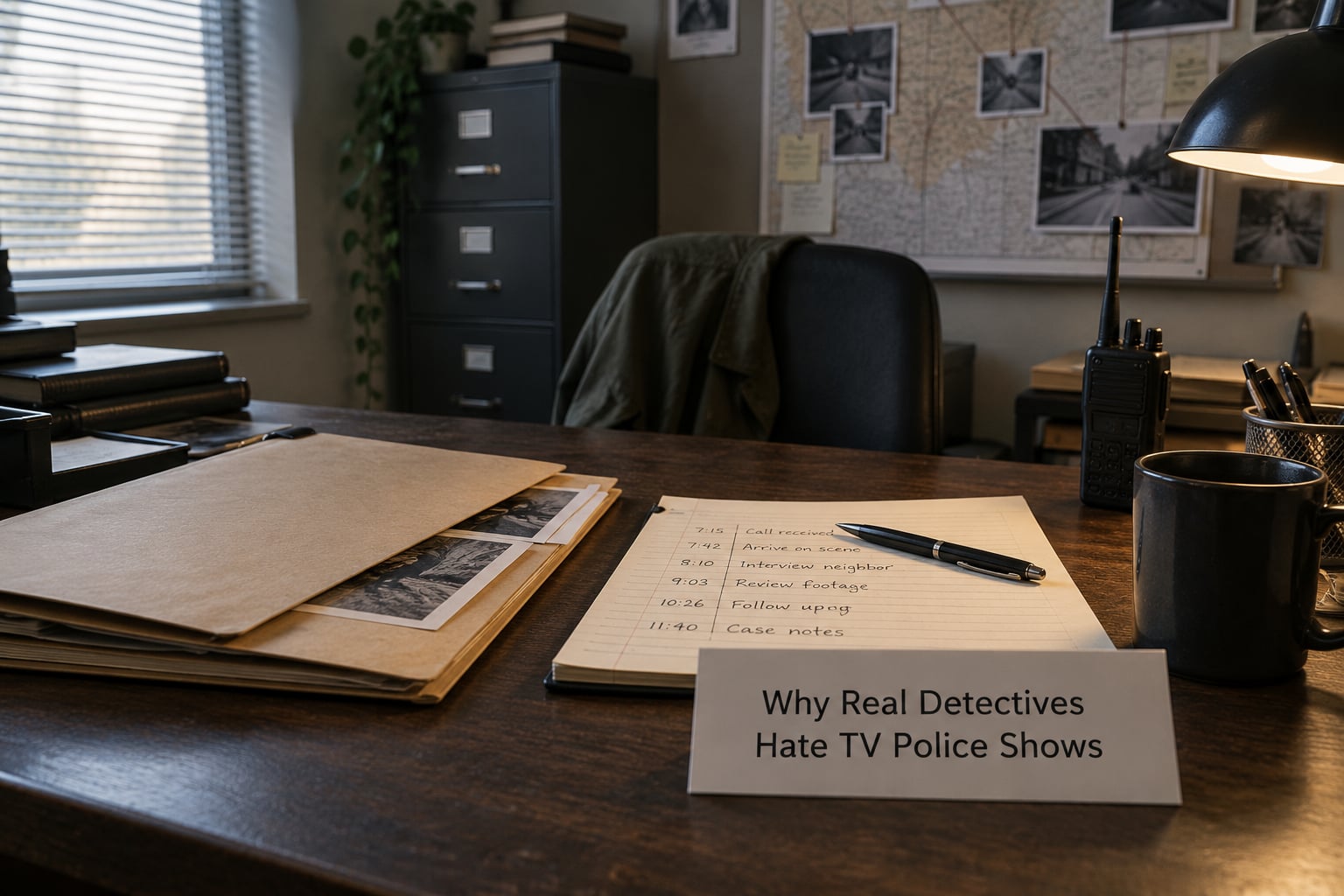
Short answer: because television shows leave out the parts of an investigation that are slow, uncertain and mostly administrative, then replace them with confident leaps of logic delivered by a lead character in twenty-two minutes of actual story time.
The objection is cumulative rather than specific. No single scene makes a detective throw a show across the room. A show that gets the scene secure right, the lab work wrong, the interview ethically wrong, and the paperwork nonexistent becomes a running irritation over a season, and that irritation is what eventually turns into a Reddit thread.
There is a fair objection to the whole genre, and it is worth separating two different complaints. One is that the shows are inaccurate. The other is that the shows portray a version of policing in which officers are uncomplicated heroes and institutions never obstruct them. Conflating the two makes the first argument weaker, because the second is largely a matter of taste and tone.
Accuracy matters most for two audiences. Viewers form expectations about how crimes are actually solved, and those expectations turn up in real courtrooms. Crime-fiction writers studying procedure, of whom there are a lot, need a map of where the real version is genuinely different from the screen version.
How TV police procedures differ from real investigations
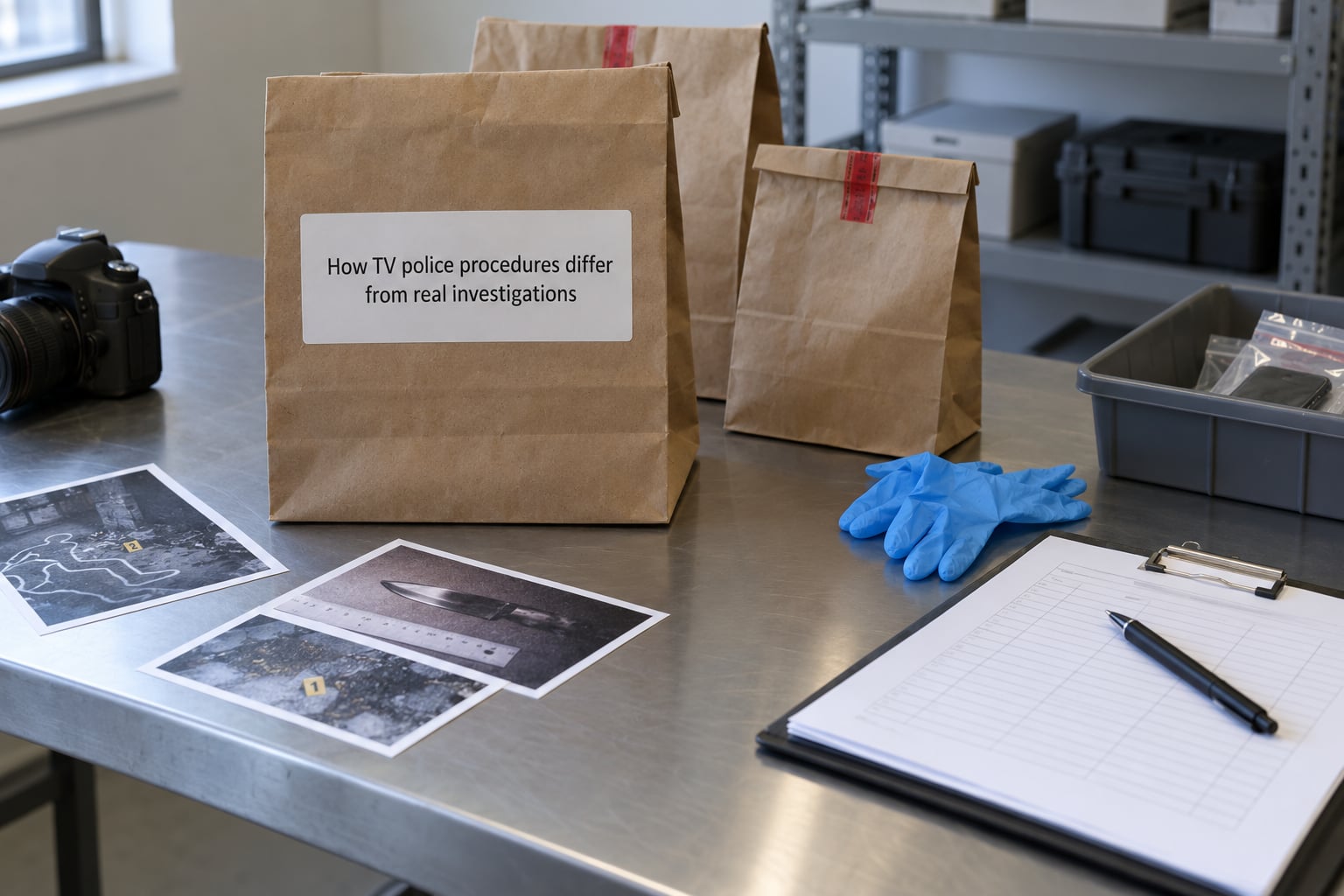
On television, a case has a shape: body, clue, suspect, confession, arrest. In a real investigation the shape is messier and much longer. A homicide detective can spend weeks securing a scene, identifying witnesses, preserving evidence and building a timeline while the case sits in line behind a crowded crime lab queue.
Charlotte-Mecklenburg Police Department homicide sergeant Henry McSwain put the gap plainly when he weighed in on the genre for a recruitment blog: the arrest-to-trial span in his city runs about five years, against roughly forty minutes of screen time including commercials. That is the whole argument in one comparison.
Detective work also runs across agencies. A single case can involve local patrol, a county sheriff’s office, a state bureau, a medical examiner’s office and one or more federal entities, each with its own forms, own case numbering and own definition of done. Television usually gives the case to two people who own it entirely.
TV scene versus real procedure
| Element | What television shows | What actually happens |
|---|---|---|
| Crime scene access | Two detectives wander in and examine everything | Access is limited and logged; entry is recorded because contamination destroys cases |
| Lab turnaround | Result inside the hour, always | Days to months, and detectives serve warrants and find witnesses while they wait |
| Autopsy | Cause and manner delivered on demand | The medical examiner schedules it, and the report arrives on its own timeline |
| Criminal profiling | A specialist walks in and names the killer | Profiling is used rarely and supports other evidence rather than producing it |
| After a shooting | The detective is back on the case by Thursday | Every officer involved is investigated and placed on modified assignment for weeks or months |
| Arrest to conviction | Confession, trial, verdict in one episode | Discovery, pretrial motions, plea bargaining and a court date that moves |
| Sentencing | Delivered immediately and severely | Families routinely hear a sentence far below what they were led to expect |
| Detective pairing | One veteran and one hot-headed rookie | Caseloads, shift patterns and department structure decide who works with whom |
| Suspect interviews | Coerced confession after a speech | Custody is documented, rights are given, and admissions get challenged |
| Serial killer behaviour | Relentless, articulate, confessing at the climax | Most serious violent crime is committed by ordinary people close to the victim |
Read the table as a list of removed scenes. Almost every row is a thing television cuts because it does not advance the plot: a technician bagging a fibre, a warrant taking nine days, a supervisor signing off on a use-of-force report. The removals are what make the remaining forty minutes watchable, and they are also exactly what a working detective spends most of the week doing.
The most common police-procedure mistakes on television
Certain errors repeat so often that practitioners treat them as a running joke. A few of them are small. A few of them would get a real case thrown out.
Contamination and the missing scene log
On screen, a dozen people walk through a crime scene in ordinary clothes and shoes. In practice, entry is controlled, because a single person can contaminate a surface, add a trace to a location or carry something out on a shoe. The Business Insider roundup of law-enforcement commentary put it in blunt terms: access to crime scenes is far more limited in real life than on television, and technicians document who comes in and out.
Chain of custody treated as optional
Television regularly has a character tuck a bagged item into a car boot, hand a jumper to a friend, or leave a weapon in an unlocked drawer, and the case still holds together. The chain of custody is a documented record of who held evidence, when and why. Break it and the defence argues contamination, and juries have been trained to listen.
Interrogation scenes that ignore the rules
Detectives on screen lean in, withhold a card, threaten a charge and get a confession in the room. In a real interview, custody is documented, the suspect is advised of rights, and the interview itself is recorded. McSwain’s account of procedure breaks down in exactly this area, and the effect on a case can be severe enough to matter more than what was said.
Forensic claims that no lab would make
Instant identification of a body from a partial image, a footprint matched in minutes, digital reconstruction assembled over an afternoon, a database hit on the first try. Practitioners named in the same 2019 roundup pushed back on each of these, including the idea that real departments routinely operate the kind of cutting-edge technology that appears on the schedule.
Solo work where backup is required
One detective walks into a warehouse, a trailer park or a suspect’s house alone, and the show treats that as competence. It is a specific procedural break, and officers who have worked the job tend to read it as the show’s clearest signal that the stakes are being invented.
Radio and car procedure
Dispatchers on television relay long descriptions, take a complete suspect description in one breath and dispatch a single unit to a developing situation. Real radio traffic is short, codes and locations get garbled, and calls for backup usually mean more than one unit.
Why fictional crimes feel easier than real cases
Television resets every week. The case opens Monday, the body is found Tuesday, the confession lands Thursday, and by the last commercial everything is filed and emotionally resolved. Real cases do not reset. They sit, they go cold, they get reopened after a tip, and they sometimes end with no answer at all.
Records are incomplete. A witness who seemed certain in March recedes by June, or contradicts a statement given the same afternoon. Surveillance footage that a lead needed turns out not to exist, or existed and has already been overwritten by the time anyone remembers to ask for it.
Jurisdiction splits cases in ways television never bothers with. A death in a home, a suspect who left the state, a body recovered from water and a vehicle registered in another county can land the file on three different desks, each waiting on the others.
McSwain’s version of the same problem is the backlog: evidence waits its turn, so detectives use the wait productively, serving search warrants and tracking down witnesses. In a real case, the delay and the chasing happen at the same time, and the delay is the part that shapes everything else. On television, the chase is the whole story and the delay is simply skipped.
The ethical shortcuts television police shows rely on
Procedural accuracy and ethical accuracy are different problems, and the second one irritates practitioners more. A wiretap described vaguely is a convenience. A hero who enters a home without a warrant, coerces a confession, conceals evidence and faces no internal inquiry is a statement about who is accountable.
Three shortcuts recur. The first is off-the-books heroics: a lone detective breaks rules and is quietly praised for it, so the show has told the audience that the rules are obstacles rather than standards. The second is the moral shortcut, where a suspect is written as an obvious villain in the first scene and the story has no room for an ordinary person who did an unforgivable thing.
The third is institutional. Internal affairs, department policy, district attorney discretion and chain-of-custody discipline either do not exist or bend for the lead character. McSwain’s description of a real officer-involved shooting is the cleanest contrast available: every officer is investigated, and modified assignment can run from weeks to months, which means the person who wanted to keep working the case usually is not working it.
There is a real-world cost to this beyond irritation. Television sets expectations about what evidence a jury should demand, and about what sentence a case should produce. Families who expected a life sentence or the death penalty and watched a defendant sentenced to years have described that moment to CMPD as the most heartbreaking part of the job, and no amount of courtroom drama helps them.
For a wider pattern: a university study reported by Manchester Metropolitan University found that television police dramas can distort the public’s view of how law enforcement actually works. If the portrayal changes what juries expect and what the public believes about the institution, then the accuracy question stops being an in-group complaint about taste.
What real detectives may still enjoy about crime television
The criticism is unfair if it treats every show as the same, and practitioners themselves tend to name the ones that get closer. Regulars in police forums consistently point to The Wire, Bosch and Southland as the closest to reality, with The First 48 singled out because it runs on footage from real investigations rather than a script. Even the ones people defend are conceded to be fiction, and the consultants involved are described as knowing the job and then adding drama to sell the episode.
What the better shows get right is usually emotional rather than procedural. The work is violent and sad, and the paperwork and the sleep loss and the way a case follows a detective home all land on screen. Detectives who come across as harsh or tired are often recognisable in a way that a charming, unbeatable lead is not. A show that shows a detective losing an argument with a district attorney is arguably more accurate than one where every obstacle yields.
Enjoyment also depends on what the viewer expects. Somebody watching for the puzzle will read the same compressed timeline as a convenience. Somebody who has worked cases will read it as a cheat, and there is no single correct way to watch a police procedural.
How writers can portray detectives more credibly
For crime-fiction writers, realism is not the same as accuracy, and the difference is useful. A novel cannot run a real timeline without becoming unreadable. What it can do is show friction, and friction is where credibility lives.
Show the wait. A detective who cannot move for three weeks because a laboratory is backed up is doing realistic work, and the waiting gives a book something television cannot: a character with nothing to do but think.
Let the evidence be imperfect. Fibre that cannot be tied to anyone. Digital footage with no usable face. A witness who is certain about the day and vague about the hour. Incomplete evidence is more useful to a writer than a clean clue, because it forces a decision instead of an answer.
Make the ethics cost something. A warrant that takes nine days, an interview that is technically clean and morally uncomfortable, a shortcut that would work and cannot be taken. The moment a detective does the right thing and it goes badly is usually the most human scene in the book.
Keep the consequences after the case closes. Families, defendants, the detective’s own sleep, the next case already waiting. A resolution that ends at the verdict reads as a television episode, because television ends there too.
One last check, and it is the most useful one: pick a single scene, and ask how many boring tasks the character skipped to get to that moment. Write two of them in. Most detective fiction is too thin not because the mystery is weak but because the protagonist’s job was too easy.
Frequently Asked Questions
Are the cops on TV police shows real or staged?
Scripted police procedurals are staged by actors working from a writers’ room, and the cases are invented. Documentary formats such as The First 48 are the exception: they follow real investigations, using footage captured by the agencies themselves. That distinction is the root of most wrong expectations, because viewers watch staged drama and then assume the pacing, the access and the paperwork are real too.
Why do real detectives hate tv police shows?
Because television shows compress months of paperwork, laboratory processing and internal review into a single episode, hand detectives forensic capability no department can buy, and present police work as clean rule-breaking heroics. Detectives tend to object to the accumulated inaccuracies rather than any one scene, and the objection is about television storytelling rather than about policing itself.
What is the CSI effect?
The CSI effect is the belief, fed by television, that juries expect a laboratory-grade package of physical evidence in every case and distrust testimony when it is missing. Practitioners describe defence arguments built on the absence of expected evidence as its clearest result. The term also covers the public assumption that forensic science is instant, unlimited and conclusive.
Which TV police show is the most realistic?
No police procedural is fully accurate, but officers most often name The Wire, Bosch and Southland as the closest, and The First 48 is singled out for using real investigation footage rather than a script. Even the strongest of these add drama to sell the episode. Judge a show axis by axis instead: forensics, procedure, pacing and psychology each fail differently.
How long does a real murder investigation take from arrest to trial?
In Charlotte, the arrest-to-trial span runs about five years, according to a CMPD homicide sergeant, against roughly forty minutes of screen time including commercials. Investigators also wait weeks or months for laboratory work, using the delay to serve warrants and locate witnesses. A cold case can also sit unresolved for years or be reopened years later by a tip.
What is the blue code of silence in policing?
It is a claimed police culture of protecting fellow officers from internal criticism. Television amplifies it into a whole genre of untouchable heroes, though officers themselves generally describe the code as rare and overstated. What is not overstated on screen is the removal of accountability: internal affairs, department policy and district attorney review bend or disappear for the lead character in most police dramas.
Conclusion
The reason why real detectives hate tv police shows is not that television is lazy. It is that a forty-minute episode cannot hold a five-year case, so the parts of detective work that are slow, documented and uncertain get cut, and what remains is confident, frictionless, consequence-free policing that almost nobody recognises.
If you write crime fiction, the fastest realism check is to pick one scene, count the tasks the character skipped to reach it, and write two of them in. Waiting, incomplete evidence and a decision that costs something will do more for your detective’s credibility than any clever deduction.