First thing out of the way: this article is about the profession. A criminal profiler is a law-enforcement specialist who studies crime scenes, victims and case files to find behavioural patterns and narrow the field of suspects. It is not the character profile worksheet you fill in before drafting. Search engines constantly blur those two, so keep them apart in your own notes.
Working out how to write a profiler character accurately comes down to three things: getting the job description right, writing method instead of mind-reading, and giving the character a flaw that belongs to the profession rather than to a stereotype.
A criminal profiler reviews case material, links crimes that share characteristics, offers investigators a set of likely behaviours and a priority list of suspects, then steps back while the detectives do the policing. That last part is the one television keeps dropping.
Here is the short version of what you get right when the method is right. Your profiler earns trust instead of demanding it, their scenes hold up under an informed reader, and the case advances because of what they noticed, not because the plot needed it to move.
- The character consults a team rather than outranking it.
- Every conclusion arrives with the evidence underneath it visible.
- The profiler is wrong once, and the wrongness costs something.
- Terminology stays accurate without turning into a lecture.
- The job takes a personal toll that shows up in the body and the habits.
Table of Contents
- What You Need — Research, Sources, and Boundaries
- How to Write a Profiler Character Accurately — The Working Method
- 1. Choose a specific profiling role and setting
- 2. Build the profiler around a narrow, plausible specialty
- 3. Research the case and the profession before the scene
- 4. Make observation and inference do different jobs
- 5. Write interviews that reveal method and character
- 6. Put the profiler inside a working investigative team
- 7. Give the character a credible blind spot and cost
- 8. Separate evidence from dramatic convenience
- Common Mistakes — and the Fix for Each
- Frequently Asked Questions
- What research should I do before writing a profiler character?
- Can a profiler identify a criminal from the evidence alone?
- How much profiling terminology should appear in dialogue?
- How do I write a profiler without making them seem unrealistic?
- What is the difference between a profiler and a forensic psychologist?
- How can I show uncertainty without making the profiler ineffective?
- Start With the Job, Then Write the Person
What You Need — Research, Sources, and Boundaries
Accuracy is bought before it is written. Six weeks of reading will do more for your profiler than a month of describing their eyes.
Agency procedure. Start with how the job is actually organised. The FBI’s violent crime resources sit under the National Center for the Analysis of Violent Crime, and the agency publishes almost nothing about how it selects people, which is exactly why writers get it wrong. Note what that tells you: the pipeline is not a public degree programme you can narrate. Plenty of working profilers come out of state and local departments, and many of them built their career in patrol, homicide or investigations before they ever profiled.
Case material. Published casework is where the method becomes visible. John E. Douglas and Robert Ressler’s Mindhunter shows interviews and inference in sequence; Douglas’s The Anatomy of Motive and his book with Mark Olshaker, Journey into Darkness, show how offender behaviour gets reconstructed from scene evidence. Robert Keppel’s Riverman and Paul Britton’s account of advising on a British case sit further out and earn their place by explaining the limits.
Vocabulary with boundaries attached. Learn the terms that carry technical weight — modus operandi, signature, linkage, victimology, crime scene staging, no-body case — and learn where each one stops. A term you can’t define in your own words is a term that will read as decoration.
Procedure and era. Chain of custody, evidence handling and interview practice all change across decades. Combined DNA indexing only went national in the mid-1990s, and surveillance footage, phone location data and consumer DNA submissions changed what an investigation can even ask. Fix your setting before you fix anything else.
A human source. The most useful hour a writer can spend is listening to police scanner traffic for a department that has calls your character would attend. The second most useful is a conversation with someone in the field, bought with coffee and a promise not to quote them.
Ethical boundaries, decided early. True-crime material, real named victims and real open cases all carry weight. Keep identifiable living victims out of invented plot mechanics, do not attach a fictional diagnosis to a real person, and check whether a case you want to borrow is still under investigation in your setting. Deciding this before you draft keeps you from having to unpick it later.
How to Write a Profiler Character Accurately — The Working Method
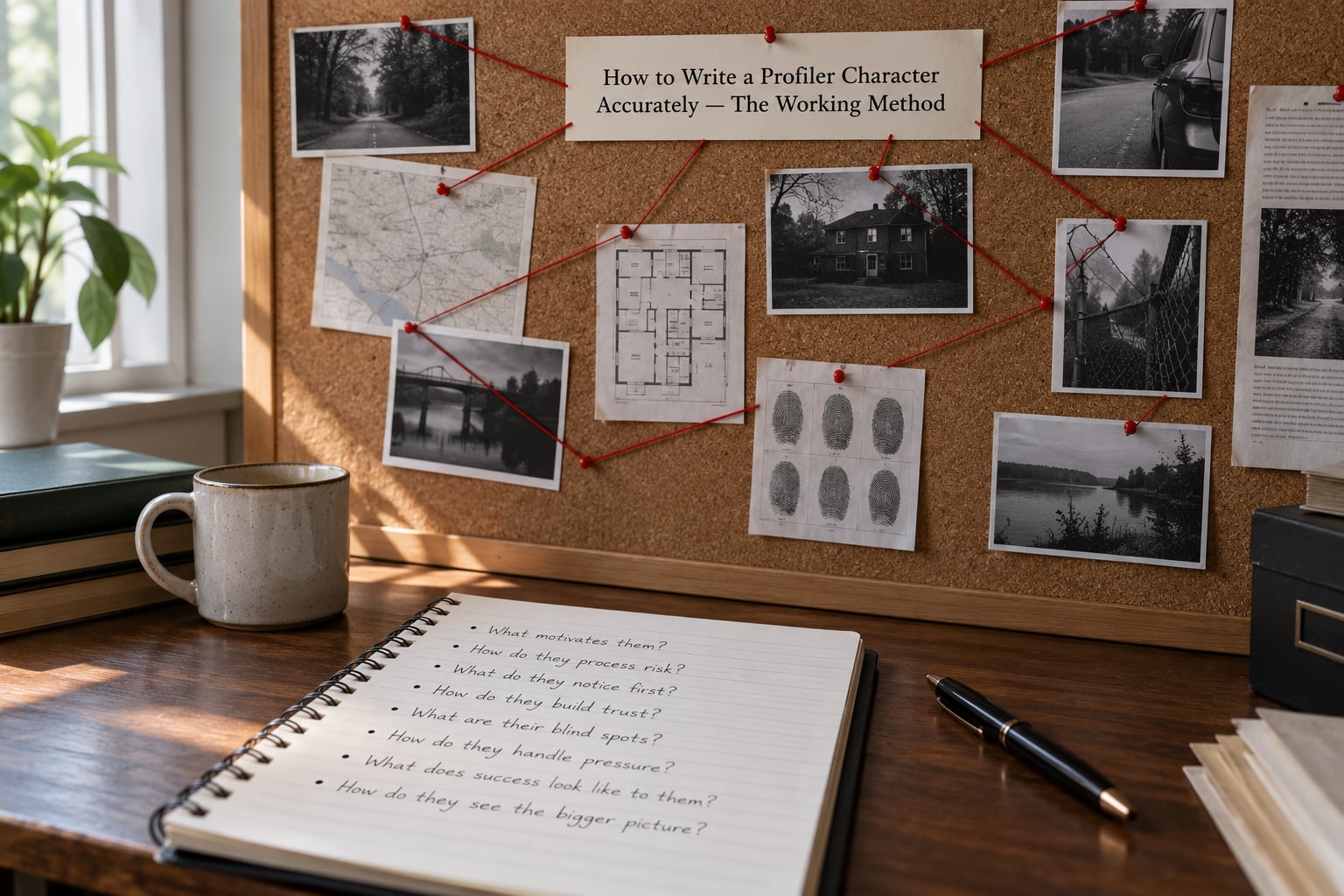
Eight steps, in the order they actually happen: role, specialty, research, observation, interview, team, flaw, evidence.
1. Choose a specific profiling role and setting
Decide what the character is before deciding who they are. The titles overlap in popular use and separate sharply in real life, and picking wrong is the most common reason a profiler feels borrowed from another genre.
| Title | What the job actually is | Typical employer | Where writers go wrong |
|---|---|---|---|
| Criminal profiler | Behavioural analysis of crime scenes and case files, briefing investigators on likely offender characteristics | Law enforcement, often state or local; some federal | Treated as a detective with a psychology degree, and often made the lead |
| Forensic psychologist | Applies psychological research inside legal settings — competency, sanity, testimony, treatment | Courts, hospitals, prisons, agencies | Confused with profiling, which is a different job with a different evidence base |
| Criminal psychologist | Research and treatment of offenders, inside or alongside a prison system | Universities, correctional services | Given police authority they would not hold |
| Criminologist | Academic study of crime, crime patterns and its causes | Universities, research institutes | Used as a synonym for every crime-related specialist |
| Detective | Investigates cases, gathers evidence, interviews, builds the admissible case | Police | Given a psychology specialty that isn’t their role |
| Television shorthand | A composite that mixes all of the above into one person who solves everything | Fiction | Absorbed as fact because it is the only version most readers saw |
Then set jurisdiction, era and authority. A county-level adviser with a caseload of three has a smaller world than a federal consultant, and that smaller world is often more interesting to write.
2. Build the profiler around a narrow, plausible specialty
A generalist reads as vague. Give the character one recurring problem they are brought in for: unidentified remains, staged residential burglaries, extortion letters, arson in connected cases, repeat violent offending. Specialty creates scenes. If the profile only ever appears when a body is present and beautiful, the specialty has not been used yet.
It also gives them a method with limits. Unidentified-remains work leans on reconstruction and historical records; extortion work leans almost entirely on language. A character who understands one of those deeply and knows the edge of their competence is far more convincing than one who is good at everything.
3. Research the case and the profession before the scene
Run a short checklist before drafting: agency terminology your jurisdiction actually uses, a chronology of the case down to dates and times, how evidence is handled and logged, how interviews are structured, which behavioural concepts you are actually naming, and which of those are documented method versus dramatic convention.
That last check is the one that earns trust. Profiling has a contested research record, and pretending otherwise is how a paragraph of jargon reads as fraud. A profiler who says “this pattern fits, and it also fits two other things we have not ruled out” is more credible than one delivering a verdict.
4. Make observation and inference do different jobs
This is the core of writing a profiler character accurately: the character collects what is there, then proposes what it might mean, and never blurs the two.
Observation is concrete. A shoe print on a windowsill that nobody logged. A curtain pulled rather than drawn. Three victims in a coastal town, all with the same type of car in the drive. Inference is the tentative reading of that, offered with a confidence level and at least one competing explanation.
Write the two in different registers. Observation belongs in flat sentences. Inference belongs in hedged ones — suggests, consistent with, we would expect to see. The moment the character’s speculation is phrased the same way as their observation, the character stops being a professional and becomes a narrator with access to the answer.
5. Write interviews that reveal method and character
An interview scene should show the profiler working and cost them something at the same time. Build the questions around sequence rather than accusation, allow for long pauses and wrong answers, and let the witness talk past the point the profiler wanted.
Then notice the non-verbal material and put it somewhere the character has to justify using it. A witness who describes an event in a flat order, who returns to a detail nobody asked about, who cannot keep a hand still — that is material a trained profiler would note and a supervisor might later throw out as suggestive and unreliable.
The same scenes carry the interior life. A profiler who softens the question is hiding impatience. One who pushes after a long pause is over-identifying. Whatever they never say aloud is doing the characterisation.
6. Put the profiler inside a working investigative team
Collaboration is the section most drafts skip. The forensic specialist who disagrees about the scene, the detective whose case the profiler is consulting, the supervisor who wants the report in an hour, the patrol officer who knew the victim, the detective who resents being advised.
| What television shows | What actually happens |
|---|---|
| The profiler leads the investigation | Profilers usually advise; detectives own the case and the arrest |
| Profiling identifies the killer | It narrows a list and sets priorities, then investigators test it |
| The profiler makes the arrest | Rarely. Authority follows the agency, not the insight |
| The profiler is always right | Profiles get reverted, revised and quietly dropped |
| A profile is proof | A profile is a hypothesis with a confidence range attached |
Use the friction. Competing interpretations between two specialists, a supervisor who trims a report for political reasons, and a team that has already decided who they are looking for are all real pressures, and all of them raise stakes without a single gunshot.
7. Give the character a credible blind spot and cost
The flaw has to affect judgement, not just wardrobe. Overconfidence in behavioural patterns is good. Difficulty trusting witnesses is good. A previous case that made them slow down in front of a family is good.
Caseload work produces its own physical record: interrupted sleep, meals eaten at a desk, a flat affect around violent material, and the loneliness of people who cannot discuss what they saw. Write those as habit rather than as symptom, and let the character not notice them.
Over-identification with an offender is the most useful version of this flaw and the least used. When the character starts modelling themselves on the subject in order to predict the next move, the method is compromised in a way a reader can follow, and the eventual correction costs something.
8. Separate evidence from dramatic convenience
Test every conclusion the profiler delivers. Which item of evidence supports it, who else would have had access, and what would have to be true for the conclusion to be wrong?
Then let it be wrong in a way that changes the case. A profile that sends officers to the wrong house costs two days of a body decomposition window. A revised profile that rules out the person everyone liked keeps the team from a tunnel. A profile nobody will listen to is the most painful outcome and the most useful one to write.
One rule keeps most plots honest: science narrows the field and never supplies motive. Why a person did something is the part no test result can hand you, which is exactly why the character is in the room.
Common Mistakes — and the Fix for Each
Most amateur-feeling profilers fail on the same small number of things.
- Profiling as mind reading. The fix: make every conclusion traceable to a specific detail, and let the character revise when a detail changes. An inference with no visible source reads as narration.
- Vague agency jargon. “We’re running behavioural analysis” means nothing. “We’re comparing the entry wounds against the distance from the door” means everything. Replace labels with operations.
- The profiler solves every case. The fix: hand the resolution to somebody else at least once, ideally the detective who doubted them. A character who only wins never has to change.
- Collaborators erased. The fix: give the forensic, legal and supervisory voices real jobs and real objections. Remove the profiler from the room for one scene and show what goes wrong.
- Jurisdiction ignored. The fix: name the agency level and stick to what that level can authorise, share and hide. A county profiler cannot run a federal database.
- Uncertainty turned into certainty. The fix: keep a competing explanation alive on the page for at least one scene after the profiler forms a view.
- A specialty with no research behind it. The fix: read two real cases in the character’s niche before you write a scene in it, and borrow the vocabulary those cases actually use.
Two extras worth watching. The always-right professional flattens tension instantly, because there is nothing left to threaten. And the profiler as empath who feels the killer’s pain misunderstands the job, which is closer to analysis than to rapport.
Frequently Asked Questions
What research should I do before writing a profiler character?
Read published casework first, so you can see method and inference in sequence rather than as summary. Then check agency material on how the violent crime units are actually organised, and read a case chronology for your setting’s era. Listen to scanner traffic if you can. Above all, know what your character cannot do, because readers forgive a limited profiler far more readily than an all-powerful one.
Can a profiler identify a criminal from the evidence alone?
No. Profiling narrows a field of possibilities and sets priorities for investigators, who then gather more evidence and do the policing. A profile that appears to name one person with certainty has stopped being analysis and started being a plot device. The honest version gives a pattern, a short priority list, and at least one alternative that survives.
How much profiling terminology should appear in dialogue?
Less than you want, and always defined by use. Terms such as modus operandi, signature and linkage earn their place inside a scene where something is happening, because the character applies them to a specific detail. A character who talks in pure jargon reads as a manual. Let plain language carry the conversation and let one precise term land per scene.
How do I write a profiler without making them seem unrealistic?
Anchor them to a real jurisdiction and era, give them one narrow specialty instead of total competence, and make the job cost them something physical and social. Real profilers advise rather than command, produce work that gets overruled, and live with a research base that genuinely argues about its own evidence. Limits are what make a character feel like a person.
What is the difference between a profiler and a forensic psychologist?
A forensic psychologist applies psychological research inside a legal process, assessing competency, sanity or the reliability of testimony. A criminal profiler studies behaviour at the level of the crime itself — how a victim was selected, what was done, what was done differently — to help investigators narrow suspects. Different training, different employer, different question answered. Writers mix them constantly.
How can I show uncertainty without making the profiler ineffective?
Uncertainty is competence, not weakness: a good analyst names what fits, what does not, and what would change the answer. Show the character doing useful work inside their uncertainty — re-ranking suspects, requesting one specific record, splitting a search area — so each scene advances the case even while the profile stays open. Give them one confident call that proves well and one that does not.
Start With the Job, Then Write the Person
If you do one thing before the next draft, pick your profiler’s agency level, specialty and era, and write one scene in which they hand a detective a report that is partly ignored. Accuracy in this genre is not detail volume. It is a character whose method, limits and costs all point at the same person.