If you are working out how to write a forensic scientist character, the job is not to memorise laboratory procedure. It is to pick one specialism, decide exactly what your character can and cannot prove, give them a flaw the work creates, and let the science cost them something on the page.
Do those four things and the rest follows. That last part is where most drafts stall, because writers get the science right, or they get the character right, and the two never meet on the page.
Crime fiction readers are unusually well read on this stuff. They notice when a pathologist chases a suspect, when a gloved suspect somehow leaves perfect prints everywhere, or when a lab result arrives in forty minutes because the plot needed it. Accuracy matters more than completeness, and being confidently wrong is far more damaging than being vague.
Table of Contents
- What You Need to Write a Forensic Scientist Character
- How to Research a Forensic Scientist Character Without a Degree
- Step-by-Step: Build a Believable Forensic Scientist
- 1. Choose a Forensic Specialty That Fits the Story
- 2. Give the Character a Precise Professional Role
- 3. Build Expertise Around a Personal Case
- 4. Create Motivations, Contradictions, and Ethical Limits
- 5. Show the Science Through Decisions and Consequences
- 6. Use Dialogue That Sounds Professional, Not Clinical
- 7. Put the Character Under Pressure
- Common Mistakes and How to Fix Them
- Checklist Before You Draft
- Frequently Asked Questions
- How much scientific accuracy does a crime novelist need?
- What degree should a forensic scientist character have?
- How do I write a forensic scientist without using too much jargon?
- Should a forensic scientist solve the mystery?
- How do I portray evidence collection and chain of custody accurately?
- Can a forensic scientist character have a personal life and emotional flaws?
- Conclusion
What You Need to Write a Forensic Scientist Character
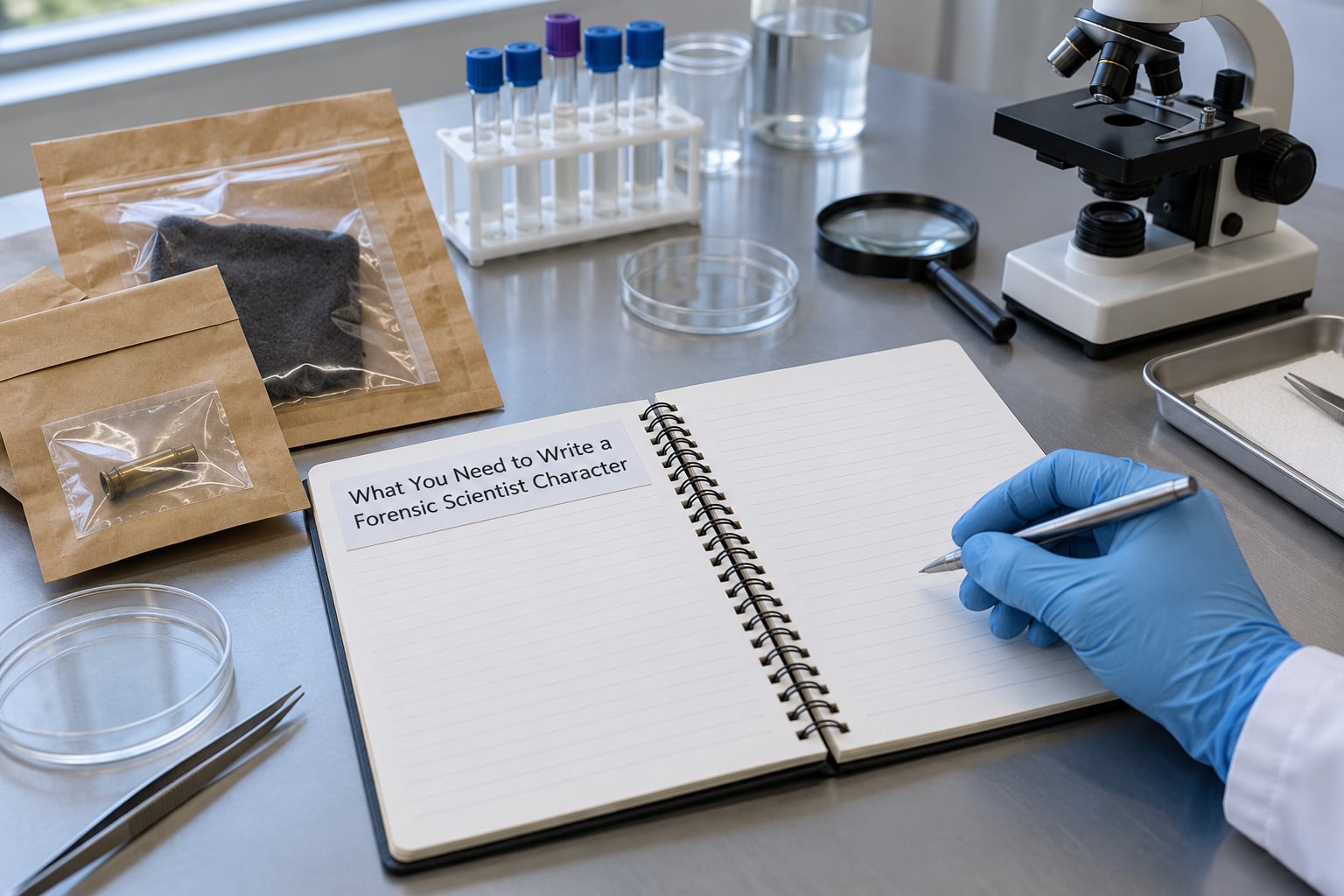
Five things need to exist on paper before you draft a single scene. Without them, a forensic scientist character reads as a mouthpiece wearing a lab coat.
A defined specialty. “Forensic scientist” is a job title, not a job. Crime scene investigation, toxicology, pathology, anthropology, digital forensics and trace evidence are separate careers with separate training and separate limits on what they can conclude.
A jurisdiction. Coroner systems, medical examiner systems and police-run forensic units do not work the same way everywhere. Pick a country and a state or county, then find out who actually employs your character and what the letter of their authority is.
A named case or question. One sentence: a woman is found in a hotel stairwell and the question is whether she fell or was pushed. Every piece of evidence your character touches should either answer that question or exist to complicate it.
A professional conflict. Who disagrees with them, and what does the disagreement cost? A forensic scientist who agrees with everyone on the case has nobody to play against.
A credible procedural source. At least one practitioner-adjacent book, society guideline or expert blog. If you are setting your story in Britain, the local police advice site for writers is genuinely useful; if you are set in the United States, look for how your state runs its medical examiner’s office.
The last one is the one writers skip, and it is the one that fixes the awkwardness in a second draft.
How to Research a Forensic Scientist Character Without a Degree
Research for a forensic scientist character is not the same as research for a police procedural, because the physics and the biology only need to be right in the places your plot touches. A practical workflow runs in five passes.
Start with a practitioner reference that was written to be read, not a journal. Then read one professional guidance document for your specialism so you know what the discipline considers proper handling. After that, watch a crime documentary critically and keep a list of what the programme claimed versus what you now suspect is wrong; that list becomes your myth-busting material for free.
Fourth, find one living professional with a public presence. Forensic scientists who write or blog for other writers exist, and some of them offer short paid consultations to authors, which is a far more efficient use of your money than buying every textbook on the shelf. Elizabeth Spann Craig writes and teaches on using accurate forensic anthropology in fiction; Katie East keeps a blog aimed specifically at writers and takes consultations. One conversation with a working professional will fix more flat scenes than a fortnight of reading.
Fifth, read your own manuscript for the mundane. Practising forensic scientists describe their actual working life as scene response, lab processing, report writing and testimony, in that order, on a standard weekday with overtime when the caseload spikes. Fiction that shows the paperwork and the waiting will feel more true than fiction that shows a genius working through the night, and it costs you nothing.
If your story is set in a historical period, stop and check what existed yet. Fingerprint comparison, DNA profiling and some forms of trace analysis are all relatively recent arrivals, and a Victorian or 1950s setting needs its own research entirely.
Step-by-Step: Build a Believable Forensic Scientist
1. Choose a Forensic Specialty That Fits the Story
Choose the specialty by asking what question your book actually asks, not by asking which one sounds most impressive. A story about a body and a contested time of death wants a forensic pathologist. A story about a warehouse fire and a missing person wants trace evidence and fire investigation. A story about an alibi built on phone data wants digital forensics.
Then draw the line in the sand. State, in a note to yourself, what the character cannot personally establish. An anthropologist estimates biological sex, age range and stature from bone and never profiles a killer. A pathologist performs the post-mortem and does not track a suspect down a canal. A toxicologist identifies and quantifies substances and says nothing about how a body ended up where it was found.
Scoping is what separates a professional from an all-purpose problem solver, and it is the single biggest credibility upgrade available to you.
A forensic scientist applies scientific methods from biology, chemistry, pathology, physics or computing to material recovered from a crime scene or a victim, in a role whose findings may end up being tested in a courtroom. The table below is the short version of what each specialism actually owns, which is the part writers most often get wrong.
| Specialty | What they establish | Best story use | Research needed |
|---|---|---|---|
| Crime scene investigator | Scene condition, trace evidence, photographs, fingerprints and packaging | The witness to the scene; the one who knows what was disturbed before anyone arrived | Scene procedure, contamination rules, how a scene is processed |
| Forensic pathologist or medical examiner | Cause and manner of death, injuries, post-mortem findings | The authority whose report reframes the whole case | What an autopsy can and cannot time, and who legally orders it |
| Forensic toxicologist | Presence and concentration of substances in a sample | The person who turns an assumption into a measurable number | Sample type, detection limits, what a level does not tell you |
| Forensic anthropologist | Age, sex and stature estimates from remains, trauma history, identification | Quiet, unsentimental expertise that lands hard emotionally | Estimation ranges, taphonomy, what bone cannot answer |
| Digital forensic analyst | Recovered data, device history, deleted content | Conflict between legal process and technical reality | Warrants, consent, what encryption genuinely prevents |
| Forensic psychologist or profiler | Behavioural patterns, interview technique, risk assessment | The character who reads people rather than objects | The evidence base for profiling, which is narrower than the public thinks |
One row worth pausing on. Profiling is the weakest-evidenced specialism on that list and the one television presents as magic. If you use it, have your character say so out loud, and let them be wrong once.
2. Give the Character a Precise Professional Role
A role is precise when another character could dispute its conclusions. That means a job title, an employer, a jurisdiction, a certification or training route, a list of routine duties, and a clear place in the investigative chain.
Write it as a one-paragraph description. “Senior crime scene investigator, county sheriff’s office, eleven years in service, processes vehicles and fingerprints, does not run DNA, works a normal shift with overtime spikes, and answers to a field sergeant who has never taken a science class.” That paragraph is enough to make every later scene accurate by default.
The test is simple: if you swapped your character for any other member of the department, would anything in their findings change? If not, the role is too vague to matter.
3. Build Expertise Around a Personal Case
Every forensic scientist in a novel should have one case they cannot put down. It might be a body they could not identify, a conclusion of theirs that turned out to be wrong, a set of remains that sat in storage for two decades, or a case that closed with no arrest.
That case is where the character’s expertise turns from professional into personal. It also earns you the one thing a technical character usually lacks: something to lose.
Be careful with the wound, though. The instinct is to make it a personal loss, a dead relative, a mentor’s disgrace, and it now reads as shorthand. The older case where nobody died but something went wrong anyway is quieter, rarer, and gives you a character who is still functional on page one.
4. Create Motivations, Contradictions, and Ethical Limits
You need four things: a private reason for doing the work, a professional value, a fear or blind spot, and at least one ethical boundary they will not cross. None of these are decoration. Each one has to be able to generate a decision.
The contradiction is what carries the character. Devotion to impartiality plus a hidden need to prove one particular theory is a working engine. So is procedural loyalty that quietly puts the discipline ahead of the victim’s family. So is a character who believes in evidence above everything except one person, and who knows it.
On ethics specifically, the job produces genuine dilemmas that are not about explosives or serial killers. There is the pressure to overstate certainty because a case is going to court and the timeline is thin. There is evidence integrity versus a request from a detective who is a friend. There is the television problem, where real cases get argued using standards lifted from a crime drama, and where the discipline itself has had to publicly explain what it cannot do.
Pick one of those and let it cost them something.
5. Show the Science Through Decisions and Consequences
This is where drafts most often go wrong, and the failure is nearly always the same: the science becomes a lecture. A character explains a technique at length to nobody who asked, and the scene stops moving.
The rule that fixes it is simple. Every answer your scientist delivers should generate four more questions, and the character should act on the discrepancy between what they have and what they need. Show the report, not the machine. A useful result changes an action, changes where the investigation goes, or changes how one person treats another.
Distinguish fact from provisional conclusion out loud, and let the reader hear the difference. “The pattern is consistent with one person” is a different kind of statement from “this is one person,” and a believable character knows which one they are allowed to make.
A good test: cover the science passages and read what remains. If nothing changes, you have written a textbook with characters in it.
6. Use Dialogue That Sounds Professional, Not Clinical
Scientists hedge. They talk in ranges and probabilities, they qualify claims before anyone asks, and they get shorter when they are certain. Reproduce that, and your dialogue will sound like the job without a single glossary.
Watch the audience. With a colleague, the vocabulary stays technical and the shorthand gets loose. With a detective, the same finding arrives translated into plain consequence: not “the deposit profile does not exclude a third party,” but “somebody else was in that room and we don’t know who.” With a jury, the language gets careful and slow, because every word will be re-read to them by twelve strangers who are looking for doubt.
Replace explanation with function. A character who needs a sample asks for it, objects when it is not taken properly, or goes quiet when someone bags a wet paper bag. That reaction tells the reader about the discipline without a paragraph of narration.
7. Put the Character Under Pressure
Pressure is where character becomes plot. Real forensic work is mostly routine, quiet and procedural, so conflict has to come from the situation rather than from constant emergencies.
Useful pressures include a turnaround deadline that outruns the science, an evidence item that degrades while it waits, a workplace reviewing the case file, a victim family who want an answer the evidence cannot yet give, a second investigator whose interpretation conflicts, and the slow pressure to sound more certain than you are in front of a court.
Now force the choice. Speed or accuracy. Neutrality or loyalty to a particular person. Evidence or assumption. Your character’s flaw decides which way they go, and that decision is the scene.
Common Mistakes and How to Fix Them
Most of these are one-line revisions once you can name them. The table pairs each error with the change that fixes it.
| Mistake | Fix |
|---|---|
| Making the scientist know everything | Write the boundary note from step one and test every scene against it. Out-of-scope moments get handed to another character. |
| Unexplained jargon | Let another character misunderstand it. The correction in a line of dialogue does the work a glossary paragraph cannot. |
| Ignoring procedure and chain of custody | Treat one handling mistake as a plot event. It creates conflict and it teaches the reader the rule at the same time. |
| Treating uncertainty as weakness | Flip it. A character who refuses to overstate is the most frightening person in the room. |
| Interchangeable credentials | One job title, one employer, one jurisdiction, one limitation. Details only count if a colleague could contest them. |
| Personality as eccentricity | Replace the quirk with a professional habit and its cost. Tidy workstation versus the third untouched scene of the day. |
| The science lecture | Delete every passage where nobody acts on the information. Report findings in one line and dramatise the reaction. |
| Laboratory results arriving on demand | Price the turnaround time into the plot. Waiting is a plot beat and a character trait at the same time. |
Three habits catch most of the rest. Read the finished scene aloud and listen for the voice of a person rather than a textbook. Ask a practitioner contact to read the two pages that matter most, which they will do for a manuscript excerpt far more readily than for a general question. And check your details against the television version deliberately, because television is where most readers learned this material from and where most of their expectations live.
One caution on that last point. Locard’s exchange principle, the idea that contact transfers material between two surfaces, is genuinely useful to writers because it gives your character a reason to care about a clean floor. Reach for it once, meaningfully, rather than as decoration.
Checklist Before You Draft
Run through these nine lines once your character sheet is finished. Any row you cannot answer is a scene that will go wrong later.
- One named specialty, not a vague title
- Employer, jurisdiction and certification route
- A written list of what the character cannot establish
- One central case question that the evidence serves
- One earlier case that wounded them professionally
- A flaw with a professional origin and a personal symptom
- One ethical line they will not cross
- A distinct way of speaking to colleagues versus outsiders
- A pressure in the plot that forces speed against accuracy
Frequently Asked Questions
How much scientific accuracy does a crime novelist need?
Enough that a knowledgeable reader never catches you being wrong. Crime fiction readers are unusually well read on forensic detail, and they do not forgive procedural errors. You do not need textbook completeness. Accuracy on the things that matter to your plot, combined with honesty about what the character cannot conclude, will carry a whole novel.
What degree should a forensic scientist character have?
Match the qualification to the specialism and the country. Forensic pathology, toxicology and anthropology are graduate specialisms, while crime scene investigation often starts with a science degree or a police academy route. Registration requirements differ widely, so check how your chosen jurisdiction actually certifies the role before naming a degree at all.
How do I write a forensic scientist without using too much jargon?
Let the jargon appear in context and get corrected by another character. Give each technical term one job, and only that job. If a term appears in three consecutive paragraphs without changing anything about the action, cut it. The reader needs to understand what the finding does to the case, not how the test was performed.
Should a forensic scientist solve the mystery?
Usually not, and the reason matters. Your character establishes what the evidence can and cannot support, and someone else decides what to do about it. A forensic scientist who also deduces the murderer and arrests them has taken over a second job. Letting them hand the conclusion to a detective keeps both characters honest and creates friction between them.
How do I portray evidence collection and chain of custody accurately?
Show the small actions that protect a case: who handled the item, when it was sealed and labelled, where it has been stored since. A well-handled item that still proves nothing is as interesting as a badly handled one that solves everything. Getting this right takes a few lines and quietly signals that you did your homework.
Can a forensic scientist character have a personal life and emotional flaws?
Yes, and they need one. The discipline rewards people who can hold their own reaction at arm’s length while working, which is exactly the kind of skill that shows up as emotional cost elsewhere in their life. Give the flaw a professional origin and a personal symptom, and resist the reflex to make their private life a tidy mirror of their work.
Conclusion
The first move in how to write a forensic scientist character is not research. It is definition: one specialty, one employer, one jurisdiction, one case, and one hard limit on what the character is allowed to conclude.
Everything after that is smaller than it feels. Write the flaw the work creates, draft a scene where the science changes an action, and let the character hand a finding to somebody who has to act on it.