
To write a medical thriller, you need one specific unanswered medical question, a protagonist personally exposed to the answer, and a clock running against both. That is the engine. The research, the jargon and the graphic procedure are scaffolding around it, and scaffolding only works if it is holding something up.
Most advice on the genre is a list of clichés to avoid, which is useful for about ten minutes. The harder job is knowing how to write a medical thriller where the medicine is the mystery rather than the wallpaper, and most drafts die because the author found a scary disease before they found a question.
Budget four to six weeks of pre-writing and a draft of roughly 80,000 to 95,000 words for a commercial-length medical thriller novel. The genre punishes rushing, because the readers who love it most are the ones who will spot a wrong instrument name or an impossible procedure on page forty.
Table of Contents
- What You Need Before You Start
- Step-by-Step: How to Write a Medical Thriller
- 1. Find the medical question at the center of your medical thriller
- 2. Build a character-driven medical emergency
- 3. Research the medicine without turning the story into a lecture
- 4. Choose a setting with clear rules and escalating pressure
- 5. Design the mystery, suspense, and ethical conflict
- 6. Outline cause-and-effect scenes and reveal information strategically
- 7. Draft for pressure, then revise for credibility and impact
- Common Mistakes That Break a Medical Thriller
- Frequently Asked Questions
- How much medical knowledge do I need to write a medical thriller?
- Do I need a medical professional to review my medical thriller?
- How do I explain medical procedures without boring readers?
- What makes a medical thriller suspenseful if the outcome is predictable?
- How should I handle medical errors and patient harm in fiction?
- Can a medical thriller include supernatural or speculative elements?
What You Need Before You Start

You need seven things in place before you write a sentence of prose: a single medical question, a character with a stake in the answer, a research file, a setting you can walk through, an ethical fault line, a countdown and someone who works in healthcare to check your work.
- A central medical question. One sentence, not a topic. Why was this diagnosis missed. Who profits from this protocol. What happens when this result reaches the wrong desk.
- A protagonist with a personal stake. Name what they lose if they walk away from it.
- A research file. Start with a general medical reference, public health guidance from your national agency, your country’s clinical guideline body, and a handful of recent review articles on your specific topic.
- A setting you know in detail. Floor plans, shift patterns, who can reach whom in ninety seconds.
- An ethical conflict. Two reasonable people, both with a case, no clean answer.
- A clock. Six hours until the next surgery. Forty-eight hours until the result is published. One shift until the family arrives.
- An accuracy reader. Someone who works in the field, recruited before you draft rather than after.
Notice what is missing from that list: a medical degree. Writers on the Absolute Write forums are blunt about credentials, arguing that academic qualifications do not decide whether a novel works and arguably distract from it. One doctor-author there reported a publisher instructing them not to print MD after their name, the same instruction Michael Crichton reportedly received.
Step-by-Step: How to Write a Medical Thriller
Seven steps, in the order that saves you the most rewriting later. Skipping ahead is how drafts end up with fifty pages of accurate, beautifully written nothing.
1. Find the medical question at the center of your medical thriller
The premise of a medical thriller is one question with consequences attached, and it is a question, not a condition. “A hospital epidemic” is a setting. “Three patients on the same ward share a symptom nobody on the team connected, and one of them is the person running the ward” is a premise.
Generate them from processes rather than from diseases. Bureaucracy produces better stories than pathology does. Ask who signed what, which sample got mislabelled, which result nobody called back about, which protocol exists because of a case that went badly ten years ago.
Check the question against one test before you keep it: can you state it in a single breath? If the answer takes a paragraph, it is a theme rather than a plot. A theme can run underneath the story, but something shorter and blunter has to run the top of it.
One warning. Start with the twist and you will write backward, which means every scene you draft is a scene you have to keep re-justifying. Start with the question and let the twist be the answer you only find in the last third.
2. Build a character-driven medical emergency
A medical thriller needs a protagonist whose access to the truth explains the whole plot, and whose stake in it explains why they cannot simply walk away.
The role you pick decides what the protagonist can see, what they can do about it and how readers will treat them:
- Surgeon. Access to everything, hubris as a default, the promise of mastery.
- Emergency resident or intern. Speed, exhaustion, near-zero institutional power.
- Nurse. The person who notices first and is believed by nobody until the chart is used against them.
- Forensic pathologist or medical examiner. Distance from the living, the body as testimony, a slower burn that rewards patience.
- Epidemiologist. Pattern-spotting and being dismissed as the person who sees ghosts.
- Researcher or biotech lead. A discovery under a deadline, with publication as both motive and threat.
- Lawyer, claims investigator or journalist. The outsider holding the documents everyone else assumes are routine.
Then attach the stake. A parent upstairs in the same ward, a career built on a technique that is now in question, a signature on a form nobody read correctly. The stake should be personal enough that ignoring the mystery would cost the protagonist something real.
The failure mode here is a protagonist who watches. If your character is a witness to other people’s decisions, you have written a narrator, not a thriller. Give them a job in the middle of the machine and a reason to keep turning the crank.
3. Research the medicine without turning the story into a lecture
Work until you can write a full clinical scene without looking anything up. That is the working definition of enough research, and practising clinicians put it the same way when they discuss the genre: readers want medical detail, and detail is plot-critical, but you need convincing, not expertise.
A rule of thumb that has held up well for uncredentialed writers is three concrete details per scene. A named procedure or test, one piece of sensory truth, one clinical constraint that forces a choice. Three is enough to establish a room as real. Ten is a lecture, and a lecture stalls the clock.
Being specific is not the same as being exhaustive. Be specific when the detail does work: the instrument, the drug, the protocol, the sequence of a resuscitation. Stay general when the detail is decoration, because readers who work in healthcare will forgive a vague description of something unimportant and never forgive a precise description of something wrong.
Line-level accuracy comes from people, not from reference books. Most authors get it by recruiting a beta reader who works in healthcare and by asking one question that gets better answers than any other: what do films and television always get wrong? Then ask them to flag plot holes and pacing problems rather than to copy-edit, which is what makes a beta reader useful to you and not a service you have to pay for.
Hold off on hiring a paid consultant until the draft exists. Before that, an hour of research and a friendly reader in the field will answer most of what is blocking you.
4. Choose a setting with clear rules and escalating pressure
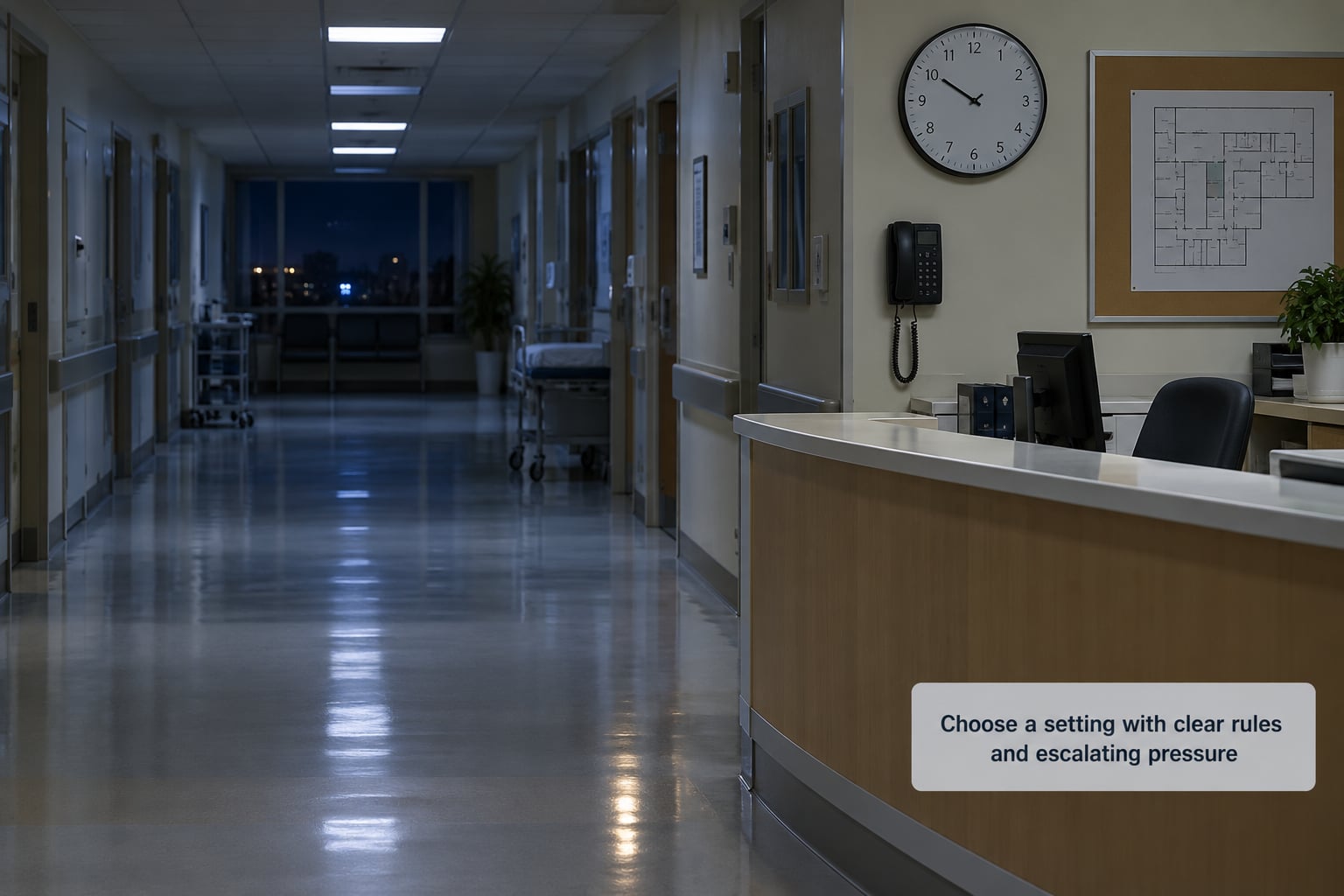
A thriller setting needs three rules your characters cannot break, because rules are what make pressure physical rather than decorative.
Every hospital thriller runs on distance and access. Write the layout down. How long is the walk from the ward to the lab, who needs a badge, which doors lock during a shift, what happens when the lift is out of service and the only route goes through the morgue corridor. Then make someone need to get somewhere they have no business being.
Sensory detail works best when it comes from the work rather than from the genre. Not spooky corridors and flickering lights, but the specific objects of a hospital at the wrong hour: a defibrillator cart squeaking down a corridor, an overhead speaker announcing a code, a hand-sanitiser dispenser empty in the one room where it matters, warm fluorescent light over a desk where someone has been awake for nineteen hours.
Competing priorities are what turn a setting into a countdown. In an emergency department, every decision is a triage decision, and the cost of doing the right thing for your patient is the wrong thing for the one in the next bay. In a laboratory, the pressure is time, chain of custody and a result that only stays valid for a window. Let the place generate the dilemma and you will never have to invent one.
5. Design the mystery, suspense, and ethical conflict
Keep two things separate, because most drafts confuse them. The mystery is the factual question: what happened, and why. The suspense is the reader’s immediate uncertainty about what your protagonist will do next. Readers forgive a predictable mystery far more readily than they forgive a predictable protagonist.
Map who knows what, and when. Every scene either moves information or hides it, and the hiding should have a reason in the world rather than in the author’s head. A lab technician who cannot share a preliminary result is hiding it for a legal reason you can state in half a sentence.
The ethical fault line is where your genre earns its name. Give the protagonist a decision with no clean answer: report the finding and destroy a colleague’s career, withhold it and risk a patient, treat the patient and falsify a record. Whatever they choose, the choice should cost them, and the cost should land on a named person rather than on an abstraction.
On the antagonist, resist the lone crazed doctor. Institutions are more frightening because they are defensible and because their reasons sound like policy. An insurer’s automated review flagging a rehabilitation stay for early discharge, a hospital protecting its complication rate before a survey, a trial sponsor burying an adverse-event log, a supplier whose contamination nobody wants to be the first to declare. Give the antagonist a case you can half agree with, and the confrontation stops being a punch and starts being an argument.
If your villain’s action is something a policy could produce without anyone intending harm, you have built the right kind of threat.
6. Outline cause-and-effect scenes and reveal information strategically
Scenes in a thriller are not atmosphere, they are changes of circumstance. Before drafting, write one card per scene with four entries: who enters, who learns something, what it costs, and what the protagonist’s options are afterwards.
If the options do not change, cut the scene or merge it into the one before. That test is brutal and it is the fastest way to find the slow middle of a draft that feels mysterious but reads as slack.
Plant clues at least twice, and make the first appearance look like noise. A colleague mentioning a supply contract in chapter two, a chart with a missing entry in chapter nine. Red herrings work best when they are true answers to the wrong question, planted by the same characters the reader already distrusts.
Twists should arrive as a rearrangement of facts the reader already has, never as new information from outside the book. If your final explanation needs a detail the reader has not been given, you have written a surprise. If it needs them to look again at what they have been given, you have written a twist.
End chapters on a change of information rather than a noise. A door that should have been locked being open, a result that arrived an hour early, someone who knew a detail they should not have known. The hook is a new question, not a raised volume.
7. Draft for pressure, then revise for credibility and impact
Draft fast and leave yourself a paper trail. When you hit something you cannot verify, type the scene with a note in capitals rather than stopping to research. You can research in revision, and you cannot research your way into a first draft.
Keep a running glossary as you go. It catches invented terminology, and it exposes a subtler problem: jargon register. Nurses, orderlies, surgeons, pathologists and administrators each compress language differently, and giving them all the same vocabulary is one of the fastest ways to make a book feel written by someone who has never been in a hospital.
Clinical dialogue is compressed and interrupt-driven. Nobody delivers a lecture inside a crisis, and nobody explains a procedure to a colleague who already knows it. Compare a line like “I’m going to run a CT of the chest to rule out a pulmonary embolism” with a version where the character says it to a superior who knows exactly what that means, and then shows what the scan reveals. The second version moves the plot.
Revision is four passes, not one. Start with credibility and fix anything a clinician would flag. Then fairness and check that every clue the ending relies on is visible on a re-read. Then pace and cut every scene that exists to explain rather than to change. Finish with the emotional pass, which is the one that decides whether the last page lands.
Two small things that catch people out. Technology dates a novel fast, so check for file formats, interfaces and equipment that have since moved on. And if real people helped, credit them in an author’s note, which costs you nothing and tells the readers who work in healthcare that someone checked.
Common Mistakes That Break a Medical Thriller
Nearly every failed draft fails the same way: invented medicine, exposition standing in for plot, a protagonist who watches instead of acts, and a twist that arrives without setup. Here are the seven I see most often, with the fix for each.
Hollywood medicine. Defibrillators used as restart buttons, a definitive diagnosis from a single scan, laboratory results inside an hour, a surgeon improvising a new technique during a crisis. One accurate procedural sequence will do more for your credibility than a page of drama, and it is cheaper to write.
The info dump. The character explains a disease to a colleague for the reader’s benefit. Deliver the same detail as conflict: someone needs the information to do something, and the other person is not cooperating.
The lone crazed doctor. A villain with a grudge and a syringe reads as shorthand. Give the threat a budget, a policy or a metric, and the fear becomes structural rather than cartoonish.
The spectator protagonist. Replace the passive observer with an insider whose job requires them to act, and give them a deadline that makes inaction expensive.
Medical error as an accident. If the central harm is a mistake, ask who chose it and why they were rewarded for choosing it. Nobody wants to read about carelessness for ninety pages.
One jargon register for everyone. Write each character’s speech from their training, not from your own. The difference between how a charge nurse and a hospital administrator describe the same problem is most of what makes a setting feel real.
The twist from nowhere. Plant it twice, let the first appearance read as noise, and never introduce the mechanism of the twist in the final act. Readers forgive a late explanation far more readily than a late fact.
Three habits that catch the rest. Write the last scene before you write the first, so you know what the book is for. Read your dialogue out loud, because the ear catches flat exposition faster than the eye. And keep your own list of five clichés you refuse to use, so that when you reach for the obvious one at chapter four you recognise it.
Frequently Asked Questions
How much medical knowledge do I need to write a medical thriller?
Enough to write one clinical scene without looking anything up. That is the working test: if you can get through a resuscitation, a lab turnaround or a difficult conversation using your own knowledge, your research is done for the first draft. Detail that does plot work should be precise, and detail that is only decoration can stay general.
Do I need a medical professional to review my medical thriller?
Not to begin writing, but yes before you publish if you can find one. Recruit a beta reader who works in healthcare and ask them to flag plot holes, pacing problems and anything that felt false to them, rather than to copy-edit. Credit them in an author’s note. Many writers also pay a consultant for a focused review once the draft is finished.
How do I explain medical procedures without boring readers?
Use three concrete details per scene and let a person want something. Name the procedure, add one sensory truth and one clinical constraint that forces a choice, then get out of the way. Readers accept detail generously when it is attached to a decision and resent it when it is attached to an explanation.
What makes a medical thriller suspenseful if the outcome is predictable?
The suspense lives in price and choice, not in the ending. Even when readers guess who is responsible, they cannot guess what your protagonist will sacrifice to prove it. Build scenes where the options narrow, make the costs personal and specific, and let the outcome be inevitable while the route to it is not.
How should I handle medical errors and patient harm in fiction?
Give the harm a name and a face. An unnamed patient is atmosphere, while a specific patient who waits for a call that never comes turns your plot into an argument. Let consequences follow the decision, and resist the late scene where everything is forgiven because the character suffered enough. In this genre the suffering is usually the point.
Can a medical thriller include supernatural or speculative elements?
Yes, and some of the strongest ones do. Set one rule early and apply it consistently, so the reader knows what is possible. Keep the medicine causal within that rule, and let the uncanny element change the cost of decisions rather than replacing cause and effect with mood.
The first thing to do when you work out how to write a medical thriller is to write your central medical question on a single line at the top of a blank page, then write the name of the person who cannot leave it alone. Everything after that is craft. Start tonight, because the research file you build in 2026 is the one part of this you cannot write fast.