TV crime labs are drawn from real forensic science, but they compress weeks of work into an hour, hand one scientist six specialties, and turn every result into a certainty. The procedures exist. The confidence, the pace and the neat conclusions mostly do not.
If you write crime fiction or you just like knowing when a scene has gone sideways, the gap is worth mapping out. Watching a show where a swab comes back as a full DNA profile in twenty minutes teaches you something that is simply untrue about how investigations work, and that lesson travels further than most people expect.
The rest of this guide walks through what a real crime lab actually does, which television procedures hold up, where the DNA and fingerprint stories break down, and how to spot a fictional scene on sight. Most of it comes down to four habits: time, specialisation, uncertainty and documentation.
Table of Contents
- How Accurate Are TV Crime Labs?
- What Does a Real Crime Lab Do?
- What is the CSI effect?
- Which TV Crime Lab Procedures Are Realistic?
- Why TV Crime Labs Seem Faster Than Real Ones
- What TV Gets Wrong About DNA Evidence
- Are Fingerprints and Trace Evidence as Decisive as TV Shows?
- Do TV Crime Labs Solve Cases Overnight?
- What Does TV Crime Drama Get Right About Forensic Work?
- How to Tell When a TV Forensic Plot Is Mostly Fictional
- Frequently Asked Questions
- Are TV crime labs based on real forensic laboratories?
- How realistic are DNA results on television crime shows?
- Can fingerprints identify a criminal with certainty?
- Why do TV crime shows solve cases faster than real investigators?
- Can a crime lab determine exactly how a crime happened?
- Are crime shows inspired by real cases and forensic techniques?
- Conclusion
How Accurate Are TV Crime Labs?
TV crime labs are inspired by real forensic fields, but they compress time, flatten uncertainty, exaggerate equipment and make results sound far more definitive than they are. Individual techniques are often real. The timeline, the specialisation, the certainty and the instant arrest are not.
That is the honest short answer. Forensic science is a genuine field with validated methods, accredited laboratories and analysts who testify in court. What television borrows from it is real, but the shape of the story around that science is engineered for drama.
As of 2026, the gap between a laboratory report and a television plot is still the single biggest reason crime drama frustrates the people who actually work in the field.
What Does a Real Crime Lab Do?
A real crime lab does far less television-style detective work than you would expect. Most analysts never attend a crime scene at all. Law enforcement officers and crime scene investigators secure the scene, photograph and document it, and collect the evidence; the laboratory receives those items later and works on them behind a bench.
The process runs roughly like this.
- Scene security and documentation. The scene is restricted, entries are logged, and photography establishes where everything was before anything moves.
- Collection and packaging. Evidence is collected with clean tools, placed in appropriate containers, sealed and labelled.
- Chain of custody. Every transfer is documented so the item can be traced from the scene to the bench to the courtroom. A gap in that record can be raised by the defence.
- Submission and triage. The lab decides what is worth analysing based on the case and available resources, and items are prioritised.
- Analysis. A specialist in one discipline performs the work using a validated method.
- Interpretation. The analyst examines the result against the question asked, including alternative explanations.
- Technical and administrative review. A second person checks the work before it leaves the laboratory.
- Reporting and testimony. If the case proceeds, the analyst may have to defend the finding in court.
That last step is where television almost always cuts away. The interesting work, from a defence perspective, happens after the report is written.
What is the CSI effect?
The CSI effect is the gap between what viewers learn from crime television and what real forensic science can deliver. The term was popularised in the early 2000s for the distortion of public expectations it produces.
It cuts two ways. Jurors may assume DNA evidence exists in every serious case and feel that its absence means something. Prosecutors and defence lawyers may both overstate what a laboratory finding means. Investigators have reported being asked to test items for methods that do not exist or that cannot produce the answer being sought.
Two landmark reviews helped define the problem for anyone curious. The National Research Council reported on forensic science in 2009, and the President’s Council of Advisors on Science and Technology followed in 2016 with an assessment of several disciplines. Both pushed the same general point: the strength of the underlying research varied widely by field, and some techniques were being presented in court with more confidence than the science supports.
Which TV Crime Lab Procedures Are Realistic?
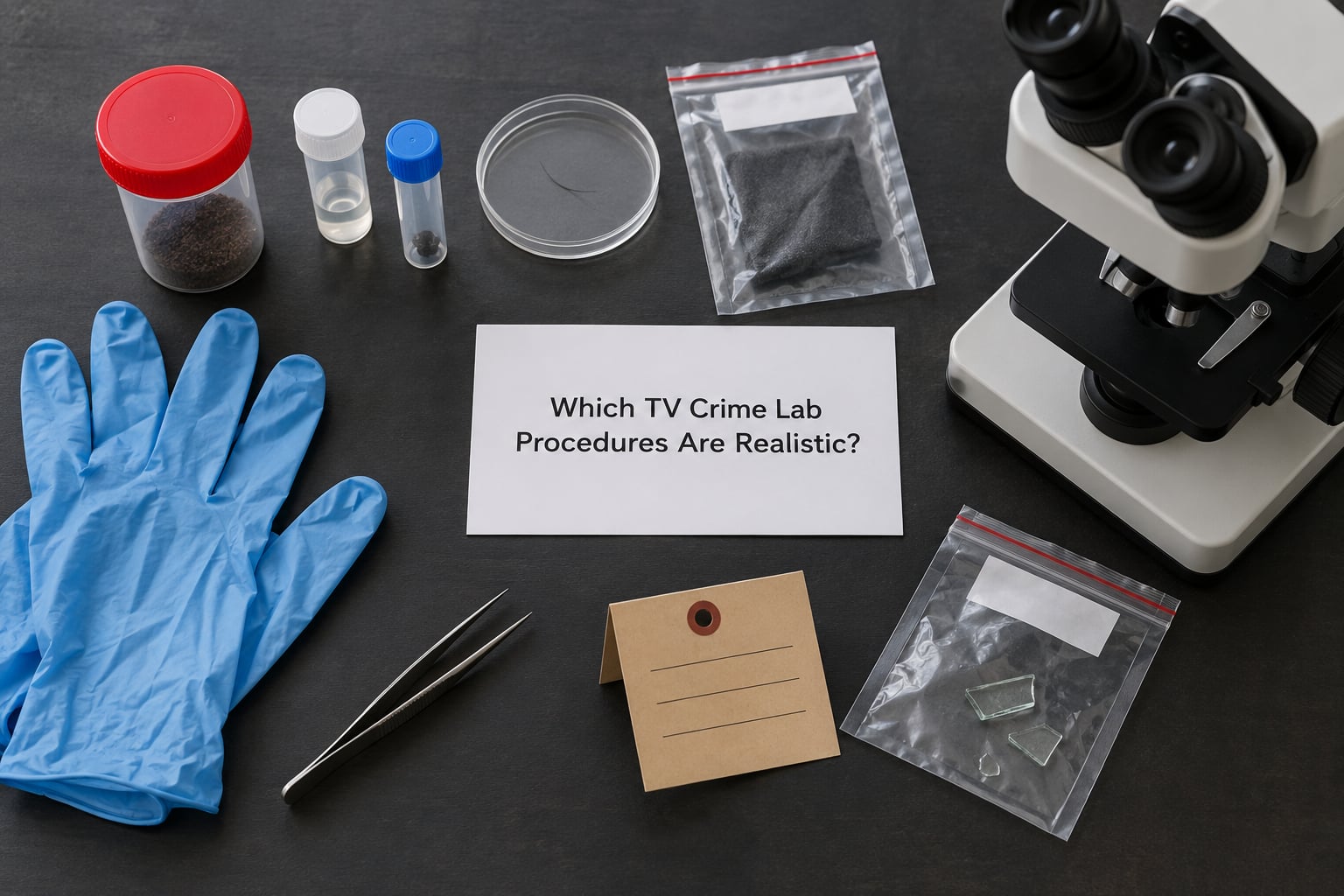
Most of the core procedures in crime drama are based on genuine laboratory work. Fingerprints, DNA profiling, toxicology, serology, trace evidence, bloodstain pattern analysis and digital device examination all exist and all appear in real casework. The science on screen is usually recognisable because the shows have been borrowing from it for decades.
What changes is the framing around each technique.
| Procedure shown on TV | Real forensic practice |
|---|---|
| One specialist handles every branch of the case | Each analyst has one specialty, and cases are split across several disciplines |
| Equipment pinpoints a unique chemical signature instantly | Instrument analysis identifies a profile or a class of material that still needs interpretation |
| The analyst interviews suspects and arrests people | Laboratory staff rarely conduct interviews or make arrests; that is an investigative job |
| A result names a suspect on the spot | A report supports or excludes a hypothesis and may need statistical context before it is usable |
| The scene is walked through casually by characters | Scenes are restricted and logged because of contamination risk |
Bloodstain pattern analysis is a good example of a real discipline that television makes look cleaner than it is. Analysts do reconstruct how blood was projected and impacted, but the conclusions depend on the surface, the angle and the context of the scene. It informs an investigation rather than settling it.
Digital forensics is the reverse case. Television versions of hacking are usually nonsense, but real digital examination is genuinely capable of recovering deleted material from phones and computers. There the drama is understated relative to the reality.
Why TV Crime Labs Seem Faster Than Real Ones
Speed is the single biggest distortion, and it comes from several separate pressures stacking up. A television lab runs without any of them.
Queueing. The bench is only part of the delay. Items wait for submission paperwork, wait in the case queue, wait for an available analyst and wait for review. A routine test that takes twenty minutes of bench time can sit for weeks beforehand.
Validation and method development. Before a method is used in casework it must be validated, documented and shown to work on known samples. Changes to methods get revalidated. None of that fits in an episode.
Repeat testing. Results that matter get repeated, sometimes by a second analyst using a different approach. A negative result often triggers a second look for technique failure rather than a re-plot.
Documentation. Notes, photographs, batch records and quality control entries have to be written as the work happens. Analysts describe most of their week as recording and reviewing what an instrument already told them.
Review before release. A second qualified person checks the work. If that person disagrees with the first, the case goes back for resolution.
Shows also collapse the pre-lab work. On television the evidence arrives as a clean bag; in reality the first hours of a case are often spent deciding whether a scene is safe to enter at all, what is worth collecting, and whether the household, the vehicle or the workplace needs searching.
What TV Gets Wrong About DNA Evidence
DNA profiling is real, powerful and widely misunderstood. The realistic version involves far more conditional language than a television script allows.
Contamination is the first gate. DNA profiles come from very small amounts of biological material, which means handling, secondary transfer and lab cross-contamination are constant concerns. Real work relies on protective equipment, separate processing areas and controls that run alongside the samples.
Not every sample produces a profile. Degraded, mixed or heavily handled material may return nothing useful, a partial result, or a result that cannot be interpreted. A wiped or washed surface often yields nothing, and a suspect sample taken years after an assault may be a difficult reference.
Mixtures are common. Where more than one person’s DNA is present, interpretation is a statistical exercise. Modern software helps, but a mixture rarely yields a single clean answer, and analysts are trained to describe what is consistent with a sample rather than what it proves.
Database searches are not instant. A profile can be run against national databases such as AFIS for fingerprints or CODIS for DNA. A cold case hit may arrive years after the evidence was booked, and a single-source search that fails is not the same as excluding everyone.
A statistical statement is part of the result. A profile match is reported alongside a figure describing how unusual that combination would be in an unrelated population. The number expresses the strength of the evidence, not the strength of the case. Guilty people have been convicted on DNA, and innocent people have been included in databases by chance.
Television also treats DNA as pointing at a person. In practice a profile can exclude someone, and that exclusion may be the most useful thing the laboratory produces.
Are Fingerprints and Trace Evidence as Decisive as TV Shows?
Fingerprints on television are usually clean, complete and unambiguous. The reality is that latent prints are the accidental residue of a touch, and most are partial, smudged, stretched or on a surface that tells you little.
Whether a print is even worth developing depends on the surface. Porous and textured materials behave differently from smooth ones, and a print on a curved or heavily handled object may not be recoverable at all. Recovery methods are chosen to suit the item, and they can damage evidence in the process.
Comparison is likewise less mechanical than it appears. Automated systems rank candidate prints from a database, which is why a possible match is described as a candidate. A qualified examiner then decides whether the comparison supports identification, and that decision is written down, reviewed and open to challenge.
Trace evidence follows the same pattern. Fibres, glass, paint, soil and debris can be highly informative, but they mostly establish that materials are consistent with each other. Where a car has been parked on a street full of the same paint, that consistency means much less, and the analyst has to say so.
None of this makes fingerprint evidence weak. It makes it context-dependent, which is the opposite of how a television verdict reads.
Do TV Crime Labs Solve Cases Overnight?
They do on television. In a real investigation, a laboratory result might land in hours for a straightforward urgent request, and much more commonly in weeks. Cases involving backlog, quality review, failed first attempts or additional legal review run to months, and cold case work often takes years before a database search returns anything.
A realistic sequence looks more like this: days for scene work, documentation and submission; a variable wait for triage and scheduling; days to weeks for routine analysis; more time for repeat testing, review and report writing; and then whatever the court schedule adds. Backlogs and staffing at regional laboratories are a genuine constraint, not a plot device.
There is another assumption worth challenging. Television implies that the laboratory resolves the case. Plenty of real investigations are closed before any report exists, because most cases are resolved by a confession or a plea rather than by a trial. The lab’s result often arrives after the case has already been settled, and its most common role is confirming or challenging a conclusion reached elsewhere.
What Does TV Crime Drama Get Right About Forensic Work?
The genre is more careful than its reputation suggests. Several habits that appear on screen are genuinely drawn from good practice.
- Contamination matters. Shows regularly treat the crime scene as something that gets ruined by careless handling, which is exactly what standard protocols are built to prevent.
- Second opinions happen. The recurring pattern of a result being challenged and re-run mirrors real quality review.
- Results are qualified. When a character says the evidence is consistent with rather than proof of something, that reflects how careful analysts actually speak.
- Specialists exist. Even imperfect shows teach the basic idea that forensic work is divided into disciplines with different training.
- A finding is not a conclusion. Good drama often ends with the laboratory report in one hand and an unresolved case in the other.
Writers who want to close that gap have a practical resource in the FBI’s Handbook of Forensic Services, which describes real procedures well enough to check a scene against.
How to Tell When a TV Forensic Plot Is Mostly Fictional
These signals show up over and over, and once you notice them you cannot unsee them in other shows.
- A result arrives from an untestable sample. A wiped weapon, a bleached surface or a decades-old fragment does not produce a profile with a name attached.
- Certainty is universal. Nobody in a real laboratory says the question is settled before the comparison is finished and reviewed.
- Equipment does everything. If one machine appears to solve hair, paint and unknown poisons in a single scan, that machine does not exist.
- No one mentions the scene log. A scene where characters and bystanders walk through freely has skipped the documentation that real cases depend on.
- One person does every specialty. Anatomy, entomology, toxicology and digital forensics are separate careers.
- The analyst becomes the detective. Interrogation, arrest and case strategy are not laboratory work, however satisfying they are to watch.
- Jargon carries no limits. Technical phrases used without any statement of what the method cannot resolve are a reliable tell.
- Failure never happens. Real casework includes inconclusive results, insufficient samples and methods that worked once and then stopped working.
None of this makes crime drama unwatchable. It gives you a sharper sense of which parts of a plot are load-bearing and which are there for pacing.
Frequently Asked Questions
Are TV crime labs based on real forensic laboratories?
Yes. The disciplines shown on television are real, and many working analysts consult with writers and producers to keep procedures broadly plausible. The compression is in the storytelling: time, staffing, documentation and uncertainty are cut for pace, and one character is often given several specialties at once.
How realistic are DNA results on television crime shows?
Realistic in outline, generous in detail. Profiling, contamination control and database searches all exist, but real samples can be degraded, mixed or contaminated by unrelated material, results need statistical context, and a partial profile is common. Television almost never shows the inconclusive result.
Can fingerprints identify a criminal with certainty?
A well-developed print on a suitable surface can support identification, but most latent prints are partial or distorted and never reach that standard. Automated systems generate candidates for a qualified examiner to assess, and even a strong comparison says the print originated from a particular person, not how or why it was left.
Why do TV crime shows solve cases faster than real investigators?
Shows skip the queueing, validation, repeat testing, written documentation and second-person review that consume most laboratory time. They also skip the pre-lab work of securing and searching a scene. Net effect is a result in an hour on screen versus days, weeks or months in a real case.
Can a crime lab determine exactly how a crime happened?
No. Laboratories work on submitted items and answer defined questions. They can describe what material is present, what it is consistent with and what is excluded, but reconstructing events also depends on scene context and investigative work. That gap between finding and conclusion is where most television plots simplify.
Are crime shows inspired by real cases and forensic techniques?
Procedures are usually drawn from real practice, and some series draw individual cases from journalism or court records. Fictional drama and true crime documentary are different categories, and both take liberties: drama compresses process, while documentary editing shapes a narrative around footage and interviews.
Conclusion
So how accurate are TV crime labs? The techniques are largely real and the results they produce are meaningful, but the surrounding story is fiction: the pace, the one-person laboratory, the clean prints and the certainty at the end of every case.
Next time you watch a scene, check four things. Does anyone keep a record of who handled the evidence? Is uncertainty stated out loud? Is there a second person checking the work? And does the show keep the laboratory finding separate from the conclusion about what happened?
Those four checks tell you more about whether a forensic plot holds up than anything else in the scene.