
A lawyer protagonist works when the job creates pressure, not answers. The interesting version is not the one who explains the law to everyone else in the room. It’s the one who knows exactly what the procedure demands, and cannot afford to do what the case needs.
Knowing how to write a lawyer protagonist comes down to nine decisions: who the lawyer is professionally, what they want beyond a verdict, which rule makes that want impossible, what they know and don’t, how the case squeezes them, how much legal detail to put on the page, how they speak, and whether they actually drive the story. Get those right and the profession supplies its own plot engine: deadlines, obligations, money, and a structure of rules built to be bent.
This guide is for crime and noir writers. It assumes you are not a lawyer and never intend to be, which is exactly the position most of us write from.
Table of Contents
- What You Need
- Step-by-Step: How to Write a Lawyer Protagonist
- 1. Define the Lawyer’s Legal Role
- 2. Give the Lawyer a Desire That Is Not Merely Winning
- 3. Build a Moral Contradiction
- 4. Decide What the Lawyer Knows
- 5. Make the Case Pressure the Character
- 6. Use Accurate Legal Texture Without Lecturing
- 7. Write a Distinctive Professional Voice
- 8. Stage the Lawyer Through Action
- 9. Test Whether Your Lawyer Protagonist Drives the Story
- Common Mistakes
- The omniscient legal fixer
- The law as a convenient plot machine
- Ignoring jurisdiction
- One-dimensional motivation
- Every scene ends in an argument
- No private cost
- Confusing accuracy with realism
- Discovery treated as a surprise reveal
- Frequently Asked Questions
- Can you write a lawyer protagonist without being a lawyer?
- Does a lawyer protagonist have to be a criminal to be interesting?
- How much legal research do I need for a crime novel?
- How do I avoid inaccurate courtroom scenes?
- What is the 80/20 rule for lawyers?
- Conclusion
What You Need
Seven planning materials, and you can build all seven in a single sitting before you write a word of prose.
- A defined role and place. Which kind of lawyer, in which country and state or province, at what career stage.
- A case with consequences. Something that ends in a verdict, a dismissal, a settlement, a judgment, or a retraction.
- A personal motive. The thing the lawyer wants that has nothing to do with the client’s case file.
- An ethical contradiction. A rule from the profession that collides with that motive.
- A professional constraint. Bills, deadlines, a supervisor, a client relationship, a court date.
- A verification plan. How you will check the terminology and procedure you use.
- A narrative goal. What the lawyer is trying to make happen by the end of the book.
The first item is the one most writers skip. Fictional law has to be tied to a specific place, because procedure, terminology and the shape of a case all change between systems. What a writer calls a hearing might be something else entirely two hundred miles away, and any reader who has spent time in a courtroom will spot the mismatch immediately.
A practical rule: pick one jurisdiction and stay inside it. If you need a legal detail your setting does not support, change the detail rather than the setting.
Step-by-Step: How to Write a Lawyer Protagonist
The nine steps below move from professional identity through to revision. They are ordered so that each one gives you something to test the next one against. You can do them as a single afternoon exercise before drafting, or use them as a diagnostic on a manuscript that already exists.
1. Define the Lawyer’s Legal Role
Start with the most boring question, because it produces the most plot. Is this person a defense attorney, a prosecutor, a public defender, a corporate lawyer, an in-house counsel, a judge, a legal aid attorney, a solo practitioner, or something else entirely?
Then pin down four things: the jurisdiction, the experience level, the specialty, and the ordinary weekly work. A third-year associate at a large firm and a solo criminal defense attorney with twenty years behind them both carry a badge of authority, but they spend their days completely differently.
The role should generate access, limits and obligations. A prosecutor can subpoena records nobody else can reach, which makes them useful. A public defender is bound by confidentiality and by the limits of a client who cannot pay, which makes them constrained. A corporate lawyer carries duty of loyalty to a company that has interests of its own, which makes them a character in a story they do not control.
Most importantly, write down what this role cannot do. That single line will save you from the commonest failure in legal fiction: a lawyer who can produce any document, call any judge or reach any witness, because the writer needed it that way three pages earlier.
2. Give the Lawyer a Desire That Is Not Merely Winning
Winning the case is a goal, not a desire. Desires are messier: the approval of a parent who was once a client, the money to clear a debt, an old friendship that requires a favor, the reputation of a firm that no longer deserves it, a promise made years ago to a person who cannot enforce it.
This is the step that turns a legal thriller protagonist into a character. A lawyer whose only engine is the case is a procedure walking around. A lawyer who wants the case to go a particular way for personal reasons is someone who can be frightened, tired, and tempted.
Fear and guilt are the easy pair because they explain themselves. Loyalty, ambition, restitution and secrecy are stronger because they can be defended, even when they are wrong. A character motivated by restitution keeps working long past the point where the case stops paying, and the reader begins to wonder whether she is helping the client or repairing herself.
Ask what the lawyer would do if the client were the wrong person and the case were unwinnable. Whatever your character answers is the real spine of the story.
3. Build a Moral Contradiction
A lawyer becomes compelling when professional rules, personal loyalty, and the desired outcome cannot all be satisfied at once. Pick one rule and make it the hinge. Confidentiality. The duty of loyalty to a client. The obligation to use only lawful means. The requirement to tell a client when their case is weak. The professional norm against representing two parties who conflict with each other.
Then let the contradiction sit there. Do not resolve it in the first third of the book. A conflict that gets solved on page ninety has been a holding pattern, not a source of tension.
There is a craft point here about ethics. If your character’s violation reads as clever strategy and nobody in the story pays for it, readers notice. Show the cost instead: a colleague who stops returning calls, a client who finds out from someone else, a supervisor who reassigns the file, a hearing where the judge already knows.
Keep the violation human-scaled. A lawyer quietly reading a document they should not have read is a character problem. A lawyer hiding evidence from a court is a plot problem, and a much more damaging one to credibility.
4. Decide What the Lawyer Knows
Map the protagonist’s information across the story. In the opening chapters, what do they know for certain, what do they suspect, what have they misunderstood, and what are they actively concealing from the people around them?
Then do the harder part: decide what they learn, and when, and what it costs them. Readers feel suspense when they know more than the protagonist about one thing and less about another.
Controlled knowledge is what stops a lawyer character from becoming a plot convenience. When the writer knows the answer and the protagonist also knows the answer, the middle of the book turns into a waiting room. The fix is small and mechanical: move the fact you have into the lawyer’s head only when they can act on it, and let them act badly.
5. Make the Case Pressure the Character
Connect the legal problem to deadlines, consequences and choices that cannot be undone. Pleadings have dates. Discovery closes. A witness has a job, a flight, a memory that is fading. Money runs out at a rate the character can calculate.
The goal is a lawyer who is technically correct and ethically exposed in the same breath. Right about the procedure, wrong about the person. Defensible on a motion, indefensible at three in the morning.
Give the case a realistic shape, which mostly means resisting compression. Real cases run for months or years, they stall, they get postponed, and a surprising number of them end in a document nobody reads rather than a courtroom verdict. Forum discussions with practicing lawyers keep returning to this: fiction routinely compresses a two-year dispute into three days of hearings, and that single distortion is what makes lawyer characters feel fake to insiders.
Pick two or three real pressures and let them pull against each other. A deadline that arrives too early, a client who wants a different outcome than the lawyer, a partner who assigns the file for reasons nobody states.
6. Use Accurate Legal Texture Without Lecturing
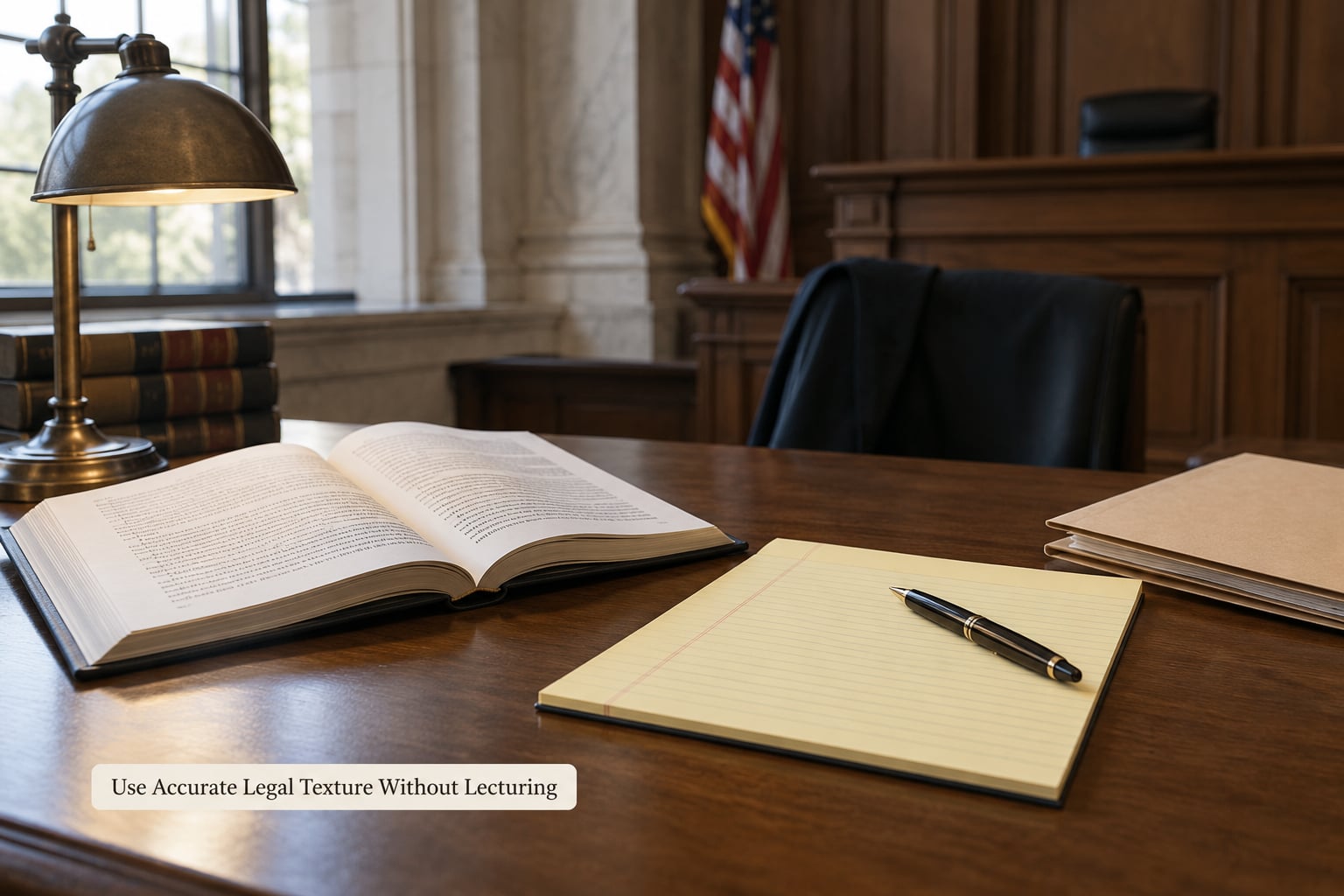
Use only the legal detail the scene needs, and verify every term that a knowledgeable reader would recognize as wrong. Research questions are specific and small: what does this lawyer file in this situation, who is allowed to be in the room, what does the judge say before the hearing starts, how long is the wait for a decision, what document must be served and on whom.
Public court records and published opinions are free and primary. Courtroom observation is available in most jurisdictions, and a public gallery will give you atmosphere faster than any book: who sits where, who speaks to whom in the corridor, how long the wait actually is, how lawyers address the bench compared with how they speak to a client.
Professionals will talk to writers who arrive with real questions and no expectation of a speaking role. The worst research note is “tell me about your job.” Ask what a typical week looks like, which part of the job they would remove if they could, what a new colleague always gets wrong, and what the most frustrating rule in their area is. That last answer will hand you a character flaw.
Then translate procedure into experience. Instead of explaining that a deposition involves sworn testimony under penalty of perjury, show the lawyer correcting the witness’s word choice before the reporter finishes the sentence.
Never use your fictional lawyer to state a legal rule you invented. Courtroom drama depends on rules being real, and a reader who catches a fabricated rule tends to stop trusting the entire book.
7. Write a Distinctive Professional Voice
A lawyer’s voice comes from work, not from personality alone. It shows up in vocabulary, in what the character refuses to say, in how they interrupt, and in the small habits their job has trained into them.
Compare two versions of the same line. Generic: “I will object to this line of questioning.” Revealing: “You have asked that question three times, and my client has answered it twice. Ask it again and I will ask the court to make you.” The second one tells you about the lawyer’s relationship with the witness, the client’s temperament, and how much patience the lawyer has left.
Watch for the traps. A character who speaks in complete paragraphs during an argument usually isn’t thinking, they’re delivering a speech. Real cross-examination is short, repetitive and rude. Lawyers who overuse Latin in speech usually exist in novels rather than offices.
Test the voice by reading the dialogue aloud. If it would sound fine with the profession swapped out for insurance agent, it isn’t doing any work.
8. Stage the Lawyer Through Action

Replace résumé-style explanation with scenes. Show the lawyer questioning a witness, walking a client through a bad piece of news, reading a contract clause twice and going cold, deciding whether to disclose something, or leaving a negotiation without shaking hands.
Meaningful professional action changes something. The character learns a fact, makes a commitment, accepts a cost. Exposition does none of that; it only reports that the character is competent.
Not every scene belongs in a courtroom. Most legal work is phone calls, email, drafting, database searches, waiting, and meetings in rooms with bad coffee. Readers who have spent any time in a legal office recognise that immediately, and they notice its absence too.
One practical technique: write the scene from the lawyer’s body. What is under their hand, what are they avoiding looking at, which question do they ask that they already know the answer to. Profession leaks into posture long before it leaks into dialogue.
9. Test Whether Your Lawyer Protagonist Drives the Story
Ask four questions in revision, and answer them honestly for each major scene. Does the lawyer make the choice? Does the choice change what happens next? Does it produce a consequence somebody else has to live with? Is this character distinguishable from your other major characters without their job title?
If the answer is no to the first two, you have a passenger. If the answer is no to the last one, the job is doing the characterisation and the person is decoration.
Revising a passive lawyer means moving three things out of the author’s head and into the protagonist’s: information, decisions and moral responsibility. Give the character the fact earlier, force them to act on it, and then let the fallout belong to them. That is usually all it takes.
Common Mistakes
Most weak lawyer protagonists fail in the same handful of ways, and each one has a straightforward fix. Knowing how to write a lawyer protagonist means catching these early rather than after a full draft.
The omniscient legal fixer
The character resolves anything, because the writer is stuck. Fix: list what the role cannot do, then let the limit cost them something on the page.
The law as a convenient plot machine
Rules appear when needed and vanish when inconvenient. Fix: decide the governing rules before you plot, and treat every legal development as something the character must earn.
Ignoring jurisdiction
One chapter in a system the writer found convenient, another in a different one. Fix: name the jurisdiction in your working notes and check every procedural detail against it.
One-dimensional motivation
Either greedily corrupt or nobly crusading. Fix: give the character a motive they would defend out loud, then let the case make defending it expensive.
Every scene ends in an argument
The courtroom has swallowed the book. Fix: move a third of your scenes into offices, corridors, parking lots and phone calls, where most professional pressure actually happens.
No private cost
The character wins and loses nothing personal. Fix: decide what the case takes from their relationships, health, money or standing, and show at least one withdrawal.
Confusing accuracy with realism
Correct procedure, no human being. Fix: for every accurate detail, add the interrupted dinner, the unanswered message, the fee conversation, the colleague who disagrees with the strategy.
Discovery treated as a surprise reveal
Documents arrive on cue at the dramatic moment. Fix: remember that disclosure is slow, duplicative and mostly boring, and let the delay create dread instead of the reveal.
A useful revision habit: take every scene where your character explains law, and cut a third of it. If the scene still works, the cut material was lecturing rather than dramatizing.
Frequently Asked Questions
Can you write a lawyer protagonist without being a lawyer?
Yes. Almost every successful legal thriller was written by someone outside the profession, and most were written by people who did not read law at university. What matters is method, not qualification. Choose one jurisdiction and stay inside it, verify every term a knowledgeable reader would recognise, observe a real courtroom once, interview a practicing lawyer with specific questions, and let the character’s mistakes come from personality rather than from ignorance you have not researched.
Does a lawyer protagonist have to be a criminal to be interesting?
No. In fact, a lawyer with clean hands and a compromised situation is usually harder to write well, because there is no easy excuse for what happens next. Obligation, loyalty, professional pride and money are enough to drive a character into trouble. Many of the most durable attorney protagonists in crime fiction break a rule rather than commit a crime, and that distinction gives you a long, slow pressure that a felony resolves too quickly.
How much legal research do I need for a crime novel?
Enough to be accurate about what you actually put on the page, and no more. Research the specific scenes you have written rather than the whole field. Public court records, published opinions and a single afternoon in a courtroom gallery will cover most of what a novelist needs. Interviewing one practicing lawyer in the right practice area tends to do more for authenticity than a fortnight of reading, because they will tell you which details look wrong.
How do I avoid inaccurate courtroom scenes?
Keep the number of people on the page small, and give each one a clear job. Watch for invented terminology, speeches that no judge would allow, arguments that ignore burden of proof, and outcomes that arrive instantly. Before publishing, check your scene against one real transcript from the same type of case and one account from a practitioner. If a detail cannot survive that check, cut it rather than defending it.
What is the 80/20 rule for lawyers?
Lawyers are commonly described as spending roughly eighty percent of their time on client communication, files, paperwork and admin, and about twenty percent on the courtroom or hearing work that television emphasises. That ratio is why most legal fiction feels off to anyone who has spent time in a legal office. Show the other eighty percent and your protagonist will read as a working professional rather than a television silhouette.
Conclusion
A memorable lawyer protagonist is built from a role with limits, a desire that has nothing to do with the case, and one rule that makes those two impossible to satisfy at once. Everything after that is craft: what the character knows, what the case demands, how much law belongs on the page, and whether they are the one making the decisions.
So start with one sentence. Write the lawyer’s role, their personal want, and the professional rule standing between them, in a single line you could pin above your desk. Then put that combination into a scene where the character cannot walk away without paying something.
If the choice is uncomfortable for them and clear to the reader, you have a protagonist. That is the whole craft of how to write a lawyer protagonist: not legal exposition, but consequential decisions.