To analyze a noir film scene by scene, log what the camera, lighting, sound, and actors actually do before you decide what any of it means. Watch once for the dramatic turn, log it shot by shot, then build your argument out of two or three details you can point to on screen. That takes about 40 minutes for a single sequence.
Noir is a trap for beginners in both directions. Plenty of people watch a Bogart film and describe the shadows. Plenty of other people quote a critic’s phrase about American Angst and never look at a single frame. Neither approach survives contact with a writing deadline.
The method below is the one I use when I have to write about a noir scene I half-remember. It is built for students with an assignment, for writers borrowing noir conventions for their own work, and for anyone who has rewatched a classic and felt the craft sliding past unexamined.
Table of Contents
- What You Need Before You Start Analyzing a Noir Scene
- What film noir is, in plain English
- How to Analyze a Noir Film Scene by Scene
- 1. Define the scene’s dramatic job
- 2. Map the visual composition
- 3. Read lighting, color, and setting
- 4. Listen for sound, silence, and dialogue
- 5. Examine editing, rhythm, and viewer position
- 6. Interpret performance, symbols, and themes
- 7. Build an evidence-based scene analysis
- Common Mistakes in Noir Scene Analysis
- Frequently Asked Questions
- What defines film noir?
- How do I analyze a noir scene if I cannot follow the plot?
- How to analyze a noir film scene by scene in a short essay?
- What is the difference between noir and neo-noir?
- Is there a 20 minute rule for watching movies?
- Which noir films should I practice scene analysis on first?
- Start With the Scene’s Change
What You Need Before You Start Analyzing a Noir Scene
You need four things, and none of them are expensive. One is a specific scene, defined tightly enough that you can find it twice, ideally with a scene number or a rough timestamp. Two is a clean viewing copy with working subtitles, watched on a decent screen, sound included.
The third is notes. Paper or a document, either way, but not a blank page you stare at while the film runs. Set up five column headings before you press play: shot, light, sound, words, what changes. The fifth column is the one that separates analysis from description.
The fourth is a rule you set in advance: description and interpretation go in different columns. If you catch yourself writing the venetian blinds make him look trapped in your notes, split it. The blinds and the bars are observation. Trapped is interpretation, and it needs more evidence before you commit to it.
What film noir is, in plain English
Film noir is a style and a mood in American cinema of the 1940s and 1950s: low-key high-contrast lighting, disorienting camera angles, cramped urban settings, cynical first-person voiceover, and flawed, isolated protagonists, usually private detectives, who rarely escape the trap they have walked into.
Noir describes how a film looks and how it makes you feel, not what happens in it. A murder plot alone is not noir. A woman walks into a detective’s office, the blinds stripe his face, and a narration tells you he was already finished before she spoke, and now it is.
One useful aside before you start: the Production Code shaped what these films could show, so a noir villain often talks around violence and the camera lingers on a cigarette as a substitute. When a scene seems oddly restrained, that restraint is technique, not an accident.
How to Analyze a Noir Film Scene by Scene
The core method is seven steps, and the order matters only in one respect. You establish what happens in the scene before you interpret how it is photographed. Beginners usually invert this, spot a dramatic shadow, and then go looking for a plot that supports it.
1. Define the scene’s dramatic job
Every scene has a job: it introduces something, turns the situation, delivers information, or makes a character choose. Write that job in one sentence before you write anything else.
In Mildred Pierce (1945), the opening pier sequence exists to establish that Mildred wants more, that the city offers it, and that taking it will cost her. The railroad tracks crossing the road, the cut to a steel wheel biting a rail, the dark water: none of that is atmosphere added later. It is argument.
Then ask what the scene reveals, complicates, or sets up. One-sentence summaries are enough. If you cannot write one, you probably do not yet know where the scene begins or ends, which is itself useful information.
2. Map the visual composition
Note framing, camera distance, angle, blocking, and negative space. Where does the character sit in the frame? What fills the space they are not standing in? How much room is above them or beside them?
Paul Schrader, the screenwriter of Touch of Evil (1958), wrote a lot about obliquity, a preference for skewed angles that deny the viewer a settled, frontal view of anything. That single habit gives you something concrete to look for: in noir, the frame often leans.
Look at where characters sit relative to doors, windows, mirrors, and furniture. A character framed by a doorway is being shown as contained, watched, or about to leave, and the direction they occupy tells you which. Corridors and stairwells recur constantly because they give the camera a hard geometry to press a figure against.
Keep the discipline: record what you see first, connect it to power or isolation second, and only when two or three details point the same way.
3. Read lighting, color, and setting
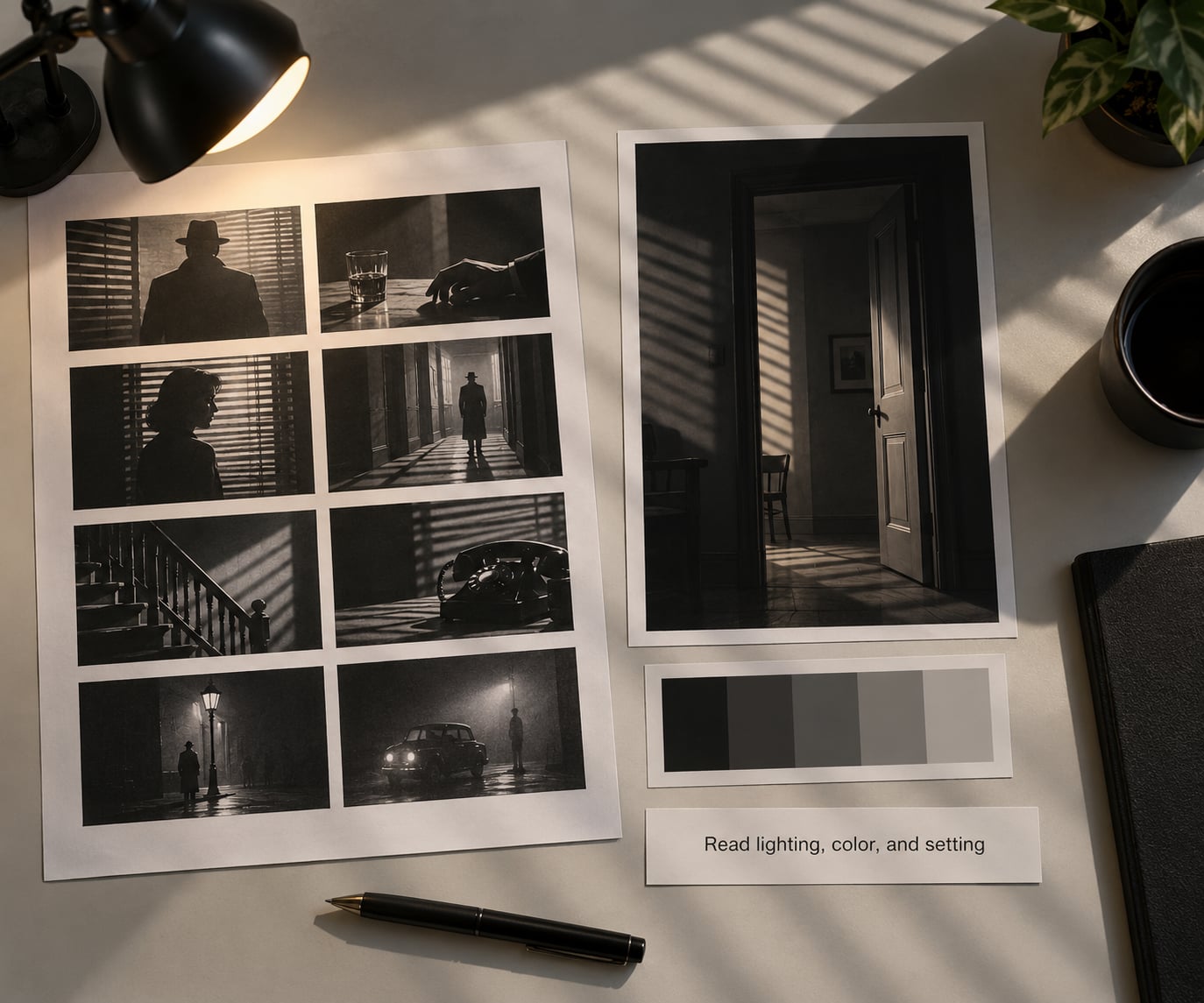
For each shot, log the source, direction, hardness, and contrast of the light. Chiaroscuro means the arrangement of strong light and deep shadow that models a face into halves. Low-key lighting means most of the frame sits dark with only small areas lit.
Ask where the light physically comes from. A desk lamp in frame, a streetlamp, a window, a car headlight. Noir lighting is often motivated, meaning you can trace the source to something in the room, and that traceability matters: a shadow with no source is a stage effect, a shadow from a window blinds is a character in a room.
Then check the palette and the location. Wet pavement, stairwells, offices with venetian blinds, hotel corridors, kitchen tables with one lamp burning. Weather does work too; rain and fog both soften contrast while making the light sources glow harder.
Do not treat darkness as a moral label. Low-key lighting signals mood and constraint far more reliably than it signals villainy, and plenty of noir heroes are lit like criminals because the genre liked a face split by shadow.
4. Listen for sound, silence, and dialogue
Most amateur analysis stops at the image. Noir sound is doing work constantly, and skipping it is the fastest way to miss half the film.
Log four things: the score, ambient noise, silence, and dialogue. Note where each sound source sits relative to the character. A voice heard through a door or a wall is a sound with a position, and position implies a barrier between people.
Ask what is missing. An office scene with no traffic and no typing undercuts the claim that anyone works there. A long silence after a line lands tells you the character has just understood something awful.
Voiceover deserves its own note. First-person hard-boiled narration in films adapted from Dashiell Hammett and Raymond Chandler is a noir convention that distances the listener from the narrator while claiming total honesty. The Big Sleep (1946) is famously close to unfollowable plot-wise, and readers on r/filmnoir describe it as watchable scene for scene anyway. The voice carries mood, character, and fatalism when the plot cannot.
5. Examine editing, rhythm, and viewer position
Ask how the cuts work: shot length, point of view, eyeline matches, and whether the scene withholds anything from you. Parallel editing across two locations implies a link the characters do not know about.
Editing controls access. A sequence of close-ups that never shows both people speaking keeps you outside the conversation. A cut that drops you into a new scene before you have understood the last one produces uncertainty rather than surprise.
Then decide what the rhythm does. Short cuts tighten nerves; a long held shot lets discomfort accumulate because nothing relieves it. Touch of Evil opens with a long take that moves through several characters and a bomb, and the difficulty of holding that much in one shot is part of its argument about a corrupt world seen too late.
Do not assume every unusual cut has one fixed meaning. A jump in continuity may be a dropped scene, a stylistic choice, or simply an editing slip, and saying so is more honest than inventing symbolism.
6. Interpret performance, symbols, and themes
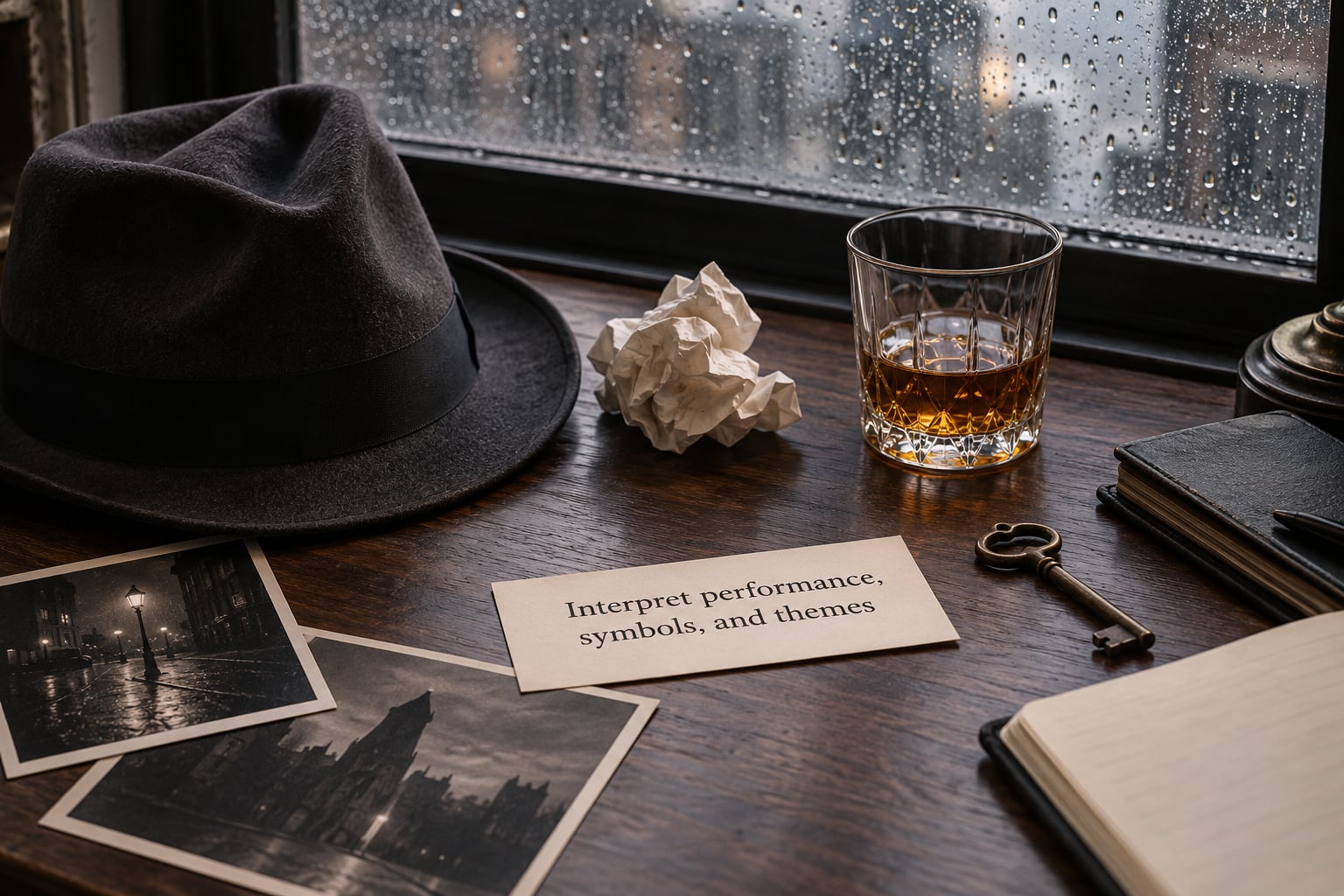
Now move to the actors and the objects. Log gesture, wardrobe, and props. Who handles a glass, when a hat goes on, whether a character looks at someone or past them.
The supporting cast in noir is frequently more precise than the lead. Walter Brennan in Double Indemnity (1944) plays Keyes, who does not lie but does not volunteer, and his line about being smart versus being dumb carries the film’s whole idea of complicity.
On symbols, set yourself a rule: support any symbol reading with at least two details from the scene. A MacGuffin, by definition, matters because everyone wants it and nobody explains it. A recurring object, a hat, a staircase, a mirror, becomes a symbol when it accumulates thematic weight across the film rather than merely recurring.
Distinguish a motif from a symbol. A motif is a visual or verbal pattern you keep seeing. A symbol is a pattern that carries meaning beyond itself.
Finally, track the contradictions. Noir characters say they want one thing and do another, and those gaps are where the themes live. Fatalism shows up not in a line about fate but in a decision that makes the ending inevitable.
7. Build an evidence-based scene analysis
Turn the log into an argument. A workable order: opening summary in two sentences, observable details, the formal techniques in play, character dynamics, thematic meaning, then a comparison with the scene before or after.
Write the analysis using technique, evidence, effect, and significance. Say what the film does, point to the exact frame or line that shows it, describe what it does to you as a viewer, and then explain why it matters to the whole film.
A thesis that works: The pier sequence in Mildred Pierce uses a low camera angle and cutaway insert shots to separate Mildred from the city in the first minute, establishing that her ambition will cost her before the plot has started. That names a technique, names the film, and makes a claim you can defend with the shots you logged.
If you are writing this as an essay, that structure becomes your paragraph plan. If you are writing crime fiction, the same log teaches you which details to plant early: the glance, the object handled, the line of dialogue that will be quoted back at the character at the end.
Common Mistakes in Noir Scene Analysis
Treating noir as a checklist. Learners find venetian blinds, a trench coat, and a voiceover, tick the boxes, and stop. The test: your analysis should still work if you removed the trench coat. If the coat was carrying the argument, you have described a costume rather than analyzed a scene.
Mixing description with interpretation. Writing the low angle makes him look powerful in the same breath as the low angle is used collapses two different jobs. Fix it with the column rule, and test each interpretation by asking what other evidence on screen supports it.
Assuming darkness means evil. Noir lighting is a mood, not a moral label. Test it by checking who else in the film is lit that way; if the sympathetic protagonist gets the same treatment, the darkness is about the world, not his character.
Over-reading every prop. A glass of water is a glass of water until it recurs with changed meaning. Require two details before you call anything symbolic, and keep a running list of what recurs before you decide what is a motif.
Ignoring sound. If your notes have no column for ambience, voiceover, and silence, you have analysed about half the film. Try watching one sequence with your eyes closed and write down what you heard.
Making broad claims without evidence. The lighting makes us feel trapped is a claim about the audience that needs a specific shot behind it. Test every general statement by asking which frame proves it.
Frequently Asked Questions
What defines film noir?
Film noir is a style and mood of American cinema from the 1940s and 1950s, defined by low-key high-contrast lighting, disorienting camera angles, urban settings, cynical voiceover narration, and flawed, isolated protagonists such as private detectives. The elements work together: the lighting and angles create the sense of a world closing in, and the narration confirms that the protagonist is already trapped.
How do I analyze a noir scene if I cannot follow the plot?
Stop trying to follow the plot and analyze one sequence at a time instead. Log lighting, camera angle, sound, and gestures for a single scene, then judge what that scene does on its own terms. Noir is unusually well suited to this because much of its meaning is carried by form rather than by plot, which is why films as tangled as The Big Sleep remain rewarding to watch.
How to analyze a noir film scene by scene in a short essay?
Pick one scene, not a whole film. Spend the first two sentences on what happens, then cover lighting, framing, sound, and performance with a specific detail from each, and close with what the scene sets up. A 600-word essay built on one well-logged scene is stronger than 1,500 words covering a plot summary, because every claim rests on evidence a reader can verify.
What is the difference between noir and neo-noir?
Classic noir is American cinema of the 1940s and 1950s, usually photographed in high-contrast black and white with hard-boiled first-person narration. Neo-noir keeps the moral ambiguity, the corrupt institutions, and the downbeat logic but drops the period costume, often uses color, and can be set anywhere. L.A. Confidential, Memento, and Chinatown are usually filed as neo-noir.
Is there a 20 minute rule for watching movies?
There is no such rule for noir, and treating a fixed cutoff as analysis misses the point. Noir scenes are short and their meanings depend on what precedes them. Watch a sequence once without stopping, then a second time with your log open, and pause only when something in the frame or the sound has stopped making sense to you.
Which noir films should I practice scene analysis on first?
Start with films where the style is loud and the scenes are short. Citizen Kane is not a noir, but its low angles, deep focus, and ceiling-and-mug shots teach visual reading better than most textbooks. For the method itself, the opening pier sequence in Mildred Pierce and the opening long take in Touch of Evil are good early targets, and both reward slow logging.
Start With the Scene’s Change
Watch your chosen scene once and write down only one thing: what is different at the end that was not true at the start. That single sentence is your analysis. Everything after it is evidence.
Then set up the log, watch again with the pause button under your thumb, and fill the columns. Pick the two or three details you can point to on screen, name the technique behind each, and draft a thesis that links technique to meaning.
Leave room for ambiguity. Some scenes resist analysis cleanly, and saying a frame is disquieting without explaining exactly why is a defensible observation. What is not defensible is a conclusion with nothing behind it. Stay open, and stay anchored to what the film actually shows.