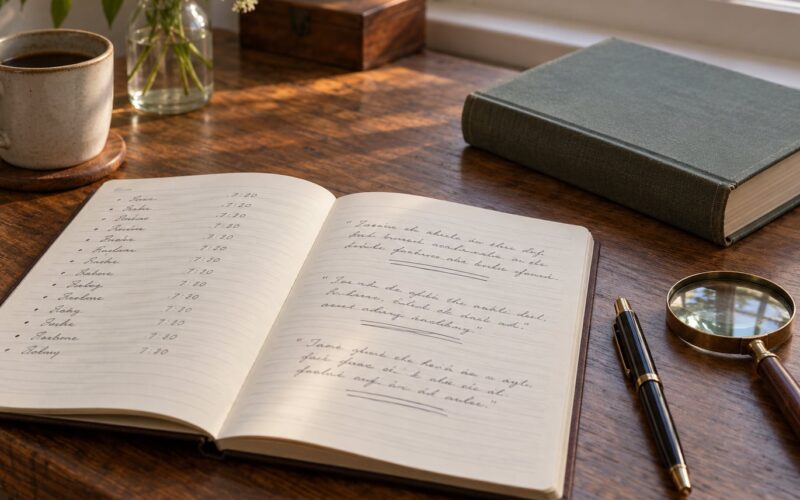
The best way to organize a crime fiction collection is a three-layer sort: shelve by subgenre, alphabetize within each subgenre by author surname, and keep every series together in publication order with the number marked on the spine. A simple catalog spreadsheet underneath it all keeps track of what you own.
For a shelf of 40 books, you can hold the whole system in your head. Past that, a collection develops two problems specific to crime fiction: the same author writes across several series and several subgenres, and publishers reissue the same novel in a new format every few years. A working system stops you buying a book twice and stops you reading book four before book one.
The whole reset takes an afternoon for a few hundred books. Have boxes, a pen, and your reading list nearby, because you will find things you forgot you owned.
Table of Contents
- What You Need
- A notebook or spreadsheet
- Shelf markers or plain labels
- A shelf map
- An optional barcode scanner
- Separate containers for the sorting categories
- Two reference lists
- Step-by-Step
- Step 1: Audit everything you own
- Step 2: Decide what to do with duplicates and reissues
- Step 3: How to Organize by Author
- Step 4: How to Organize by Series and Standalone Novels
- Step 5: How to Organize by Subgenre, Setting, and Mood
- Step 6: Create a Simple Catalog Record
- Step 7: Shelve or Store the Collection
- Step 8: Maintain the System
- Common Mistakes
- Frequently Asked Questions
- What is the best way to organize a crime fiction collection?
- Should I sort crime fiction by author, series, or subgenre?
- How can I keep track of series reading order?
- How should I organize crime novels in multiple formats?
- What is the easiest cataloging system for a large collection?
- How do I decide which unread books to read next?
- Start With One Shelf
What You Need
How to organize a crime fiction collection starts before anything moves. Gather the tools first, because the method changes depending on whether you have a spreadsheet or a shoebox of index cards.
A notebook or spreadsheet
A spreadsheet is the better option past about 50 books, and paper is fine below that. A notebook works for anything under roughly 50 titles, and a card index handles up to a few hundred if you write small. Do not buy software before you need it.
Shelf markers or plain labels
You need something that tells you what a run of spines contains. Printed shelf markers, masking tape with a marker pen, or folded card tucked into the first book of each group all work. The marker is a removable one, so a rental or a future move does not leave permanent stripes on your shelves.
A shelf map
A shelf map is one piece of paper naming each shelf or section and what lives there: Shelf 3, Nordic noir; Shelf 4, police procedural; Shelf 5, forensic, currently reading. It is the thing that saves you from re-deriving the layout from scratch every time you move books.
An optional barcode scanner
A handheld scanner is optional, and it only earns its place once you are past a few hundred books. A phone camera plus a free scanning app does the same job and costs nothing. Without a scanner you can still catalog by typing title and author, which is slower but perfectly workable.
Separate containers for the sorting categories
You need four containers: keep, duplicates, donate, and unknown. The unknown box is the important one. It holds anything you cannot immediately place, and it stops you from forcing a book onto a shelf where it does not fit.
Two reference lists
Your unpublished wish list and your to-be-read stack, kept separately. A new book arrives into the TBR stack, not onto a shelf, until you read it. That one habit stops the shelf system from eroding every time a bookshop does a favour.
Step-by-Step
Eight steps, in this order. The order matters more than the details, because each step assumes the one before it has been finished.
Before you start, know that three approaches compete for the same shelf, and picking the wrong one is the most common reason a system collapses by book two hundred.
| Shelving method | Best for | Where it breaks down |
|---|---|---|
| Author surname first | Collections heavy on one or two writers; readers who reread a favorite detective | Fails fast in crime fiction, where prolific authors write in four or five unrelated series and a single surname block will not fit on one shelf |
| Subgenre first | Collections that span golden age to Nordic noir, and readers who browse by mood | Genre boundaries blur, so you argue with yourself over whether a book is noir or psychological crime |
| Series first | Readers following one or two long series closely | Standalone novels get scattered, and shared universes become a guessing game |
| Color or spine height | A single shelf of paperbacks you want to look tidy | Breaks series integrity immediately and gives you nothing to search by |
Step 1: Audit everything you own
Pull every crime book into one place, including the ones stacked horizontally on top of a cupboard and the ones on the bedside table. Work through them in batches of maybe twenty. As you go, note three things: which series you already own in full, which ones have gaps, and which titles you own in more than one format.
The gap list is more useful than you expect. Half-finished series are the most common thing readers forget they started.
How you know it worked: the pile is smaller than your shelves and every book has a name you can say out loud.
Step 2: Decide what to do with duplicates and reissues
Crime fiction gets reissued constantly, so this step saves more space than any other. Pick one format to keep per title and put the rest in the donate box.
A workable rule: keep the format you actually read. If you read audiobooks in the car, the hardback going unread for six years is a donor. If you read paper, the ebook you bought on a sale is a donor, and the library app is a free alternative. Keep the copy with the best condition if the formats match, and keep any copy that contains material the others lack, such as a prequel printed as an appendix or a revised introduction.
Omnibus editions deserve their own case. A three-book box set replaces three paperbacks on your shelf but the same three ebooks on your device, so it never duplicates anything digital. Store box sets flat on a shelf where the weight will not bow the shelf, or stand them with the spines facing out.
How you know it worked: for every title in your collection, one of the following is true. You own one format, or you own a physical copy plus a digital one, and you know which shelf the physical copy is on.
Step 3: How to Organize by Author
Alphabetize by surname, ignoring first names and any title such as Doctor or Dame. Then group each author’s books so a series sits as one unbroken run.
That is the community default for fiction, and the tie-breaker question comes up every time. My answer: when an author’s series and standalone novels share a surname, put the series first in publication order, then run the standalones alphabetically by title. The books you are most likely to return to sit at eye level and stay together.
Crime fiction breaks the clean author block more than most genres. Ruth Rendell wrote police procedurals, psychological thrillers, and standalone novels that borrow from both, all under one surname. Ian Rankin wrote a long-running Inspector Rebus series and separately a celebrated literary crime series under a different name. When one author fills more than one shelf, split by series and add a small card at the start of each run, or keep the whole author on a single shelf with series running left to right and standalones after.
How you know it worked: you can put a hand on any author you can name within five seconds, and no series is split across a shelf edge.
Step 4: How to Organize by Series and Standalone Novels
Keep every series together, in publication order, and mark the number on the spine with a small sticker or a strip of masking tape. Numbered spines turn a browsing problem into a solved problem.
Publication order is not always reading order, and the difference matters in crime fiction more than in most genres. Writers often publish a series out of sequence, then issue the prequel later, sometimes in a different market and sometimes under a different name. A third book printed before the second does not mean you should read it first.
Here is how to shelve the awkward cases:
Prequels. Put them physically after the main run, in their own numbered block, and never let them interrupt the sequence. If a prequel reveals an ending, the spine number keeps it from being read by accident.
Spin-offs. Give a spin-off its own shelf card but place it immediately after the series it grew out of. Readers of the main series are your most likely audience for it, and separating it by subgenre alone is how spin-offs get forgotten.
Shared universes. Where two series share detectives, setting, or a recurring villain, put them in one block with a single shelf marker. Add a card at the start listing the safe read order for a newcomer, and a second card at the back for anyone who has already read the main run.
Standalone novels. These get an alphabetized or dated run of their own after the series blocks for that author. Mark them so you can tell at a glance. A small dot on the spine is enough; I use a strip of tape and write S in the corner.
How you know it worked: you never have to check a website to know what comes next in a series, and no series has members on two different shelves.
Step 5: How to Organize by Subgenre, Setting, and Mood
Subgenre is the layer most readers skip and the one that pays off best in crime fiction, because it gives you a browsing axis that author and series cannot. A shelf of eight series is a commitment. A shelf labeled Nordic noir is an invitation.
Use this taxonomy as your shelf blocks. Each row is a shelf or shelf section, and the last column is the label you print for it.
| Subgenre | Defining feature | Shelf label |
|---|---|---|
| Golden age / classic detective | Puzzle-box mysteries, closed settings, clues laid out for the reader, 1920s to 1960s | Classic Detective |
| Hard-boiled | First-person or close-third, gritty US cities, cynical narrators, prose like a clenched jaw | Hard-Boiled |
| Noir | Tragic or doomed protagonists, corruption, obsession; film noir and literary noir both belong here | Noir |
| Police procedural | Institutional investigation, detectives working inside a force, British and Nordic traditions | Police Procedural |
| Forensic procedural | Crime solved through lab and pathology work, often with a recurring specialist team | Forensic |
| Cozy / amateur mystery | Low violence, a likeable non-professional sleuth, small town or village setting | Cozy and Amateur |
| Domestic noir | Crime inside the home; marriage, family, and power rather than the public sphere | Domestic Noir |
| Historical crime and mystery | Crime solved against a real period, often with a modern or outsider investigator | Historical Crime |
| Organized crime and mafia | Criminal hierarchies, families, and rackets, from the Corleones to modern London | Organized Crime |
| Caper novel | Crime as puzzle and romp, usually with a heist at the center and a comic tone | Capers |
| Spy thriller | Espionage, agents, tradecraft, and international stakes rather than domestic policing | Spy Thriller |
| Psychological and serial killer fiction | The investigation is really about a mind; unreliable narrators and procedural framing | Psychological |
| True crime | Nonfiction accounts of real cases, usually read alongside fiction on the same case | True Crime |
Subgenre labels only work if they are not too fine. If you end up with four shelves of two books each, you have made sorting harder, not easier. The fix is a rule of thumb: no subgenre shelf gets under roughly ten books, and any smaller run folds into its nearest neighbor.
Once subgenre is in place, sub-shelve by setting where a shelf is big enough. Nordic noir splits from British police procedural, and Southern gothic crime or Australian rural mystery can hold their own if you have the books. Two competing labels on one shelf is normal. A book can be noir and set in New York, and you only have to choose one location for it.
How you know it worked: you can browse by mood on a bad evening and find three books you have not read, instead of alphabet.
Step 6: Create a Simple Catalog Record
A catalog earns its keep at about 50 books. Below that, memory and a shelf map do the job. Above it, the catalog is what stops duplicate purchases and tells you which shelf to walk to.
Here is the decision rule readers argue about most, so here it is plainly: under roughly 50 books, you do not need a catalog. Above that, you do, and a spreadsheet beats anything else.
There is a real camp that says cataloguing is a waste, and they are not wrong about small collections. Cataloguing is only tedious when it is more effort than the shelf already was. Skip it, and keep a single sheet listing the series you have started.
Copy this column schema into a spreadsheet. These eleven columns cover everything that matters for crime fiction:
| Column | What goes in it |
|---|---|
| Title | Full title, no subtitle needed |
| Author | Surname first, so the sheet sorts correctly |
| Series | Series name, or Standalone |
| Series number | Whole numbers only, so the column sorts |
| Subgenre | Pick from your shelf labels and keep the list short |
| Format | Hardback, paperback, omnibus, ebook, audiobook |
| Publisher and year | Enough to identify a reissue from its spine |
| Read status | TBR, Reading, Read, Did Not Finish |
| Rating | Your score out of five, optional |
| Shelf location | Shelf 3, Nordic noir. Update this when you reshuffle |
| Date acquired | Useful later when you decide what to pass on |
How you pick a tool:
| Tool | Effort to start | When it pays off |
|---|---|---|
| Spreadsheet | Low, if you start with the column list above | Above 50 books, especially for filtering by series or read status |
| Book cataloging app | Medium, because scanning and fixing metadata takes time | Above several hundred books, or if you want reading progress on your phone |
| Card index in a box | Medium, and it takes real physical space | Small to mid-size collections where you enjoy the handwriting and never expect to search digitally |
| Memory plus a shelf map | None | Under 50 books, permanently |
Two habits keep a spreadsheet from going stale. First, log a new book the day it joins the collection, not the week you shelve it. Second, accept that a shelf location column is a snapshot, and update it after every reshuffle rather than trying to keep it live.
How you know it worked: you can search your own collection for a half-remembered title, a completed series, or every book by an author, and get a list back in seconds.
Step 7: Shelve or Store the Collection
Now translate the catalog into physical order. Work shelf by shelf, and place books in the sequence your system dictates: subgenre block, then author, then series.
Real shelves are awkward, and crime books are awkwarder than most. A trade paperback of a debut runs about 200 pages and half an inch thick, while a later volume from the same series can arrive as an oversized hardback more than an inch and a half wide. Two consequences follow: your author blocks will not be one uniform depth, and a series can need two shelves even when the math says one.
Decide what breaks first. A reasonable priority is series integrity first, then author blocks, then subgenre, then neatness. Let the last book on a shelf stop short of the next author’s books, and use a bookend. If a subgenre block spills onto an adjacent shelf, mark the second shelf as a continuation so you are not hunting for the missing part.
Formats need homes of their own:
| Format | Where it lives |
|---|---|
| Hardback | On the shelf with the rest of the series, ideally the one you keep |
| Trade paperback | On the shelf; group with matching spine heights where you can |
| Mass-market paperback | On the shelf, and a good shelf for cheap duplicates you kept |
| Omnibus and box set | Flat on a shelf or standing spines out; count as the series, not as extra copies |
| Ebook | On your device and in the cloud; keep one folder per series, named Author – Series – 01 |
| Audiobook | On your device, named to match the ebooks exactly |
Multi-room collections need a rule or they become two bad collections. Keep the current reads and the TBR stack by the bed or in the chair you actually read in, and keep the main cataloged collection in one room where you do the sorting. Nothing in the main collection should need a second look to find.
Back up the digital half. A cloud copy of the spreadsheet plus a copy of the ebook folders is enough, and it is the only insurance your catalog needs.
How you know it worked: you can walk to any subgenre, scan the spines, and read a series in order without lifting a book twice.
Step 8: Maintain the System
A sorting system fails from neglect, not from bad design. Three routines keep it alive.
Log on arrival. Any book that joins the collection gets a row in the spreadsheet and a place in the TBR stack that day. Books waiting to be read live in one stack, not scattered on shelves where they block a series.
Keep a did-not-finish shelf. A crime novel that stalls at chapter nine is common and not a failure. Give abandons their own marked shelf and a spreadsheet status, and stop treating them as unfinished business.
Run a seasonal audit. Once a season, spend twenty minutes checking three things: books out on loan, titles in the donate box that have been there more than a month, and any series with a gap you now want to fill. Loans go back where the catalog says they went.
When shelf space runs out, deaccession deliberately. Sell or donate the duplicates, the formats you never read, and the one-offs you have no interest in rereading. Keep the short story collections, the award winners, and anything with a note in it from a friend, even when those books are not your favorites. Those are the ones you will not replace.
How you know it worked: six months later, a new book takes under a minute to place, and you can still find anything you already owned.
Common Mistakes
Most of these are not hypothetical. They are the exact failures that show up again and again in reader discussions about home libraries, and each one has a direct fix.
Mixing two sorting systems on one shelf. Half the shelf is alphabetical by surname and half is by color, and nobody remembers which. The fix: one rule per shelf, written on the shelf marker. If you want a decorative shelf, give it its own shelf so it never touches a working one.
Color coding that breaks up a series. This is the popular choice and the most damaging one for crime readers. A shelf sorted by spine color scatters a nine-book series across four blocks, and the numbering you added becomes decoration. If you want the look, apply it to a shelf of standalones and keep series shelves functional.
Shelving a series by publication date across decades. A detective series that started in 1994 and ended in 2019 should read left to right as one run, not as a chronological block of the whole shelf. The fix: separate the series from everything else first, then order it internally.
Ignoring duplicates until the shelf collapses. Readers often own four formats of one novel and no clear idea which one they read. The fix is step 2, run at the start rather than when space runs out.
Building a catalog and then never updating it. The shelf location column goes wrong the first time you reshuffle, and after that the whole sheet stops being trustworthy. The fix: accept the snapshot, and re-check locations during your seasonal audit. If you cannot commit to that, record the subgenre and series but leave the shelf location out entirely. Half a catalog that is accurate beats a full one that is wrong.
Over-tagging. Six categories per shelf, four of them holding two books each, plus a setting layer and a mood layer. The fix: enforce the ten-book minimum per shelf label and delete any category smaller than that.
Putting the TBR stack on the shelf. The collection stops being a record of what you own and becomes a queue. The fix: one stack, physically separate, with a rule that books leave it in order.
Sorting by the size of the bookcase rather than by the system. Long-term collections get shaped by shelf dimensions, and the taxonomy bends to fit. A little of this is unavoidable. Decide it once, write the real layout on your shelf map, and stop apologizing for it.
Two habits do more than any of the fixes above. Put a book in its final home when you finish it rather than when you buy it, and do a five-minute tidy once a month. A system that gets five minutes a month outlives one that depends on a heroic weekend you never schedule.
Frequently Asked Questions
What is the best way to organize a crime fiction collection?
Use three layers: subgenre first, then author surname alphabetically, then each series kept together in publication order with the number marked on the spine. Back it with a spreadsheet catalog listing title, author, series, series number, subgenre, format, read status, and shelf location. Start cataloging once you pass roughly 50 books; below that, a shelf map and your memory work fine.
Should I sort crime fiction by author, series, or subgenre?
Subgenre first, if your collection spans more than about a hundred books or covers more than three kinds of crime fiction. Author-first works well when you follow a handful of writers closely. Series-first suits readers tracking a long run and little else. Whichever you pick, keep a series intact as one unbroken block and give standalones their own marked run.
How can I keep track of series reading order?
Number the spines of every series you own, using whole numbers so the sequence sorts correctly, and record the same number in a series number column in your spreadsheet. When a prequel appears later, keep it after the main run rather than in its printed position. Spin-offs go immediately after the series they grew from, not on a separate subgenre shelf.
How should I organize crime novels in multiple formats?
Pick one physical format per title to keep, usually the one you actually read, and donate or lend the rest. Keep ebooks and audiobooks as separate digital copies rather than duplicates, and name the files by author, series, and number so they match the paper set. Treat an omnibus as a replacement for the paperbacks it contains, not as an extra copy of the ebooks.
What is the easiest cataloging system for a large collection?
A spreadsheet with a fixed column list: title, author, series, series number, subgenre, format, publisher and year, read status, rating, shelf location, and date acquired. Type the author surname first and keep series numbers as whole numbers so sorting works. Log new books the day they arrive, and re-check shelf locations during a seasonal audit rather than trying to keep them live.
How do I decide which unread books to read next?
Rank the stack twice: once by series, so you finish what you started before starting something new, and once by shelf, so you can pick up whatever is within arm’s reach. A simple rule is one book per finished series at the top of the stack. If a book stalls, move it to a did-not-finish shelf and stop counting it as pending.
Start With One Shelf
Do not plan the whole system before you touch anything. Pick the single worst shelf in the room, sort it by subgenre, then author, then series, and leave the number on the spines. Do the same one shelf at a time until the room is done, and add the spreadsheet on the day you finish the last one, so you are cataloging a collection that already has a shape.
Back up whatever works, and change it whenever a new subgenre earns a shelf. Updated for 2026.