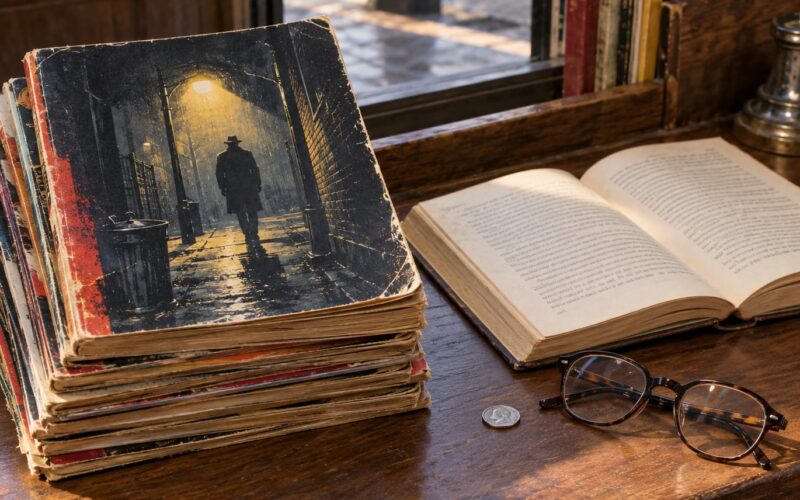
Why film noir looks the way it does comes down to a handful of deliberate choices made under pressure: one hard light source, almost no fill, black-and-white film, cramped rooms, and a camera that refuses to give you a clean view of anybody. The style that came out of 1940s Hollywood crime films is not decoration. It is the argument the films are making about a world where you cannot trust what you see.
If you have watched Double Indemnity or The Maltese Falcon and found the shadows oppressive rather than atmospheric, you are reacting to the technique working exactly as intended. A little patience with how the light was built changes the experience more than most people expect.
Table of Contents
- What Makes Film Noir Visually Distinctive?
- Why Film Noir Looks the Way It Does: Light and Shadow
- How Do Venetian Blinds and Dark Windows Create Suspense?
- Why Film Noir Uses Low Angles, Diagonal Frames, and Tight Close-Ups
- How Did German Expressionism Shape the Noir Look?
- What Do Rain, Fog, Smoke, and Wet Streets Do for Film Noir?
- Why Are Film Noir Interiors So Cramped and Cluttered?
- How Did Black-and-White Photography Define Film Noir?
- What Visual Techniques Separate Film Noir From Other Crime Films?
- Why Film Noir’s Look Still Matters Today
- Frequently Asked Questions
- Is film noir the same thing as black-and-white cinema?
- What is the point of lighting scenes with venetian blinds?
- Which director most strongly defined the film noir look?
- Why is film noir associated with rain and dark city streets?
- How can a modern film or story use the noir look effectively?
- Conclusion: Start with Shadow and Contrast
What Makes Film Noir Visually Distinctive?
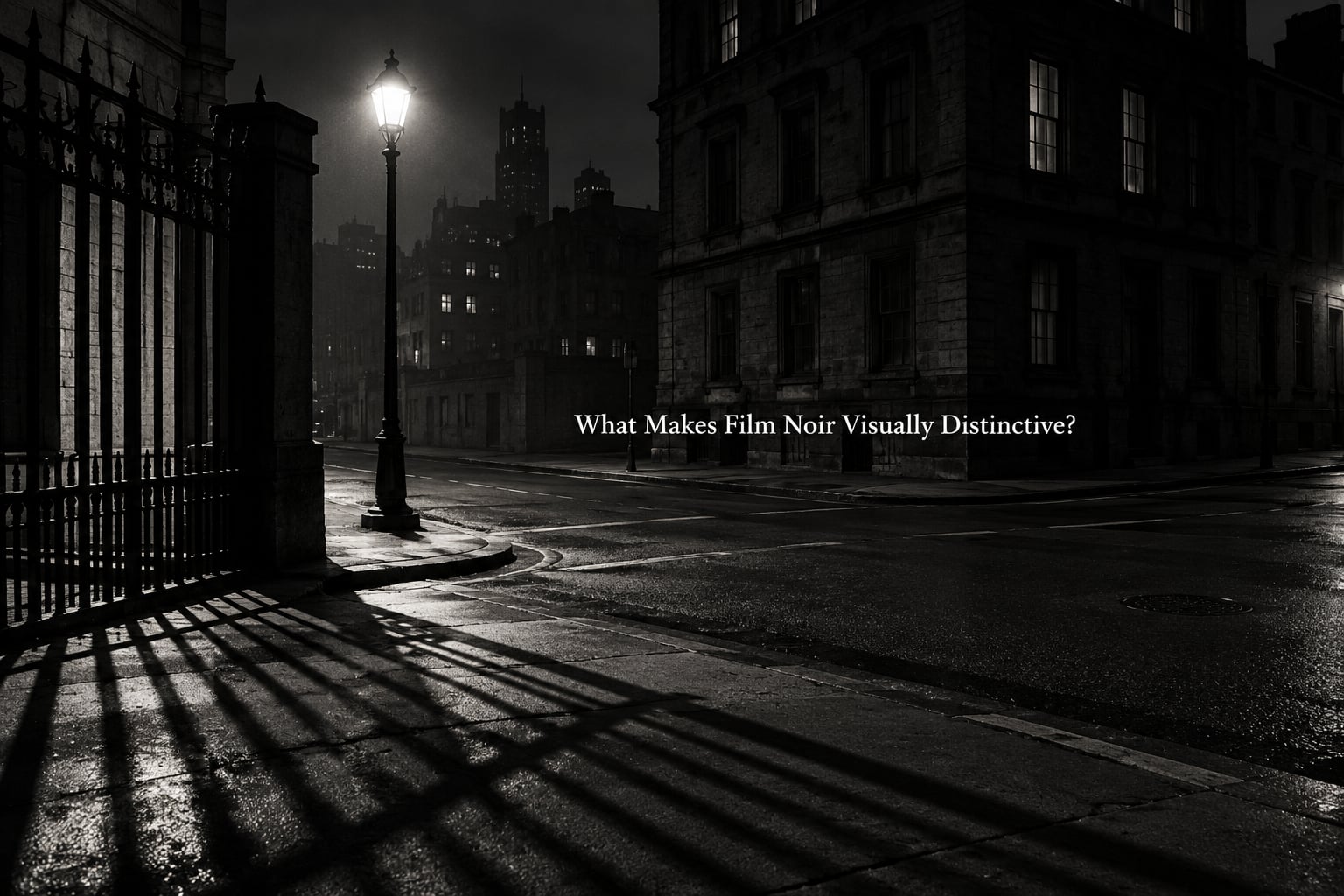
Film noir is a style rather than a genre, and it is defined visually more than anything else. The direct answer to why film noir looks the way it does is this: the lighting, framing and set design of noir were built to keep half the frame in shadow, so the audience is given partial information and forced to fill the gaps with suspicion.
The signature runs to ten points, and once you can name them you will start spotting them in films that have nothing else in common:
- Low-key lighting with a high key-to-fill ratio, so most of the frame falls into darkness
- Chiaroscuro — strong contrast between light and shadow drawn from chiaroscuro painting
- Hard, directional sources rather than soft, flattering ones
- Venetian blind shadows striping faces, walls and floors
- Canted frames and oblique angles that unsettle the horizon
- Obstructed sightlines through doors, stairwells, railings and foreground clutter
- Cramped interiors and cluttered mise-en-scène
- Night exteriors with rain, fog, steam and wet reflective pavement
- Monochrome photography amplifying tonal contrast and silhouette
- Subjective camera and extreme close-ups that withhold context
Where the name came from matters too. French critics reviewing American films that American audiences had not seen during the war called them film noir, literally dark film, after Nino Frank used the term in 1946. The label stuck to the look rather than the plot, which is why a corrupt police chief and a lonely widow in a doorway can both be noir.
Why Film Noir Looks the Way It Does: Light and Shadow
Chiaroscuro is the technique of using strong tonal contrast to model form and mood. In noir it means lit faces floating in black, with nothing in between to soften the transition. A shadow in a noir frame is not empty space. It is active, and it hides whatever the filmmakers have decided you should not see yet.
Low-key lighting is the practical version of that idea: a single hard key light, minimal fill, and darkness allowed to go genuinely dark. Classic three-point lighting exists to make faces look good and readable. Noir deliberately refuses that. Look at how that plays out across techniques:
| Lighting technique | What the audience gets | What it signals |
|---|---|---|
| Single hard key, no fill | A lit cheekbone and an unreadable half-face | Secrecy; the character is not fully knowable |
| Blind shadows across the face | Expression visible in stripes only | Someone is being watched or is hiding |
| Practical lamp as the visible source | Light you can trace to an object in the room | Confinement; nowhere else to go |
| Backlit silhouette | A shape with no readable features | Threat, or a secret identity |
| Under-lit key from a low angle | Eyes in shadow, jaw lit | Power imbalance and suspicion |
| Falloff to total black | A face emerging from nowhere | The city out there is hostile and unknown |
Double Indemnity is the cleanest example. Walter Neff’s office is lit by a desk lamp and a window with blinds, so his own explanations play across a moving grid of light and dark on the wall behind him. The pattern never changes. His story does.
How Do Venetian Blinds and Dark Windows Create Suspense?
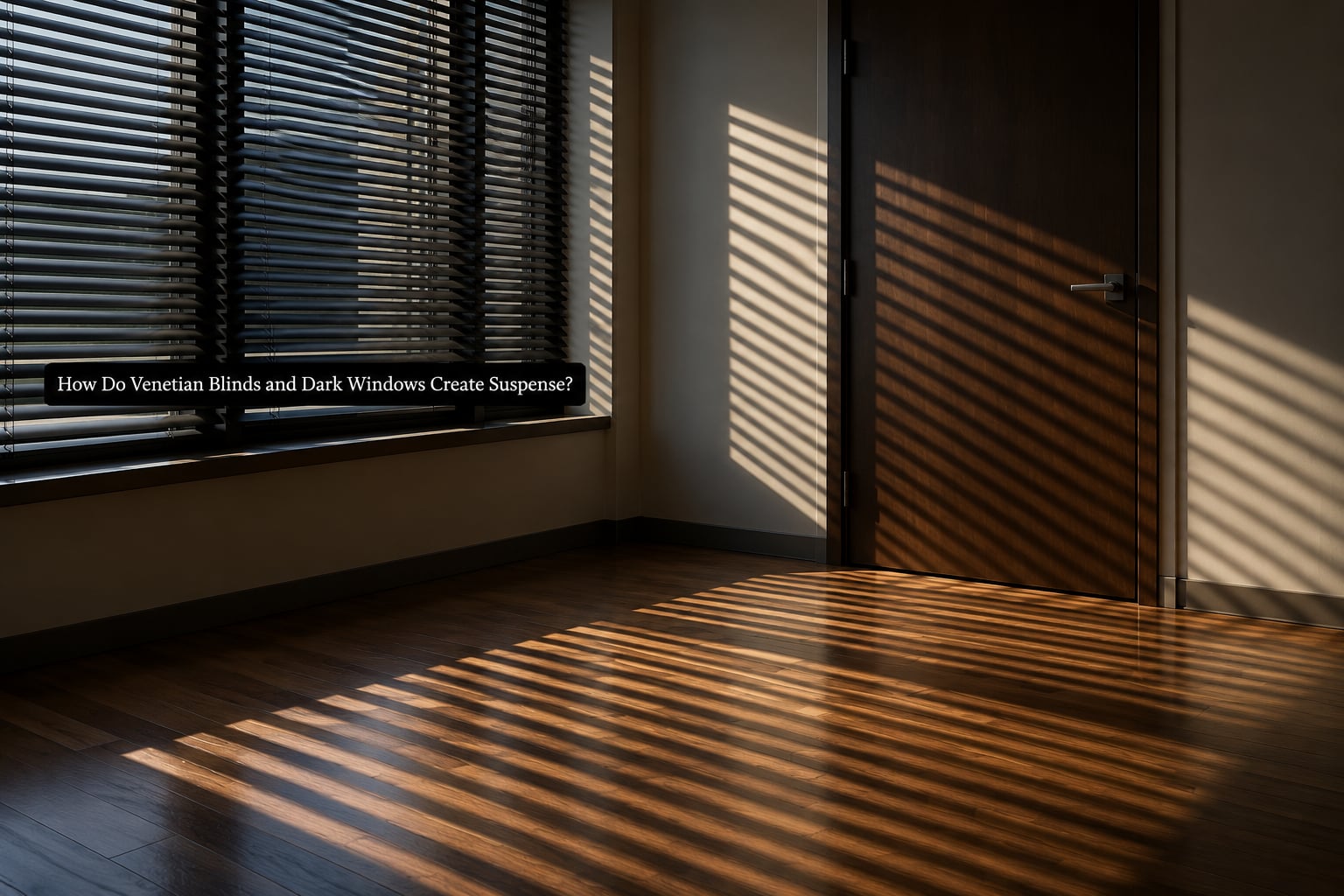
Venetian blinds are the cheapest and most useful prop in the whole style. Physically they split one light source into a repeating pattern, which is exactly what noir wants: half the frame readable, half the frame blocked.
Because the obstruction sits between the camera and the subject, it also puts a barrier into the story. Someone on the other side of that slat gap is not fully available to us, and the waiting is the tension. Doors do the same thing more slowly, a hallway light under a door saying somebody is home but not opening. Reviewers on classic film forums point to this as the single most recognisable noir habit, and it survives into neo-noir almost unchanged.
The effect scales up. A stairwell balustrade, a chain-link fence, a curtain half drawn, a parked car across the street: each one lets the camera watch from a position the character does not control.
Why Film Noir Uses Low Angles, Diagonal Frames, and Tight Close-Ups
A canted frame, or Dutch angle, tips the horizon so the world looks briefly unstable. Noir uses it sparingly, which is exactly why it registers. Shot after shot it would be a gimmick; once per sequence it reads as a jolt, as though the room has tilted to match a character losing control of their situation.
Low angles do the opposite work. Shooting up at a figure against a ceiling makes the person loom, or makes the architecture look like it is closing in. In Touch of Evil the camera drops to pavement level for the opening, and the whole frame becomes a trap the protagonists cannot see the edges of.
Close-ups subtract information. An extreme close-up of eyes or a hand tells you how someone is doing without telling you what room they are in or who else is present. Combined with first-person voice-over, it also narrows the story to one consciousness, which makes any gap between what is said and what is seen feel deliberate.
None of this is only about looking stylish. Framers who study noir note that viewers praise films that are stylish without being excessive, and that balance comes from picking two or three devices per scene rather than stacking all of them.
How Did German Expressionism Shape the Noir Look?
The Cabinet of Dr. Caligari, released in 1920, set the template that noir later drew on: sharp angles, walls that bend, shadows that fall the wrong way, and light that behaves like a hostile character. German sets of the 1920s made architecture visibly nervous, and when the studio system crushed that tradition, the people who had learned it moved.
When Hollywood started making anti-Nazi films after 1939, directors who had worked in Germany brought the visual vocabulary with them. Fritz Lang had already shaped the American crime picture with M before the war ended. Robert Siodmak arrived with a reputation for economical, high-contrast lighting and turned out a run of studio noirs. Billy Wilder imported a colder, more verbal version of the same pessimism.
Hollywood supplied its own pressure and its own material. Wartime audiences were uneasy, the studios had budgets to defend, and the gangster picture and the hard-boiled detective novel had already supplied the plots. Expressionism was the raw material, not the whole answer. Orson Welles, for instance, ran noir’s concerns about unreliable perception in a direction of his own: Citizen Kane uses deep focus, low angles and a ceiling of black cyc to make a man’s wealth feel like a hiding place.
What Do Rain, Fog, Smoke, and Wet Streets Do for Film Noir?
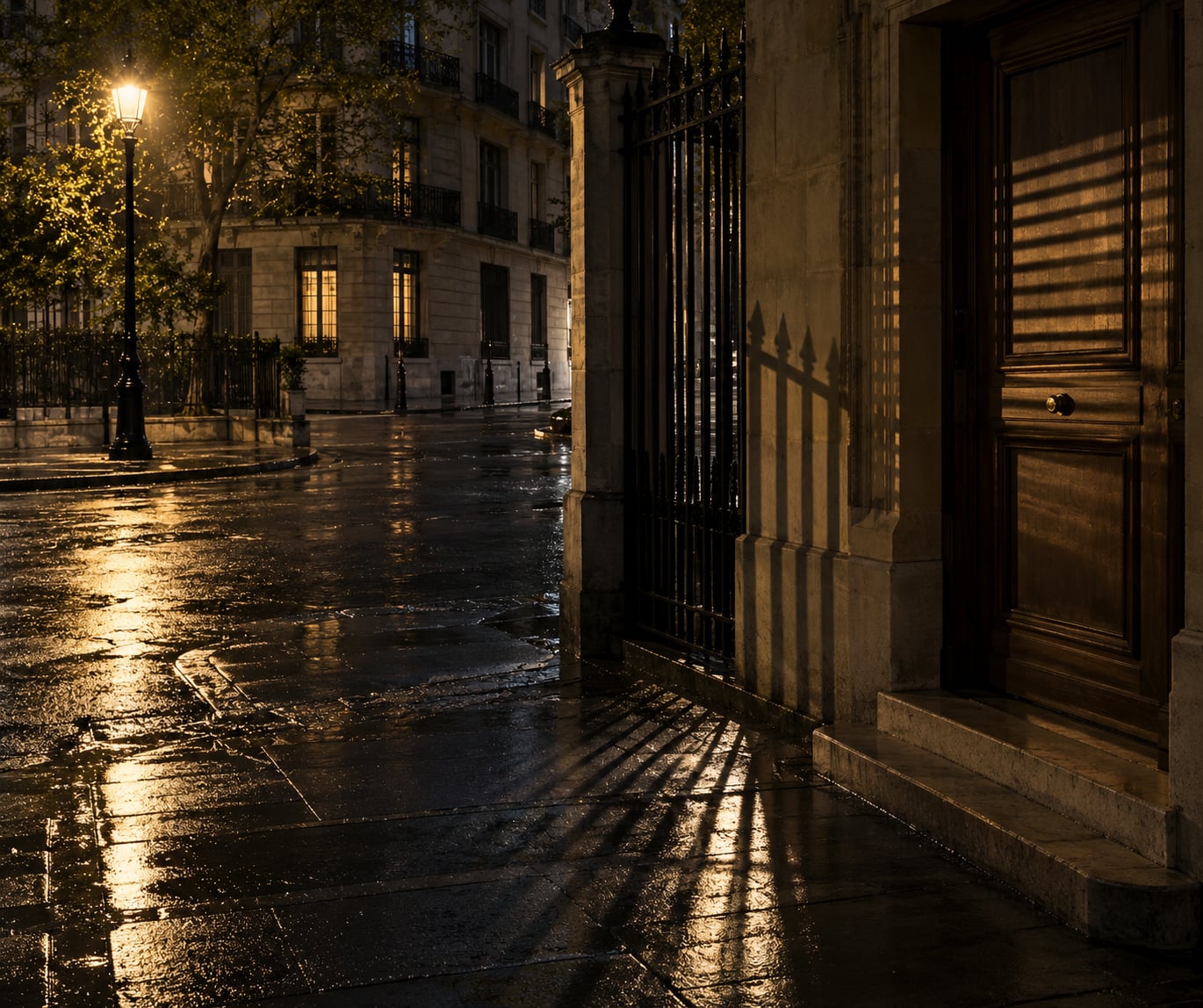
Rain does three jobs at once. It wets the pavement so a streetlamp or a neon sign doubles underneath it, it softens the edges of the city into haze, and it lets a figure approach as a blur before you can read them. Fog and steam do the same thing more slowly, with fewer moving parts.
Weather also shortens the visible world. Noir exteriors are usually at night, usually partially obscured, because a character who cannot see the corner cannot check what is behind it. Fear in noir is informational as much as physical, and atmosphere is how you get it without a monster.
Worth saying plainly: rain alone is not noir. A gentle shower in a bright, evenly lit family drama is just weather. What matters is whether the atmosphere reduces what the viewer can verify. If the wet street is there to make the city beautiful, it is decoration. If it is there to hide a car idling out of focus, it is noir.
Why Are Film Noir Interiors So Cramped and Cluttered?
Small rooms keep people close together and keep exits in frame. A cramped apartment or a narrow office gives a conversation nowhere to go, and a character who cannot leave the room cannot dodge the question. Production design pushes in the same direction: a filing cabinet, a radiator, a coat on a hook, blinds on every window.
There was also a budget reason. Studio noir was often made on Poverty Row schedules with sets dressed once and shot from several angles, and cramped interiors are cheaper to light than wide locations. Reused apartment interiors became so associated with the style that they read as a code: if the walls are close and the light is low, expect a bad ending.
Wardrobe does quiet structural work in the same rooms. A fedora brim cutting across a lit cheekbone, a light-coloured suit against a dark wall, a woman standing in a doorway rather than entering it — these are silhouette decisions that survive being described on the page, which is why crime writers borrow them.
How Did Black-and-White Photography Define Film Noir?
Monochrome removes hue and leaves tone, which is exactly the axis noir works on. Without colour to separate objects, a face and a wall at similar brightness merge, and the shape of a shadow carries the information instead. Reflections in wet asphalt, wet windows and polished desks all become legible as light rather than as reflections of coloured signs.
The stock itself was not always the artists’ first choice. Wartime restrictions limited film supplies and forced faster, less plentiful shooting on smaller budgets, and many B-movies shot monochrome partly because it was what the studio had and partly because it hid cheap sets. Those constraints then became a style, and once audiences had learned the vocabulary they expected it.
Nor is noir the same thing as black and white. Plenty of black-and-white crime films are bright, evenly lit and full of deep focus, and plenty of noir happens in colour: Sunset Boulevard and The Third Man, both from 1950, play the shadow game in colour. What noir requires is the treatment of light, not the absence of colour. That distinction is worth holding on to when a modern film arrives with a grayscale filter and none of the lighting to go with it.
What Visual Techniques Separate Film Noir From Other Crime Films?
Noir overlaps heavily with several other traditions, which is where most online confusion comes from. The boundaries are visual and tonal rather than subject-based:
| Tradition | Lighting and camera | Moral outlook | Typical period |
|---|---|---|---|
| Detective film / police procedural | Even, informative lighting; wide shots and inserts | Justice is achievable | 1930s onward |
| Film noir | Low-key, hard shadows, canted and obstructed frames | Fatalistic; the system is corrupt | 1940s to mid-1950s |
| Film grey | Cooler, more naturalistic; less stylised contrast | Cynical but unsentimental | Overlapping period |
| Neo-noir | Colour, digital, wider dynamic range; same framing habits | Ambiguous to the point of open endings | Late 1970s onward |
A useful test: if you removed the shadows and canted angles, would the film still be tense? If yes, you are probably looking at a detective story with noir styling rather than noir proper.
Why Film Noir’s Look Still Matters Today
The devices travelled well because they are cheap and legible. A modern film can put a hard shaft of light across a face, block a doorway, or push a colour palette down to two or three hues and be read instantly as noir. Nightmare Alley leans on the same chiaroscuro the 1947 original used. The Batman takes the flooded city, the vertical frames and the corruption-under-the-city structure. Se7en pushed the wet, unlit city so far that it made noir lighting a horror device.
Outside film, the look shows up in book covers, in photography where a blinds gobo is still a favourite tool, and in crime fiction written to be filmed. In prose the technique is the same: tell us what light is doing and what it hides, and the reader supplies the fear.
What fails is imitation without purpose. Grey skies, long coats and a slow zoom are costume, not style. The look only works when it is doing a job a normal lighting setup would not do.
Frequently Asked Questions
Is film noir the same thing as black-and-white cinema?
No. Black-and-white is a photographic format; film noir is a style built around low-key lighting, hard shadows and obstructed framing. Some noir films were shot in colour, including Sunset Boulevard and The Third Man in 1950, while plenty of black-and-white crime films are brightly lit and plainly shot. Ask instead why a scene is dark: if shadow is concealing faces and motives, you are probably looking at noir.
What is the point of lighting scenes with venetian blinds?
Blinds split one light source into a repeating pattern, so part of a face stays readable and part is blocked. That partial visibility is the point. It hides motive, suggests somebody is watching, and creates anticipation because the character cannot see as much as the camera can. The blinds also work as a cheap gobo, letting a crew create noir lighting with one lamp and a prop that is already in the set.
Which director most strongly defined the film noir look?
Robert Siodmak is usually credited with defining the template, particularly through films such as Phantom Lady and The Killers, where hard single sources and controlled contrast did the psychological work. Fritz Lang established much of the American crime idiom before him, and Billy Wilder brought a colder, more verbal version to Double Indemnity. Directors worked within a studio system, so no single signature explains the whole style.
Why is film noir associated with rain and dark city streets?
Rain wets the pavement so lights double underneath it, fog and steam soften the edges of a city, and both reduce how much the viewer can verify. Combined with night exteriors, that makes the surroundings feel larger and less knowable than the character. Why film noir looks the way it does comes down to this: the atmosphere is there to shorten the distance between a person and the thing they cannot see coming.
How can a modern film or story use the noir look effectively?
Pick a light source and let it withhold something. Shoot one hard source with minimal fill, block part of the frame with something in the foreground, and decide what the audience is not going to learn yet. Then cut rather than add: two or three devices per scene is plenty, and noir loses authority when every frame competes. Writers can do the same thing in prose by describing what the light hides instead of narrating everything plainly.
Conclusion: Start with Shadow and Contrast
The noir look was built from a small number of deliberate constraints: one hard key light and little fill, blinds and doorways cutting the frame into readable and blocked pieces, canted and low camera angles, cramped rooms, night weather, and monochrome to leave tone doing the work. Add postwar anxiety, German-trained directors arriving at Hollywood, and studios shooting fast on limited budgets and materials, and you get why film noir looks the way it does.
Start with a single scene and find its main light source, then notice everything the shadows refuse to show you. If that withheld information is what makes you uneasy about a character, the style is doing what it was built to do, and you will never have to ask why again.