Learning how to collect vintage paperbacks takes four habits, not a big budget: choose a narrow focus, read the copyright page before you pay anything, grade condition with the same words every single time, and write down what you already own. That is the whole method, and it works whether you are hunting crime paperbacks from the 1950s or just trying to stop a box of inherited books from falling apart.
I will be straight about the money side early: most vintage paperbacks are not valuable. The format is mass-produced, so supply is enormous and only a narrow slice of it ever earns more than a few dollars. The collecting is worth doing anyway, because these are cheap books that are pleasant to own, easy to store and — with the right handling — good for decades.
Updated for 2026.
Table of Contents
- What You Need
- Tools
- Records
- Supplies
- Research resources
- Step-by-Step: How to Collect Vintage Paperbacks
- 1. Pick one focus and write it down
- 2. Learn what the publisher and date clues look like
- 3. Source cheaply, in this order
- 4. Inspect before you commit
- 5. Identify the edition
- 6. Grade it honestly
- 7. Log it, then decide keep, sell or pass
- How to Collect Vintage Paperbacks Online
- What to look for in a listing
- Spotting the traps
- Using comparable sales
- Communicating safely
- How to Collect Vintage Paperbacks at Bookshops and Fairs
- A field routine that works
- Reading dealers
- Negotiating without the theatre
- Mistakes unique to in-person buying
- How to Identify a First or Early Edition
- What to check, in order
- Edition types at a glance
- How to Store and Protect Your Collection
- The condition scale you should use
- Shelving
- Climate and light
- Cleaning
- Handling, sleeves and moving books
- Reading your own collection
- Common Mistakes
- Treating any old paperback as a first edition
- Paying without checking the back cover
- Over-cleaning the cover
- Storing flat in piles
- Letting light and damp do the damage quietly
- Buying box lots wholesale
- Packing badly when selling
- Three habits that fix most of the above
- Frequently Asked Questions
- How old does a book need to be to be vintage?
- Are most vintage paperbacks worth anything?
- How do I know if my paperback is a first edition?
- How do I clean old paperbacks without ruining the cover?
- Should old paperbacks be stored upright or flat?
- Conclusion
What You Need
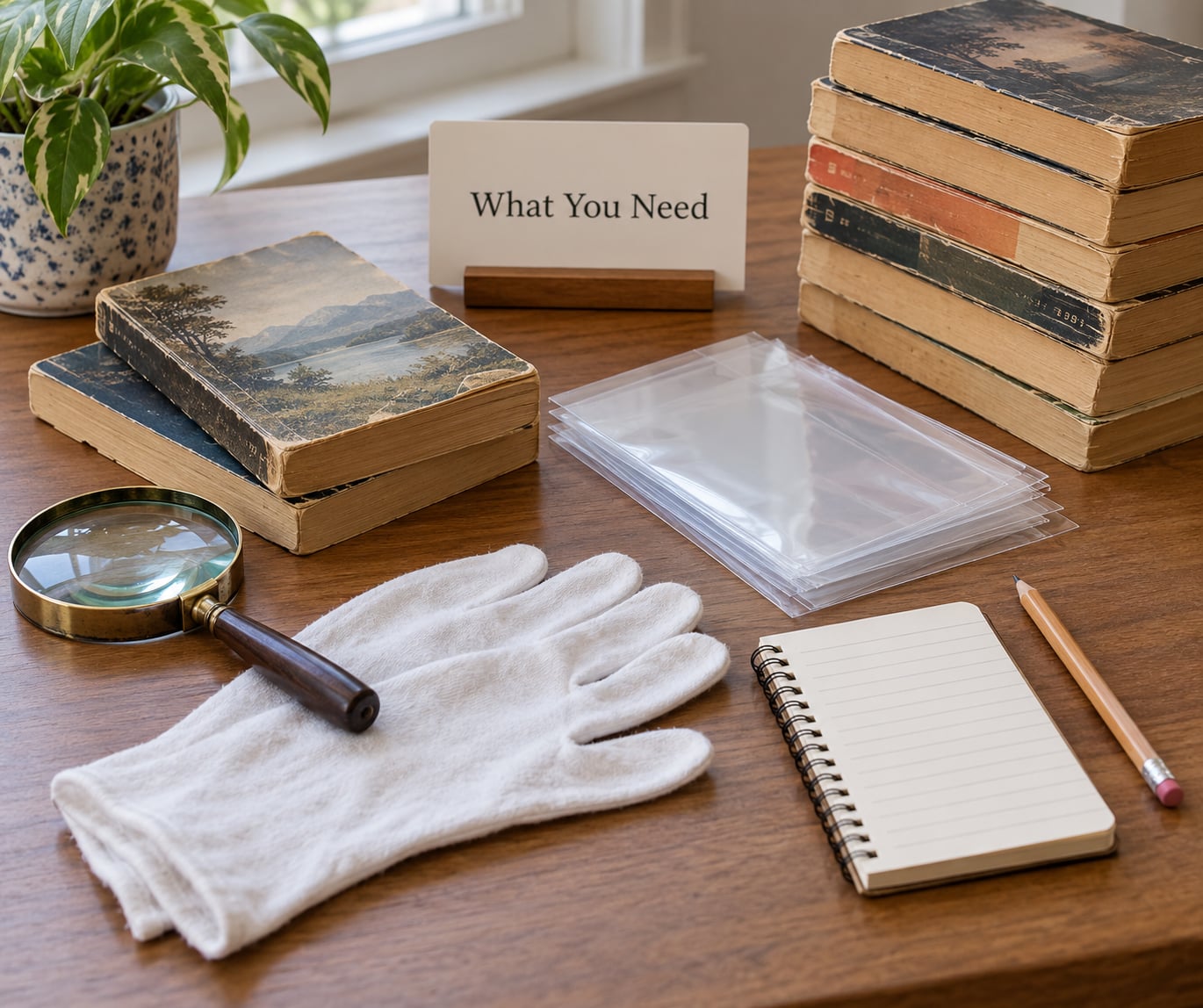
None of this is expensive, and you can improvise most of it for the first few months. Buying the wrong tools is the only real risk, and the wrong tool here is the aggressive cleaner.
Tools
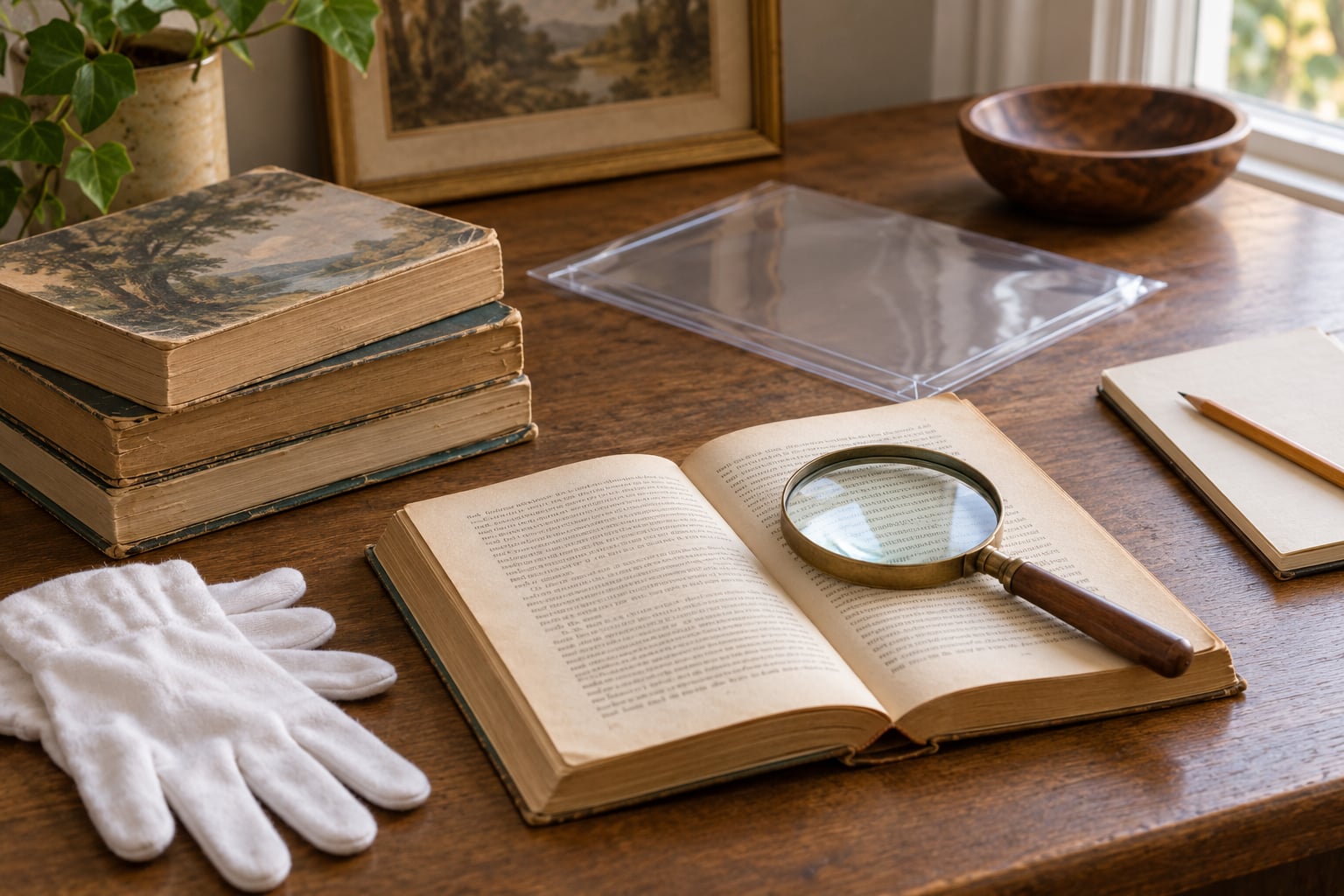
- A magnifying glass or loupe. The printing code on the copyright page of a 1960s paperback can be a line of four numbers no wider than your thumbnail. You need to read it, not guess at it.
- Cotton gloves. Handling books with clean, dry hands is honestly fine for most paperbacks. Gloves matter more for the glossy, varnished covers of the 1960s and 1970s, where fingerprints show and oils catch.
- A pencil, never a pen. Pencil marks on an endpaper or a price sticker can be erased. Ink cannot, and it follows the book into every resale listing as a defect.
- A soft brush for dry dust off edges and hinges, plus a clean cloth.
Records
- A collecting notebook or spreadsheet. One row per copy: title, author, publisher, printing code, condition grade, date, source, and what you paid. This is the single most useful item on the list and the one beginners skip.
- A wishlist of the specific authors, series or publishers you are chasing. Impulse buying at a thrift store is how shelves fill with duplicates.
Supplies
- Archival polyester sleeves for anything you care about. Polyester, not polypropylene, which can stick to ink over time. Brown or buffered board inside gives a flimsy mass-market paperback a spine that will not crack.
- Interleaving paper to line acidic neighbours against better books.
Research resources
- Comparable sales, not asking prices. BookFinder and sold-listing pages show what copies actually sold for; an asking price is a wish, not a market.
- A publisher and imprint list for your chosen era. Pocket Books, Bantam, Signet, Ballantine, Ace, Lancer, Pyramid, Dell, Popular Library, Belmont, Lion and Arrow all ran paperback lines with distinct cover styles, and knowing which imprints to hunt cuts your sorting time in half.
- One preservation reference you trust. Bern Marcowitz and Margot Rosenberg’s The Care and Feeding of Books is the standard I keep going back to.
Step-by-Step: How to Collect Vintage Paperbacks
Seven steps, in order. Skipping ahead to the buying is how people end up with forty books they cannot identify and no idea which ones matter.
1. Pick one focus and write it down
A focus turns a random shelf into a collection with a shape. Choose one author, one series, one publisher imprint, one decade, one cover artist, or one subject you actually read. “Crime paperbacks, 1945 to 1965” is a workable focus. “Vintage books” is not.
Write the focus on the first page of your notebook. Every book that does not fit it gets a decision later, and you make that decision in ten seconds instead of twenty minutes.
2. Learn what the publisher and date clues look like
Before hunting, spend an hour with five or six books you already own. Flip each one to the copyright page and find the publisher’s logo, the printing code, the price and the copyright year. That single exercise teaches you more than any article, because you are building a reference set you can check anything against later.
Mass-market paperbacks from the 1950s through the 1980s often carry an alphanumeric symbol on the copyright page. The small infinity-like mark that began appearing in the 1980s signals acid-free paper. Absent that mark, assume the paper is acidic and will keep degrading.
3. Source cheaply, in this order
Thrifting and library sales come first because the price of a mistake is tiny. Estate sales and flea markets are next. Online listings and dealer stock cost more, so you want a method before you spend there.
Library sales are the most underrated source on this list. Donations arrive by the carton, prices are low, and nobody is negotiating with you at seven in the morning.
4. Inspect before you commit
Run the same five-point check on every copy, in every setting, so your judgement does not depend on how tired you are or how much you want the book.
- Spine and hinge: is it unbroken, uncracked, uncreased?
- Cover: any creasing, corner bumps, or fading?
- Edges: foxing (brown spots), brittleness, or a dark halo from an old rubber band?
- Odor: any mustiness at all? If yes, walk away.
- Interior: pastedowns, a price sticker, an inscription, a missing ad leaf?
Photograph the copyright page the moment you buy. On forums, a clear shot of the printing code line is what earns trust, and you will want that photo for your own notebook later.
5. Identify the edition
Flip to the copyright page. Read the number line, edition statement and any book club marking. Five minutes here is the difference between a copy worth something and a copy worth pocket money.
6. Grade it honestly
Write one word — As New, Fine, Near Fine, Very Good, Good, Fair or Poor — and note the defect that earned it. Collectors trust sellers who state defects plainly rather than praising a book vaguely.
7. Log it, then decide keep, sell or pass
Enter the row in your notebook on the same day. Then apply a fixed rule: anything outside your focus goes to the trade pile, anything inside it gets a sleeve, and anything you will never read is a candidate to sell or donate once duplicates start stacking up.
How to Collect Vintage Paperbacks Online
Online is where editions get described in words instead of measured by hand, so your job is reading between the words. A listing that says “first edition” without a photo of the copyright page is a guess.
What to look for in a listing
- A photograph of the copyright page, not just the cover.
- A printing code, or an explicit statement that there is none.
- Named defects: spine cracking, corner wear, foxing, a price sticker, an inscription.
- A condition word used consistently with the photos.
- A note on missing pages, advertisements or the rear ad panel. Incomplete copies are common and are worth less.
Spotting the traps
Later printings and book club editions are the two reliable ways to overpay. A book club edition usually carries a blind stamp or a small logo on the back cover and inside the front board; if the seller does not mention it, ask directly. Also watch for stock photos — a cover image lifted from a dealer site tells you nothing about the copy in the box.
Using comparable sales
Check BookFinder or the sold-listing history for the same title, publisher and printing code before you bid. If a copy sold three times in the past year at a steady figure, that is your market, not the listing in front of you. Sellers on collector forums routinely point newcomers toward sold listings for exactly this reason.
Communicating safely
Ask for the copyright page photo if the listing has none. Pay through the marketplace rather than by transfer, so you keep buyer protection. Never let a seller move you off-platform because they want to avoid fees.
How to Collect Vintage Paperbacks at Bookshops and Fairs
In person you have the one thing you cannot get online: you can look at the actual copy. The habit that matters is a fixed routine, because in a thrift store the good stuff gets into your hands and into your head at the same speed.
A field routine that works
Pull the spine check first, since it takes one second and eliminates half the shelf. Read spines like a word search for the authors and imprints on your focus list. Only then open anything that survives: hinge test, corner press, edge and odor check. Flip to the copyright page last, on the ones you already want.
Reading dealers
Useful signals from a used bookseller: they shelve upright rather than in leaning piles, they bag and board the better stock, and they will tell you honestly why a copy is priced as it is. Ask them what came in this week that is not on the shelf. Regulars get told first, and that answer is free information.
Negotiating without the theatre
For a shelf copy, offer a modest, plain number and expect a plain answer. Multi-book deals are where sellers actually move. Being pleasant and asking about their stock usually returns more than haggling over three dollars does.
Mistakes unique to in-person buying
- Buying a box because it is cheap and sorting it for six months.
- Skipping the odor check because you did not want to open it.
- Leaving without writing down what you bought, then losing the receipt and the printing code together.
- Paying specialty prices at a charity shop that sells by the title, not by the copy.
How to Identify a First or Early Edition
Age alone tells you nothing. A book from 1972 can be a genuine first printing of a debut, and a book from 1948 can be the thirtieth printing of a blockbuster. Identification happens on one page: the copyright page, sometimes called the publishing page.
What to check, in order
- Title page and publisher imprint. Early paperbacks often omit the publisher entirely, which is itself a clue to the era.
- Copyright year. Compare it against the story’s setting and the author’s other titles. An odd year is worth a second look.
- Edition statement. Any line saying “first edition,” “first printing” or “first edition thus” tells you directly.
- The printing code. A row of numbers and letters near the bottom of the page. The number that comes second or third usually increases with each printing.
- The number line. A ten-digit number system in use from about 1970 onward, where the last digit tells you the printing.
- Paper, binding and jacket. Cream or grey pulp stock and a stapled binding point to an earlier era. A price on the cover that differs from the others on the shelf points to a different printing.
- The back cover and inside board. Look for a book club blind stamp or logo.
Edition types at a glance
| Edition type | How to spot it | What it means for value |
|---|---|---|
| True first | First printing, first issue jacket, no book club marking | The only version serious collectors pay a premium for |
| Later printing | Printing code number has climbed; same cover, later paper | Cheap reading copy; worth a few dollars at best |
| Reprint | New edition statement or updated price and jacket art | Worth no more than the market for that edition |
| Book club edition | Blind stamp or club logo on the back cover or inside board | Discounted issue; widely avoided and priced accordingly |
Two things can override edition entirely. Condition, because a damaged copy of the right printing is worth less than a clean copy of the wrong one. And a dust jacket: Biblio, the used-book marketplace, notes that a missing or poor dust jacket can cut a collectible book’s value by more than half. That figure comes from hardcovers, where jackets are normal, but the habit of protecting the outer wrapper applies to a fine-art paperback cover too.
How to Store and Protect Your Collection
Paperbacks are the fastest-deteriorating format in your house. Cheap paper, glue-heavy bindings and acidic stock mean a book that looks fine today can be brittle in a decade. Storage is where most collectors actually protect their investment.
The condition scale you should use
| Grade | What you should see | Effect on resale price |
|---|---|---|
| As New | Reads as unread; crisp spine, sharp corners | Top of the range; rare in mass-market stock |
| Fine | Very light shelf wear, spine bright, no creasing | Strong selling point |
| Near Fine | A few small flaws detectable on close inspection | Minor reduction only |
| Very Good | Light spine wear, corners just beginning to soften | The usual honest thrift-store grade |
| Good | Visible shelf wear, spine lettering faded, board scuffed | Reading copy; low resale value |
| Fair | Creasing, small tears, foxing, writing inside | Give it away or trade it |
| Poor | Cracked spine, water or mold damage, missing pieces | Recycle or use for parts |
Shelving
Stand paperbacks upright, and fit them snugly rather than loose — a tight row supports the spines and a gapped one lets them lean and crease. Very large or heavy books lie flat, since upright they bow and crack. Never stack mass-market paperbacks in a horizontal pile; the ones at the bottom take the weight.
Climate and light
Regulate temperature and relative humidity where the books live, and keep sunlight off the shelf entirely. Heat and damp accelerate deterioration in every book, and ultraviolet light fades cover art permanently — the single most visible loss to a paperback collection. A closed closet on an interior wall beats an open bookcase by a window.
Cleaning
Dry dust first with a soft brush. Never use household sprays, alcohol or damp cloths on a printed cover: modern spines are printed with inks that dissolve or lift, and a yellowed cover can end up with bare patches where the lettering was.
If a book smells musty, separate it from the rest immediately, fan the pages and leave it in a dry room. If you see fuzzy growth or mustiness that does not clear, bag it and stop there. Biblio’s advice is to seal mold-affected books in plastic straight away, because one wet paperback will contaminate everything on the shelf.
Handling, sleeves and moving books
Handle by the spine, not the edges, and open it around a book weight if you care about the hinge. Bag and board anything valuable before it goes back in the box. When you move a collection, use small boxes and fill every gap with paper; a corner crunched in transit is the most common loss a reseller reports, and it happens in the mail rather than on the shelf.
Reading your own collection
Plenty of beginners say they are afraid to read what they collect. Read them. A paperback is a book, not a specimen; put a sleeve over the one copy that matters, buy a second reading copy if it is rare, and use the rest.
Common Mistakes
Almost every beginner mistake shares one cause: skipping the record of what a book actually is before paying for it. Each of these has a direct fix.
Treating any old paperback as a first edition
The most common and most expensive error. Copy is not edition. Read the copyright page every time, and if there is no number line, assume it is a later printing until proven otherwise.
Paying without checking the back cover
Book club copies are discounted issues and collectors avoid them. Check the back cover and inside front board before paying.
Over-cleaning the cover
Sprays and damp cloths strip printed lettering from old spines. Dry dust only. It is the fix that costs nothing and cannot be undone.
Storing flat in piles
Horizontal piles crease spines and dog-ear corners of books in the middle. Stand them up, snug and supported.
Letting light and damp do the damage quietly
A sunny shelf fades every cover it touches, and a damp basement grows mold. Move the books first; the cost is an afternoon.
Buying box lots wholesale
Do not buy forty unknown paperbacks so you can find the three good ones. Box lots only make sense once you already know what you are looking for and can process them quickly.
Packing badly when selling
A rigid mailer with cardboard stiffeners inside, corners protected, never a padded envelope. Sellers who state their defects plainly in the listing are also the ones whose buyers come back.
Three habits that fix most of the above
- Compare editions before you compare prices. Two copies of the same novel can differ by an order of magnitude, and the difference is on the copyright page.
- Set a fixed monthly spend and stop when it is gone. It turns collecting into a process instead of a mood.
- Buy slowly. The Fedoral Lounge poster with several hundred books built over years described collecting “the great titles” rather than chasing a checklist, and a good find still arrives in a thrift store bin most weeks.
Frequently Asked Questions
How old does a book need to be to be vintage?
Most collectors use 20 to 30 years as the working line, so anything printed before the mid-1990s or so counts as vintage. There is no industry-standard cutoff, and age alone decides nothing. Rarity, printing, condition and whether an author mattered at the time move the value far more than the calendar year on the copyright page.
Are most vintage paperbacks worth anything?
No. Paperbacks were mass-produced, so supply is enormous and most copies sell for a few dollars or nothing. The exceptions are genuine first printings of debut or significant novels, scarce pulp titles and early cover art. Collect for interest in the book and the hunt, and treat money as a pleasant surprise rather than a plan.
How do I know if my paperback is a first edition?
Turn to the copyright page and look for an edition statement, a printing code or a number line. Absent any of those, treat the copy as a later printing. Check the back cover and inside front board for a book club blind stamp, then compare sold listings for the same publisher and code before paying.
How do I clean old paperbacks without ruining the cover?
Brush off dry dust with a soft brush and stop there. Skip sprays, alcohol and damp cloths, because printing on old covers dissolves or lifts and leaves bare patches. For musty books, separate them from the shelf, fan the pages in a dry room and bag anything with visible mold growth straight away.
Should old paperbacks be stored upright or flat?
Upright, fitted snugly so the spines are supported rather than leaning, which is the standard guidance from Biblio’s guide to book collecting. Leave large or heavy books flat, since upright they bow and crack. Avoid long horizontal piles, and keep the shelf away from direct sunlight and damp.
Conclusion
Collecting vintage paperbacks comes down to four repeatable moves: narrow the focus, check the copyright page, grade honestly, log it the same day. Everything else — sourcing, sleeve and board, climate, safe packing — follows from those. The knowledge is cheap, the mistakes are cheap to avoid, and the shelf gets better every time you add one book you can actually name the printing of.
Start with a single action tonight: pick one author, one title or one edition type, find five copies of it, and write down the publisher, printing code and condition grade for each. Once that record exists, the next purchase becomes an easy decision rather than a gamble — and that is the whole difference between a shelf of old books and a collection.