To spot a formulaic thriller before buying it, you screen the material you can already reach: the jacket copy, the cover, the review consensus, the free first chapter and the author’s previous books. The useful test is not whether the book uses familiar tropes. It is whether those tropes are examined, motivated or subverted. Most thrillers borrow a structure on purpose. The flat ones borrow it because they have nothing else to say.
Definition box: a formulaic thriller reassembles a familiar plot structure, character archetype or set piece without subverting, complicating or justifying it, so a genre-savvy reader can call its major beats before they land.
That distinction matters more than it sounds, because thriller publishing runs on comp titles and seasonal release slots. Recycled structures are the industry default rather than a warning sign on their own. What separates the book worth your money from the book you abandon at page 90 is the writer’s handling of the recycled part.
Table of Contents
- What You Need
- Step-by-Step
- How to Spot a Formulaic Thriller Before Buying It Through Its Premise
- Check Whether the Plot Has a Visible Machine
- Look for Characters With Unequal Stakes
- Measure Suspense Instead of Counting Twists
- Read for Voice and Control
- Use Reviews Without Letting Them Decide for You
- Common Mistakes
- Frequently Asked Questions
- Does a familiar plot premise mean a thriller is bad?
- Can a book have many twists and still feel predictable?
- How can I tell whether a thriller is suspenseful from a sample chapter?
- Should I avoid buying a thriller if the synopsis reveals a surprise?
- How much should reader reviews influence my decision?
- What if I enjoy formulaic crime novels?
What You Need
Before you start judging, gather four things. Each one is free, and together they take about ten minutes.
The jacket copy, read twice. First for the premise, then word by word for the phrases doing the selling. Publishers write blurbs to advertise a book’s appeal, which means the words doing the most work are the ones describing the twist, the tone or the atmosphere. Those are the words worth interrogating.
The review consensus, not the star rating. Ratings tell you whether readers liked a book. The phrasing in reviews tells you why, and predictability complaints are usually stated in plain language by readers who have no interest in being polite about it.
A free sample of chapter one. Reader forums treat this as the only honest pre-commitment test available, and it is the one piece of the book you can legally read without paying for it. Library services, retail sites and library apps all offer samples in 2026.
The author’s previous three books. A single repeated structure is a coincidence. The same structural signature three times is an author formula, and no publisher will flag that for you.
Add the cover, but rank it last. Cover conventions are marketing, not authorship, and reading a book as a series of isolated set pieces tends to produce false positives. Note the tropes anyway, then move on.
Set your threshold against the subgenre rather than against thrillers in general. A domestic noir, a police procedural, a serial-killer investigation and a gothic estate mystery lean on different conventions, and the same element is a convention in one and a cliché in another. Serial-killer procedurals are built on procedure, so a procedural lacking process is the anomaly worth flagging. Gothics owe you atmosphere and owe you very little plot originality, and readers who buy them rarely expect a surprise. The bar that matters is the bar your favourite books in that lane already set.
Step-by-Step
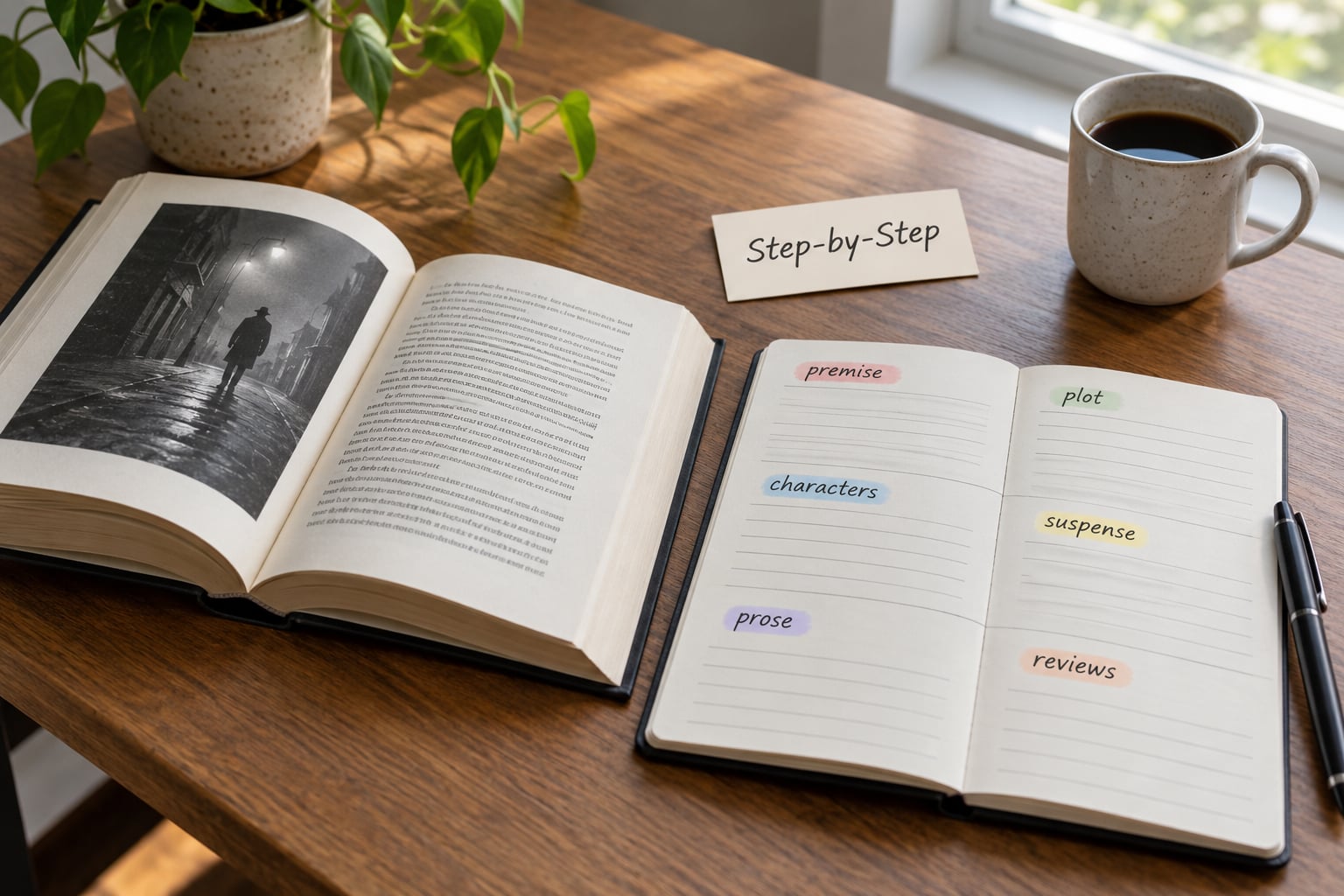
Run the screen in this order. Each step depends on the one before it, so a book that fails early will cost you less attention than one you sample at random.
How to Spot a Formulaic Thriller Before Buying It Through Its Premise
A premise is formulaic when it rearranges well-worn conventions without changing what the book is asking of you. A detective who solves the case through insight, a marriage that hides a body, a disappearance that becomes obsession: those are premises, and plenty of excellent novels have them. What matters is whether the premise creates a problem only this particular book could produce.
The test is substitution. Write the premise in one sentence, then swap in a different killer, a different victim and a different location. If the sentence still works unchanged, the setup is doing nothing except telling you the genre.
Readers run a version of this screen without wording it. In an r/Fantasy thread about synopsis language, one poster described rejecting a book outright on the strength of a single word in the jacket copy. That reaction looks extreme until you realise how much of a blurb is atmosphere and how little of it is information. If one word can end the evaluation, you are entitled to run your own word list too.
Watch also for premises that arrive with their own ending attached. A blurb that names the turn outright has, functionally, handed you the book in marketing form. That is not automatically bad. It does mean the only remaining question is execution.
Some phrases in jacket copy now announce their trope so reliably that experienced readers screen on the words alone:
| Blurb phrase | What it announces | What to check in the sample |
|---|---|---|
| No one is beyond suspicion | Unreliable narrator or a police conspiracy | Does the narrator’s account actually contradict itself |
| A twist you will not see coming | Undisclosed reversal | Does the opening plant fair clues or none at all |
| Blood runs cold in this house | Isolated location set piece | Is the location chosen or is it the only option available |
| Some secrets are worth dying for | Dying-parent or dying-spouse backstory | Whether the secret changes anything for the protagonist |
| The case that haunted the town for years | Cold case or serial offender structure | Whether the past crime is solved or merely re-framed |
| Nothing is what it seems | Everything-is-a-lie premise | How many separate things the book asks you to distrust |
These are prompts, not verdicts. Each one has produced books worth reading. They tell you which question to bring to the sample chapter, which is the whole point.
Check Whether the Plot Has a Visible Machine
A formulaic plot moves through stages you can predict before the characters act. The isolated location. The body discovered early. The suspect who seems too calm. The investigator who ignores the obvious witness. You can recognise this in the sample chapter within a page or two, because the opening usually performs the machine’s first move rather than starting inside a life.
Map the advertised conflict and see how many beats follow from it. If the sample supplies beats one through three and you could name four through six without hesitating, the plot is a visible machine.
Serialization fatigue shows up here too. Readers in r/thrillerbooks ask for unpredictable twists unconnected to crime scenes, and readers elsewhere report having worked through a long run of serial-killer novels that all resolve the same way. That run is not a complaint about murder. It is a complaint about identical structure.
Look for Characters With Unequal Stakes
Fixed roles are the quietest warning sign, because they rarely feel wrong on the page. The jaded investigator with a drinking problem. The victim’s wife who will not leave the house. The young analyst who is good enough at their job and not quite good enough at being a person. Recognise these as archetypes in fiction and as recycled characters in a specific book, and the distinction is motivation.
Ask whether the protagonist, antagonist and one supporting character each stand to lose something specific. Specific means nameable: a custody hearing on Thursday, a signature on a document, a career that cannot survive a scandal. Vague stakes read as stakes-shaped placeholders in the sample chapter.
The inverse signal is strong too. When supporting characters carry the scene, the book is usually character-driven, and character-driven books survive a familiar setup far better than plot-driven ones. Forum readers who tolerate heavy tropletion tend to tolerate it for exactly this reason.
Measure Suspense Instead of Counting Twists
Twists are not suspense, and plenty of books with four twists feel flatter than books with none. Suspense depends on what the reader knows versus what the characters know, and on whether the danger changes shape as the book runs.
In the sample chapter, check three things. Does the reader know something a character does not? Does the character’s plan depend on information you do not have? When a complication arrives, does it narrow their options or merely delay them? Uncertainty that narrows options is suspense. Delay with the same outcome attached is pacing.
Judgement calls do belong in suspense fiction, and that is what good foreshadowing looks like: a fair clue that rewarded attention. Clues that force the outcome, or a twist that solves problems nobody had, read as machinery rather than surprise. Treat any book whose sample page explains itself in exclamation marks with suspicion.
Read for Voice and Control
Prose is the hardest thing to assess from a sample and the most revealing. Look for a specific point of view, deliberate withholding, and detail that could only come from this character’s attention rather than from generic description.
The negative signal is distinctive. Passages of instruction, shorthand characterisation, dialogue that could be swapped between any two scenes without rewriting, and interiority that reports a mood instead of dramatising it. Those read as an outline expanded to length.
A related trap is the unreliable narrator advertised as a selling point when the narrator turns out to be reliable all along. Forum readers list that specific broken promise among their dealbreakers, right next to flat characters and a second half that sags below the first. Reliable publishers honour the hook in the copy, so an unreliable-narrator claim you cannot feel in the sample is worth distrusting.
Use Reviews Without Letting Them Decide for You
Reviews are evidence, not a verdict, and predictability shows up in them as concrete phrasing. Search review text for phrases like “saw it coming”, “called it from page 40”, “nothing new here” and “the ending was obvious”. Then sort by recent and by most helpful, since a rating average destroys exactly the wording you need.
Set the filters this way. Predictability complaints are only meaningful when the reviewer names the mechanism, so discount “predictable” from someone who cannot say which beat gave it away. Overweight single reviews about pacing and prose style, since taste in sentence rhythm varies enormously between readers. Trust repetition: when a dozen separate reviewers point at the same structural weakness, that is the book’s shape, not one reader’s taste.
Trailers cannot help you here. A trailer exists to show plot beats, which means it removes the structure you need to inspect while keeping the tension that sells the book. A coherent trailer is evidence of competent editing, not of an original novel, and the same goes for a heavily merchandised adaptation. Judge the book.
Common Mistakes
Treating a familiar premise as automatically bad. Familiar setups are how genre readers recognise a book’s promises, and plenty of well-built novels run on conventions they openly acknowledge. The divorced and drunk cop is tired as characterisation, not as a plot device, and judging a book for the convention rather than the execution loses books you would have liked.
Counting twists as a quality score. More turns do not add tension when the outcome is fixed in advance, and readers reliably punish a book whose second half sags rather than escalating.
Trusting spoiler-free reviews too heavily. A review that avoids the ending usually avoids the ending because it wants the reader to buy in. Look for structural criticism instead, which can be made without revealing anything.
Judging from the cover. Cover imagery is bought to signal a mood, and one publisher’s bleak farmhouse is another publisher’s bleak farmhouse. It tells you what the marketing department believes the book is about, which is useful context and weak evidence.
Applying a writer’s checklist to a reader’s decision. Nearly every guide on this topic is written for authors avoiding clichés. Those lists describe what a writer should vary; they do not tell you what to refuse as a buyer, because execution quality and plot originality are separate questions.
Ignoring the backlist. Readers distrust an author with one strong novel followed by a repetition of it, and they have no way to see that pattern unless they check. Spend thirty seconds on the previous three titles before you spend a weekend on the new one.
The backlist check is more reliable than any single trope, because it measures the writer rather than the genre. Look for the same structural signature repeated: the same twist location, the same betrayed-spouse setup, the same sequence of reveals in the final act. Authors know this happens, and at least one has gone public about preventing it. Riley Sager described setting himself explicit self-imposed rules for his own books, no unreliable narrator, no flashbacks, no cabin in the woods, precisely so he would not repeat himself. That is a writer auditing his own formula in advance. A reader can do the same thing retrospectively by lining up three covers and three summaries side by side.
One more trap worth naming, because it makes a good book look bad. Books that rely on atmosphere or mood often land very differently across readers. A spare style that reads as controlled to one person reads as thin to another, and a patient opening that feels slow on page 40 may be the thing you still think about a month later. Before dismissing a book as flat, check whether the subplot or the setting is doing the work the dialogue is not. If the review summary mentions the setting in detail, that is your answer.
One last note on why formula is everywhere. Publishing plans books against comp titles, market research and seasonal slots, so a house that knows readers bought last year’s serial-killer structure has a business reason to sell another one. That incentive produces volume, and volume means some books are assembled from what sold rather than from what the writer found. Your screen is not a cure for the pipeline. It is a way to spend your own time better.
Frequently Asked Questions
Does a familiar plot premise mean a thriller is bad?
No. Familiar premises are genre shorthand, and plenty of admired novels run on conventions they openly lean into. What weakens a book is a familiar premise the writer never complicates: the same beat sheet, the same fixed roles, the same ending. Judge execution and motivation, not the raw material.
Can a book have many twists and still feel predictable?
Yes, and it happens constantly. A twist only adds surprise if it opens a new problem. If each turn lands where you were already heading, the book is showing you motion rather than changing direction. Count how many twists force a character to abandon a plan, not how many arrive.
How can I tell whether a thriller is suspenseful from a sample chapter?
Look for a gap between what you know and what the protagonist knows, and check whether complications narrow their options or merely delay them. Suspense comes from narrowing. Also check whether the opening starts inside a life or performs the first move of a plot machine, since the latter is a weak signal.
Should I avoid buying a thriller if the synopsis reveals a surprise?
No. A blurb that names the turn simply tells you the remaining question is whether the book earns it. Some of the best-loved thrillers are advertised by their premise. Sample the first chapter anyway, because the marketing version of the twist and the executed version are rarely the same thing.
How much should reader reviews influence my decision?
Enough to detect a repeated pattern, not enough to skip the book. Mine review text for predictability wording and discount complaints that never name a mechanism. When a dozen separate reviewers describe the same structural weakness, believe them. When one does, it is taste.
What if I enjoy formulaic crime novels?
Then the screen still works, because you are judging execution rather than surprise. Familiar structures with strong voice, fair clues and characters carrying specific stakes hold up well. The tolerance question is whether the book gives you something while staying inside the shape you like.
Start with the blurb and the first chapter, in that order, and give it four minutes. Read the sample asking one question: does this writer use the familiar parts on purpose? If the answer is yes, check the backlist for repetition and buy. If it is no, walk away, because nothing later in the book will change it.
The whole method rests on one line worth remembering: a trope is not the problem, an unexamined, unmotivated, repeated trope is the tell.