Knowing how to write a bar scene in noir comes down to three things: a room that constrains the people in it, characters who each want something incompatible, and dialogue that says far less than it means. The room does half the work for you — dim light, low voices, one bartender who sees everything, nowhere easy to leave.
The bar is the most efficient room in the genre. It lets a writer drop exposition into a stranger’s overheard conversation, stage a confrontation with no physical action, plant a clue in plain sight, and end a chapter on suspicion, all inside a space that already carries the reader’s expectations.
Planning one takes about twenty minutes on a single page. Drafting takes an hour, and another hour goes into the revision pass, which is where the noir either shows up or doesn’t. The plan below is that process, in order.
Table of Contents
- What You Need
- Step-by-Step: How to Write a Bar Scene in Noir
- 1. Decide What the Bar Scene Must Change
- 2. Give Every Character an Objective
- 3. Build the Room in Layers
- 4. Write Dialogue That Carries Subtext
- 5. Control the Rhythm of a Bar Scene in Noir
- 6. End on a Turn or Decision
- Common Mistakes to Avoid
- Frequently Asked Questions
- How long should a bar scene be in a noir story?
- What makes a bar scene feel noir without sounding clichéd?
- Should I write a bar scene in first person or third person?
- How much dialogue is too much in a bar scene?
- What details make a bar setting feel believable?
- How do I make a bar scene move the plot forward?
- Conclusion
What You Need
You need five decisions and nothing else. No writing software, no scene templates, no research budget beyond one walk through a real bar of the type you are describing. Every competent noir bar scene on the page was built out of exactly these five things.
- The scene’s dramatic job. One sentence, in plain language, saying what this scene does for the book. If you cannot write that sentence, you are not ready to draft.
- One objective per character. A concrete want, expressed as a verb. Find the money, get the name, keep him in the room, leave before he wakes up.
- The immediate conflict. The specific thing standing between character A and character B right now, in this room, tonight.
- A noir contract. The genre’s conventions, not its costume: moral ambiguity, a protagonist who cannot be trusted even by himself, information traded at a cost, and the sense that the arrangement was bad before anyone walked in.
- Six concrete details about this bar. Not bars in general. This bar has a specific crack in the mirror, a specific jukebox that only takes dimes, a specific bartender with a reason to keep wiping one glass.
Put those five on one page before you write a line of dialogue. It takes twenty minutes and it saves an hour of drafting a scene that goes nowhere.
Step-by-Step: How to Write a Bar Scene in Noir
Six steps, and each one comes with a test for whether it worked. Run them in order. Most first drafts that feel flat are scenes that skipped step one and paid for it in dialogue nobody wants to read.
1. Decide What the Bar Scene Must Change
The bar scene earns its place by doing one of five jobs: it reveals information, it applies pressure to a character, it introduces a player, it deepens the corruption, or it forces a decision. Pick one. Two is a scene that is trying to be a chapter.
Write the change as a single sentence with a before and an after. “Before this scene, Ruth thinks her brother is innocent. After it, she knows who paid for the warehouse and cannot use the knowledge.” That sentence is the scene’s spine, and every line you draft gets tested against it.
How to tell it worked: cut the scene and read the chapter that follows. If nothing breaks, the scene changed nothing, and the reader will feel that without knowing why.
2. Give Every Character an Objective
Nobody is in a bar by accident, including the person who says they only stopped in for a drink. Give each significant character one want and one obstacle, and put both in your planning notes where you can see them while drafting.
Two people in a booth who both want information make a conversation. Two who want the same information from each other, and neither will say so, make a noir scene. The obstacle does the work: a witness who is too frightened, a debt that is too old, a price that is too high.
Count the bartender. She is not furniture. She has her own calculation, which is usually about the tab, the noise, or who pays for the broken glass. A bartender who watches the door during the one line that matters is doing more for the scene than a paragraph of weather would.
How to tell it worked: state every character’s want in a single verb phrase. If two of them are the same verb, merge them or give one a different layer, because you have written two people who want one thing and the scene will read as a queue.
3. Build the Room in Layers
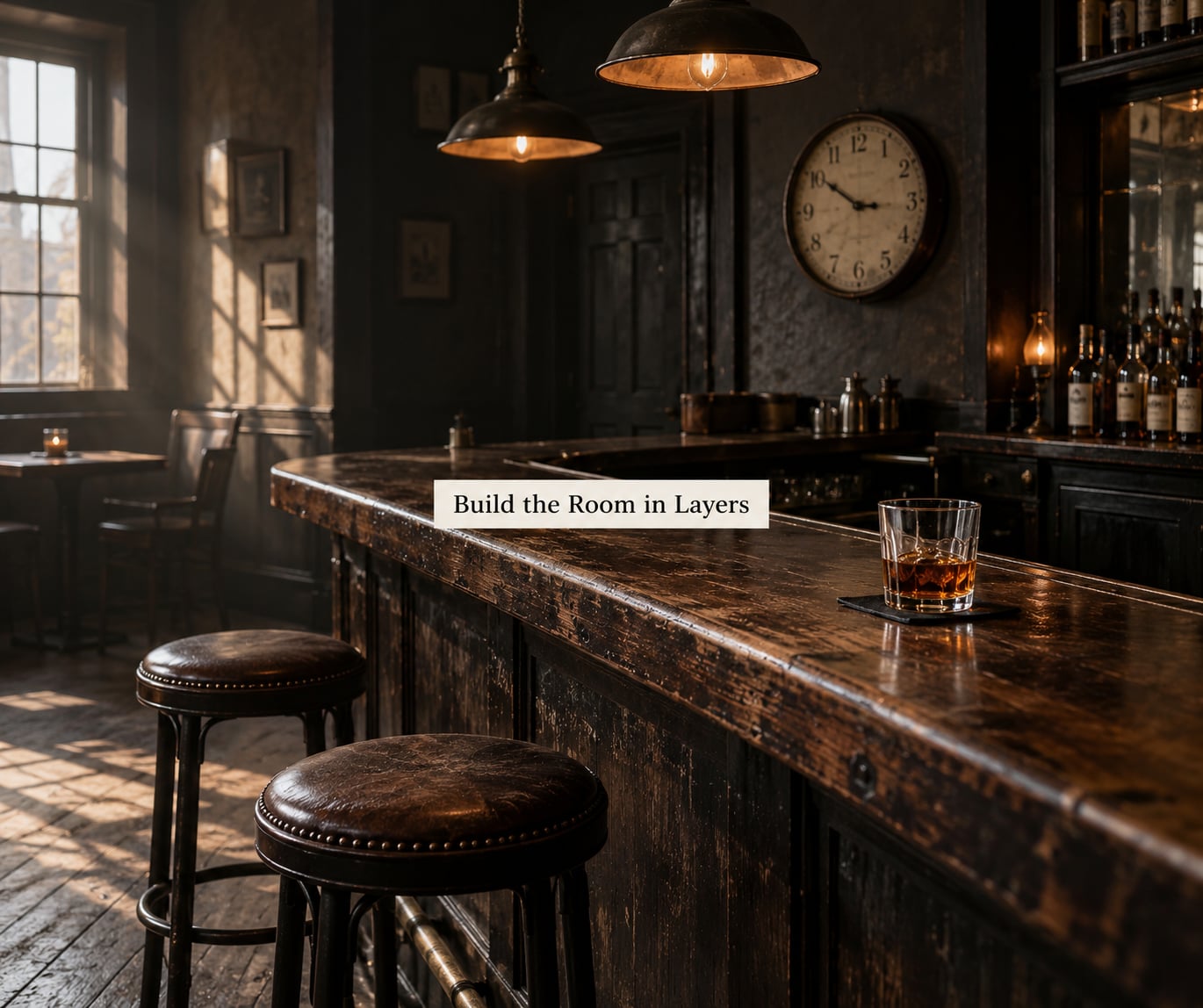
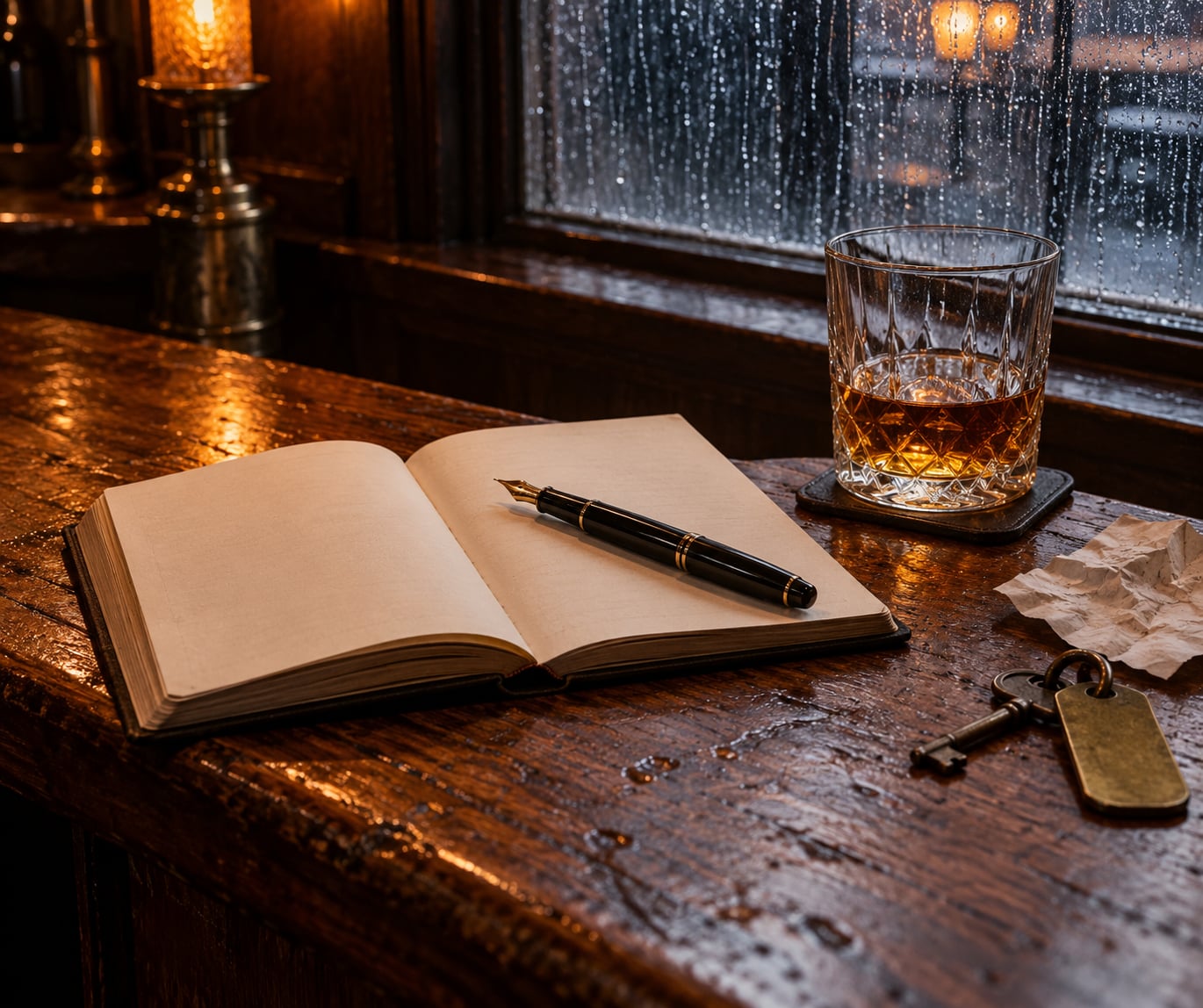
Build the room in three layers and no more. The first layer is the first impression, two or three details that place the reader in the room before anyone speaks. The second layer is what your viewpoint character notices when they get nervous, which is a different set of details entirely. The third layer is one detail that means something, placed where it can be picked up later.
Rain on the window is layer one and it is free. A clock the character keeps checking is layer two. The bottle behind the bar with a year on it that matters is layer three. Stock the room with one of each and stop.
Most important for noir: work out the geometry before you cut. Who can see the door, who can hear the booth at the far end, who is cornered in a seat with no exit and no reason to stay. Constrained space is the engine of the genre, and a bar that nobody can leave is a bar where the conversation has to go somewhere.
How to tell it worked: someone could sketch your bar from the paragraph alone, using only the details you chose. If a reader could add a jukebox, a dartboard, and a fish tank without contradicting you, the room is still generic.
4. Write Dialogue That Carries Subtext
Subtext is what the character is doing while the words are doing something else. It is the reason noir dialogue is short: nobody in a bad room spends forty words being clear about their intentions. They imply, they evade, they test, and occasionally they threaten outright because the implication has stopped working.
Here is the shape of it, written for this article. Ruth wants the name of the man who signed the warehouse lease. Eddie knows it and wants her to leave before she says it out loud.
“You still keeping hours.”
“Somebody has to.”
“Nobody does that job for the money.”
Eddie looked at the door, then at his glass, and decided the door was the safer of the two. “You always did like a straight question.”
“Only when the crooked ones stop working.”
Note what nobody says. The name is never spoken, the warehouse is never mentioned, and Eddie’s three seconds of looking at the door is the whole confession. That beat is doing more plot work than a page of explanation would.
Vary the rhythm so the scene does not read as a list. Answer a long question with a short sentence. Put an action beat between two lines that are both trying to be clever. Use the speech tag where the reader needs an anchor and drop it everywhere else, and never let two consecutive exchanges share the same verb.
How to tell it worked: read the exchange aloud with all adjectives deleted. If it survives, the dialogue is carrying the scene. If it turns into trivia, the adjectives were doing the work instead of the subtext.
5. Control the Rhythm of a Bar Scene in Noir
Pacing comes from interruptions and withheld information. Somebody comes in. The jukebox changes. A phone rings and is not answered. A name gets half-mentioned and then dropped. Every one of those is a legitimate reason to cut away, and cutting away is how you keep a conversation from settling into a pond.
Compress the ordinary parts ruthlessly. Nobody needs to read a summary of the first five minutes of small talk, and the character does not need to order a drink in full sentence every time. Slow down for exactly one beat in the scene, the one where something irreversible almost happens, and give that beat room to breathe.
Overheard conversation needs its own handling, and it is the question writers ask most often. The rule is that your viewpoint character must be doing something else while it happens, or hearing it means nothing. A character waiting for a drink, reading a newspaper she is not reading, or watching a man at the end of the bar is listening. A character standing still is eavesdropping, and the reader notices the switch.
How to tell it worked: there is no stretch of pure talk longer than a page, and no two consecutive paragraphs that both begin with a character name saying something. If you have a run of paragraphs that all report conversation rather than dramatize it, compress that run into a single line of summary and let the scene breathe again.
6. End on a Turn or Decision
A bar scene ends on a turn: a revelation, a threat, a bargain, a departure, or a choice that cannot be unmade. The character gets up and the arrangement between them is different from the one they walked in with. That is the exit, and everything after it belongs to the next chapter.
Be careful with the character who simply leaves. Walking out is not a turn by itself. Walking out because he decided she was not worth the risk is. The difference is one clause of interiority, and it is usually the only interiority a hard-boiled narrator gets to spend in the entire scene.
Then connect the scene to what follows in a single sentence, not a summary. The next chapter should start from the thing you just changed, and the reader should never have to reread the bar scene to understand why the characters are different.
How to write a bar scene in noir, at the level of mechanics, comes down to this: the ending is the scene. Everything before it is setup, and setup is the part that gets cut.
Common Mistakes to Avoid
Six drafts come back from the same handful of faults. Run your own scene against them before you send it anywhere.
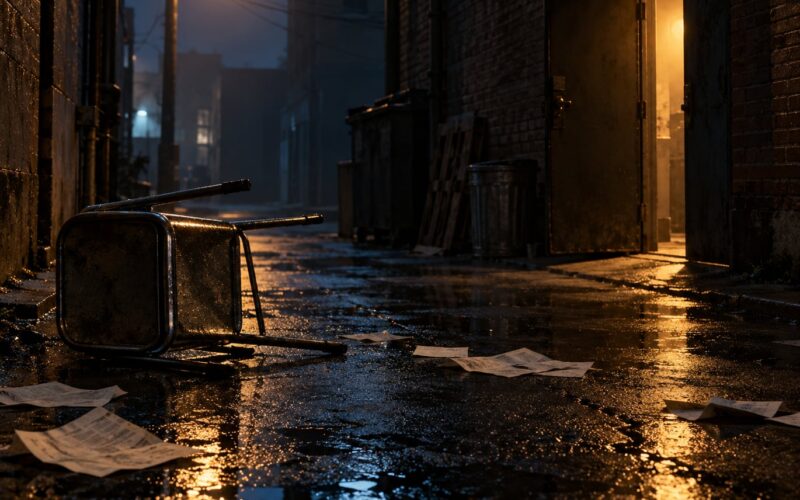
The atmosphere is flat. Rain, neon, and a bottle of whiskey in a paragraph is set dressing, not atmosphere. Atmosphere comes from pressure the room puts on the people in it, so fix it by changing the room’s geometry instead of adding adjectives. Seat the viewpoint character where the door is behind them.
The dialogue is aimless chatter. Every line should either advance the objective, block it, or change how the other character is regarded. If a line does none of those three, cut it and let the silence sit where it was.
It reads as parody. This is the most common problem writers name, and it comes from treating noir as a costume. Overdone hard-boiled banter, characters too pleased with their own lines, a femme fatale who announces herself in satin: the parody is never caused by the voice, it is caused by characters who are enjoying themselves too much while supposedly terrified. Let them be frightened. Fear is what makes the short sentences sound short.
There is too much description. An inventory of every object in the bar kills the scene. Readers cannot feel a room they are being toured through, and the details stop carrying weight when nothing is being withheld.
A character appears without a reason. If you cannot say why someone walked in, they are a plot delivery system. Give them an errand, a debt, or a habit, and let the errand go wrong, which is usually the point.
The scene changes nothing. The diagnosis from step one, and the most common one. If the reader could skip the chapter without noticing, the bar has become a waiting room. Either give the scene a job or cut it and save the room for the chapter that needs it.
A few habits worth keeping. Draft bar scenes last, because the setting is easier to write when you already know what has to happen in the room. Cut the first paragraph of atmosphere in every scene and see if anything is lost, because the room usually announces itself best once somebody is in it. And give the scene one prop that matters, so the bar is doing story work rather than holding the chairs.
Frequently Asked Questions
How long should a bar scene be in a noir story?
Most bar scenes run between 500 and 1200 words in a novel, and roughly two to four pages in a screenplay. If yours runs longer, check whether the second half is still changing the situation between the characters. Length is the easiest thing to fix in a second pass, so when you learn how to write a bar scene in noir, leave the trim until the plot turn is already in place.
What makes a bar scene feel noir without sounding clichéd?
Noir is a set of narrative conventions, not a look. What makes a bar scene work is moral ambiguity, a protagonist who cannot be trusted, information traded at a cost, and an outcome that leaves every party worse off. Neon, rain, and a femme fatale are decoration. Keep the conventions and cut the decoration and the genre survives.
Should I write a bar scene in first person or third person?
Both work, and the choice is about how much interiority your narrator can spend. A first-person hard-boiled narrator gets one or two interior clauses per scene and spends them on the decision, not the mood. A close third-person narrator can track two characters at once, which helps when the scene is a negotiation rather than an interrogation.
How much dialogue is too much in a bar scene?
Dialogue is the point of a bar scene, so volume is rarely the problem. Proportion is. If more than about eighty percent of the scene is people talking with no action beat, no silence, and no room detail, the reader has nothing to hold. Insert a beat every dozen lines or so, and let one of them last long enough to matter.
What details make a bar setting feel believable?
Believable details come from use, not from appearance. Who wipes the same glass all night and why, which stool has a cracked vinyl seat, what the tab system looks like, whether the door sticks. Pick six of these, give them to one viewpoint character, and let the others be felt rather than listed. A bar that is wrong in one specific way reads truer than a bar that is right in every detail.
How do I make a bar scene move the plot forward?
Give the scene a before and an after, written as a single sentence, and make the difference visible in the final exchange. A revelation, a threat, a bargain, or a departure will do it. Then open the next chapter from the new arrangement rather than summarizing the old one, so the reader feels the plot has shifted rather than been recapped.
Conclusion
Decide the change, give everyone a want, build the room in three layers, write the subtext, break the rhythm, and end on a turn. That is the whole method, and it runs in about two hours including the revision.
Start now with the sentence nobody has written yet: by the end of this scene, X knows Y. Then draft the moment where that knowledge becomes unavoidable, and let the rest of the bar fade out around it.