
How to start a crime fiction newsletter is mostly a series of small, reversible decisions: pick one reader, promise them a specific thing, send it on a schedule you can actually keep, then find the first hundred people who want it. A solo editor with one laptop and free software can do this in a weekend, and a useful first issue takes a day rather than a month.
Crime fiction is a good genre to build this kind of list around, and it is also oddly underserved. Readers in the mystery, noir, procedural and thriller world are loyal, opinionated and easy to reach through small communities, yet almost every how-to guide on the internet treats newsletters as generic marketing software. Nobody is writing about the specific craft problems: how to run a spoiler-sensitive roundup, how to interview a debut novelist who is nervous about a series, or why readers leave when a newsletter turns into a sales blast.
So here is the working version. It starts with what you need, moves through ten steps, and ends with the numbers worth watching once you have been sending for a few months.
Table of Contents
- What You Need
- The reader, in one sentence
- An editorial promise
- A format and a schedule
- A set of content categories
- A small tool stack
- A modest budget, and permission to spend nothing
- How to Start a Crime Fiction Newsletter Step by Step
- Choose a Specific Editorial Focus
- Choose a Format and Publishing Schedule
- Build the Core Issue Structure
- Create a Simple Publishing System
- Write the Launch Issue
- How to Start a Crime Fiction Newsletter on a Free Tool Stack
- Cover Real Cases Responsibly
- Find and Welcome the First Readers
- Monetise a Small List Without Rattling Readers
- Measure Whether the Newsletter Is Working
- Common Mistakes
- Frequently Asked Questions
- How long does it take to launch a crime fiction newsletter?
- How long should each issue be?
- How often should a crime fiction newsletter be sent?
- What does it cost to start a crime fiction newsletter?
- How do I grow a newsletter without buying subscribers?
- Should I start a newsletter before my novel is published?
- Conclusion
What You Need
Almost nothing physical. A crime fiction newsletter can be run by one person, which is the most useful fact about the whole enterprise. What you genuinely need to settle before you write a word is a set of editorial decisions, and each of them narrows the ones that follow.
The reader, in one sentence
Not “crime fiction readers.” Someone who reads three detective novels a month and feels guilty about the queue on their bedside table, or a lapsed procedural fan who drifted away from the old police-procedure series, or a working writer who wants blunt craft notes rather than encouragement. Any of those is a real audience. “Anyone who likes crime” is not, because you will never be able to guess what to put in the email.
An editorial promise
This is the sentence that goes near the top of your signup page and in your welcome email. It should say what arrives in the inbox, how often, and who it is for. “Every other Thursday: five new crime releases worth your attention, one interview with a working writer, and a short story recommendation you can finish in a coffee break.” That is the sort of promise that survives contact with a busy Tuesday morning.
A format and a schedule
Decide these together, because they dictate how much original material you must produce each cycle. A fortnightly rhythm with one lead feature and two or three short sections is the most common landing spot for a new list, and for a good reason: it produces something substantial without the weekly treadmill.
A set of content categories
Five or six recurring columns, decided in advance. A new-release roundup, an author interview, a craft note, a reading list, a short-fiction pick, a community or awards mention. Categories are what let a reader skim an unfamiliar issue and still find the part they came for.
A small tool stack
Email delivery and a signup page, an editor you already know, a scheduling tool so issues send themselves, and link tracking so you can see what gets clicked. Free tiers of the major platforms cover a list under a thousand subscribers comfortably. Paid plans add custom domains, higher sending limits, referral tools and more design control.
A modest budget, and permission to spend nothing
There is a genuinely zero-cost version of this: a free newsletter platform, a free scheduling tool, a free editor, and a free mailing list for your existing contacts. Spend later, on the domain name and the cover art, when you know what the newsletter is. Money is not the constraint here. Time is.
How to Start a Crime Fiction Newsletter Step by Step
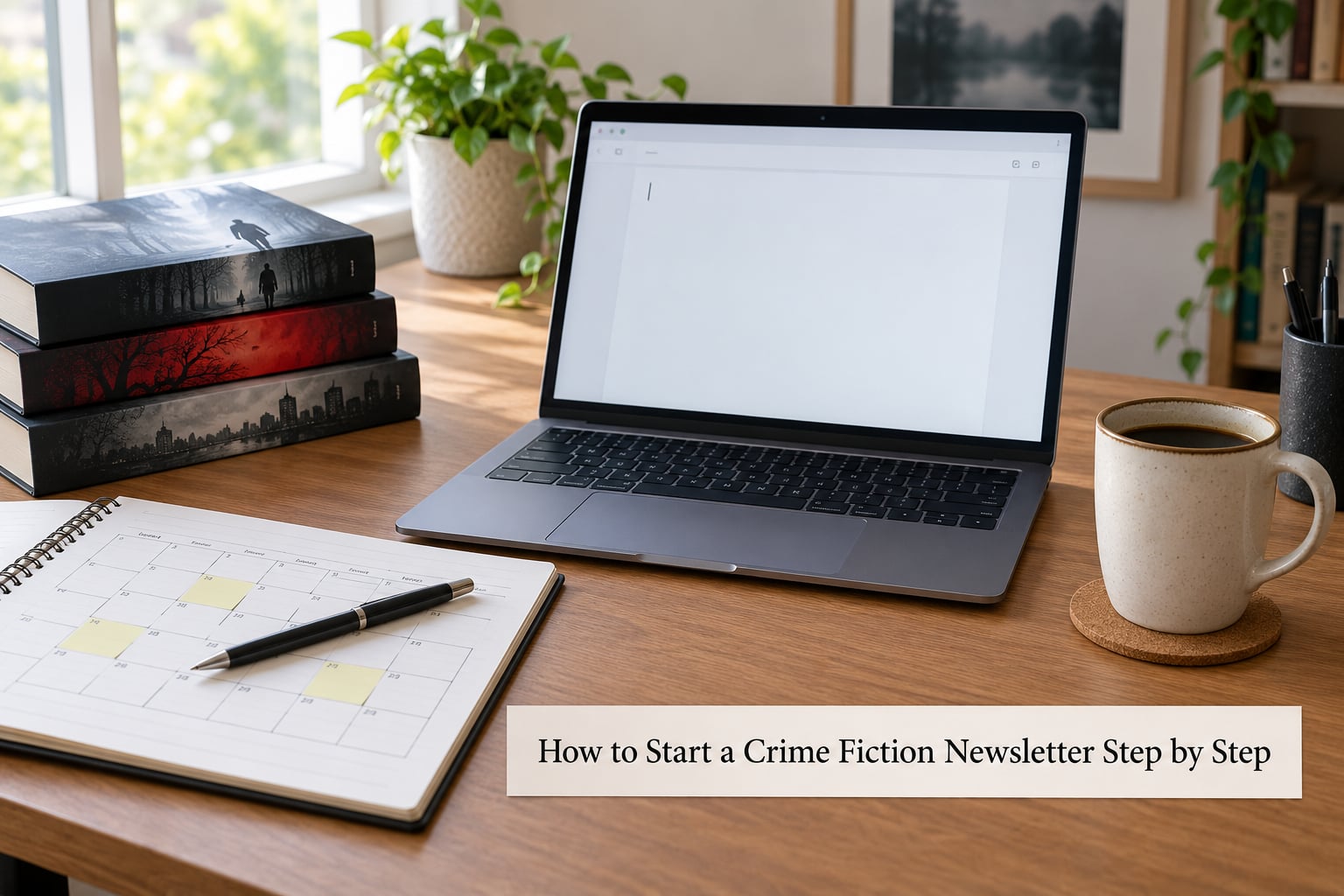
Learning how to start a crime fiction newsletter works best as a sequence rather than a brainstorm. Each step removes a decision from the pile, so by the end you are not choosing from scratch, you are following through on choices you already made.
Choose a Specific Editorial Focus
Narrow by reader first, then by subject. The genre is wide enough that “crime” is not yet a focus. Classic noir reissues are. Contemporary Nordic and British crime. Police procedurals on the shelf and what came after them. Short story recommendations under three thousand words. Writing craft, with real notes on structure rather than pep talks. Reviews where every book is assessed against the same four questions. Author interviews with debut novelists who have one book and no publicist.
The test is whether you can write three issues in a row inside that focus without running dry. A focus that only supports one issue is a launch, not a newsletter.
Then write the one-sentence promise. It has to contain the what, the how often, and the who. Mine reads: “Every other Thursday, one interview with a crime writer, five new releases sorted by who should read them, and a short story you can finish before the kettle boils.” Draft three versions and say them out loud. The one that does not make you wince is the right one.
Choose a Format and Publishing Schedule
Match the schedule to the output you can produce on your worst week, not your best one.
- Weekly suits a short, modular issue: a roundup plus two short sections, maybe eight hundred words. It rewards volume and punishes you the week you miss.
- Fortnightly suits one lead feature plus two or three shorter sections. Most solo genre newsletters settle here, and it survives a holiday.
- Monthly suits interview-heavy or research-heavy material. It is forgiving, but readers forget you between issues, so each one has to earn the click on its own.
Whichever you choose, write the schedule down where you will see it and decide what happens when you miss. I recommend sending a short note on the normal day saying the feature will run late, rather than skipping silently. Readers forgive a delay far more readily than a gap.
Now build a rolling editorial calendar: four to six weeks of issues with a one-line pitch each. “Week 2: interview with a debut novelist, plus the procedural roundup.” Four issues are far enough ahead to see a problem and near enough to still write them.
Build the Core Issue Structure

A reusable template is what separates a newsletter that lasts from one that dies in issue nine. Keep the spine identical every time so readers learn where to look, and vary the content inside it.
The editor’s note. Eighty to a hundred words in your own voice, connecting one thing you read, watched or argued about this fortnight to the rest of the issue. This is the only section with a byline that means something, and it is the reason people reply.
New-release roundup. Four to six books with a line each on who they suit, plus a spoiler-free verdict. The format to use: “The procedural your commute has been missing. Procedural, 2026, 380 pages.” One line per book keeps it readable on a phone.
The craft note. Where the plot went right, and why. Openings, alibi construction, interview scenes, the second-act sag. This is the section that earns you a place in a crime reader’s inbox, because it is the only part nobody else is sending them.
The interview. Monthly or every other month. Three or four questions instead of ten, published with permission, with dates spelled out so nobody misreads the writer’s current situation.
Short fiction pick. One story or one essay on crime, with a real reading time at the top. Crime readers have enormous respect for short work, and very little of it arrives in a tidy weekly email.
Reader recommendations. A standing request for what people are reading. It costs you one paragraph and it converts readers into contributors, which is the cheapest engagement you will ever get.
Community and awards news. Short. Debut shortlists, translated crime, new crime imprint launches, a local bookshop event.
A workable issue runs about twelve hundred to eighteen hundred words: note, roundup, craft note, interview or short pick, recommendations, a line of news. Balance matters more than volume. A month of pure roundups reads like a catalogue, and a month of craft notes reads like homework.
Create a Simple Publishing System
Write the process down once, then follow it. Research and permissions, drafting, fact-checking, edit, layout, proof, schedule, send, archive.
Fact-checking is the step genre-specific writers skip and then regret. Verify every publication detail, every quotation and every date. If you cover a real case rather than a fictional one, source it properly and say what your sources are, because a crime publication that gets a detail wrong loses readers for good.
For tools, most editors land in the same four categories: an email platform that handles delivery and list management, a writing app, a layout and image tool, and link tracking. Pick one of each and stop there. Chasing tools is a good way to avoid writing the issue.
Two habits worth building now. Schedule sends so the issue goes out without you at the keyboard, because an issue that leaves at seven in the morning reads differently from one that goes out at midnight. And keep an index page of every past issue, linked from the header, so a new subscriber can see what they missed.
One more: set up double opt-in before your first send if your platform offers it. It costs a few subscribers at signup and removes a pile of undeliverable addresses later.
Write the Launch Issue
The first issue does three jobs: it introduces you, it demonstrates the format, and it gives people a reason to reply. Treat it as a piece of writing, not a sign-up appeal with an essay attached.
Open by naming what the newsletter is in two sentences, then who it is for, then the schedule. Then deliver the full structure once, even if some sections are short. A reader who subscribes after issue one should be able to look at that issue and understand what they just signed up for.
Give them one strong feature. Whatever is the best thing you can write in the first issue, write that, even if it means a shorter roundup. This is the piece that gets forwarded.
End with one specific invitation, not three. “If you have a debut coming out in the next six months, reply and tell me about it” works better than a paragraph listing every way to support the newsletter. Ask for exactly one action and you will get it.
A welcome paragraph, roughly: “Thanks for subscribing. I started this fortnight because I kept seeing brilliant crime novels nobody was talking about and brilliant crime writing nobody was teaching. Every other Thursday you’ll get five new releases sorted by who should read them, one craft note, and a short story you can finish in a coffee break. If you have a debut out soon, reply to this email.”
Then write the welcome sequence that follows the signup: one email confirming what they got and when, one email three or four days later pointing them at the index of past issues, and nothing more until the next issue.
How to Start a Crime Fiction Newsletter on a Free Tool Stack
Where the list lives deserves its own decision. The platforms writers gravitate toward differ in ownership, discovery and cost, and the thing to check before you commit is how easily you can move later.
Ask yourself three things. Do you get a subdomain, or a custom domain you own from day one? Does the platform push your newsletter into its own recommendation network, where a reader who likes your roundup can find you without you asking? And what happens to your list if you decide to leave?
That last question comes up constantly in writing communities, and the anxiety is real rather than imagined. Writers on Reddit and on writing forums keep repeating the same point: build the list as insurance against any single platform changing direction, and treat your archive as the thing you own.
The practical version is unglamorous. Publish every issue to a public indexable page on your own domain, keep the archive index link in your header, and export your subscriber list regularly so you are never starting from zero again. It adds a little work at launch and removes a large category of risk later.
Discovery matters in the early months too. A platform with built-in recommendations can hand you a hundred subscribers you did not chase, which is genuinely useful when you have zero readers. Weigh that against the portability question, not against a feature checklist.
Cover Real Cases Responsibly
Most crime newsletters stay inside fiction, but many drift toward true crime because readers ask for it and the material is compelling. Once you do, the ground shifts under you, and the rules are worth settling before the first case rather than after a complaint.
Source the way a journalist would, not the way a forum poster would. Name your sources, link to primary material, and state clearly what is established fact and what is contested or alleged. Distinguishing those two things in the writing is not pedantry; it is the difference between a credible publication and one that gets quietly abandoned.
Be conservative about the living. Victim families did not consent to their relative’s murder being the hook of your fortnight, and the smallest sensible courtesy is not writing a joke paragraph about a death that is recent or unresolved.
Understand the defamation basics before you need them: the risk sits with you, not your sources, and repeating an unproven allegation in your own words is publication, not gossip. Where a case is live or a person is on trial, describe what the courts have actually decided and nothing beyond it. If a piece sits close to that line, leave it out and put something else in the issue. A gap is always fixable, a retraction is not.
Readers notice this and they reward it. Trust in a crime title is built slowly and lost in one issue, and handling the material carefully is the most durable differentiator you have when a bigger newsletter with a bigger budget arrives.
Find and Welcome the First Readers
The first fifty subscribers are the hardest and the most important, because they set the tone. Where crime readers actually gather matters more here than any growth tactic.
- Small-press authors you have interviewed or reviewed. They have a reason to reciprocate, and their readers are already the right readers.
- Bookshops with a crime shelf worth looking at. Staff will often hand out a card or add you to their mailing list if you bring something useful.
- Writing groups and local crime-reading clubs. Offer to visit and speak, and bring a printed signup sheet.
- Genre communities online. Crime and detective-fiction subreddits, writing subreddits, Goodreads genre shelves and lists, and crime-focused Discord servers. Read the room before posting, and never drop a link without contributing to the discussion first.
- Other genre newsletters. Cross-promotion is the tactic writers on Reddit and writing forums recommend most often, and it works because both lists are already qualified.
Personalise every outreach note. Four sentences naming something specific about the recipient’s work beats a hundred-word pitch every time. Tell them your cadence honestly on the first ask, because someone signing up expecting a weekly will leave fast if you send monthly.
Never buy a list. Bought addresses tank your deliverability, land you in spam folders, and produce unsubscribes that undo weeks of work. Every community rule that bans self-promotion exists for a reason, and ignoring it costs you the one audience you cannot buy back.
Monetise a Small List Without Rattling Readers
Money is not the point in year one, and readers in this genre are unusually allergic to a newsletter that has turned into a sales page. Still, it helps to know what a small list is realistically worth before you build habits around an assumption that turns out to be wrong.
At a few hundred engaged readers, paid subscriptions will not cover a living. That is not failure; it is what a list this size does. The channels that actually return something at that scale are different in kind: a small sponsor slot in an occasional issue, affiliate links on books you genuinely recommend, and paid work in the craft or bookselling space, where a newsletter with a known readership is more valuable than a large account with no trust behind it.
The arithmetic is simple enough to state plainly. Assume a modest but real figure for revenue per thousand engaged readers from a mix of sponsorship and affiliate commissions, and the number at five hundred subscribers is small, at a thousand it becomes worth doing properly, and at several thousand it stops being a hobby. Which means the honest answer to whether it can pay for itself is: not soon, unless you build it deliberately toward it.
Whatever you try, keep the ratio honest. One clearly marked sponsorship in a twelve-issue year reads as a working newsletter. A sponsor in every issue reads as a magazine nobody chose.
Before you take any money, check what your platform demands of you. Some take a share of subscriptions, some take nothing and sell the audience data instead, some charge for advanced features at a list size you will reach. Find out now rather than at issue forty, when the list is finally worth having.
Measure Whether the Newsletter Is Working
Track a handful of numbers and resist the rest. In the first six months, these are the ones worth a monthly glance.
- Delivery rate. If this drops below the high nineties, stop adding people and fix the list first.
- Open rate. Small niche lists typically see somewhere in the forties to sixties. Apple privacy changes and inbox filtering make this figure shakier than it used to be, so treat it as a direction rather than a score.
- Click-through rate. Single digits is normal for a digest with no call to action; anything under two percent usually means the links are buried at the bottom.
- Replies and shares. Two or three genuine replies an issue is a strong signal from a small list. Replies tell you exactly which section worked.
- Unsubscribe rate. Under one percent per issue is fine. Spike above it and the fault is usually a section you added rather than removed.
- Net subscriber growth. Not total size, the change per month.
Use the numbers to change one thing at a time. Replies are a goldmine: readers will tell you they skimmed straight past the roundup, or that the craft note got forwarded to their whole book group. Write those answers down for the next issue.
And keep expectations realistic. A hundred engaged subscribers who finish every issue is worth more than a thousand who signed up from a give-away and stopped opening after two. Benchmarks from large general lists tell you nothing about a focused genre publication.
Common Mistakes
Positioning that could describe any newsletter. “A weekly roundup of great reads” tells a crime reader nothing they cannot get anywhere. Fix: name the reader and the angle in one sentence, and put that sentence on the signup page.
Over-producing before anyone is listening. Hours of layout polish on issue one is procrastination in a nicer outfit. Fix: ship a plain, well-structured issue, then improve the design once you know readers are actually opening it.
Copying another newsletter’s format. A format built for a different genre fails because the habits don’t transfer. Fix: use the column structure your readers actually discuss.
Ignoring permissions. Reposting review copies, using a cover image you found, or quoting an interview you deleted. Fix: ask before you publish, keep replies, and use rights-cleared or commissioned art.
Sending irregularly. One issue then silence for two months teaches readers to ignore you, and re-subscribing them is harder than winning them the first time. Fix: commit to a cadence you can hold in your worst month and hold it.
Pushing every link to everything. A crime newsletter that is half affiliate links gets filtered by readers and by inbox providers. Fix: one call to action per issue, earn the rest.
Writing only for phones and only for desktops. Long subject lines get cut on mobile; wide layouts scroll sideways everywhere. Fix: preview on a phone before every send.
Chasing viral numbers. Broad give-aways produce signups and then silence. Fix: aim for a hundred readers who reply, and treat the first fifty as people, not numbers.
A few closing tips. Give every interview a concrete angle before you ask question one. Set a hard word limit on the roundup so it never eats the issue. Keep a plain-text-and-image design that will still render correctly in five years. And write the archive index post at launch, when you can still remember why you made each choice.
Frequently Asked Questions
How long does it take to launch a crime fiction newsletter?
A focused launch takes about a week of spare evenings, or one solid weekend. Settling the editorial promise, picking a platform and drafting the signup page takes a day. Writing and laying out the first issue takes another two or three, because you are inventing the template as you go. Adding a custom domain and commissioning cover art can follow later without blocking anything.
How long should each issue be?
Twelve hundred to eighteen hundred words is the sweet spot for a fortnightly genre newsletter. Long enough to carry a lead feature and a proper roundup, short enough that a reader finishes it in one sitting on a phone. New-release digests can be shorter, around six hundred. If an issue regularly runs past two thousand words, split the roundup into its own email rather than trimming the craft note.
How often should a crime fiction newsletter be sent?
Fortnightly is the most reliable rhythm for a solo editor, because it produces something substantial without a weekly treadmill and survives a holiday. Weekly works if your issue is a short digest of six hundred to eight hundred words. Monthly suits interview-led or research-heavy material, though readers forget you faster and every issue has to earn its own click.
What does it cost to start a crime fiction newsletter?
Less than most people expect. Free tiers of the major platforms cover sending, signup forms and list management for a list well under a thousand subscribers, and scheduling, editing and design tools have free options too. You can launch at no cost and move to a paid plan later for custom domains, higher sending limits, referral tools and more design control. Spend on the domain and cover art once the format is settled.
How do I grow a newsletter without buying subscribers?
Cross-promotion with other genre newsletters, reciprocal interviews with small-press authors, and contributions in communities your readers already use. Offer to visit book clubs and writing groups. Publish past issues on a public indexable page so search traffic can trickle in. The first fifty subscribers should come from people you can name, and every one of them should get a personal note explaining what they signed up for.
Should I start a newsletter before my novel is published?
Yes, if you can keep a small cadence. A fortnightly issue with a roundup and one craft note is easy to sustain while writing, and starting six months out means readers meet your work while they are still following the story. Do not serialise an unfinished manuscript publicly unless you want the loss of control that comes with it, since many writers prefer to finish first and send the completed novel as a serial.
Conclusion
Write down who reads your newsletter and what they get, in one sentence each. Choose a fortnightly schedule you can hold in a bad month. Build a seven-column template and fill it once, properly, for the launch issue. Then go and find fifty people by name rather than buying a thousand addresses. The first replies will tell you more about the format than any amount of second-guessing will.