An epistolary novel is one told entirely through documents: letters, diary entries, emails, texts, police reports, news clippings and other found records, rather than narrated scenes. An epistolary thriller takes that form and uses it to withhold, misdirect and detonate. This guide is about the mechanics, in eight steps.
The form has one great advantage and one honest cost. The advantage is that your reader has no authority to trust, so a lie inside a document carries weight it never would in close third person. The cost is interiority — a published novelist put it plainly: the number one reason they love a book is interiority, and you cannot get it from a letter.
Everything below is about spending that advantage carefully and paying for the cost deliberately. Budget a full weekend for the planning stages. Most of the work happens before you write a single entry.
Table of Contents
- What You Need
- Which document format fits which thriller
- Step-by-Step
- 1. Choose a Document Format That Creates Pressure
- 2. Build the Central Thriller Premise
- 3. Map the Timeline and Information Flow
- 4. Design Distinct Voices and Points of View
- 5. Plant Clues Without Making Them Obvious
- 6. Use Alternation to Escalate Suspense
- 7. Write the Reveal and Final Document
- 8. Revise for Voice, Pace, and Fairness
- Common Mistakes
- Frequently Asked Questions
- How is an epistolary novel structured?
- Do epistolary novels have to be written as letters?
- How many words should a thriller novel be?
- Is an epistolary novel harder to write?
- How do I write an unreliable narrator in epistolary form?
- How do I keep tension high across short entries?
What You Need
You need five decisions locked before drafting: the premise, the document set, the point of view, the central danger, and the suspense mechanism. Vague on any one of these and the entries start floating free of each other, which is the single most common reason epistolary manuscripts stall at page fifty.
- The premise. One sentence: who is in danger, from what, and what they want badly enough to write it down.
- The document set. Two to four formats, no more. More than that and the voice work becomes unmanageable.
- The point of view. Whose words reach the reader, and who else exists only as a quoted line or an attachment.
- The central danger. Something physical or professional that escalates across the timeline.
- The suspense mechanism. The specific device that withholds information: a deadline, a disappearance, a contradicting date.
Which document format fits which thriller
Match the format to the story’s pressure. A format that suits grief rarely suits a countdown.
| Document format | Thriller it suits | Pressure it creates naturally |
|---|---|---|
| Letters | Historical, gothic, slow-burn noir | Distance and delay |
| Diary entries | Psychological, domestic noir | Self-deception in real time |
| Texts and emails | Crime, contemporary conspiracy | Urgency and dwindling credibility |
| Police or clinical reports | Procedural, institutional | Institutional blindness |
| Interview transcripts | Serial-crime investigation | Contradiction between speakers |
| Ransom notes and clippings | Kidnap, true-crime framing | A hostile voice entering the record |
Two to four formats is plenty. The Writing Excuses podcast episode on playing with format frames this as a deliberate structural choice rather than decoration — if you mix media, each shift should change what the narrator can know, not just how the page looks.
Step-by-Step
1. Choose a Document Format That Creates Pressure
Choose a document format for what it forbids the narrator, not for how it looks on the page. Letters forbid real-time confrontation. Texts forbid considered explanation. Reports forbid opinion. A diary forbids honesty with hindsight.
Pick formats whose natural limitations create your story’s tension. If your thriller runs on a kidnapping clock, texts and voice notes force the narrator to compress, and compressed information misleads in ways a page of narration never would.
Check authenticity against era and device. Forum writers on epistolary technique keep naming the same failure: modern emails and texts read as fake the moment a timestamp or notification convention belongs to the wrong period or platform. Get this wrong and the reader exits the book.
2. Build the Central Thriller Premise
Build the premise as four questions answered in one sentence each: what crime or mystery exists, who is in danger, what the documents conceal, and what each writer wants from the person they are writing to.
The wants matter more than writers expect. Two people writing the same week about the same disaster will describe it differently because one wants absolution and the other wants evidence. That gap is where a thriller lives.
Then set the irreversible consequence. A deadline, a transfer, a hearing, a flight. Without a clock, epistolary fiction drifts toward a log, which is exactly what experienced writers on r/writing mean when they advise treating each document as a unit carrying only the details that matter to that scene.
3. Map the Timeline and Information Flow
Map a chronological timeline of everything that actually happens in the story, including what the reader never sees directly. Then, in a second column, write what each document reveals and what it conceals. Every entry must both disclose something and hide something.
Do this on paper or in a spreadsheet before drafting. It is the least glamorous task in the process and the one that saves a rewrite.
Next, decide the reading order, which is rarely the event order. Chronological documents feel calm; reordering them by tension turns the same material into a thriller. Consider opening two or three entries before the inciting incident so the reader has something to worry about before they know what to worry about.
4. Design Distinct Voices and Points of View
Give each writer a recognizable voice built from vocabulary, sentence length, emotional defences and blind spots. A defence is the most useful tool here: a character who always answers a question with a question is doing characterisation work in every single entry.
Keep the differences functional. If two writers both sound clipped and hostile, the reader cannot use voice as a clue and you have lost a whole dimension of the form.
One writer is enough for the main line. A second voice — a correspondent who replies once, or an investigator whose emails appear as attachments — gives you a reliable counterweight for the reveal.
5. Plant Clues Without Making Them Obvious
Plant clues inside the mechanics of the documents rather than in statements about them. Dates that do not match the surrounding season. A subject line that answers a question the text has not asked yet. An attachment referenced once and never explained.
Use these five hiding places, in rough order of subtlety:
- Omission. The entry steps around a fact entirely.
- Contradiction. Two entries cannot both be true; neither is flagged.
- Vocabulary shift. A word or formality the character suddenly adopts.
- Format anomaly. A typed page where everything else is handwritten.
- Redaction. A blacked-out line that the character never comments on.
Test fairness by rereading the finished section as a reader who missed everything on the first pass. If the solution only works when you already know the answer, the clue was unfair.
6. Use Alternation to Escalate Suspense
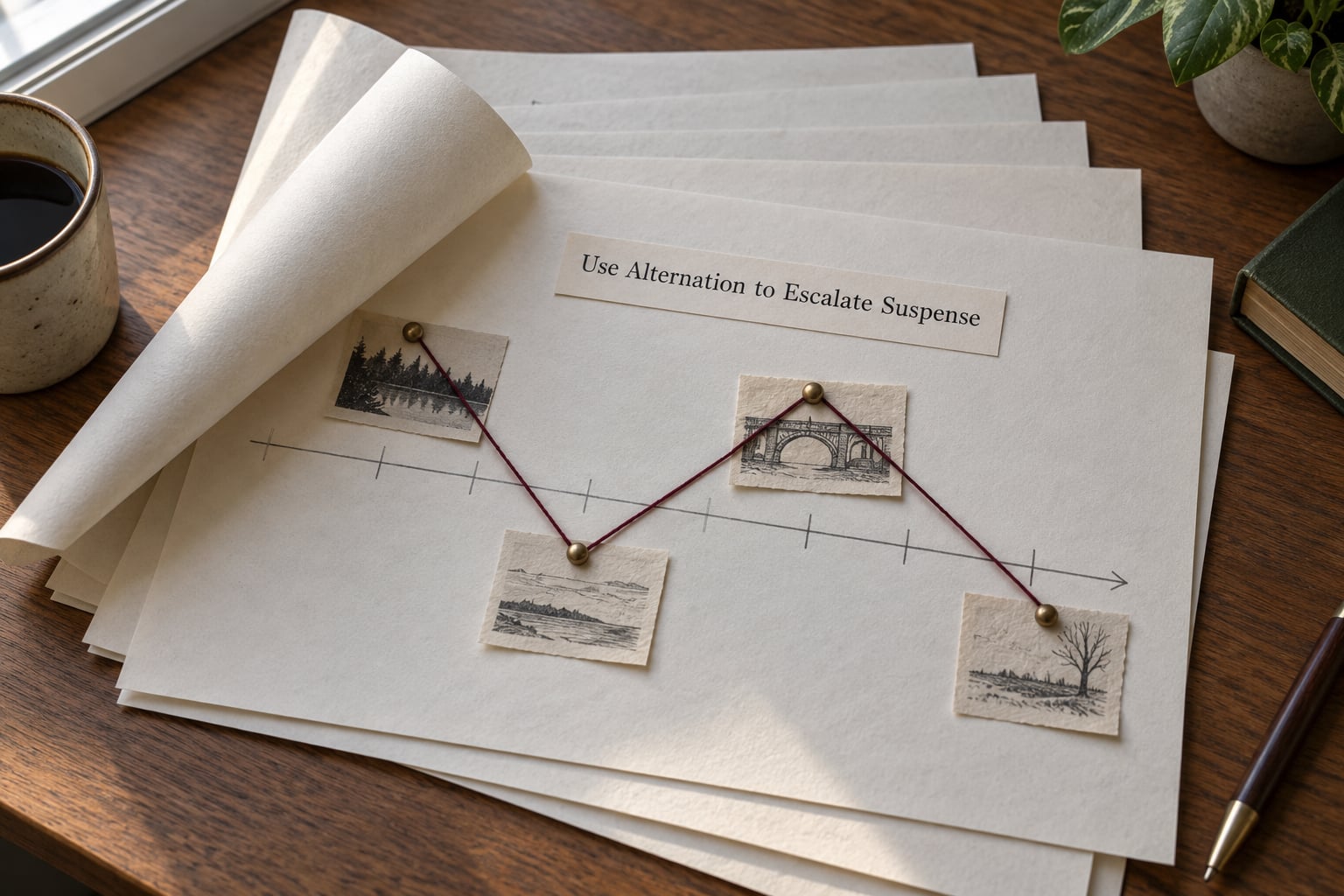
Alternate documents by unanswered question, not by alternating uniformly. The top-voted advice on the Absolute Write forum is to mix the document format with conventional narrative to keep tension high, while conceding it is very difficult to execute. That is good advice with a warning attached, and the way through is the same mechanics you already have.
Three rules keep alternation working. Each document should answer one question and open a worse one. The person writing should feel more isolated than the one before. And the gap between what is said and what is meant should narrow as the book goes, so that by the final third the reader can hear the lie even when they cannot name it.
Interruption is your sharpest instrument. An entry that stops mid-sentence, or a reply that arrives three days later and answers a different question, produces more tension than a paragraph of escalating prose.
7. Write the Reveal and Final Document
Aim the final document at re-reading, not at explaining. The last entry should recontextualise material the reader already has, resolve the central question, and leave a visible cost rather than a neat summary.
Two structures work reliably. The confessional document, where the writer finally tells the truth and the reader realigns every earlier page; and the found record, where a report or transcript written by an outsider quietly supplies what the narrator spent the book avoiding.
Write the ending first, in draft. If you cannot make the final document pay off earlier entries, you will not be able to plant for it either.
8. Revise for Voice, Pace, and Fairness
Revise in passes, each with one job. Read the whole manuscript aloud to catch voice monotony; if you cannot tell who is writing an entry within two sentences, that entry needs work.
Check chronology and consistency against your timeline, then check information density. Every entry should either advance the plot, deepen a relationship, or plant something paid off later. Entries that do none of the three are diary filler, and filler is what makes readers describe the book as a log.
Finally, verify the digital formats. Read the emails and texts aloud; if the phrasing feels written rather than typed, rewrite it shorter. The form’s credibility rests entirely on the reader believing someone actually typed this.
Common Mistakes
Every entry sounds the same. Voice monotony kills the format faster than anything else. Fix it by giving each writer one verbal tic, one sentence-length habit and one topic they always avoid, then auditing the manuscript with the writers’ names removed.
Explaining the plot inside the letters. Characters start narrating information to each other because you need the reader to know it. Fix it by cutting roughly half the explanatory lines and trusting the reader to assemble the picture, which is the bargain of the form.
Random ordering. Documents shuffled without a rule feel arbitrary, and arbitrary suspense reads as noise. Fix it by writing the tension question at the top of every entry during outlining; if two entries carry the same question, one of them is redundant.
Weak clues. Clues written as statements rather than mechanics get ignored. Fix it by burying each one in a date, a formatting habit or a missing sentence.
Repetitive formats. Sixty emails of equal length read like a data dump. Fix it by varying entry length deliberately, so a long entry against three short ones makes the reader sit up.
No emotional stakes. If only the mystery matters, the book is a puzzle rather than a thriller. Fix it by deciding what the narrator stands to lose personally, and letting documents show the cost being calculated.
Ignoring the interiority problem. No one has solved this one, and pretending otherwise is dishonest. The closest substitutes are omissions, evasions and the space between a document’s stated purpose and what it actually does — that gap carries interiority in a way straight confession cannot.
One production note worth knowing before you query: epistolary manuscripts carry extra costs at the publishing stage. Graphic design and distinct typographic treatment for each document medium are requirements rather than preferences, so build the design into your budget rather than treating it as a bonus. Bram Stoker’s Dracula in 1897 needed almost no design; a text-message novel needs a great deal.
Frequently Asked Questions
How is an epistolary novel structured?
An epistolary novel is a sequence of dated documents, each with a writer, a recipient and an occasion. Most run chronologically, many add a second voice for counterpoint, and thrillers usually reorder entries by tension rather than by date. The structure lives in three layers: what happens, what each document discloses, and what each document withholds.
Do epistolary novels have to be written as letters?
No. Letters, diary entries, emails, texts, transcripts, police reports, medical records, news clippings and blog posts all count. For thrillers, digital formats are often stronger than letters because they compress information, and compression is what makes a narrator’s account unreliable.
How many words should a thriller novel be?
Commercial thrillers usually land between 70,000 and 100,000 words. Epistolary thrillers run shorter, around 60,000 to 85,000, because the format carries less exposition. Fix your entry count instead: 40 to 70 documents is a workable novel, and mixing in 200 to 400 words of conventional narration between some entries stops the middle sagging.
Is an epistolary novel harder to write?
It is harder in specific ways rather than overall. Plotting is harder because each entry must carry its own tension, and pacing is harder because you cannot slow down for interior monologue without breaking the form. What is easier is suspense, since withholding narrative authority comes free with the format.
How do I write an unreliable narrator in epistolary form?
Distrust should come from pattern, not from error. Build the narrator’s defences first, then show them repeating: skipped questions, tidy explanations, a word that changes when a subject gets close. Keep one small contradiction visible early so readers are given credit for noticing it.
How do I keep tension high across short entries?
Give every entry an unanswered question, isolate the writer a little more each time, and interrupt. A reply that answers something else, or an entry that stops mid-sentence, creates more tension than escalating prose. Vary entry length too, so a long document after three short ones resets the reader’s pulse.
Start tonight with three entries, not a chapter. Write the same event three times from the same narrator, each version revealing less and contradicting more, then read them in sequence. If the third one makes you uneasy, you have the engine.