
An essay about a crime novel is an analytical piece of criticism that argues an interpretive thesis about how a detective or crime novel works: its narrative structure, its use of clues and misdirection, its characterisation, or the social argument underneath the mystery. It uses passages from the text as evidence rather than retelling what happened. This guide walks through how to write an essay about a crime novel in seven stages, from first reading to final citation.
One warning before we start. Searches for this question tend to pull in guides about writing crime fiction itself, which is a different job entirely. Crafting a mystery means hiding the killer’s identity and planting clues. Analysing one means taking that apart and saying why it works. You are doing the second thing here.
The method below suits undergraduate literature students, book bloggers covering noir and serial thrillers, and anyone who has finished a crime novel with a point to make rather than a mystery to solve. Budget somewhere between four and eight hours across several sittings. Rushing the first two stages is the most common reason these essays end up as plot recaps.
Table of Contents
- What You Need
- How to Write an Essay About a Crime Novel: Step-by-Step
- 1. Read the Novel With the Assignment in Mind
- 2. Identify the Central Crime and Questions About It
- 3. Analyze Narrative Style, Structure, and Setting
- 4. Build a Focused Analytical Thesis
- 5. Create an Outline With Paragraph-Level Evidence
- 6. Write the Essay Paragraph by Paragraph
- 7. Revise, Cite, and Proofread the Final Draft
- Common Mistakes
- Frequently Asked Questions
- How long should an essay about a crime novel be?
- Does the crime novel have to be a recent book?
- How do I begin if I do not know what to write about yet?
- How many quotations should I use in a crime novel essay?
- Should I worry about spoilers?
- Which citation style should I use for a novel?
- Conclusion
What You Need
You need five things, and three of them cost nothing.
- The novel itself, in a physical or digital copy you can search and re-read. Page numbers matter later, and you cannot cite a copy you cannot return to.
- The assignment prompt, if there is one. Photograph it. Prompts specify the approach, the length, the citation style and often the number of sources, and guessing any of those costs marks.
- An annotation method: sticky notes, a margin notebook, or a plain document with headings per chapter. What matters is that notes carry page numbers as you go.
- A place for readable notes, separate from the novel. This is where claims and quotes get assembled. Mixing your own thinking with the text while reading is the fastest route to a page of plot notes and no argument.
- The rubric or length requirement, in words. A 750-word essay and a 3,000-word essay are different animals, and the difference shows up in how many body paragraphs you can defend with evidence.
If you have none of these beyond the novel itself, borrow the book and use whatever notes your phone supports. The method does not depend on expensive tools.
How to Write an Essay About a Crime Novel: Step-by-Step
Seven stages, in this order. Stage one takes the longest because it is the only one where you are still reading for the first time. Budget two to three hours for stages one and two, forty minutes for stage three, and no more than an hour for each of the drafting stages.
Before you start, run a sixty-second readiness test. In one sentence each, can you say what the central crime or injustice is, who investigates it, and what question the novel raises about guilt, justice, identity or corruption? If you cannot, keep reading. Everything downstream depends on those three sentences being clear.
1. Read the Novel With the Assignment in Mind
Read the prompt first, then read the novel looking for what the prompt asks about. If it asks about unreliable narration, you are reading for the seams where the narrator’s account contradicts itself. If it asks about social critique, you are reading for who is suspected and why. Same book, different passages, completely different notes.
As you read, record only the plot information your argument will actually depend on: who is killed or wronged, who is suspected and wrongly suspected, what the investigator gets wrong early on, and any reveal that changes how an earlier scene reads. Everything else can wait.
Keep a running note titled questions the novel raises. This is your most valuable document and the one most people skip. Halfway through, pause and write down three things the book has made you wonder about rather than merely understand.
2. Identify the Central Crime and Questions About It
Name the triggering crime or injustice in a single sentence, using the novel’s own event rather than a generic description. Then separate what happened from what it means to you. “A woman is murdered and the police misdirect the investigation” is plot. “The novel makes the reader complicit in the police’s first assumption” is analysis, and it is the sentence your essay will grow from.
Now list the questions the novel puts to its readers about guilt, motive, identity, justice, corruption and who gets protected. A crime novel almost always has a position on at least two of these, and a position you can disagree with is worth more than an observation nobody would dispute.
The test for a good angle is whether two readers could read the same novel and argue opposite sides. If no one sensible could disagree, you have a summary, not an argument.
3. Analyze Narrative Style, Structure, and Setting
Craft in crime fiction is unusually visible, which makes it unusually easy to quote. Look at five things: voice, viewpoint, chronology, pacing and setting.

Voice and viewpoint. First person or third? How much does the narration withhold? Does the detective see everything, or does the text show you the crime scene before it shows the detective’s reaction to it? A narrator who describes a body in flat procedural detail tells you something about how that narrator deals with violence, and that something is arguable.
Chronology. Crime novels frequently break the order of telling. Non-linear structure, delayed identification of the victim, or a chapter that rewinds hours can signal that memory, guilt or concealment shapes the whole story.
Pacing. Count how many chapters pass before a crime occurs, then count how many pass before the detective names a suspect. In fair-play fiction those gaps are controlled and meaningful. In a subverted detective story, the widening of those gaps can be the argument.
Atmosphere and setting. Rain-slick streets, a locked ward, a small town where everyone knows everyone. Crime settings carry symbolic weight because they limit who could have done it, so a change in setting is rarely decorative.
Pick one analytical lens and read the whole novel through it. Six work well for this genre:
- Fair play and whether the clues were genuinely available to the reader.
- Narrator reliability and where the account contradicts itself.
- Procedural realism and what forensic accuracy is being used to achieve.
- Social critique of institutions, class, policing or punishment.
- Gender and violence, particularly how the book treats the victim’s body as evidence.
- Setting as constraint, from a locked building to an entire community.
One lens is enough. Two lenses in a 1,500-word essay usually means neither gets enough evidence, and you end up listing observations instead of defending a claim.
4. Build a Focused Analytical Thesis
An interpretive thesis makes a claim about how the novel works, not about what happens in it. It should name the author and the novel, then state your argument in a sentence that someone could reasonably argue against.
| Weak thesis | Strong revision |
|---|---|
| This novel is interesting because the detective solves the murder. | In The Name of the Rose, Umberto Eco uses the abbey’s poverty and enforced silence to make the investigation itself an argument about knowledge, so the mystery’s resolution lands as a moral verdict rather than a puzzle answer. |
| The narrator is unreliable. | Because the narration repeats the town’s rumour verbatim before contradicting it two pages later, its unreliability works less as a puzzle device than as a portrait of a community that would rather circulate a comfortable story than a true one. |
| The book says a lot about corruption. | By giving the corrupt official a sympathetic interior monologue in the same chapter as his testimony, the novel refuses to let the reader file him under villain, forcing the question of whether corruption persuades through charm rather than force. |
Notice that the strong versions all do four things: they identify a technique, they cite where the technique appears, they explain what the technique produces, and they connect it to the novel’s larger concern. That four-part move is also the shape of your body paragraphs.
If your thesis can be restated as “the novel explores X” without adding anything, it is still a topic rather than a claim. Push it one sentence further until it commits to something.
5. Create an Outline With Paragraph-Level Evidence
An outline for this kind of essay is short: an introduction, three to five body paragraphs, and a conclusion. The discipline is in what each body paragraph carries.
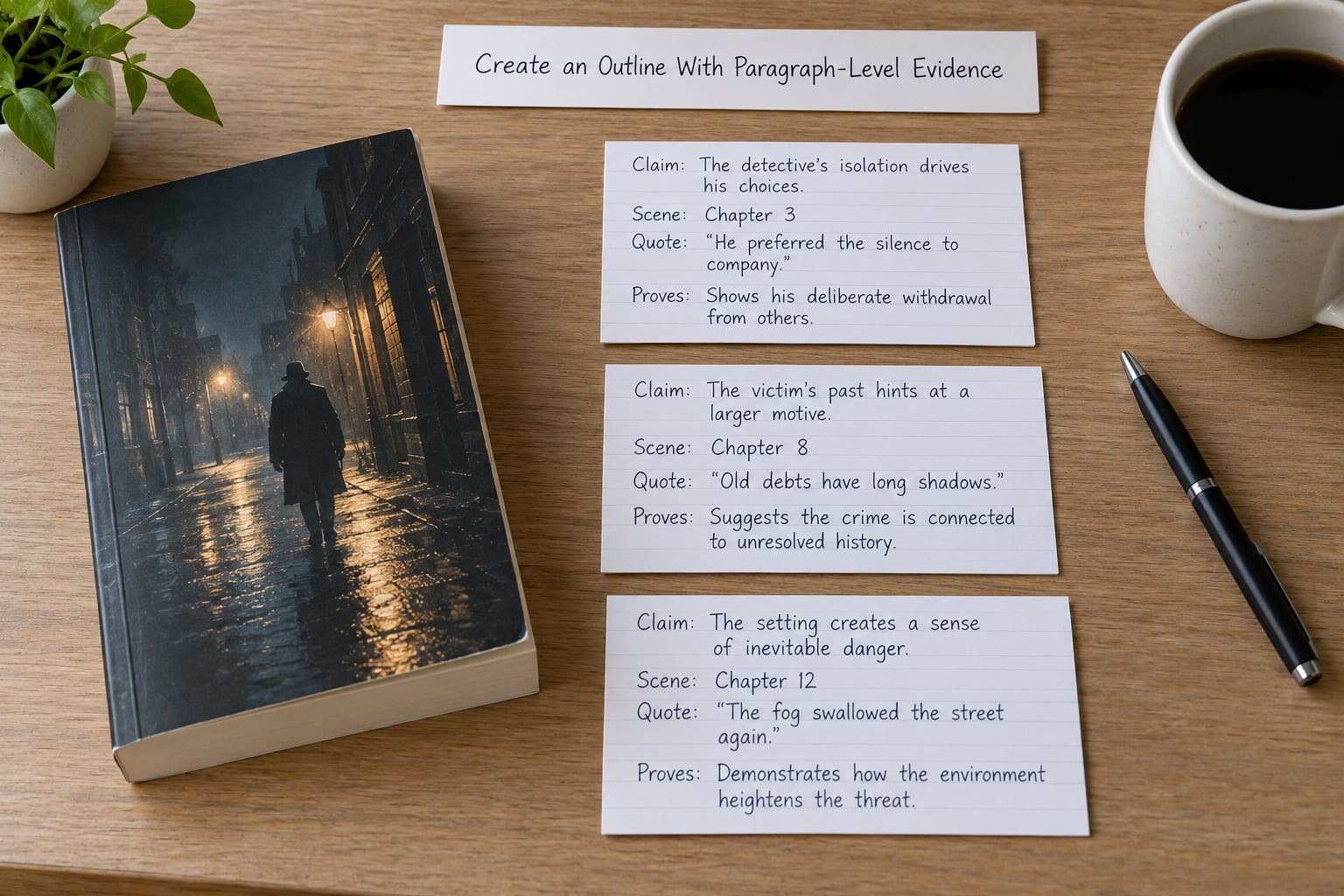
For every body paragraph, write down four lines before you draft it: the claim this paragraph makes, the scene or moment it uses, the exact passage you will quote, and why that passage matters to the thesis. If you cannot fill all four lines, the paragraph is not ready and usually should not exist.
Order the paragraphs so the most obvious point comes first and the subtlest comes last, or move by analytical lens. Either way, each paragraph should advance the argument rather than restate it from a different angle.
Keep the introduction and conclusion in the outline as single lines. They get written last, and planning them in detail early wastes time you need on evidence.
6. Write the Essay Paragraph by Paragraph
Each body paragraph follows four moves: topic sentence stating the claim, the quotation embedded in your own sentence rather than dropped alone, several sentences of analysis, and a link back to the thesis.
The analysis-to-quotation ratio is where most crime novel essays fail. Aim for three to four lines of your own writing for every line you quote. One quoted line followed by two sentences of restating what it says is padding, not analysis.
Here is one paragraph built on the formula, with its moves marked in brackets:
[Topic sentence and claim] The detective’s early certainty reads as competence rather than arrogance because the narration withholds the scene of the crime from him, and Eco uses that gap to keep the reader one step ahead of the man solving it. [Evidence] When Adso first sees the body, he records wounds and orientation “with the indifference of a man who had not yet understood what he was looking at” (Eco 178). [Analysis] The clinical vocabulary here is doing moral work: the phrase places Adso outside the event he is documenting, and “not yet” quietly promises a later reckoning with what the sight means. [Analysis] The passive construction removes Adso from the sentence entirely, so the indifference belongs to the narration rather than to a man who merely lacks experience. [Link back] That choice makes the eventual flood of evidence in the library feel like a change in Adso rather than a change in the case, which is precisely the reversal the thesis describes.
Transitions between paragraphs should name the relationship between ideas, not just signal order. “The same technique returns here with opposite effect” tells the reader why the next paragraph exists.
Write the introduction last. It needs three things: the novel and author named, the interpretive thesis stated in one sentence, and a short roadmap of the argument’s shape. Skip the definitional opening about what detective fiction is unless the assignment asks for it; instructors already know.
Write the conclusion to extend the argument, not to repeat it. Restate the claim in fresh language, then say what the novel’s technique makes possible that a plainer telling would not. Never introduce a new quotation or a new argument in the last paragraph.
7. Revise, Cite, and Proofread the Final Draft
Revise in separate passes, one job per pass, or you will miss things.
- Argument pass. Read only your topic sentences in order. Do they form a coherent chain? If a sentence could be moved without damage, the paragraph is not doing work. This is also where you catch thesis drift, where the final third of the essay starts defending something the introduction never claimed.
- Evidence pass. Check every quotation against the copy in front of you, character by character. Transcribed-from-memory quotes are the single most common reason essays lose marks.
- Balance pass. Count the words spent summarising plot against words spent analysing. If a quarter of the essay is summary, cut it to what the analysis needs.
- Citation pass. For MLA, an in-text citation gives author and page: (Eco 178). The works cited entry needs author, title in italics, publisher, year, and no city. For a novel with a named translator, cite the translator after the author: (Gaiman 41). Check your course’s required style before assuming MLA.
- Proofread pass. Last. Fragments in evidence quotations, inconsistent capitalisation of quoted speech, and stray double spaces after full stops all read as sloppiness to a marker.
Leave a night between the proofread pass and submission where you can. Fresh eyes catch what familiarity hides.
Common Mistakes
Almost every weak crime novel essay repeats a handful of failures. Each one has a specific fix.
| Mistake | Correction |
|---|---|
| A plot-summary opening that retells the murder before any analysis | Open with the interpretive thesis and keep background to the two sentences your first paragraph needs. |
| A thesis that restates the novel’s topic (“explores guilt”) | Commit to a claim about technique and meaning, using the weak-versus-strong rewrites in step four as a model. |
| Quotations dropped alone on their own line | Embed the quotation inside your own sentence and follow it with three to four lines of analysis. |
| Assuming the reader knows nothing, so everything is explained | Write for a peer who has read the novel but not your argument; one sentence of orientation is plenty. |
| Topic sentences that describe rather than claim (“This chapter shows the murder investigation”) | Turn each into an argumentative claim about what the chapter’s choices produce. |
| Uneven paragraphs, with a strong opening and a thin back half | Reorder so the paragraph’s key move lands second; if you cannot find analysis, the evidence is wrong. |
| Ignoring the citation requirement until the night before | Capture author, page and edition as you quote, then build the works cited list during drafting. |
| A conclusion that only summarises | Add a sentence about what the technique makes visible, and cut any new quotations. |
| Writing about a book you disliked with no critical distance | Separate your taste reaction (“I found the prose slow”) from the arguable claim about what that slowness does in the novel. |
A useful revision routine: mark every paragraph that only summarises, then cut or rewrite it. Then mark every paragraph where the quotation does more work than your analysis, and expand those first. The remaining problems are mechanical and worth handling last.
Frequently Asked Questions
How long should an essay about a crime novel be?
Most undergraduate assignments run between 1,000 and 1,500 words, which fits three to five body paragraphs plus introduction and conclusion. A 750-word critical response leaves room for only two or three points, so pick one analytical lens rather than three. Longer pieces of 3,000 words and above need secondary sources and usually a comparative argument across two novels. Always follow the stated word count over any generic guideline.
Does the crime novel have to be a recent book?
No. Classic detective fiction from the 1920s through the 1940s offers abundant material on fair play and narrative convention, and its rules give you something concrete to argue about. Contemporary thrillers tend to be easier to discuss for social critique and unreliable narration. Choose based on your prompt and on whether the technique you want to analyse is visible in the text.
How do I begin if I do not know what to write about yet?
Write down the question the novel left you with, not the answer you found. Then pick one passage that unsettles you and ask why the author handles it that way. That single moment becomes your evidence, and the question around it becomes your thesis. This is more reliable than trying to decide a topic before you have reread the book with a pencil in hand.
How many quotations should I use in a crime novel essay?
Aim for one short quotation per body paragraph, sometimes two tightly related lines, and write three to four lines of your own analysis for each. In a 1,500-word essay that is four or five quotations in total. Choosing fewer passages and analysing them properly reads as confidence, while quoting constantly and skimming each quotation reads as an unfinished argument.
Should I worry about spoilers?
Only in the sense of balance, not avoidance. Your reader has already read the book, so withholding the ending helps nobody, but a paragraph spent on plot mechanics crowds out the argument. Keep background to what the paragraph needs, usually under a quarter of the essay. Some prompts ask you to avoid revealing the solution, so check the brief before you start drafting.
Which citation style should I use for a novel?
MLA is the most common requirement in literature courses, giving author and page in the text, such as (Eco 178), plus a works cited entry with author, italicised title, publisher and year. Chicago uses author-page as well but builds a bibliography rather than a works cited list. Harvard puts the year in parentheses. If the prompt does not say, ask your instructor rather than guessing.
Conclusion
Read the novel with the prompt in view, find the central crime and the questions it raises, choose one analytical lens, turn your observations into an arguable thesis, gather evidence paragraph by paragraph, draft in four moves, then revise in separate passes. The genre helps you more than most, because clues, misdirection and revelations are all visible enough to quote and argue about.
Start before you feel ready. Write one sentence now: a claim about how a single scene, a narrative choice or a pattern of clues reveals what the novel is really concerned with. That sentence is your thesis in embryo, and the rest of the process is the work of proving it.