
You read a mystery without guessing the ending by recording what happens in each scene before you try to explain it, keeping three or more suspects alive in your notes, and treating any detail the book seems to underline as a likely misdirection. It takes about ten extra minutes per chapter and it does slow your reading down, which is the honest cost.
Most readers who spoil their own mysteries do the same three things: they lock onto the most prominent suspect in the first fifty pages, they read emphasis as evidence, and then they never update. By page 80 the case is solved and the rest of the book is a waiting period.
I keep a notebook for exactly this reason. My handwriting gets worse, my reading gets slower, and I have been genuinely wrong about the culprit more often than I have been right.
Table of Contents
- What You Need
- Step-by-Step: Read the Mystery as Evidence
- 1. Read for the Scene Before the Solution
- 2. Keep Suspects Separate from Conclusions
- 3. Track Motive, Means, and Opportunity
- 4. Mark Contradictions and Repeated Details
- 5. Form Theories Without Guessing the Ending
- Common Mistakes
- Frequently Asked Questions
- How do I stop guessing the killer while reading?
- Should I take notes while reading a mystery?
- What is a red herring and how do I spot one as a reader?
- I already guessed the ending. Is the book ruined?
- How do I read a book with an unreliable narrator?
- Should a mystery be solvable by the reader?
- Conclusion
What You Need
A fair-play mystery hands you the clues in the text, so the tools you need are unglamorous.
- A quiet reading session where you can go back a paragraph without losing your place.
- A notebook or a highlighting tool. Paper suits a clue log better because you can compare columns; highlighting suits a reader who just wants to catch odd details.
- A four-column tracker: person, motive, opportunity, contradiction.
- Nothing else. No search engine open in another tab, and no reviews.
The last point is the hard one. Readers describe a detective phase of seventeen browser tabs open, checking their theory against other people’s reactions mid-read. That converts a novel into a puzzle you are auditing instead of a story you are inside.
Step-by-Step: Read the Mystery as Evidence
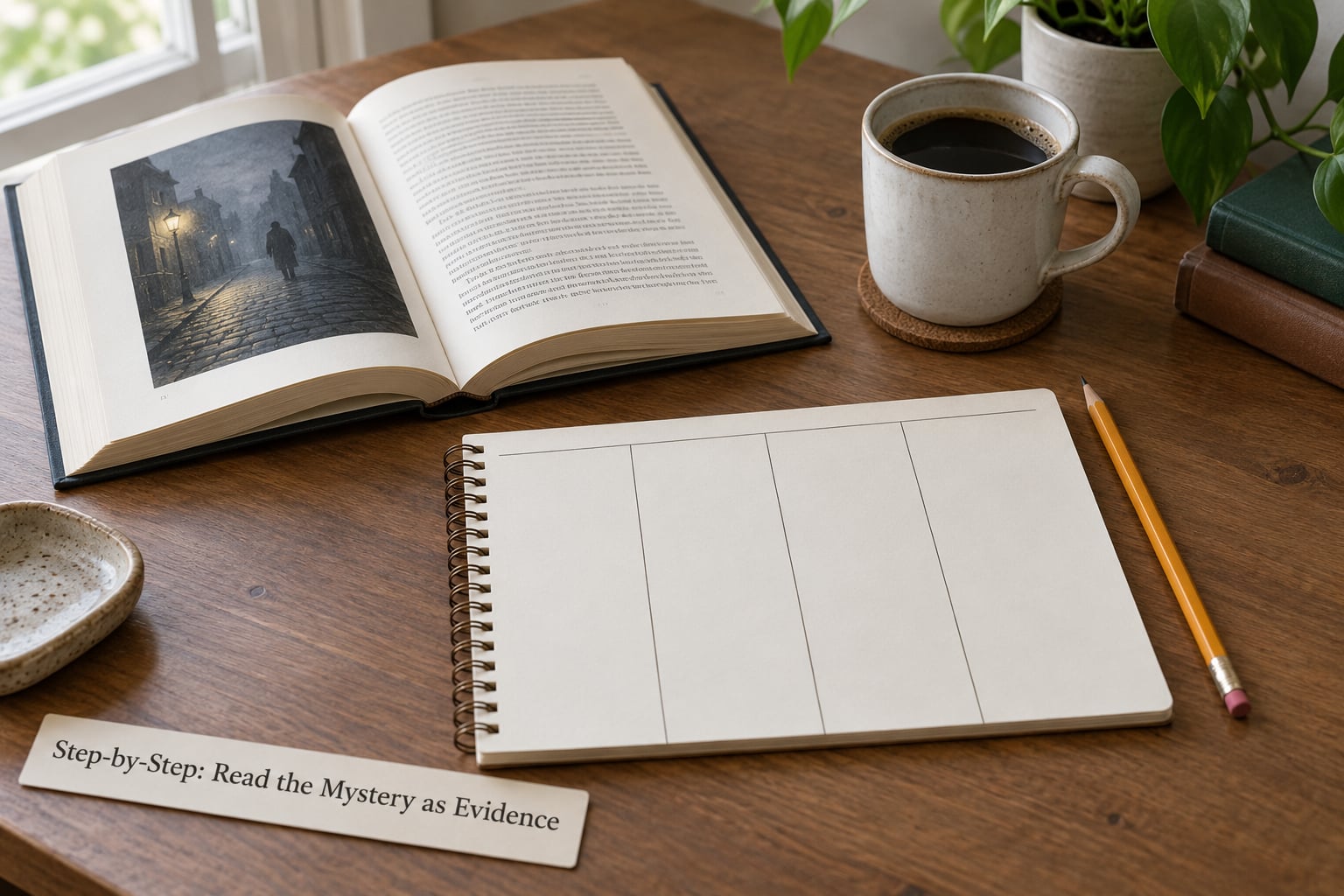
Five steps, in order, and each one is a habit you can fail at deliberately.
1. Read for the Scene Before the Solution
Write down what happens, who is in the room, and what changed by the time the scene ends.
Take a fictional example. A character leaves a study at nine, the storm cuts the power, and she is found on the stairs at half past. Observation says she left, the room went dark, she ended up on the stairs. It does not say she was pushed. Interpretation arrives later and it arrives from somewhere you cannot check.
That gap is where spoilers live. If you skip the observation column, the interpretation shows up pre-made and you experience it as intuition, which is untestable.
2. Keep Suspects Separate from Conclusions
Maintain a neutral list of everyone with access, and record actions rather than feelings about them.
A neutral list looks like this: name, last seen, access to the scene, stated alibi, who vouches for that alibi. It holds the detective, the spouse, the nephew with a debt and the person nobody has looked at twice. Four names minimum, five better.
Do not cross anyone out. A crossed-out name is a finished theory, and finished theories are the reason reveals feel cheap. Character emphasis is not evidence either. The book spends most of its words on whoever it wants you watching, and that is a budget decision, not a clue.
3. Track Motive, Means, and Opportunity

These are three separate columns, and guilt needs all three.
Motive is a reason. Means is the ability. Opportunity is a window of time that someone else can place you in. Readers chase motive because motives are legible and comforting, but a strong motive plus no window is just a person with grievances.
The reverse mistake is just as common: someone with means and twenty free minutes on the night looks worse than the person with the loudest grievance. Score the three columns separately and resist adding them together.
4. Mark Contradictions and Repeated Details
Two statements that cannot both be true are worth more than ten odd-looking details.
Watch for conflicts in timing, an alibi whose detail is slightly off, an object described twice in two different rooms, a reaction that arrives a beat too late. Repeat and contradiction are the two patterns that survive close reading, because authors use them deliberately.
A clue does not have to answer anything to be worth logging. The cracked teacup in chapter four tells you nothing about the ending, but it tells you the author noticed that room, and that is worth a line in your notebook.
5. Form Theories Without Guessing the Ending
Turn observations into theories you can test against what comes next, and give each one a confidence level.
Low, medium or high, in writing, so revising is honest rather than embarrassing. A high-confidence theory that survives chapter nine deserves promotion. One that collapses when a second alibi shows up gets demoted, and the demotion is data rather than failure.
The payoff is that a mystery ending lands properly when you arrive at it holding two live theories rather than one finished answer. Learning how to read a mystery without guessing the ending is mostly about staying in that two-theory state, and about resisting the urge to look up whether you were right.
Common Mistakes
Five things go wrong most often, and each has a simple correction.
Announcing the culprit too early. The fix is a rule you can keep: no name gets written as a verdict until at least three chapters have passed without new information about it.
Overreading a red herring. A red herring is a detail that points away from the answer on purpose. It becomes a mistake when you promote it to proof simply because the book underlined it. Fix: anything the author displays gets logged as displayed, never as evidence.
Treating author withholding as evidence. Silence, a missing backstory, an unexplained off-page errand: these are usually pacing, not clue. A book that refuses to tell you something has not accused you of anything.
Calling every odd detail a clue. If everything matters, nothing is trackable. Fix: a detail earns clue status only when it recurs, contradicts something, or is tied to access, timing or motive.
Ignoring narrative perspective. In first-person novels the narrator is a character with an agenda, and a third-person section may be filtered through a frightened witness. Fix: ask who is telling this scene and what that person wants.
Worth knowing the flip side too. Some books are not solvable by design. Literary and psychological thrillers often withhold the answer on purpose, and treating those as failed whodunits is a category error rather than a discovery. Check whether the book made a promise before you hold it to it.
Frequently Asked Questions
How do I stop guessing the killer while reading?
You cannot switch the habit off, so give it a container. Write theories in a separate column from observations, label each one low, medium or high confidence, and review them only at the end of a chapter rather than mid-scene. The guessing continues, but it stops running the reading. Most readers find the urge fades after two or three chapters of logging instead of arguing with it.
Should I take notes while reading a mystery?
Yes, but only what you can produce in under a minute per chapter: who was present, what changed, and any detail that felt odd. A four-column log of person, motive, opportunity and contradiction takes about that long and beats a page of highlighting. If note-taking pulls you out of the story badly, mark two or three details per chapter instead and stop there.
What is a red herring and how do I spot one as a reader?
A red herring is a detail that points the reader toward the wrong answer on purpose. As a reader you spot one by weight: the book spends disproportionate attention on it, describes it twice, or attaches a reaction to it. Treat heavy emphasis as a reason to log the detail more carefully, not as proof. Emphasis is how a novel spends your attention, and misdirection is what happens when it aims that attention at the wrong person.
I already guessed the ending. Is the book ruined?
Usually not. What gets ruined is the investigation, not the prose, and a solved case gives you a second read with different eyes. Keep a running note of what you expected, then mark the places where the book contradicts you; those are the places worth rereading. Readers who log their own theory before the reveal usually get more from the ending than readers who stayed blank.
How do I read a book with an unreliable narrator?
Read the narrator as a suspect rather than a camera. Track where their attention goes, what they skip, what they insist on, and whether they describe their own feelings in unusual detail. A narrator who reports a strange event with no reaction is doing something. Hold at least one alternative reading of any scene where their account is the only source, and revise when the text contradicts them.
Should a mystery be solvable by the reader?
In fair play detective fiction, yes, and the promise is roughly this: the information needed sits in the text, not in a withheld aside. Trick endings that depend on a hidden twin or an invented character break that contract by design. Judge a book by the promise it made. A puzzle-box novel that wants you to feel beaten and a police-procedural that wants you to feel clever are different promises, and only one of them is failing if you cannot solve it.
Conclusion
Read for the scene before the solution, keep your suspects untarnished by conclusions, and separate motive, means and opportunity into their own columns.
Start smaller than that. Open the book and do a scene inventory for chapter one: who was present, what changed, one detail you cannot place. Everything else on this page grows out of doing that one exercise and repeating it after each chapter, with two theories alive until the book ends you.