A stakeout scene reads as boring when it has no objective, no obstacle and nothing at stake. Fix those three things and the waiting starts doing real work, because suspense comes from the reader’s worry rather than from anything exploding. Knowing how to write a stakeout scene that is not boring comes down to a chain of small discoveries that ends on a turn.
That is the whole idea. Everything else is technique, and most of it is restraint: arrive late, keep a clock running in the reader’s head, choose two vivid details instead of ten, and let two people stuck in a parked car argue about the thing neither of them wants to say out loud.
What follows is the order I work in. There is a seven-step build with a beat clock you can drop straight into a chapter, a set of named anti-patterns that kill stakeouts, and a revision pass you can run on your own draft in about twenty minutes.
Table of Contents
- What You Need Before You Write
- Step-by-Step: Building a Dynamic Stakeout Scene
- 1. Define the Character’s Objective
- 2. Build a Stakes-and-Discoveries Chain
- 3. Use Waiting to Reveal Character
- 4. Add Complication Without Adding Random Noise
- 5. Control the Information Gap
- 6. Make the Setting Work Like a Clock
- 7. End With a Turn, Not Just an Arrival
- Common Mistakes and How to Fix Them
- Frequently Asked Questions
- How long should a stakeout scene be?
- How do I make a waiting scene tense without action?
- How do I write dialogue between two people who are just waiting?
- Should I write a stakeout scene from the target’s side?
- When should I cut the stakeout scene entirely?
- Conclusion
What You Need Before You Write
You need four things on paper before you draft a single sentence of waiting, and pinning them down takes about ten minutes.
The scene objective. One sentence, in the character’s own terms: confirm whether the man in the third-floor flat is the man from the warehouse. An objective with no deadline is a mood. An objective with a deadline is a countdown, even when the deadline is just the end of the shift.
What failure costs. If the target walks and the character loses him, what breaks? A blown arrest is a bad Tuesday. A witness who ends up in the river is a different book. You cannot write pressure into a scene where the viewpoint character is free to shrug and go home.
The setting’s constraints. Real surveillance is dull in ways that are useful to you: a cold car, one window with a usable sightline, a partner who talks too much, a radio that drops out under the viaduct, a shift change at midnight. Constraints are free tension, because the character has to work around them.
The question the scene answers. Not a theme. A literal question: is she alone in there? Is the second car a coincidence? If you cannot phrase yours as a question with a yes or a no, the scene has no spine.
Then run the objective test. Ask what changes if the target walks, and write the answer in one honest sentence. If the answer is that nothing changes except the length of the chapter, you do not have a stakeout, you have a delay. Merge it into the scene before it, or give the character something to lose.
Step-by-Step: Building a Dynamic Stakeout Scene
1. Define the Character’s Objective
A stakeout works when the character is trying to do one specific thing and the reader knows exactly what it is. The objective is the engine: surveillance, protection, evidence, a contact who promised to show up. Write it in a sentence you could put in your notes, then decide what happens when it fails.
Failure is where the pressure comes from, so make it concrete. If this is a protection stakeout, failure is not an arrest going cold, it is a person who trusted the detective getting hurt because he went to the shop for milk. Ian Irvine’s version of the same question is more useful than a plot outline: not what needs to happen, but what can I promise will go wrong. Promises get paid off. That is suspense.
Put the deadline somewhere the reader can see it. The relief shift ends at six. The bar closes at midnight. The bag is due on the flight at seven in the morning. Deadlines shorten with every scene, and a deadline running quietly in the background is doing more work than a car chase.
2. Build a Stakes-and-Discoveries Chain
A working stakeout is a ladder, not a plateau: one small development after another, each one changing what the character knows and what they must do next. Here is a beat clock you can drop straight into a draft and adjust. Elapsed time is the elapsed time inside the scene, not real time.
0:00 — Entry, already twenty minutes in. The character is parked, cold, watching. The reader gets one problem and one image. No arrival, no kit inventory.
0:15 — First anomaly. A curtain moves. The target’s car is still there but he is not. Something is wrong with the plan, and the character has to decide whether it is a problem or nerves.
0:40 — A partial answer. He confirms one thing and it makes the next thing worse. The second visitor is not a delivery driver because delivery drivers do not park across the street and wait.
1:10 — Contact fails or doubles back. The radio goes dead at the worst moment. Someone knocks on the car. The partner wants to leave and the character wants five more minutes, and neither of them says why.
1:45 — Setback. The target leaves on foot. Following means losing sight of him for good. Not following means losing the only chance. Pick one and make the character pay for it.
2:30 — Revelation. What he saw recontextualises the case. Usually it is smaller and stranger than the theory he came in with, and that is better, because it forces a decision.
3:00 — Turn and exit. The scene ends the moment the situation is different from how it began, not when the character has finished reacting to it.
Here is the difference in practice. The flat version reads: They waited for three hours. Nothing happened. At half past eleven the man finally came out and got into a car, and they followed him across town. Every beat in that paragraph is a non-event, and the reader can feel it sliding.
The working version reads: At eleven the light in the third-floor flat went out, and Dunn did not move. Five minutes later a second car turned into the street, parked opposite, and killed its lights. Dunn looked at the notebook where he had written MAKE, MODEL, COLOUR and found he had written nothing since nine. Beside him Frey said, “That’s the second one tonight,” and he did not ask what she meant, because they had both seen it. Same events, arranged so that every line changes the situation.
3. Use Waiting to Reveal Character
Boredom is the best character material you will ever get, because a stakeout shows you exactly who someone is when nothing is required of them. It is James Scott Bell’s enter-later, exit-earlier logic working in reverse: the scene stays on the page longer because the character is on the page, not because the target is.
Physical discomfort does the characterisation without a word of exposition. The leg that has gone numb. The bladder the character will not admit to. The second cup of coffee going cold at the bottom of the cup rather than the top. Specific, dull, slightly embarrassing, and it tells the reader who this person is when nobody is watching.
Memory works here too. The character starts rehearsing the worst version of the case, and the rehearsal shows you what they are afraid of. A detective who thinks about the paperwork is different from one who thinks about the victim’s face, and both can be doing exactly the same job.
Suspicion is the cheapest engine in crime fiction. Nobody has to do anything. The character starts reading the partner’s phone face-up on the seat, then reading it face-down, then reading it at all. Small, ugly, entirely in character, and it moves.
4. Add Complication Without Adding Random Noise
A complication earns its place when it forces a choice, hides information, or raises the price of staying. Everything else is noise, and noise is what makes stakeouts feel stuffed and still boring.
Weather is the usual offender. A downpour changes what the character can see, whether the car’s interior light throws a reflection across the window, whether a passerby can see two faces inside. That is weather as a plot device. It started to rain, with nothing after it, is wallpaper.
The false lead and the absent target do the same work differently. The target does not show, and the character’s assumption about why becomes the scene’s real subject: is he out, or is he sitting in the dark watching them? A car that circles the block twice is a complication. A cat on the bonnet is a distraction.
Test every complication with one question. Does the character’s next decision change because of it? If not, cut it, no matter how good the image.
5. Control the Information Gap
Dramatic irony is the most efficient tension tool in a low-action scene: the reader knows something the character does not. Give the reader one fact the viewpoint character cannot see, then let the scene play out under that knowledge.
The neighbour who waved at the character is not friendly. The partner’s radio silence is not a dead battery. The person who left the building at nine was not the person in the flat, because the reader saw the earlier scene and the character did not. Restricting your viewpoint is what makes this work, so keep the narration tight to the person on watch.
Withhold rather than tease. Let the reader assemble the answer from details you have already planted, and resist the urge to hint with a look, a sigh or a meaningful pause. Cheating the reader’s intelligence is worse than a slow scene.
Screenwriters have the tighter version of the same problem. A stakeout beat on the page is a slugline, INT. CAR – NIGHT, a compressed chunk of time, and beats marked by commas. Prose can spend four pages on the same beat; a script cannot, so the decisions and reversals have to land inside the lines. Read more on how crime fiction gets adapted to the page in our coverage of screen adaptations and noir classics.
6. Make the Setting Work Like a Clock
Let the environment mark the time. Passing light, temperature, sound, traffic and the routines of a street will tell the reader how long it has been without you ever saying a time word, and it makes the wait feel long instead of reported.
Streetlights coming on, the delivery traffic thinning, a dog walker who goes past every night at the same hour, the pub opposite putting its chairs up. Each one is a tick. Two ticks and the reader has spent half an hour, with no paragraph spent telling them so.
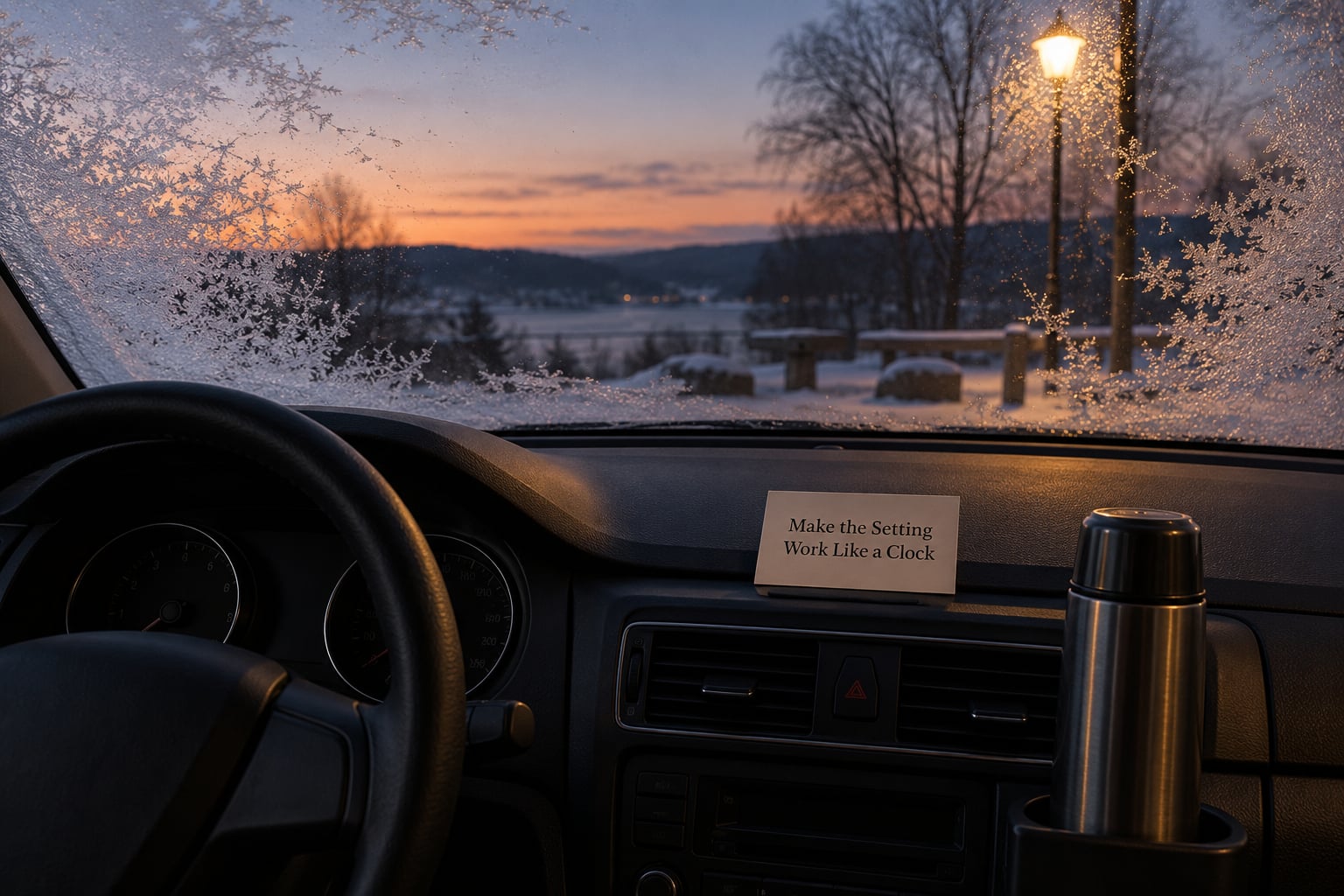
Small environmental changes are also warning systems. When the ambient noise drops because the pub has shut, that is a change in the situation, not in the mood. When frost starts on the inside of the glass, the character has been sitting still long enough for the car to become part of the problem. Hitchcock’s axiom is a great story with the dull bits removed, but the inverse also holds: keep the dull bits and stretch them, and the ordinary hour on watch can carry as much weight as the fight that follows.
Choose two details per beat, not ten. The neck, the cold, the radio. Everything else is inventory, and inventory is the thing readers skip.
7. End With a Turn, Not Just an Arrival
A stakeout should finish on a change in the situation, not on a target turning up. Arrival is the midpoint of the scene. The turn is the moment the character knows the case has a different shape, or has to choose between the mission and something else entirely.
Good landing points: the target arrives and does something the character did not predict; the target never arrives and the absence means something; the character is made; the cover is blown. Then leave the scene. Peer editors in the writing communities call scene endings landings and go out of their way to avoid soft ones, which is good advice for any ending but essential here.
Enter late and exit earlier, and if neither edit helps, consider cutting the scene entirely. One line of summary, or none, will often do the work of three pages: They watched the house for six hours. He never came home. That is a legitimate stakeout, and it is stronger than a padded version.
Common Mistakes and How to Fix Them
Six patterns account for most dead stakeouts. Each one has a fix you can apply in a single revision pass.
The log dump. You narrate the wait in chronological order: 9pm, 9.30, 10. Fix: keep one hour of the wait on the page and jump the rest. Pick the two hours that changed something.
The procedure info dump. The detective lectures the partner about surveillance doctrine. This is the single most common complaint in writer forums about stakeout scenes. Fix: cut the explanation, keep one accurate detail that costs the character something. If the character has to explain it, nobody had to do it that way.
Weather narration. Rain, wind and streetlamps described for atmosphere. Fix: give every weather detail a mechanical consequence. Rain kills the sightline, wind makes the door slam and gives the character away, darkness removes the excuse to be parked there.
Unearned silence. Nothing happens and the prose signals dread it has not earned. Fix: put a real question at the centre of the wait, then let the not-knowing do the work. Tension needs a question attached to it.
Dialogue without conflict. Two detectives on watch discuss the case like colleagues in a lift. Fix: replace exposition with friction. They should each want something the other will not give, such as calling it in, going in alone, driving the witness home tonight.
The target who never arrives. Four pages of waiting and no payoff, so the reader feels cheated rather than tense. Fix: the absence has to deliver something. The character learns the target’s routine, or realises they have the wrong man, or sees something they were not looking for.
One more check before you call it done. Rate the scene out of ten for suspense, scene by scene, and plot the line. Ian Irvine recommends this as a revision exercise, and for stakeouts it is brutal in a useful way: a flat scene among high ones shows you exactly where the problem sits.
Frequently Asked Questions
How long should a stakeout scene be?
A few hundred words to about 1,500 is the working range, and length is not the real measure. Ask instead how many changes in the situation the scene contains. Four developments in 600 words will feel longer and tighter than four developments spread over 3,000. If you can write the whole stakeout as one line of summary without losing anything, the long version is padding. Many writers find the shape works best in a mid-chapter turn or a chapter-ending escalation.
How do I make a waiting scene tense without action?
Tension comes from the gap between what the reader knows and what the character knows, plus a deadline that is visibly running. Give the character one objective, one obstacle and one thing they are afraid of, then keep the situation changing. Restricted third person or close third helps because it lets you plant a fact the character cannot see. Add micro-tension between partners so the reader has something to worry about even when the target does nothing.
How do I write dialogue between two people who are just waiting?
Make them want incompatible things during the wait. One wants to call it in, the other wants five more minutes. Dialogue during a stakeout should be about the choice in front of them, not about the case they already understand. Give each line a subtext the other person refuses to name, let one of them misread the silence, and cut anything that could be delivered in a briefing. The car is a two-hander room and the constraint is what makes the dialogue interesting.
Should I write a stakeout scene from the target’s side?
Sometimes, and it is the same scene from the other side of the glass, which makes it a strong late-chapter reversal rather than a second stakeout. You already know who the target is, so you can plant behaviour the detective will later misread. The risk is losing the dread the reader had, so use it as the reveal that reframes the earlier scene rather than as a replacement for it.
When should I cut the stakeout scene entirely?
Cut it when nothing in it changes the case, the character or the relationship between characters. A surveillance scene that only confirms what the reader already believes is a cost with no return. Two tests before you keep it: name the discovery the character makes, and name the decision they now have to make. If you cannot do either in a sentence, compress the scene to a line of summary or drop it and give the pages to the scene where something happens.
Conclusion
A stakeout scene stops being filler the moment something changes in it. Write one objective, one meaningful discovery and one irreversible turn, then enter the scene late and leave the moment the situation is different from how it started.
Take your draft, find the paragraph where nothing happens, and ask what the character is afraid of. Put the answer there and keep going.