If you want to know how to write terse dialogue, the short answer is this: cut every word that is not carrying information, threat or subtext, then let the characters’ physical behaviour say what they refuse to say. It takes one focused revision pass, and it works best on a scene you have already drafted.
Crime and noir scenes drag for one reason almost every time. Two people are explaining the plot to each other. They greet each other, clarify things they both already know, and announce their feelings in full sentences. Nothing is at stake while they do it.
Terseness is not minimalism. Terse lines are short because every word is load-bearing, not because the character has nothing to say. The goal is a scene where the reader fills in the gaps, which is exactly the sensation that makes crime fiction feel dangerous on the page and works so well on screen.
Table of Contents
- What You Need
- Step-by-Step: 7 Techniques for Writing Terse Dialogue
- 1. Start With the Scene’s Unspoken Conflict
- 2. Cut the Framing Around Every Line
- 3. Let Action Interrupt the Speech
- 4. Give Each Character a Different Rhythm
- 5. Put the Important Information in Subtext
- 6. Control the Pace With Line Length
- 7. Edit for the Line That Changes the Exchange
- Common Mistakes
- Frequently Asked Questions
- How do I make dialogue sound more natural?
- How long should a line of dialogue be?
- What is subtext and how do I use it in dialogue?
- How many lines of dialogue should a scene have?
- What is the three-line rule in screenwriting?
- Should I use said or something more interesting?
- Conclusion
What You Need
Before you touch a single line, five things make the trimming possible. Without them, cutting just produces thin, generic speech.
- A scene objective. One sentence naming what each character wants in the room and what each is refusing to say out loud. Terse dialogue without a hidden objective is just clipped noise.
- A line budget. Most tense exchanges run five to twelve words per line. Set a ceiling and treat anything above it as a candidate for cutting.
- Two distinct voices. Decide in advance how each character differs: sentence length, vocabulary, whether they answer or deflect, whether they use profanity or never do.
- A subtext target. Pick the one fact the scene needs to deliver and decide which character will state it, which will imply it, and which will actively deny it.
- A revision pass with the scene printed out. Screen reading and page reading hide the same problems, but print makes rhythm and repetition obvious in a way a laptop does not.
None of that needs tooling. A legal pad and a red pen have done this job since before word processors, and the writers I know who cut best are the ones who still do it on paper.
Step-by-Step: 7 Techniques for Writing Terse Dialogue
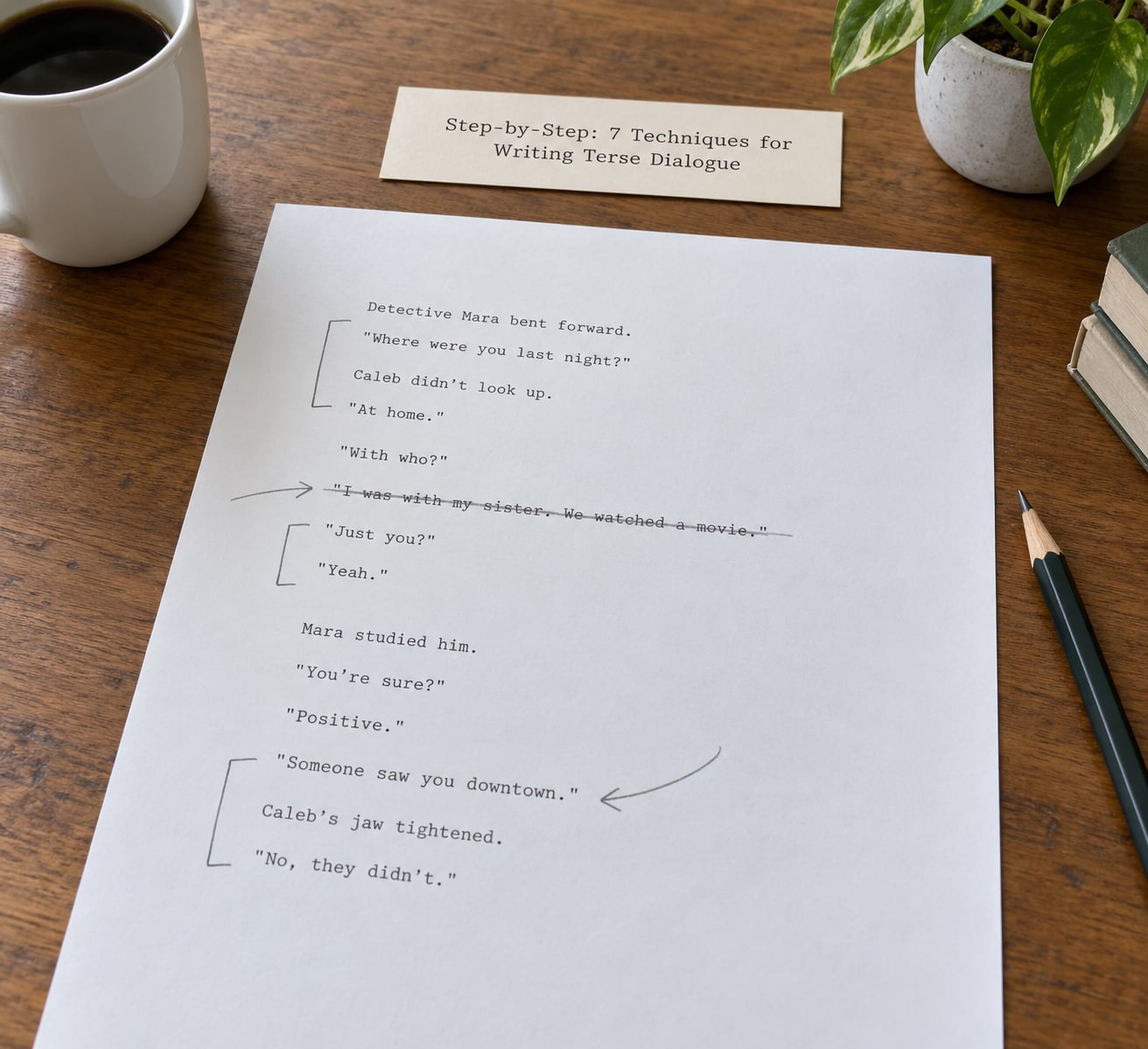
Work through these in order on a scene that is already drafted. Each technique depends on the one before it, because you cannot differentiate voices in a scene that has not yet been stripped of its framing.
1. Start With the Scene’s Unspoken Conflict
Terse dialogue exists to hold two things apart: what is said and what is being fought over. Write the hidden conflict first, in one line, before you edit anything. Who wants what, and who is lying about wanting it.
Before (noir interrogation, first draft):
“I’m only going to ask you this one more time,” I said. “Where were you on the night of the fourteenth? You were out somewhere, weren’t you? You were at least at the car park, at least. Look, I’m not trying to catch you out here, I’m just trying to understand what happened, because people want to know what happened, and if you tell me the truth then we can all go home, can’t we?”
After (the hidden conflict: he will not say he was at the car park, and the detective knows it):
“Again. Where were you.”
“I told you. I was home.”
“The car park.”
He looked at the table. “Nobody’s home.”
Twenty-seven words, and the reader now knows the detective is fishing, the suspect is frightened, and both of them think the other is lying. That exchange can run for two pages if you keep feeding it new pressure.
2. Cut the Framing Around Every Line
Most bloated dialogue is framing, not content: greetings, throat-clearing, repeated questions, and characters narrating what they are about to do. Delete the frame and the content usually survives intact.
Four cuts do most of the work. Remove the greeting that only exists because the scene starts. Remove the question that repeats the one just asked. Remove the line where a character explains the subtext they just created. Remove “I mean to say” and its relatives.
Before: “Look, Officer, I mean to say, I wouldn’t have touched the car if I had known it was his, honestly I wouldn’t have, you have to understand where I was coming from.”
After: “I didn’t know it was his.”
Also check the opening lines of every scene. A police interview starting with “I want you to understand I’m not your friend here” is dead on arrival. Start on the first question that matters and let the reader infer the rest.
3. Let Action Interrupt the Speech
Action beats inside dialogue serve one job: they stop a line from being pure explanation. A hand that does not move, a cup set down too hard, a coat buttoned that was already buttoned. That is enough.
Two rules keep this from turning purple. Use one physical detail at a time, and only when it contradicts the words. Characters pick things up precisely when their hands should be doing something else.
Before: “I’m not angry,” he said quietly, looking out of the window, and turned away from her, his jaw tight, and then he spoke again.
After: He turned to the window. “I’m not angry.”
That also clears up dialogue tags. Once the beat is doing the work, the tag gets thinner, and most of the time you can go back to said and let the sentence stand.
4. Give Each Character a Different Rhythm
Interchangeable dialogue is the complaint writers raise most often, and the reason is nearly always that every character speaks in the author’s own default sentence. Real voices do not share a rhythm.
Give one character long, hedged sentences that trail off. Give the other clipped commands of four words or fewer. Give a third a habit of answering beside the question. Vary vocabulary deliberately: a detective who says “the vehicle” and a thief who says “the car” tells you things before either of them speaks.
Before:
“Tell me about the night,” said Shaw.
“I don’t really want to talk about the night, if I’m honest, but I was at home and there is nobody who can prove that I was at home, so it doesn’t matter either way, does it?”
After:
“Tell me about the night.”
“Wasn’t there.”
Read the scene aloud with two different actors. If they sound the same to you, they will sound the same to the reader, and no amount of trimming will fix it.
5. Put the Important Information in Subtext
Subtext is the second conversation running underneath the one on the page. In crime fiction it does most of the emotional work, because characters in an interrogation or a stakeout almost never say the real thing.
There are three reliable moves. Have a character lie outright. Have a character answer a different question than the one asked. Have a character focus on a detail that quietly contradicts what they just said.
Before: “I never saw him that night, and I wasn’t anywhere near the docks.” He was wearing a new coat, damp at the shoulders, and it had been raining for two days.
After: “I never saw him. I wasn’t near the docks.” His coat was damp at the shoulders. It had rained for two days.
The coat now says everything the mouth refuses to. A reader who catches it will trust you for the rest of the book.
6. Control the Pace With Line Length
Line length is a tempo control. Short lines under pressure speed a scene up and read as tension. A single longer line in a run of short ones slows everything down, which is how you signal authority, hesitation or a character losing control.
The distribution matters more than the individual count. Dialogue written in four-to-eight-word lines hits a steady clip. Dialogue written mostly in three-word lines reads as artificial, and dialogue written in twenty-word lines reads as lecturing. Vary the two against each other.
A useful anchor from screenwriting: roughly two and a half to three beats per page, borrowed from Robert McKee’s idea of page economy in Story. Robert McKee’s law of diminishing returns applies directly here. Each additional line in a tense exchange returns less than the last, and somewhere near the end of a scene more lines make it weaker, not stronger.
For prose, the equivalent is that dialogue should rarely run to more than a third of the scene. A well-known analysis of published fiction puts the average share of dialogue in a novel at roughly 30 percent, with crime authors such as Agatha Christie sitting well above that, often in the 50 to 80 percent range. Use those numbers as a diagnostic, not a target: if your interrogation chapter is 80 percent speech, ask what the room looks like.
7. Edit for the Line That Changes the Exchange
Final pass: read every line and ask what it changes. If the answer is nothing, cut it. This single test does more than any word count.
Five things justify keeping a line. It reveals motive. It escalates danger. It shifts the power between the characters. It withholds something the other character wants. Or the silence after it is doing work.
Then run three quick checks. Count the words per line and flag anything over fifteen. Search your draft for said alternatives like muttered, choked out, interjected and replied, which are usually a symptom of a beat that was not written. Read it aloud and listen for rhythm, not grammar, because a scene with a good rhythm survives a missing comma and a scene without one does not.
Before: “You told me she was in Leeds,” said Doyle.
After: “You said Leeds.”
Four words instead of seven, and the accusation is sharper because the emphasis moved from the information to the promise.
Common Mistakes
These five failures account for most of the trouble writers report on writing forums, and each has a simple fix.
Robotic brevity. Characters who answer everything in one word read as machines, not people. The fix is to let the one place where a character is losing control run long, and put that longer line in the middle of the short ones. Revision tip: if a scene is nothing but short lines, break it on purpose and see whether the break helps.
Indistinct voices. Everyone speaks in the same measured register. The fix is rhythm and vocabulary rather than more cutting. Revision tip: read the scene with each character played in a different register, or bold the character names and read only their lines.
Over-decorated action beats. When every line is interrupted by a gesture, none of them register. Keep one meaningful beat every half page at most. Revision tip: delete every second beat and reread; almost always the scene gets tighter.
Cutting the emotional context. A scene stripped of every line of feeling becomes unreadable, because the reader has no measure for what the danger costs. Keep one line that names what a character is trying to protect. Revision tip: ask what each character would lose if this went wrong, and make sure the page shows it once.
The over-correction trap. This is the failure writers are warned about least and hit most often. Terse dialogue cut too hard becomes cryptic, and readers stop reading to decode it. Forum advice tends toward cutting more than feels comfortable, and that instinct is right about filler and wrong about information. Keep the load-bearing detail even when it feels obvious, and trust the reader with the work you are not doing.
Two habits help more than any rule. Read the scene aloud to a friend and watch their face at each line, because boredom shows before it can be explained. And finish by writing the scene again in one unbroken pass with no reference to the draft. Whatever you do not remember, the reader will not have either.
Frequently Asked Questions
How do I make dialogue sound more natural?
Write down how two people actually talk: repeated words, unfinished sentences, questions that answer other questions. Real speech is messy, and readers notice when it is not. Keep that messiness inside a scene with a clear objective, trim the politeness, and let the characters interrupt or mishear each other. Realism is a matter of texture and rhythm, not perfect grammar.
How long should a line of dialogue be?
Five to twelve words is a good working range for a tense exchange, and any line past about fifteen words is worth a second look. There is no hard rule, because authority and emotional collapse both show up in long lines. The useful test is variation: if every line is short the page turns mechanical, so save the longer lines for the moments that need a beat of hesitation.
What is subtext and how do I use it in dialogue?
Subtext is the second conversation running under the spoken one, where characters say something other than what they mean. Three moves produce it most reliably: a character lies outright, a character answers a different question than the one asked, or a character focuses on a detail that contradicts what they just said. In crime fiction it carries most of the tension, because people being questioned rarely volunteer the truth.
How many lines of dialogue should a scene have?
A tense two-hander usually runs somewhere between two hundred and four hundred words of speech, broken into short exchanges. The count of lines matters less than the page count. Dialogue is meant to take up roughly a third of a scene, with the rest carrying action and description. If a scene is all speech, you have written a transcript, and a transcript has no weather in it.
What is the three-line rule in screenwriting?
The rule refers to the three-line format on the page in a screenplay, where each line of dialogue, the character name and the parenthetical fit within about three lines of vertical space before the page break. It is a formatting convention rather than a limit on how much a character can say, which is why the advice in this guide is a word budget rather than a line count.
Should I use said or something more interesting?
Use said. It is invisible, and it disappears so the sentence carries the weight, which is why crime and noir scripts lean on it heavily. Colourful tags like muttered, hissed or spat draw attention to the writing instead of the scene, and they are usually covering for a missing action beat. Reach for something stronger only when the word itself carries meaning, and only once or twice in a page.
Conclusion
Here is the first thing to do. Take the scene you are least happy with and write two characters who each want something the other will not give. Then cut every line that does not change the tension, the information or the power between them.
Everything else follows. The framing goes, the tags get thinner, the voices separate, and the detail that contradicts the lie lands harder than any speech you cut. Do it in one sitting with the scene printed out, and see how much of the page you get back.