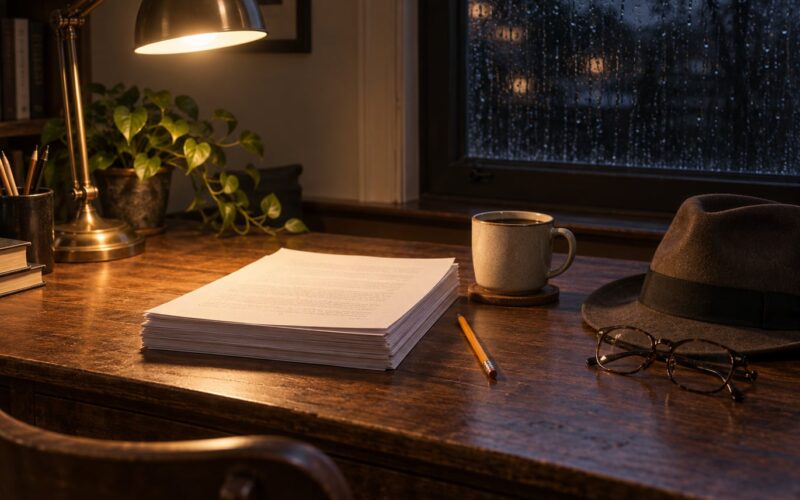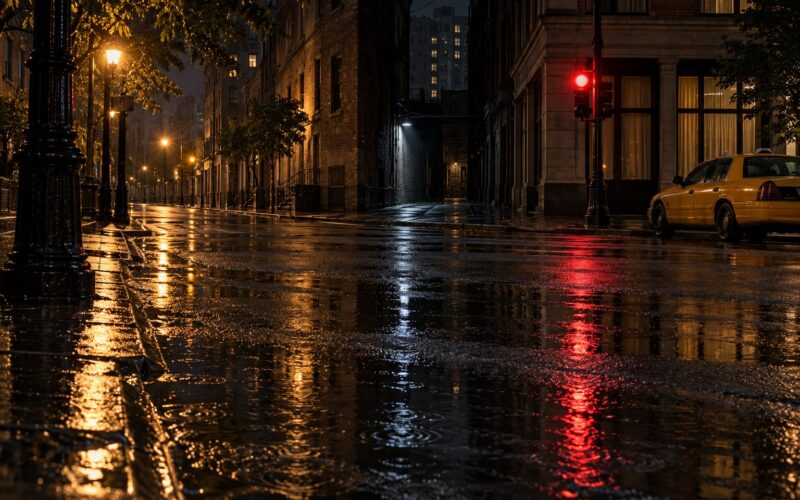
Purple prose in a setting description is language so ornate that the reader stops moving through the scene to admire the sentences. To write setting description without purple prose, you choose one or two concrete details that do an actual job — mood, character, information or pressure — filter them through your point-of-view character’s attention, then cut every line that does not change what the reader understands. The setup takes about an hour; the editing pass takes longer than you would like.
The guide below is written for crime and noir writers, where a room has to do two jobs at once: build dread and move a plot forward. The same method works anywhere, but noir has the least room for decoration.
Table of Contents
- What You Need
- Step-by-Step: How to Write Setting Description Without Purple Prose
- 1. Decide What the Setting Must Do
- 2. Choose a Limited Set of Specific Details
- 3. Filter Details Through the Character’s Viewpoint
- 4. Add Sensory Information Selectively
- 5. Use Verbs and Plain Language
- 6. Let the Setting Interact With the Scene
- 7. Cut Any Setting Description That Does Not Earn Its Place
- Common Mistakes
- Frequently Asked Questions
- What is the difference between purple prose and effective description?
- How much setting description should I include in a short story?
- How do I create atmosphere without using clichés?
- Should setting description be written from the character’s point of view?
- How can I revise a paragraph that sounds overly ornate?
- What makes setting description especially important in crime and noir fiction?
What You Need
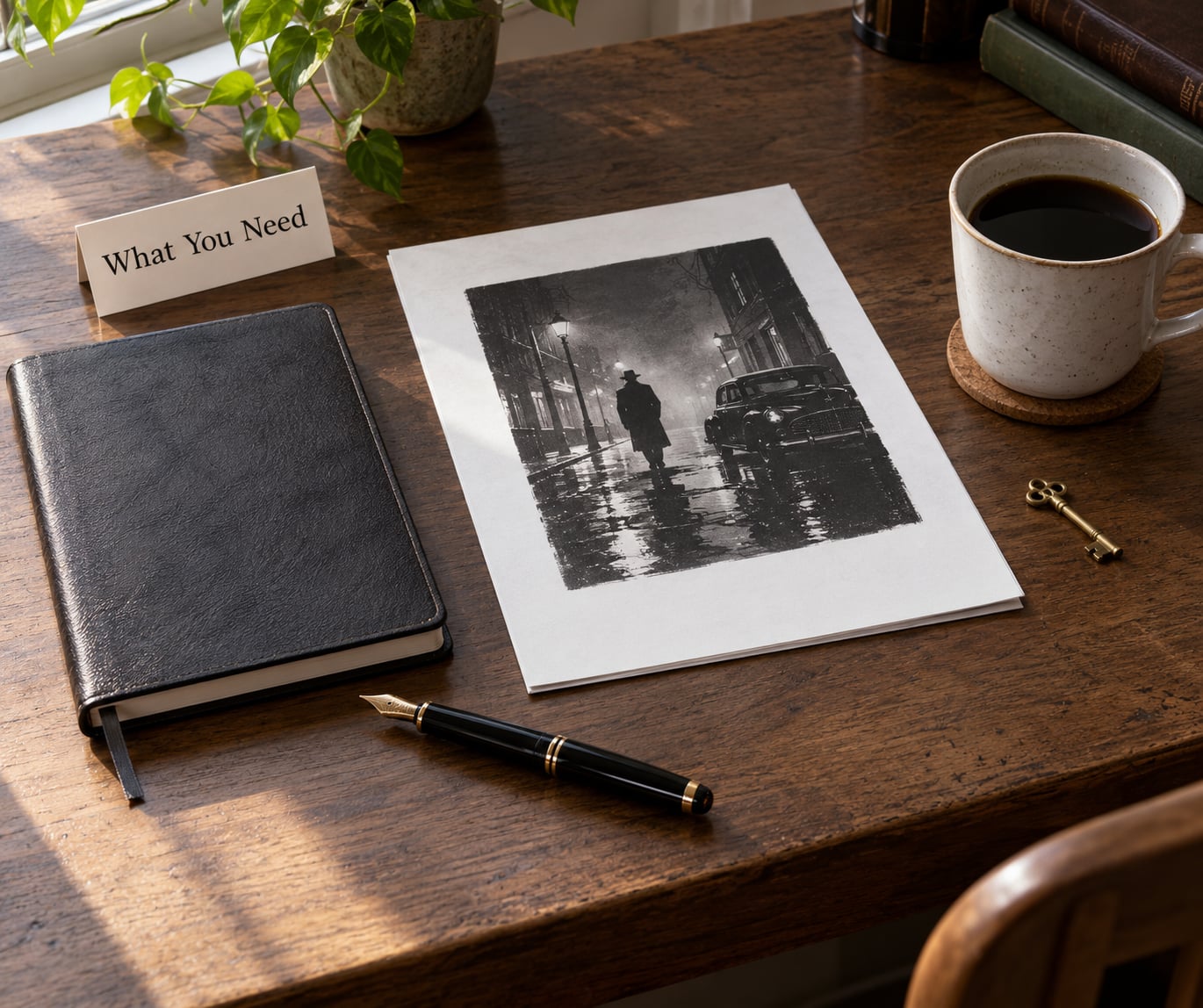
Four things, and none of them is talent.
A scene purpose. Before you describe anything, finish this sentence: by the end of this scene, the reader should know or feel one new thing about this place. “The room is depressing” is not a purpose. “She realises the file was signed out by someone who works nights” is.
A short list of details. Three to five physical things you could put in your hand. Not a catalogue — a handful. If you cannot name them without labels, you have not looked yet.
A viewpoint. Whose eyes are doing the noticing? This decides what gets noticed and what is treated as furniture.
A revision test. Every descriptive sentence has to earn its place against atmosphere, character, plot or place. That is the sentence to come back to on the last day, when you no longer love the paragraph.
Step-by-Step: How to Write Setting Description Without Purple Prose
1. Decide What the Setting Must Do
Every setting carries at least one job, and the job decides the language. A courtroom establishing scene establishes mood. A kitchen where a body was moved shows you something about the person who moved it. A corridor the character walks down alone builds pressure.
Pick the single most important job before you draft a descriptive phrase. If the job is pressure, you want short sentences and an obstruction in the way. If the job is revelation, you want one object the character looks at too long.
Before: The room was filled with a heavy, suffocating silence that hung in the air like a living thing. The job was pressure, and the sentence gives the reader a mood they could have got anywhere.
After: The room was quiet enough to hear the radiator knock. Nobody had moved for six minutes. Same mood, but now the clock in the room is part of the scene.
2. Choose a Limited Set of Specific Details
Generic description fails the same way every time: it reaches for the first word that comes to hand. Dark. Quiet. Towering. Crowded. Those words are not wrong, they are exhausted, and readers recognise them from the last four books they read.
The fix is a hard cap. Pick three to five details and write nothing else. The cap is what stops the paragraph from becoming a room tour.
One well-chosen detail can carry age, neglect, class and threat at the same time. A café in a noir novel could be described as charming, or as sticky-floored with a slot machine that only takes quarters and a chair mended with tape. The second one gives you three of the four jobs in a sentence, and it does it without an adjective doing any work.
Test: name the detail in ten words or fewer. “A chipped porcelain sink with a crack running into the drain” is a detail. “A sink” is furniture.
3. Filter Details Through the Character’s Viewpoint
This is the step that separates a place from a photograph. A detective walking into a flat counts exits. A grieving sister counts dust. A hitman with four minutes looks at the phone on the table.
Profession, mood, memory and current intention all narrow the field. The narrower the field, the fewer adjectives you need, because the detail does the characterising for you.
Before: The kitchen was old and worn, with faded checkered curtains and a cracked linoleum floor. Nobody is in that room. It could be in any novel.
After: Marisol had not moved the table since her mother died, and there was a ring of grease on the wood where the fruit bowl used to go. The grease mark does the work a page of decay could not.
4. Add Sensory Information Selectively
Most writers dump all five senses in sequence and the scene turns into a form. Pick one sense for atmosphere and let the others come in only when they carry information.
Sound and smell are the most efficient in noir because they reach the character without a line of sight. Cold air off broken glass. A radiator knocking in another room. Cigarette smoke that has been there long enough to soak into the curtains — that last one tells you the detective is not the first one here.
Touch works when it changes behaviour. Fingers stopping on a banister that has been painted over and over become tacky underhand means your character is being careful, and the reader learns it before you say a word about caution.
Skip the taste detail unless someone is eating or drinking, and be suspicious of a smell that appears in every paragraph of your chapter. If it is there on every page, it stops being a detail and starts being wallpaper.
5. Use Verbs and Plain Language
Nouns and verbs carry description; adjectives only decorate it. When a draft starts to feel heavy, the fix is rarely another adjective. It is a better verb or a more exact noun.
Before: The room exuded a suffocating atmosphere of decay and forgotten dreams. Three nouns, two abstract nouns and a verb that does nothing.
After: The radiator had bled rust across the floorboards and nobody had cleaned it. Nobody is hidden in that sentence, which is the good part — absence is a fact you can describe.
A useful drill for the revision stage: circle every abstract noun in a description paragraph — freedom, tension, decay, loneliness, beauty, menace — and make the character do something instead. You cannot abstractly name loneliness. You can have them check whether the door is locked twice.
6. Let the Setting Interact With the Scene
A room described before anyone enters it is a pause button. Push the description into movement instead: let the characters cross it, be blocked by it, use it.
Before: The warehouse was vast and cavernous, with rusted girders disappearing into darkness and puddles of rainwater on the concrete. Then the action starts somewhere else.
After: Water came up over her shoes before she reached the third girder. Somewhere past the dark, a chain scraped. The setting has just told you the building is big, it is wet, and something is in there with her — before the dialogue does.
This is the single biggest difference between flat and working description, and in a crime novel it does extra work. A corridor, a waiting room and a car park are all pressure chambers if you make the character move through them under a clock.
For writers still stuck on how to write setting description without purple prose, this is the habit that matters most: description delivered while somebody is doing something reads as world-building, and description delivered while nobody does anything reads as a paragraph.
7. Cut Any Setting Description That Does Not Earn Its Place
Now run the sentence test. For each descriptive sentence, ask what the reader knows afterward that they did not know before. If the answer is “they know the room is old,” cut it or replace it with the specific version. If the answer is “they know the file has been opened,” keep it.
Three sentences cover most openings. Most of my own drafts that feel over-written turn out to run seven or eight for what needed four, and the extra lines are almost always restating a detail already given.
The other reliable cut is the one that matters most in noir: remove any image the reader can already infer. You do not need to write that the alley is dark once you have told us the streetlight has been out for a week. You do not need to write that the room is freezing once the character has been in his coat since the door.
Common Mistakes

Most purple prose in drafts comes from six habits, and each has a specific fix.
Loading every sense at once. Sight, sound, smell, touch and taste inside one paragraph turns the scene into a form the reader fills in. Fix: one atmosphere sense per scene opening, and let the rest wait for a line of dialogue.
Reaching for the default word. Dark, quiet, towering, crowded, ancient, eerie. These are not banned; they are exhausted. Fix: keep one per scene at most, and never in the same three scenes in a row.
Metaphors from the wrong head. Compare a noir flat to a battlefield and the register collapses. If the comparison would not occur to your POV character, it does not belong in their narration. Fix: compare to something from the character’s own life or trade.
Viewpoint drift. The narration describes what is objectively true rather than what this character is noticing, which flattens an otherwise strong voice. Fix: read the paragraph aloud as the character. If you slip into a neutral third-person register, rewrite it in their idiom.
Repeating what the reader already inferred. You showed the broken window in chapter one; you do not need to reference the broken window every time they return to the room. Fix: on re-entry, change one detail instead of repeating the set.
The info dump. Worldbuilding delivered as a block of exposition makes the scene stop dead. Fix: release it in pieces, tied to something the POV character needs right now — a door they cannot open, a document they cannot read, a person they have to lie to about it.
One correction worth making, because the advice on this topic contradicts itself constantly. Purple prose is not the same thing as stylish prose, and cutting every adjective produces flat, lifeless writing. If every reviewer in r/royalroad told you that adjectives make prose purple, ignore them. The discipline is saying more with less, not deleting modifiers. An elegant sentence that carries dread and character is doing the job. An ornate sentence that only sounds expensive is the thing to cut.
Frequently Asked Questions
What is the difference between purple prose and effective description?
Purple prose draws attention to its own elegance, so the reader stops moving through the scene to admire the phrasing. Effective description does a job instead: it builds mood, reveals the POV character, delivers information or creates pressure, and it uses concrete detail rather than stacked modifiers. Stylish prose is not the same as purple prose. What separates them is whether the ornament is doing work.
How much setting description should I include in a short story?
Enough for the reader to place the character in space and time, and nothing that stalls the scene. Three sentences usually establish a new location, and one well-chosen detail can replace a paragraph of general atmosphere. Most writers over-write openings, so test every line against what the reader knows afterward. If a detail only says the room is old, cut it or make it specific.
How do I create atmosphere without using clichés?
Replace the general word with the particular thing. Instead of a dark alley, name the streetlight that has been out for a week and the sound of water in the gutter. Atmosphere comes from one concrete detail that implies a larger condition, not from a mood word the reader has seen in every other book. Reusing dark, quiet, towering or crowded is what makes a setting feel generic.
Should setting description be written from the character’s point of view?
Yes, in almost every case. Filtering description through the POV character is what separates a place from a photograph. Profession, mood and current intention decide what gets noticed, and a detective counting exits reads differently from a grieving sister counting dust. A neutral register usually signals viewpoint drift and is worth rewriting in the character’s own idiom.
How can I revise a paragraph that sounds overly ornate?
Line-edit it in three passes. First, cut every image the reader can already infer. Second, circle abstract nouns such as tension, decay and loneliness and replace each with an action. Third, keep one atmosphere sense and remove the rest, then read the paragraph aloud as the character. What survives those passes is usually the paragraph you wanted to write.
What makes setting description especially important in crime and noir fiction?
Location is evidence. Whether a lock is rusted, a lamp is broken or a corridor has one exit tells the reader about the case and the characters before anyone explains it. Noir has little room for decoration because tension is carried by the room, the clock and the blocked exit. Getting this wrong produces a flat set rather than a threatening one, and readers notice fast.
Start with the purpose. Before you write a single descriptive phrase, decide what the reader should know about that place once the scene is over, then find one concrete detail that delivers it and filter it through your character’s attention. Everything else gets cut on the last read.