Subtext is the unspoken meaning sitting underneath the literal line a character speaks: the want they will not admit, the fear they will not name, the question they would rather you did not ask. If you know how to write subtext in dialogue, you can carry exposition, characterisation and suspense in the same three lines.
The honest part first. Subtext is not a first-draft skill. Nearly every writer I know builds the obvious version, sees how flat it reads, then subtracts until the line starts carrying weight. That subtraction pass takes two to three hours for a single four-page scene.
Table of Contents
- What You Need
- Step-by-Step: How to Write Subtext in Dialogue
- 1. Identify What the Speaker Wants and Hides
- 2. Separate the Literal Meaning from the Implied Meaning
- 3. Filter the Line Through the Character’s Knowledge
- 4. Replace Direct Answers with Evasion and Delay
- 5. Let Contradictions Expose Inner Conflict
- 6. Calibrate Subtext to Point of View and Genre
- 7. Revise by Removing Unnecessary Clarification
- Common Mistakes
- Frequently Asked Questions
- How do I identify subtext in dialogue?
- How much subtext should dialogue contain?
- What is the difference between subtext and implication?
- Should readers understand every implication in dialogue?
- How do I revise dialogue that has too much subtext?
- Conclusion
What You Need
Five things, and none of them expensive. You need the draft itself, printed or on screen, plus a markup tool. A pen and a printed page beat a laptop for this, because you cannot quietly fix a line while you are hunting for it.
You also need one sentence per character describing what they want from the scene, and one describing what they are afraid will happen if they get it. Without those, subtext has nothing to hide behind.
Next, scene-specific stakes. What breaks if this conversation goes badly: a case that walks, a bail decision, a marriage that was already cracked. Stakes named in a single sentence give you a hundred evasions to choose from later.
Finally, enough knowledge of each speaker to guess what they would avoid saying outright. That last one is the hardest to write down and the one that makes every other decision obvious. If your suspect was raised by a mother who never asked where he was, you already know he will not answer a direct question about his whereabouts.
Step-by-Step: How to Write Subtext in Dialogue
Run these in order. Each step produces something you can look at and check, which matters more than it sounds, because the failure mode in this craft is doing step five before step two and never noticing.
1. Identify What the Speaker Wants and Hides
Write four short lines at the top of the scene: the surface objective, the concealed objective, the fear, and the leverage. “Surface: get the alibi. Concealed: keep the detective from tracing the second phone. Fear: that his sister ends up in the file. Leverage: the 1994 conviction he has not disclosed.”
Pressure comes from the collision between the want and the fear. A character who wants something and has no particular dread about getting it speaks in a straight line. A character who wants the interview to end and dreads what comes next cannot answer a simple question without working around it.
How to tell it worked: you can guess what each character would do if the scene continued another ten minutes. If both would do the same thing, one of your four lines is wrong.
2. Separate the Literal Meaning from the Implied Meaning
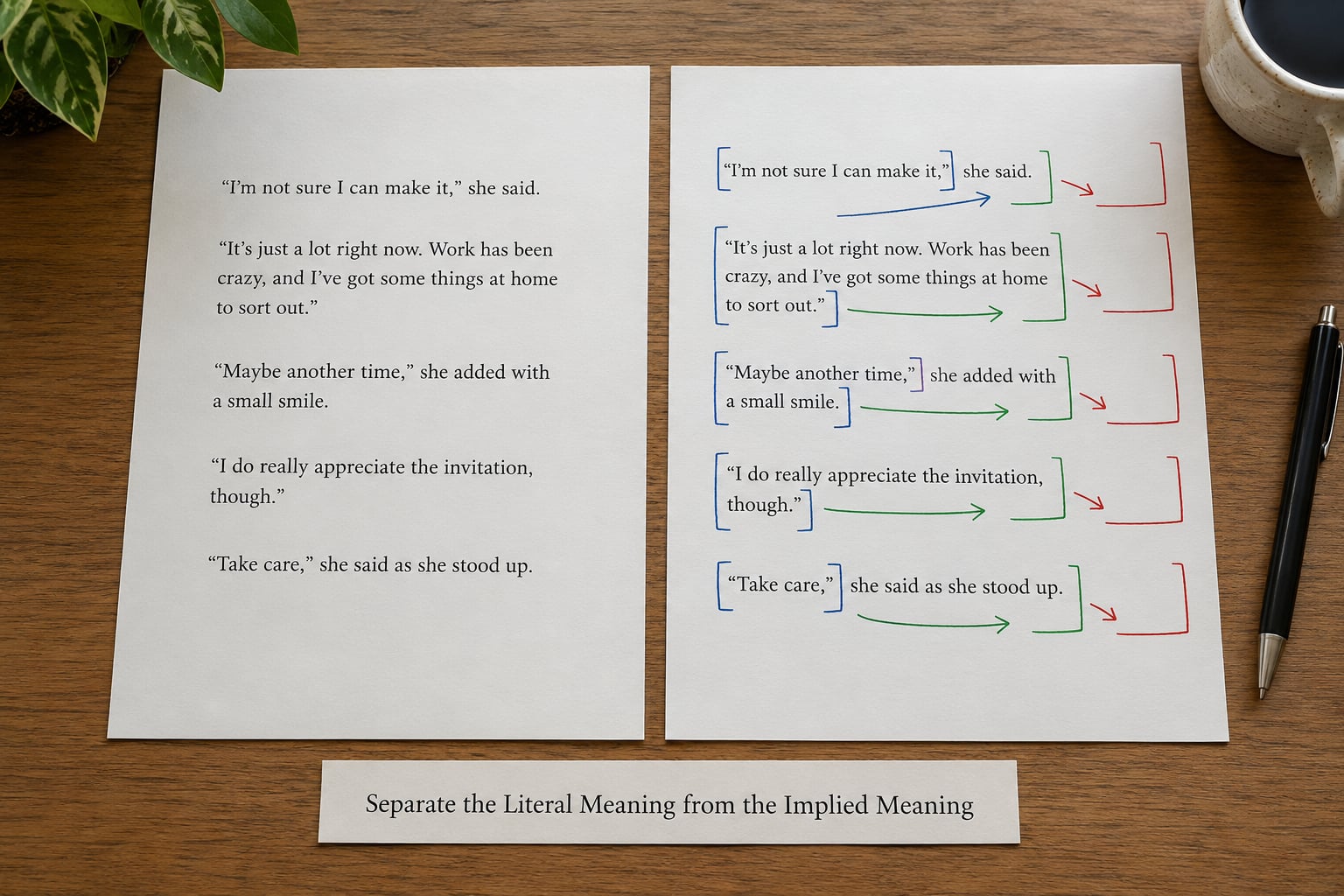
Mark each line of dialogue in three columns: what is stated, what is implied, and what the listener may fear is true. Most flat dialogue has nothing in the third column, which is why it reads as filler.
Here is a noir exchange before and after. First draft:
“You were at the club last night.”
“I was home.”
“That’s not what I asked.”
Everything is stated. Nothing underneath. The revision withholds the obvious clarification and lets the detective’s imprecision carry the pressure:
“You were out.”
“Somewhere.”
“Somewhere near Canal Street.”
“Sometimes.”
Stated: he was not home. Implied: he was at the club, or near something he will not name. What the detective may fear is true: the man has a second location he keeps off the record.
How to tell it worked: the implied column is not empty for any line that matters, and the third column holds a fear the characters never voice.
3. Filter the Line Through the Character’s Knowledge
Two people can discuss the same event and choose entirely different subjects, verbs and evasions, because they know different things about it. Asymmetry in dialogue is not a trick for its own sake. It is what makes two people in the same room sound like they are in different rooms.
Take a suspect interview. The detective knows the victim owned a boat that has not been in the marina log since March. The suspect knows the detective does not know that yet.
“You never touch the water, do you,” the detective said.
“Never.”
“Fish is good for you. Keeps a man sharp.”
“I don’t eat much of anything. Nerves.”
“You look well enough.”
“I’m a good-looking liar. That’s all of it.”
He picks nerves because it is a complaint she cannot act on. He picks the compliment because it is the only thing he can control in the room. Filtered through a man who assumes everyone wants something physical from him, the line stops being dialogue and becomes evidence of character.
How to tell it worked: if you swapped the two characters’ names, the scene should break. If it still reads fine, the knowledge filter is not doing anything.
4. Replace Direct Answers with Evasion and Delay
There are six evasion moves, and a scene usually borrows four of them: a false answer, a topic change, an unfinished reply, a question returned as a question, a strategically irrelevant detail, and silence that lasts one beat too long.
Do not use evasion to confuse the reader. Use it to show control. A character who has power in the room chooses what to answer. A character without power fills the gaps.
“Did you sell the car?”
“Which car?”
“You owned two.”
“I owned a great many things. I was young.”
“Answer the question.”
“Answer which one you mean.”
The second speaker does not know whether the detective has the registration or the mechanic’s receipt. That uncertainty is legible from the page, because the evasion narrows and then corrects.
How to tell it worked: you can point to the exact word where control changed hands, and the reader never needs a narrator to confirm it.
5. Let Contradictions Expose Inner Conflict
The three-layer pattern: stated position, visible action, concealed need. A character says they are fine, hands over the keys without being asked, and has been waiting six hours for this call. The gap between the three layers is the subtext.
Before you write around a line, check whether the contradiction is already there. Understatement is the cheapest subtext in fiction and the one most often left on the table.
“It’s a scratch.”
She set the frame face down on the table.
“It will buff out.”
Two flat sentences and one action beat. The reader gets the real thing without anybody in the scene saying a single emotional word.
This is also where blunt characters get solved. The forum complaint is fair and common: you build an honest, direct person, then feel obliged to make them evasive, and they turn into someone else entirely. Do not do that. A blunt character can carry subtext perfectly well through selection rather than deflection. They state the obvious thing and omit the important one.
“I got the money back.”
“Good.”
“Not from him. From the policy.”
“That’s not what I asked.”
He answers plainly every time and reveals nothing. The evasion has moved to the listener, who asks the wrong question because asking the right one would be admitting what he already knows.
How to tell it worked: the character’s honesty survives the scene intact, and the reader still feels withheld from something.
6. Calibrate Subtext to Point of View and Genre
Ambiguity only works when it stays legible, and legibility comes from the viewpoint. If you are close inside one character, you can hold that character’s interpretation of every line and let the reader assemble it themselves. If you are outside in a wide third, you need a physical clue in almost every exchange, because nobody is available to interpret.
Genre sets the ceiling on indirectness. Noir wants the gap wide. A thriller interrogation can withhold the fact for forty lines because the reader is waiting anyway. Literary fiction about a family dinner can get away with far less, because the scene has no other engine.
Keep the concrete clue. A hand flat on the table, a coat put on too early, a name that appears twice in a conversation where it was only relevant once. Concrete things survive summarisation; abstractions do not.
How to tell it worked: you can name the physical detail that carries each withheld meaning. Where you cannot, you have written mood instead of subtext.
7. Revise by Removing Unnecessary Clarification
This is the step most writers skip, and it is the one that does the work. Go line by line and cut four categories: explanatory dialogue, repeated emotion, redundant gestures, and motives announced before they are earned.
Clarity is not the goal. Comprehension is. A reader who has to assemble a meaning once is doing your job with you. A reader who has to assemble it three times stops reading.
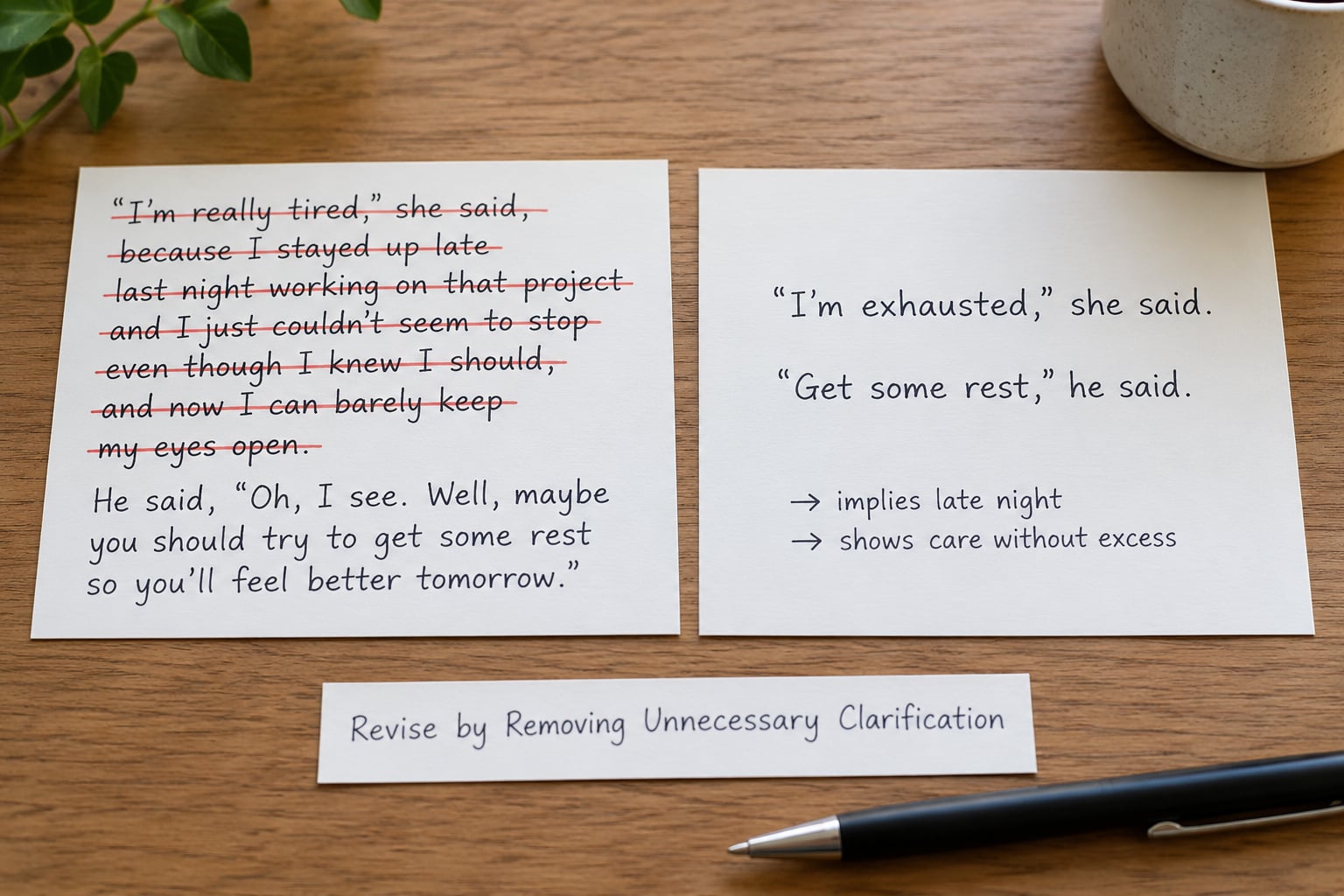
Take six lines and cut three of them:
“I know you’re angry.”
“I understand why you’re angry.”
“I know I shouldn’t have lied to you.”
“I shouldn’t have lied to you.”
“I’m sorry.”
“I know what I’ve done was wrong.”
Down to two:
“I shouldn’t have lied to you.”
“I’m sorry.”
Same apology, more pressure, because the missing lines are where the reader used to put their own conclusion. Put them back in narration and you will get the same paragraph of emotion with none of the charge.
How to tell it worked: the scene is shorter than it was, and it is harder to leave.
Common Mistakes
Subtext nobody can reach. You withheld the information the reader needs to make the inference. The repair is to move your first explicit version of the fact forward, often a chapter or two, then let the scene lean on the absence. Subtext pays interest on information the reader already holds.
Everyone sounds the same. Two characters with identical syntax and identical evasion patterns read as one character split in half. The fix is vocabulary and sentence rhythm, not more hidden meaning. Give one character short declaratives and a small word bank. Give the other interruptions and long subordinate clauses that never quite arrive.
Contradiction without motive. A character’s body betrays them for no reason the scene has established, and readers register it as authorial manipulation. Every contradiction needs a why in your four lines from step one. If you cannot supply one, remove the contradiction rather than inventing a tell.
Excessive coyness. Pairs of characters circling a subject for four pages while the reader waits. Every evasion scene needs one explicit line eventually, or two characters who disagree about something on the record, and the withheld part burns with more heat for having burned in one place.
Narration that solves everything. The scene works, then a paragraph explains what just happened and the temperature drops. Delete the explanation and check the scene cold. If it still lands, it was never load-bearing.
Two testing habits help more than any rule. Read the dialogue aloud with no narration around it, just the lines in order, and listen for the places where you feel yourself filling in a meaning. Those gaps are working. Then do three separate passes rather than one, because a single pass cannot hold subtext and clarity and voice in view at the same time.
Subtext usually appears on the rewrite, when you are consciously hunting for it, not in the first draft. That is not a failure of discipline. It is how the work gets done.
Frequently Asked Questions
How do I identify subtext in dialogue?
Subtext shows up as a gap between a line and its consequence. Ask what the speaker is trying to get, what they are trying to avoid, and which of the two they would never state out loud. Understatement, a topic change one beat too early, a contradicted gesture, or a detail that returns twice will all mark it. Mark up each line in three columns: stated, implied, and feared, and the third column tells you whether the scene has any.
How much subtext should dialogue contain?
Most working dialogue needs some, but not every line. Think of it as seasoning rather than the base: one or two exchanges per scene can carry a real gap between what is said and what is meant, and the rest can run straightforward. A scene with subtext in every line exhausts the reader fast. If you have to choose, put it on the line that matters most and let the rest be clean, or the reader has nothing left to notice.
What is the difference between subtext and implication?
Subtext is the character’s meaning. Implication is what the reader derives from it. A line carrying subtext says less than it means, and the reader infers the rest. An implication can exist without subtext, for example when narration sets up an expectation the dialogue never touches. Subtext is what the character withholds. Implication is what you, the reader, build from that withholding.
Should readers understand every implication in dialogue?
No, and chasing that is the most common way subtext dies. Readers reliably catch the implications you have grounded in something concrete, and they miss the ones that exist only in your head. Leave two or three implications unresolved on purpose; they become the questions that pull a reader into the next chapter. If a beta reader can state every single meaning your scene contains, you have written explanation with extra steps.
How do I revise dialogue that has too much subtext?
Cut back from the cryptic end, not the explanatory end. Add one explicit line, or let two characters disagree openly about something, and the withheld meaning regains its heat because it has burned somewhere. Then check the concrete clues still exist: one physical detail per withheld meaning. A reader who has nothing to hold on to stops inferring and starts rereading the paragraph.
Conclusion
Knowing how to write subtext in dialogue comes down to one discipline: decide what each character wants and hides, then remove every word that would tell the reader either. Write the obvious version first, mark it up in three columns, and cut the clarification line by line until the scene is shorter and harder to leave.
Start with one line today. Find the speaker’s hidden fear, rewrite the exchange so the conflict is felt rather than explained, and see what the page does without it.