Silence works when it is written as a choice, not a gap. To use silence in a scene, decide what a character refuses to say, build the scene around that refusal, and mark the quiet with a beat, a (pause) parenthetical or a held action line so the reader knows the emptiness is deliberate.
I have read a lot of scene drafts, and the same thing happens over and over. A writer builds three pages of sharp dialogue, gets nervous about a quiet stretch, and fills it with chatter. The tension leaks out through the floorboards.
This guide covers seven techniques for using silence in a scene, the notation that keeps it professional, and the mistakes that make a quiet moment read like an unfinished draft. It works for screenplays, prose and stage plays, since the mechanics of withheld dialogue change less than people expect. Crime and noir writers get the most out of it, but the examples run across genres.
Table of Contents
- What You Need Before You Write a Silent Beat
- Step-by-Step: How to Use Silence in a Scene
- 1. Define What the Character Is Not Saying
- 2. Let Silence Interrupt the Rhythm of Dialogue
- 3. Use Physical Actions to Carry the Unspoken
- 4. Withhold a Detail Until the Silence Changes Its Meaning
- 5. Make the Setting Quiet by Making the Conflict Louder
- 6. Give Each Character a Different Relationship With Silence
- 7. End or Begin a Scene at the Point of Tension
- Common Mistakes When Writers Use Silence
- Frequently Asked Questions
- How much silence is too much in a scene?
- When should I use a pause or silence tag in dialogue?
- How do I create suspense with silence without confusing the reader?
- How can I show what a character feels without adding exposition?
- Should I use dialogue tags when characters remain quiet?
- Conclusion: Start With the Unspoken Beat
What You Need Before You Write a Silent Beat
You need four things mapped out, and none of them are adjectives. Get these straight and the silence writes itself; skip them and you get a gap.
- The scene’s dramatic objective. What does one person want from another in this scene, in one sentence?
- A live conflict. Two people who already agree have nothing to be silent about.
- A speech pattern for each character. Note the word length, the vocabulary and the habit of finishing sentences.
- A short list of details that can stay unsaid. Three is plenty. Pick facts the reader needs and cannot yet have.
That last item is the one most people skip, and it is the engine of the whole technique. Silence needs something specific to be withheld. Write down three facts the character is avoiding, then decide which one the reader gets at the end of the scene and which one stays shut.
Step-by-Step: How to Use Silence in a Scene
1. Define What the Character Is Not Saying
An unspoken objective organizes everything else in the scene. Give your character a want they will not admit out loud, and every pause they take becomes a tactic rather than a gap.
Example. Two detectives in an interview room. One wants the suspect to sign a confession he knows is worthless. The suspect wants the recording to be found in the drawer and played later. Neither says it. The scene is now about two people waiting for something neither will name.
The test is whether a reader could describe what went unsaid. If they could not, you have not withheld anything yet, you have just left the page thin.
2. Let Silence Interrupt the Rhythm of Dialogue
Dialogue at a steady pace reads like a list of facts. A pause breaks the rhythm, and the break hands control of the scene to whoever does not speak next.
Before: “I found the ledger.” “Which ledger?” “The one from the office.” “What does it say?” “Names.” “How many names?” “Enough.”
After: “I found the ledger.” Her mouth stays closed. “Which ledger?” “The one from the office.” He does not look up. “What does it say?” “Names.” Nothing. “Enough.”
Two insertions did the work. The reader feels the power shift because the character who stopped talking is now the one being waited on, and the scene has changed owner without a single line of exposition.
On duration, writers on r/Screenwriting ask for a rule and there is not a clean one. A beat is roughly one second, enough for a breath. A (pause) runs closer to two. If you hold silence past three or four seconds without changing anything visually, readers start checking whether they missed a line.
On notation: (beat) has been overused to the point where some readers skim past it. Use it sparingly, put (pause) when the stop is deliberate and longer, use an ellipsis for a trailing thought, and let an action line carry the rest.
3. Use Physical Actions to Carry the Unspoken
An action beat does the work a line of internal monologue cannot, and it survives the cut into any medium. Show the avoidance with the hands: what a character refuses to pick up, the object they keep straightening, the second time they check a door that has not moved.
Contrast the two versions. “She was nervous” tells the reader once and asks them to forget the scene. “She turned her cup a quarter turn clockwise, then back, then left it alone” gives them something to hold for the length of a conversation.
The useful test: the action has to change the dramatic situation. If the character could fidget identically in a scene with no conflict in it, the gesture is decoration and it should go.
4. Withhold a Detail Until the Silence Changes Its Meaning
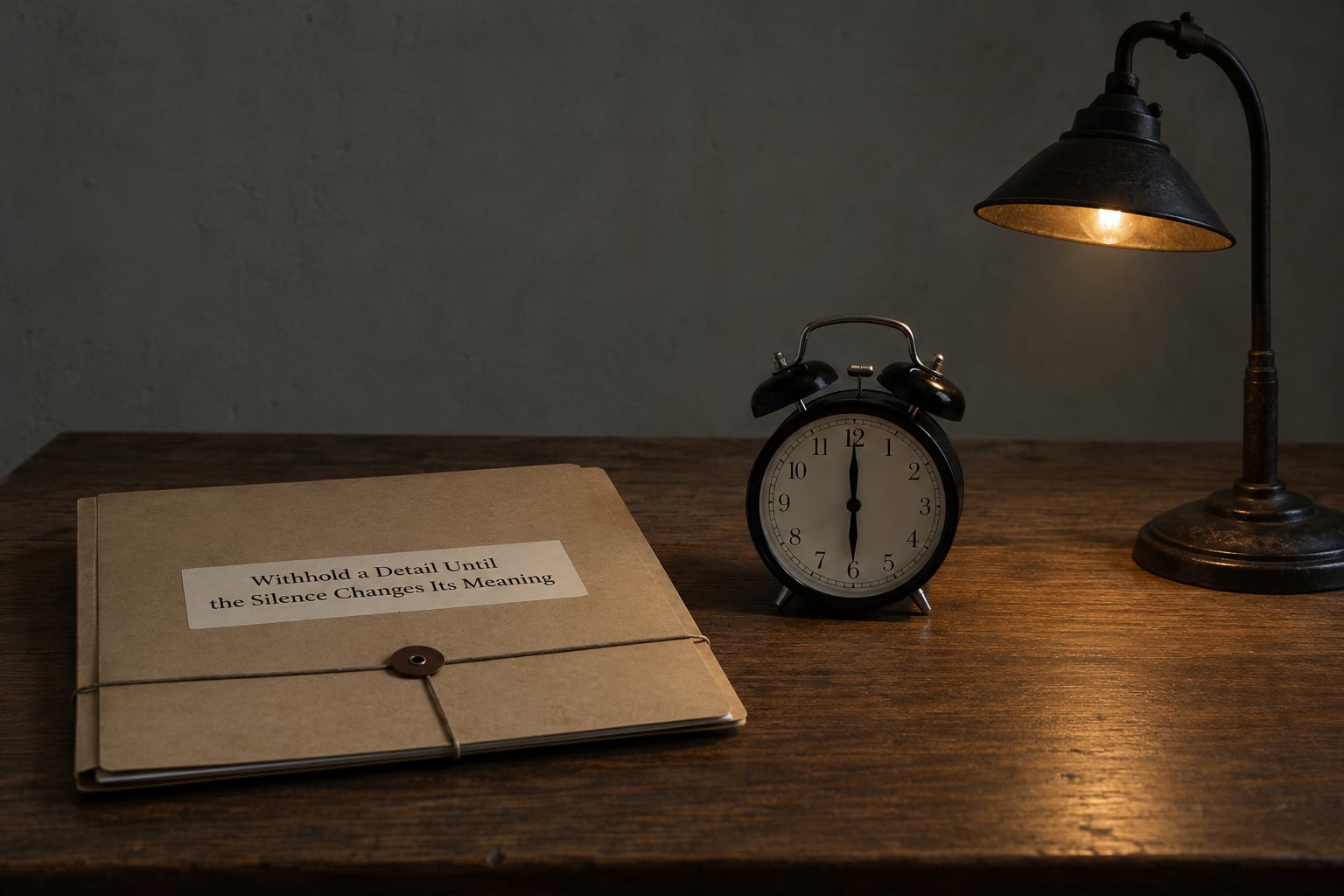
One delayed fact is enough. Drop it early as something trivial, then bring it back once the quiet has done its work and the detail lands differently.
In a noir scene, mention a stopped clock on the mantel during the first exchange, when nobody looks at it. Return to it at the end, after the character has sat in silence long enough for the reader to assume the time is irrelevant. The silence has not changed; the information has, and the room now reads as a place where something stopped and nobody said so.
Pick a detail that supports two readings at once: a switched-off lamp, a coat still on the hook, an engine left running outside. Anything the reader can only fully understand on the second pass.
5. Make the Setting Quiet by Making the Conflict Louder
A quiet room does not create tension by itself. Tension comes from pairing a controlled setting with involuntary sensory detail: a fridge humming through a long beat, a fluorescent tube flickering in the corner, traffic passing behind a locked door the character has stopped pretending not to hear.
These sounds are not there to fill the gap. They are there because they are the only thing the body cannot control, which is exactly why they surface when someone is holding themselves still.
The strongest version of this is a room that is almost too comfortable for what is happening in it. The calm of the setting makes the conflict read as an intrusion, and intrusion is what a frightened character is really sitting through.
6. Give Each Character a Different Relationship With Silence
Silence is not one thing, and if both characters treat it the same way the scene goes flat. Pick a motive per character and make it visible in how long they can last without speaking.
The suspect goes quiet out of fear, and the fear has a tell: watching the door. The detective goes quiet out of discipline, because talking is a tool she chooses to use and she can stop. The partner goes quiet out of evasion, filling every gap so nothing can be questioned. Three silences, three different textures, and the reader learns who is hiding what before anyone confesses.
Speech habits do most of the work here. The disciplined one uses short sentences and never trails off. The frightened one repeats the last word she heard. The evasive one answers with questions. These patterns cost nothing to establish and they carry the scene.
7. End or Begin a Scene at the Point of Tension
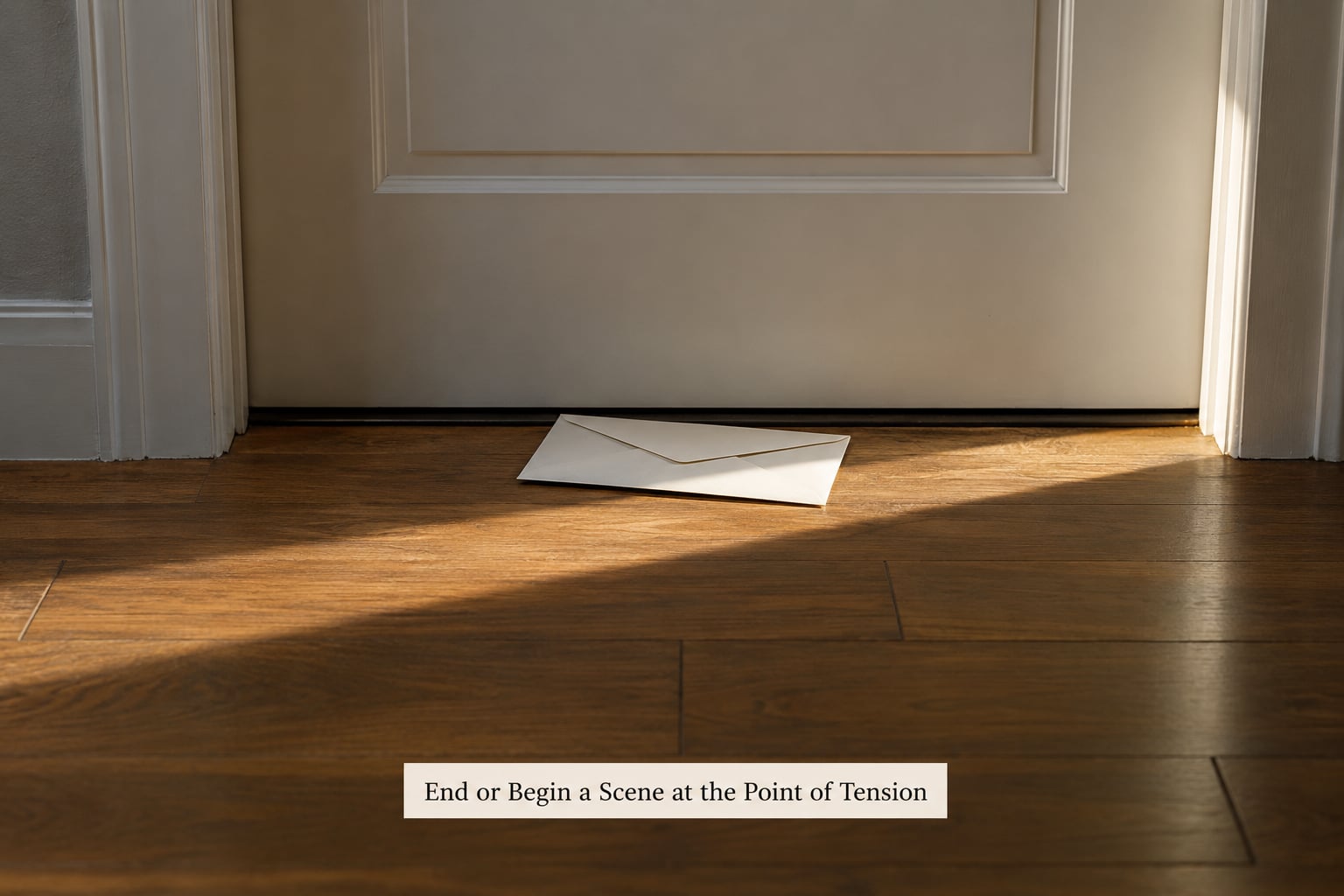
The most efficient silence in a script sits at the cut. End a scene on the moment a character decides not to speak and the next scene inherits that decision as pressure.
A letter on the table. The character reads the first line, sets it down, and looks at the door instead of answering. Cut to black. The audience fills in the rest, and because they did the work themselves they argue about it afterwards.
Run this test on every omission: does it leave the reader with a question, or only without an answer? A question is a hook, and hooks survive a page turn. A missing fact reads as an author who forgot, and readers forgive craft mistakes faster than they forgive indifference.
Common Mistakes When Writers Use Silence
Almost every quiet scene that fails fails for one of five reasons. Each has a fix you can apply in a single revision pass.
Using silence to cover weak dialogue. The most common problem, and the one that hides a script rather than improving it. If you delete three lines and the scene gets stronger, the lines were exposition and they go. If the scene collapses without them, they were doing real work and silence was never the answer. Test it by cutting one line at a time and reading the join aloud.
Confusing omission with mystery. Hiding something from the reader is suspense. Hiding something from the reader with no promise that it will be returned is just a withheld ending. Leave a physical trace: the glance at the drawer, the name said once and never explained.
Overusing the beat. When every exchange carries a (beat), the notation stops meaning anything and the reader stops reading it. Two or three per scene is usually plenty, and one is often better than two.
Erasing character voice. Silence that flattens everyone into the same moody pause has removed voice along with words. Give each character a different reason for quiet and a different tolerance for it.
Making every quiet moment equally heavy. If the whole scene runs at the same emotional temperature, nothing registers. Put a loud beat or a burst of fast dialogue next to the silence so the quiet has something to push against, and vary the length of the stops so the rhythm never settles into a pattern the audience can predict.
One more warning, from the production side. Pure digital silence in a finished film can read as dead air rather than stillness. Most editors leave a thin bed of room tone or ambient noise under the gap so the quiet still feels like a room with a person in it. Write for that version, because that is the version audiences see.
Frequently Asked Questions
How much silence is too much in a scene?
A beat runs about one second and a longer pause around two. Past three or four seconds with no visual change, readers start checking whether they missed a line. Extend a silence past that point only when something moves in the frame, a sound intrudes, or the camera is doing new work. The duration should match a change in the dramatic situation, not a stopwatch.
When should I use a pause or silence tag in dialogue?
Use a beat for a brief thinking gap, a pause parenthetical for a deliberate and longer stop, and an ellipsis for a thought that trails off. Action lines are better when the silence involves the body rather than the mind. Keep beats rare, since overuse has made some readers skim past them entirely.
How do I create suspense with silence without confusing the reader?
Leave a physical trace of whatever you are withholding, such as a glance at a locked drawer or a coat still on the hook. Suspense is a question the reader can hold; confusion is only an absence. Give them one clear unknown, keep orientation easy to follow, and let the payoff arrive within the scene or the chapter.
How can I show what a character feels without adding exposition?
Replace the statement with an action that changes the dramatic situation, such as turning a cup a quarter turn clockwise and then leaving it alone. Internal narration is the least durable option because it disappears in any adaptation. Action costs nothing, survives the cut, and lets the audience do the interpreting.
Should I use dialogue tags when characters remain quiet?
Keep tagging the speaker in any exchange where the reader could lose track, since during a long quiet stretch the characters are no longer talking and the tag is the only thing anchoring the lines. Once it is clear who is silent, drop the tags entirely and write the silence as action, because repeated tags draw attention to the absence of speech.
Conclusion: Start With the Unspoken Beat
Silence is not the absence of writing. It is the part of the scene you chose to leave out, and it works exactly when the reader can feel that something was withheld on purpose.
Here is the first thing to do. Take your current scene and underline the single most important thing a character refuses to say. Build the scene around that refusal, cut the line that explains it, and read the version without that explanation. If it gets tighter and you want to know what happens next, the silence is doing its job.