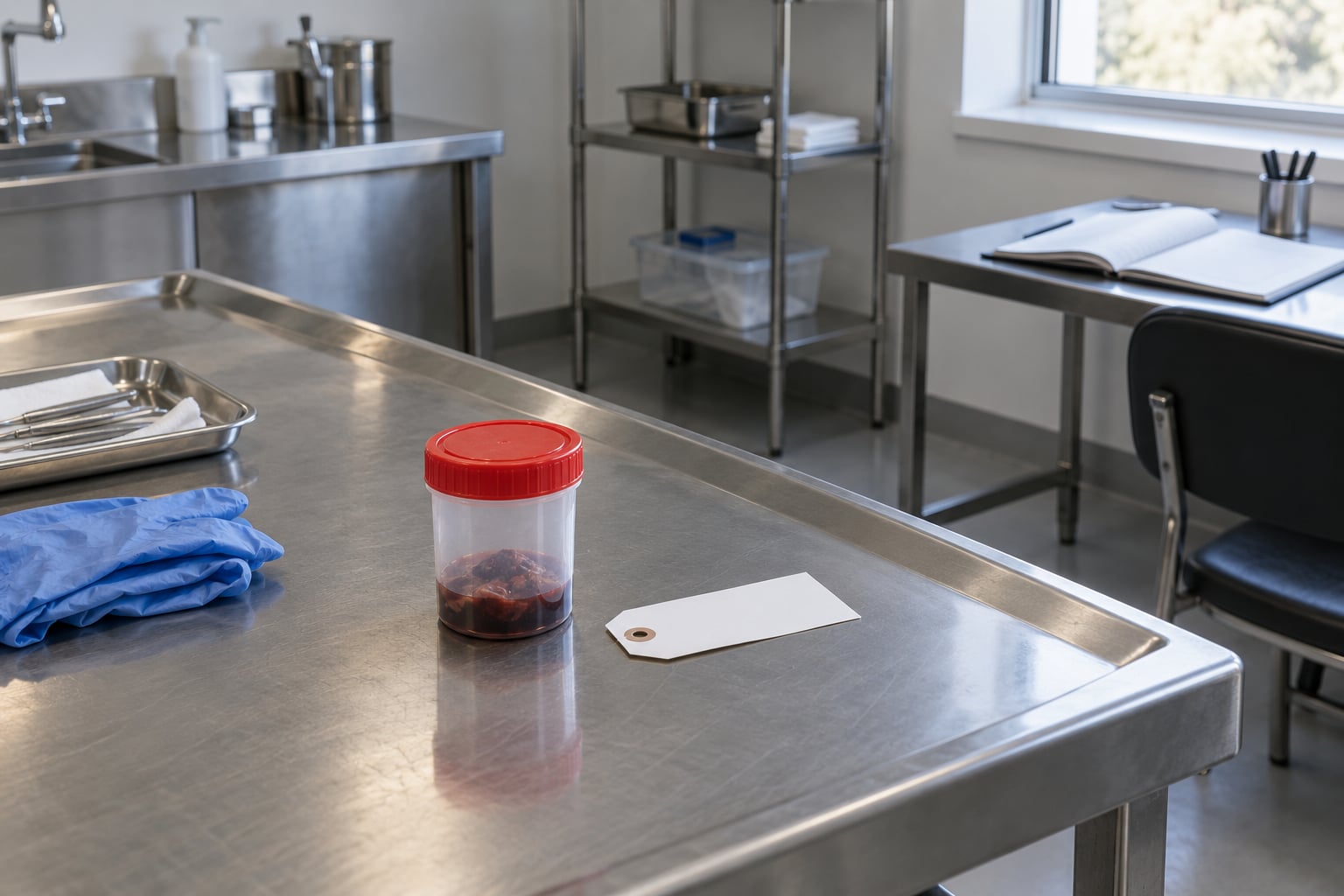
To write believable autopsy and forensics scenes, you need four things: the right sequence of professional steps, honest limits on what an expert can actually determine, correct job titles, and detail filtered through one character who is allowed to understand it. Gore is nearly irrelevant to credibility. Readers forgive a lot, but they never forgive a pathologist who says a time of death to the minute, a detective who leans over the body, or a lab that phones results the same afternoon.
That matters more here than in most genres, because crime-fiction readers include working coroners, detectives, paramedics and lab scientists who spot a gaffe on page forty and stop trusting the whole book. Get it right and those readers become the ones recommending the book to friends.
Here is how I break the work down. I use the same sequence every time: decide the scene’s job, choose the viewpoint, get the room right, follow an observable order of operations, and run a fact-check pass before the chapter leaves my desk. It takes an afternoon for a single scene once you have the habits, and most of that time goes on the check pass, not the drafting.
Table of Contents
- What You Need
- Step-by-Step: Building a Believable Autopsy and Forensics Scene
- How to Write Believable Autopsy and Forensics Scenes From the Point of View
- Choose What the Scene Must Reveal
- Establish the Place, Team, and Point of Entry
- Use an Observable Sequence Rather Than a Lecture
- Turn Evidence Handling into Story
- Write Clinical Detail in Proportion
- Make Dialogue Sound Like a Real Investigation
- Check Accuracy, Causality, and Reader Clarity
- Common Mistakes
- Frequently Asked Questions
- How much forensic research do I need to write an autopsy scene?
- Do I need to understand the difference between a coroner and a medical examiner?
- How can I write realistic uncertainty when the cause of death is still unknown?
- Should I include poison, toxicology, or DNA details in my crime scene?
- Why do autopsy procedures seem different in books set in different countries?
- How graphic should a believable autopsy or forensics scene be?
- Conclusion
What You Need
Four kinds of preparation, and only the first is glamorous.
Research materials. Start with something official rather than a television script. A medical examiner or coroner office website usually publishes a plain-language description of what a postmortem examination involves, and professional bodies in pathology and forensic science publish short explainers on cause of death, postmortem change and evidence handling. A general forensic science textbook borrowed from a library gives you the order of operations in a chapter rather than a paragraph.
You also need a sense of place. Watch a real morgue or scene-of-crime walkthrough if you can find one, and read practitioner accounts from working examiners. What you are hunting for is the ordinary: the temperature of the room, what paperwork exists, who is allowed to stand where, how long a body waits before anyone examines it.
Story information. Before you research anything, write down what the scene has to accomplish in the plot. The list is short. Confirm a death. Complicate a death the reader thought was settled. Redirect suspicion. Reveal something about a character. Move the investigation forward. A scene that does none of these is a lecture, no matter how accurate it is.
Then write down what your viewpoint character already knows. A detective knows procedure, statements, scene security and the case file. A forensic pathologist knows the body. A relative standing in a corridor knows almost nothing and can only observe. Fixing this early saves you the classic mistake of letting a grieving character understand a finding no ordinary person could interpret.
Ethical boundaries. Decide in advance how far you are willing to go with a dead body. The dead are frequently depicted in ways living victims never are, and readers notice when a story treats a corpse as a plot device rather than a person who was alive last week. Decide whether anyone close to the deceased is present, and if so, what you will not put them through.
If the material touches bereavement, trauma, religion, race, disability or body-related humour, plan for a reader outside your own experience to check the scene before you publish. A single willing sensitivity reader catches more than a month of your own re-reading.
Accuracy checks. Keep one file per scene with three things: claims you are certain of, claims you are inferring for story reasons, and claims you have no source for yet. The third list is the useful one. Fictional diagnosis belongs in that list explicitly, labelled, so a reader of your draft knows which is which.
And find one real person. Coroners, medical examiners, crime scene investigators and homicide detectives in most regions will answer a specific written question from a writer, and several publish free guides for authors. Ask about the thing you are least sure of, keep the question narrow, and say who you are. A pathologist who knows you are writing fiction will give you a far more useful answer than a general plea for help.
Step-by-Step: Building a Believable Autopsy and Forensics Scene
How to Write Believable Autopsy and Forensics Scenes From the Point of View
Realism in this genre is mostly point-of-view discipline. The same procedure reads as completely different writing depending on who is watching it.
From a forensic pathologist, you can report what was observed in clinical language, and you would know the difference between an observation and a conclusion. That character can think about what a finding means without narrating a lecture, because the language is simply how they work.
From a detective, you get procedural and evidentiary focus. This character wants a timeline, a name, a contradiction. When the pathologist says something clinical, the detective’s attention snags on the part that matters to the case, which lets you deliver technical information through the act of listening rather than through explanation.
From a witness or relative, you get the emotional register: the cold, the smell, someone covering a nose, the sound of a cart in a corridor. These characters cannot interpret the finding, and that limitation is a strength. It keeps the scene human, and it gives the expert in the room something to do.
Test each line of the scene against one question: could this viewpoint plausibly know this? If the answer is no, either change the viewpoint, or convert the information into something the character can observe instead of understand. A detective watching a pathologist lift a bagged hand and say nothing is more tense than a paragraph explaining what was inside.
Choose What the Scene Must Reveal
Before you write a word of procedure, decide which one job this scene does. The list above is worth using literally.
Confirming a death is the weakest reason to write the scene, because readers have been waiting for the scene already. Complicating a death works far better: the body was not what the first report implied, or the injuries and the location do not match. So does redirecting suspicion toward a person the reader did not expect, or revealing that someone in the story lied about the timeline.
Character revelation is the reason many good books write these scenes at all. A detective who cannot sit in the room, a colleague who photographs the body anyway, a relative who wants to know everything and is told less than she expected. Procedure gives you a natural reason for someone to behave badly.
Once the job is fixed, separate what the scene must show from what readers can infer. A reader will happily assume the body was documented and photographed. You do not need to narrate the whole of that. Necessary beats are the ones where the story changes: a discovery, a delay, a contradiction, a decision.
You will know the scene works on the page when you can state its effect in one sentence, for example: she now believes her brother was in the house that night, and the reader knows she is wrong. If you cannot, the scene is not ready to draft.
Establish the Place, Team, and Point of Entry
Readers get lost in these rooms because nobody tells them where they are standing. Fix that in two or three sentences, once.
Give one room, one light source, and one temperature. A body on a table in a cold, brightly lit room with a ventilation hum reads more clearly than a page of institutional description. One UK commenter describing a real investigation building as an unheated, grubby Victorian building with no flashy equipment is exactly the right level of detail: plain, specific, and true.
Then say who is present and why. In a postmortem examination you may have the pathologist, an autopsy technician who assists and handles much of the preparation, and sometimes a detective or a scribe. On a scene you will have crime scene personnel documenting, an officer controlling access, and a medical examiner or investigator arriving later. Each person there has a reason to be there, and if you cannot supply it, remove them.
Also settle why the viewpoint character is allowed in. Medical examination of a body is generally restricted, and a relative is usually not brought in. Fiction ignores this constantly. Give your character a legitimate reason: they are the investigator of record, they are identifying the deceased, they have been asked to observe. One line is enough, but it needs to be there.
Avoid the facility tour. Readers do not need the floor plan or the history of the building. They need to know who speaks to whom, and where the tension sits in the room.
Use an Observable Sequence Rather Than a Lecture
Procedure becomes believable when it happens in the order it actually happens. Follow the real sequence and your scene will feel right before you have written a single line of dialogue.
In broad strokes, a postmortem examination runs like this. Keep disputed or detailed methods general rather than instructive; you want the order, the purpose and the people, not a manual.
| Stage | What happens | What it can tell you |
|---|---|---|
| Identification and documentation | The body is identified, tagged, photographed and the case details are recorded before anything is moved | Who the deceased is and where the body has been |
| External examination | The body as found: condition, injuries, marks, and the state of the skin and cooling | Whether the body moved, how long it has been there, obvious injury |
| Evidence recovery | Samples, swabs and foreign material are collected, sealed and labelled before the examination continues | What can still be tested later, and by whom |
| Internal examination | Organs are removed, examined and returned, in an order that lets a dissection run from head to toe | Injury, disease, and the chain from finding to cause |
| Provisional findings | The examiner states what the examination shows, and what it does not yet show | Cause, and the honest gaps around it |
| Specimen labelling and storage | Each sample is documented, stored and scheduled for a named test | Why nothing is finished today |
| Restoration and release | The body is closed, made presentable and released for disposition | That the process ended, and what remains outstanding |
Notice how much of this is administrative. Identification, labelling, sealing, release. Real examination rooms spend a surprising share of their time on records, and that is one of the cheapest ways to sound accurate.
Keep the internal examination general in your prose. A character can note that the body is opened from the base of the neck, that organs are removed and examined, that everything is put back. They do not need the procedure spelled out, and readers who want that are not reading your novel for it.
The same order applies at a scene: document before disturbing, photograph from wide to close, collect before you reason. When your character walks straight in and starts theorising over an untouched body, that single image is the problem.
What a finished report contains is worth knowing too, since many writers invent one on the page and never use it again. Reports typically carry identification and case details, the circumstances as reported, the external examination, the internal examination, the cause of death, the manner of death, and a list of pending tests that will change the picture later. If you need a fictional one as a prop, that structure is enough, and the pending-test line is the most useful thing on the page because it gives you a reason for nothing to be finished.
Turn Evidence Handling into Story
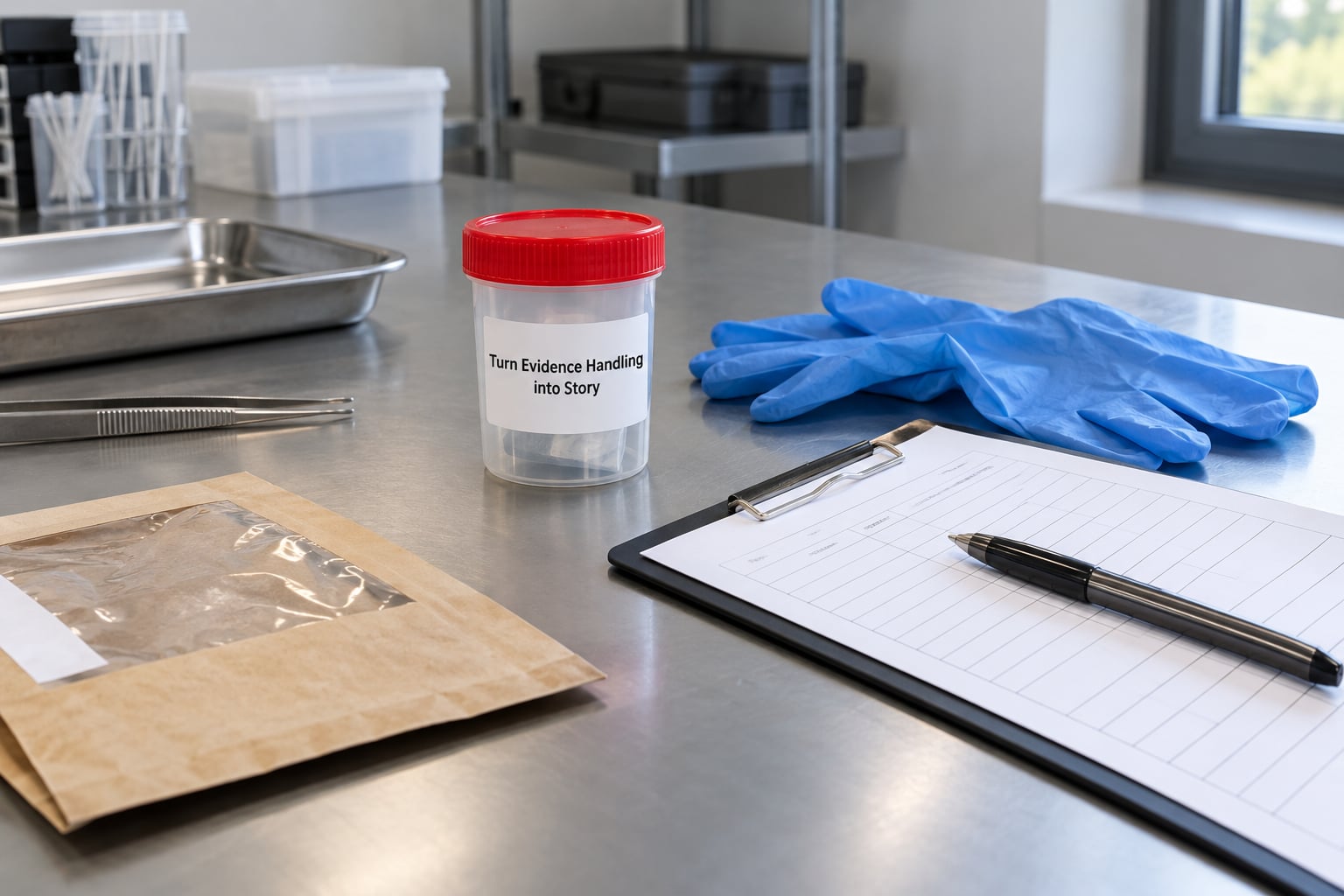
Evidence handling is the most underused source of quiet tension in this genre, because it is a system of small correct actions performed by tired people under pressure.
Continuity of custody works like this: an item is collected, sealed, labelled with what it is and who took it, signed over on transfer, stored, and later opened for a test. Each hand-off is documented. A gap in that chain can make a result unusable, and a good detective knows it, and worries about it.
Give that system a problem. A form is misfilled. Someone leaves a room with a sealed bag and cannot remember where they put it. A body waits longer than it should because a shift did not hand over. A character is asked to sign something they did not witness.
Make sure the negligence is plausible. The worst version of this scene is a trained professional forgetting the most basic rule, because readers correctly read it as author ignorance. Understaffing, a difficult family, a cold case reopened after years, an unfamiliar scene type, a rushed handover: these produce real errors. Simple carelessness produces only bad writing.
You can also use the paperwork as a clock. Every item that goes to a lab is a scene where a character is waiting on someone else’s schedule, which is a decent source of pressure without anyone threatening anybody.
Write Clinical Detail in Proportion
Take your research and cut it down to the handful of observations that matter to the plot. Everything else belongs in your notes, not the novel.
Start with the four terms writers most often confuse, and get them right because readers in the field know them.
| Term | What it actually means | What it gives you in a scene |
|---|---|---|
| Cause of death | The injury or disease that killed the person | The answer the family will eventually hear |
| Manner of death | The broad category: natural, accident, suicide, homicide, undetermined | A place to leave the case open without a body failing to deliver a verdict |
| Postmortem interval | The estimate of how long since death, always a range | Pressure on a timeline without a timestamp nobody can defend |
| Decedent | The formal term for the deceased person | Register for an official document |
The cause versus manner distinction is worth learning properly, because it is the cleanest way to write an honest scene. An examiner can be certain of the cause and still record the manner as undetermined. In real cases, manner is often undetermined, and that fact alone fixes a lot of bad television writing.
Qualify everything. “Consistent with” and “cannot be excluded” are the phrases real examiners use, and using them in dialogue tells a reader the writer knows the difference between a fact and an opinion. It also leaves your plot room to move.
On postmortem change, stay general unless the plot turns on it. Body cooling, the stiffening of the limbs, the settling of colour in the skin, and decomposition all proceed on overlapping timelines that are affected by clothing, environment, body size and temperature, which is exactly why a competent examiner gives a range. Write a range. Then let a character be frustrated by the range, because a range that blocks a theory creates plot.
For decomposition specifically, if you need to place a body in time, insects give a useful window that broadens rather than narrows, and heat accelerates them. Keep it to a line or two of dialogue, and keep it uncertain.
Finally, use sensory detail as selection, not accumulation. The hum of ventilation, the chill of a room, the smell of formalin and old carpet, the cart wheels in a corridor. Two accurate sensory details do more than six graphic ones, and they do not cost you anything with readers who came to your book for the story rather than the shock.
Make Dialogue Sound Like a Real Investigation
Give every speaker one informational role, and let roles collide. That is where the scene gets its friction.
One person asks about the body. One asks about the timeline. One asks about the scene itself. One asks about records, statements and chain of custody. One asks about what it means for the case. When two characters need the same information and only one is going to get it, you have a scene.
Use direct questions and qualified answers. Real professional talk is short, slightly impatient, and full of “I can’t tell you that yet.” Let a pathologist interrupt a detective who is asking the wrong question. Let the detective come back to the same body an hour later with a name and get a different answer, because the question changed.
Watch the register. Experts are not lectures, and they are not sages either. They are people with a narrow vocabulary of their own, tired at the end of a long shift, occasionally funny, and very clear about the boundary of their own knowledge.
Two things to avoid. First, never let two experts explain to each other what they both already know; that is the single most criticised habit in this genre, and readers notice it as artificial instantly. Second, never let a suspect or a witness absorb technical vocabulary. If your murderer calmly uses a clinical term, either they have a reason to know it, which is a plot point, or you should cut it.
On profanity and how blunt these people sound, decide early and stay consistent. A department that swears constantly and an office that does not are both realistic, and mixing them reads as a slip.
Check Accuracy, Causality, and Reader Clarity
Run a verification pass before the chapter leaves your hands. It is the step writers skip and readers punish, and it is the whole reason this article exists.
Go through your list of claims one at a time. For each, find a source you would be comfortable naming. Check the terminology against an official definition rather than a forum post. Check the job titles: a medical examiner, a coroner, an autopsy technician and a crime scene investigator are different jobs, and in many places the same person is called two of them depending on the state or country.
Check that your crime is caused by what you say caused it. Very often an autopsy states a cause without explaining a mechanism, and the writer quietly assumes the mechanism. Make sure somebody in the story says the thing that connects the injury to the death.
Check jurisdiction and era. Procedures are not the same everywhere, and they were not the same in 1981 as they are in 2026. DNA profiling, digital evidence and some scene procedures changed completely within a single working career, so a period book needs a period lab.
Then read for clarity, not accuracy. Mark every sentence where you had to stop and re-read. Those are the sentences where you were writing for the author rather than the character.
Finally, get a beta reader whose background touches the subject, and ask them one question: where did you stop believing this? The answer will point straight at your worst paragraph. Working writers report that this single question is worth more than a page of general feedback comments.
Common Mistakes
Most credibility failures fall into a small number of buckets, and each has a straightforward fix.
The expert who knows everything. Fix: decide what your character cannot know yet, and let the scene end on a question rather than an answer.
An instant, definitive finding. Fix: give the finding a route. A sample goes to a lab, the lab has a queue, the result comes back with a range and a set of caveats. Nothing that requires a laboratory is finished the same day.
Terminology dropped in without context. Fix: if a technical term appears, either the viewpoint character would naturally use it, or the scene explains it once in plain language and never uses it again.
Implausible access to a body. Fix: give the viewpoint character a reason to be in the room, in one sentence, and remove anyone who does not have one.
Muddled evidence continuity. Fix: track each item by hand. Who collected it, who sealed it, who signed for it, when it was opened. A single unexplained gap is enough for a sharp reader to distrust everything after it.
Graphic excess. Fix: keep the images that carry meaning and cut the ones that only shock. Readers who love graphic detail are a small group, and they are not the readers who recommend books to other readers.
False precision. Fix: exact measurements are fine for objects a character handled themselves. Estimates by an expert should read as ranges.
One procedure for everywhere. Fix: choose a country and a year, then be consistent. Coroner systems, medical examiner systems and police-led systems differ in real life, and mixing them reads as a writer who did not choose a country.
To see how these stack up, here is the tolerance most readers bring.
| Detail | What readers notice | How to handle it |
|---|---|---|
| Wrong body position, such as a body described as prone while lying face up | Immediately, and fatally | Check every position word against your scene |
| A weapon described with a feature it does not have | Readers who know weapons catch it immediately | Use the generic word unless the detail changes the case |
| A specific time of death to the minute | Readers who read two books a year catch it | Give a range and let it frustrate the character |
| A detective leaning over the body | Everyone; it signals television | Photograph, record, stay back |
| A body temperature described in detail | Mostly noticed by nobody | One line at most, and only if it drives the plot |
| A specific lab turnaround time | Noticeable only if it is impossibly fast | Say results take time and move on |
| Which mortis sign is present | Noticeable only when it contradicts the timeline | Use it as a check on your own plot logic |
One useful working rule from the craft forums: writers panic about the details readers never check, and blithely write the ones everybody checks. The berries-and-blueberries problem. A cooling rate nobody will query is worth a sentence; a body lying the wrong way up costs you the reader.
A second rule from the same conversations has saved more manuscripts than any other: no autopsy stands alone. Examiners repeat the phrase because it is true. A death is established by scene, history, records, toxicology and postmortem examination together, and a scene that treats one examination as the final word is the signature of a television script.
Frequently Asked Questions
How much forensic research do I need to write an autopsy scene?
Enough to know the order of operations, the four or five terms your dialogue actually uses, and the limits of what an examiner can determine. For one scene, that is a few hours of reading and one conversation with a working professional. For a series, build a reference file once and reuse it. Readers are not checking your science; they are checking whether you sound like you were there.
Do I need to understand the difference between a coroner and a medical examiner?
Yes, because the two systems are organised differently and readers in the field will know which one you mean. A medical examiner is a physician appointed to investigate deaths; a coroner in many jurisdictions is an elected or appointed official who may be a physician, and in some places decides cause of death without an examination. Pick one system for your book and use its vocabulary throughout.
How can I write realistic uncertainty when the cause of death is still unknown?
Let the characters work inside the gap. An examiner can describe what was found and state plainly that it does not yet explain the death, and the case can be classified as undetermined while the investigation continues. Give a postmortem interval as a range, never a timestamp. Uncertainty is not a gap in your writing; it is the actual condition the professionals are working in.
Should I include poison, toxicology, or DNA details in my crime scene?
Only if they change something. Toxicology screens can show what was present but not always what caused death, and results take time. DNA can link a person to a sample or exclude one, but a match means a profile match, not a name until there is a database hit or a suspect to compare. Use these to narrow a case, never to solve it on the page.
Why do autopsy procedures seem different in books set in different countries?
Because the systems genuinely differ. Some jurisdictions use elected coroners, some use appointed medical examiners, and some run investigations through the police. Terminology, the sequence of the examination and even what counts as a reportable death all vary. Choose a country and a year, be consistent, and say so once if your book needs to explain it.
How graphic should a believable autopsy or forensics scene be?
Graphic enough to be honest about what the work involves, restrained enough that the reader stays in the story. Two accurate sensory details carry a room better than a catalogue of injuries. Over-writing the body usually signals the writer is avoiding the emotion; under-writing it leaves readers unable to feel the weight of the death. Aim for the detail that changes how a character behaves.
Conclusion
Start with four things, in this order: the scene’s dramatic question, one point of view, one accurate procedural sequence, and one carefully verified set of sources. Everything else is description, and description is easy to fix later.
Then write the scene small. One room, one body, four people, one thing that changes. If the examination does not change what your character believes by the end of the page, cut most of it and keep the discovery. Accuracy gets you past the first objection. Restraint is what makes people read the next chapter.