
To write a compelling book description, build it from four parts: a hook that earns the first line, a synopsis that raises the stakes without giving anything away, a selling paragraph that says who the book is for, and a call to action. Twenty minutes of work, one central conflict, and a ruthless edit for spoilers.
Crime writers get this wrong more than most, and I think it is because the good stuff is hidden. A noir premise usually runs one sentence long, and the instinct is to spend the description explaining why you had to hide it. Nobody browsing a sales page cares about your restraint. They care about the body, the detective who cannot leave it alone, and the reason she might be next.
The description is the last thing a reader sees before they decide. So it carries one job: turn a browsing reader into someone who opens chapter one.
Table of Contents
- What You Need
- Step-by-Step
- 1. Identify the Story’s Central Promise
- 2. Choose the Main Reader Emotion
- 3. Build a Compact Story Hook
- 4. Add Stakes and Tension
- 5. Signal the Crime and Noir Genre
- 6. Keep the Description Reader-Focused
- 7. Write the First Draft
- 8. Edit for Voice, Rhythm, and Accuracy
- Common Mistakes
- Frequently Asked Questions
- How long should a book description be for a crime novel?
- Should a book description include spoilers or reveal the ending?
- What is the difference between a book blurb and a book description?
- How do I write a book description for a series without confusing readers?
- Should I use the same book description everywhere I sell my novel?
- How can I make a noir book description sound compelling without cliches?
- Write the Reader-Facing Version
What You Need
You need eight things on the page before you write a word, and all eight come from the manuscript rather than from a list of adjectives. A strong description depends on a clear understanding of the book.
- The premise in one sentence. Who wants what, and what stands in the way.
- The central conflict. The pressure that escalates for most of the book.
- The protagonist. Name, job, flaw, and the specific want that will not let go of them.
- The setting. City, decade, ward, weather. Noir lives or dies on place.
- The tone. Bleak, procedural, elegiac, funny-in-the-dark-way, relentless.
- Two or three comparables. Readers who bought those will buy yours.
- The genre conventions. What a mystery reader expects that a literary reader does not.
- The reader promise. The one thing this book delivers that the books beside it on the shelf do not.
Two pieces of vocabulary first, because authors mix them up constantly. The book description is the sales copy on an online listing. The back-cover blurb is the printed version, which can be a little bolder and a little shorter. The author bio is a third thing entirely and belongs in its own field.
Step-by-Step
Eight steps, in order. Each one has a test for whether it worked, so you can tell when a section is finished instead of endlessly reordering sentences. That is the most common stall in the threads I read: authors describe their own process as ninety-nine percent rearranging. Cut and move, do not add.
1. Identify the Story’s Central Promise
Write one sentence: the reason a reader should care about this book and not the other four in the same series box. Fiction usually turns on death, love, or a change of heart. Crime narrows that further, because the death is the starting gun rather than the climax.
If your sentence needs the word “and” to hold two unrelated crises together, the book has two central promises, and no description will fix that. Pick the one that appears most often.
Weak: a detective returns to a town she left and finds corruption. Stronger: a detective returns to the town she left and finds the body of the friend who drove her out of it.
2. Choose the Main Reader Emotion
Decide which single emotion the description is doing work on: curiosity, dread, suspense, shock, empathy, anticipation, or the release of catharsis. One dominant emotion, supported by concrete details from the story.
Curiosity and dread suit procedural and noir. Suspense suits anything with a body count. Empathy is the risky one for crime fiction, because sympathy for the suspect can read as a spoiler if you push it.
The test: read your draft aloud and ask which feeling came up first. If two answers come back, pick the one that arrives faster.
3. Build a Compact Story Hook
A hook needs four things in one or two sentences: a protagonist, a pressure or desire, an obstacle, and an unanswered question. Drop any one and it stops working. The question is what carries the reader into the synopsis.
Five hook types get used in crime and noir, and they do different jobs.
| Hook type | What it does | Crime fiction example |
|---|---|---|
| Bold statement | Declares the mood fastest | Everyone in this city lies, and Detective Ruiz is the only one who admits it. |
| Provocative question | Pulls the reader into the same doubt the detective has | What do you do when the only witness to a murder is the man who committed it? |
| Scene in motion | Shows rather than tells | At 2 a.m. the phone rings, and the voice on it is a man reported dead four hours ago. |
| Unreliable narrator | Flags the twist without naming it | My memory of that night has been edited so many times I am no longer sure who I am protecting. |
| Provocation | Writes to the subculture the book argues with | The people who run this city call it a favour. Halloran calls it a body. |
Compare two versions of the same open. The weak one: a gripping psychological thriller where a detective uncovers a conspiracy. The stronger one: Ruiz had eleven months left and one decent lead, and both were about to be taken off her hands.
Neither tells you the title. That is deliberate. If you write fifteen variations of your first line, as the process in step seven requires, you can keep the one that produces dread fastest.
4. Add Stakes and Tension
Make the consequences specific and emotionally legible. In crime fiction the stakes usually run through murder, corruption, betrayal, reputation, family, identity, or survival, and they get stronger when you name what specifically is lost.
A vague threat is a shrug. “She risks everything” tells a reader nothing. “Her badge goes, her mother’s house goes, and so does the case she has spent nine years building” is three concrete losses, and a reader can picture all three.
The test: for each risk you name, check that the manuscript pays it off. Stakes the book never collects are promises you should not make.
5. Signal the Crime and Noir Genre
Genre is signalled by world, not by mood words. A corrupt city precinct, a body found in a place it should not be, a narrator who cannot be trusted, a legal system working slowly while someone powerful does not: that is the signal.
You can also signal with plain nouns. Detective, informant, precinct, autopsy, evidence bag, cold case, payoff, informant fee. Readers searching those words find you, and the words themselves set the register.
Skip “dark”, “gritty”, “twisted” and “haunting”. Every one of them is doing nothing by the third listing you scroll past that week. The setting tells you how dark it is, which is why noir titles like The Big Clock sold by naming a countdown rather than a mood.
6. Keep the Description Reader-Focused
Ask what questions your target reader needs answered: who, where, what is wrong, and why now. Answer those and cut everything else. Backstory that does not change the central conflict is dead weight, and readers can feel it.
Compressing does not mean making it thinner. It means moving detail to where it earns tension.
Writing a book description without spoilers comes down to five moves:
- Describe the question, not the answer. Tell readers what the detective is trying to establish, never what she finds.
- Admit the narrator is unreliable without explaining why. “My account of that night changed every time I told it” raises tension. Explaining the mechanism kills it.
- Use pressure in place of plot. “The longer she stays, the more people want her to stop” creates motion without events.
- Keep the suspect unnamed or lightly named. Ambiguity is the product for a mystery reader.
- End on the pressure, not the crime. Your last line should leave a question open, not close a case.
Test it by handing the draft to someone who has not read the book. Ask what they think happens next. If they can guess the ending, cut.
7. Write the First Draft
Assemble the draft in a fixed order and stop when the parts are done: opening hook, protagonist and situation, central pressure, genre or tonal signal, and a final reader-facing promise.
Here is the fill-in-the-blank template, in the order you fill it:
[HOOK: protagonist plus pressure plus obstacle plus unanswered question, in one or two sentences]
[SITUATION: name, job, city, and the one thing that puts them inside this story]
[PRESSURE: what gets worse, and what it costs them specifically]
[SIGNAL: one concrete genre detail that tells a crime reader this is written for them]
[PROMISE: what the reader gets by finishing — a revelation, a confrontation, a verdict they did not expect]
Filled in, for a fictional noir novel about a detective called Elena Ruiz, it reads like this:
Everyone in Ardmore lies, and Detective Ruiz is the only one who admits it. Eleven months from a pension and one decent lead, she is pulled off a cold case that her old partner worked until it killed him. The longer she stays in the file, the more people in the department want her to stop, including the family who have spent twenty years insisting he was clean. Somewhere in that evidence bag is the name that ends the case, her career, and the only family she has left.
One hundred and two words, no spoilers, no adjective doing all the work.
Length matters less than most advice suggests, but the genre norms are worth knowing before you cut. Amazon truncates after a sentence or two behind a read-more link, so the opening carries more weight than the middle.
| Genre | Working length | Notes |
|---|---|---|
| Literary and noir | 120 to 180 words | Style earns attention, so keep the voice visible. |
| Crime and thriller | 150 to 200 words | Every sentence after the hook should raise pressure. |
| Mystery and cosy crime | 130 to 180 words | Cast list matters more than atmosphere here. |
| Series launch | 150 to 220 words | Name the series and the standing question. |
| Memoir | 180 to 250 words | Lead with the circumstance, not the childhood. |
| Nonfiction | 200 to 300 words | Promise a transformation, then support it. |
Write it yourself in the publisher’s hat rather than the writer’s. Nobody else can supply the details that make it yours, and an AI tool will hand you fifteen competent hooks built from nothing but your premise. Use it for the raw list if it helps you start, then overwrite every sentence with specifics only you know, and check what your publisher or contract requires about disclosure.
8. Edit for Voice, Rhythm, and Accuracy
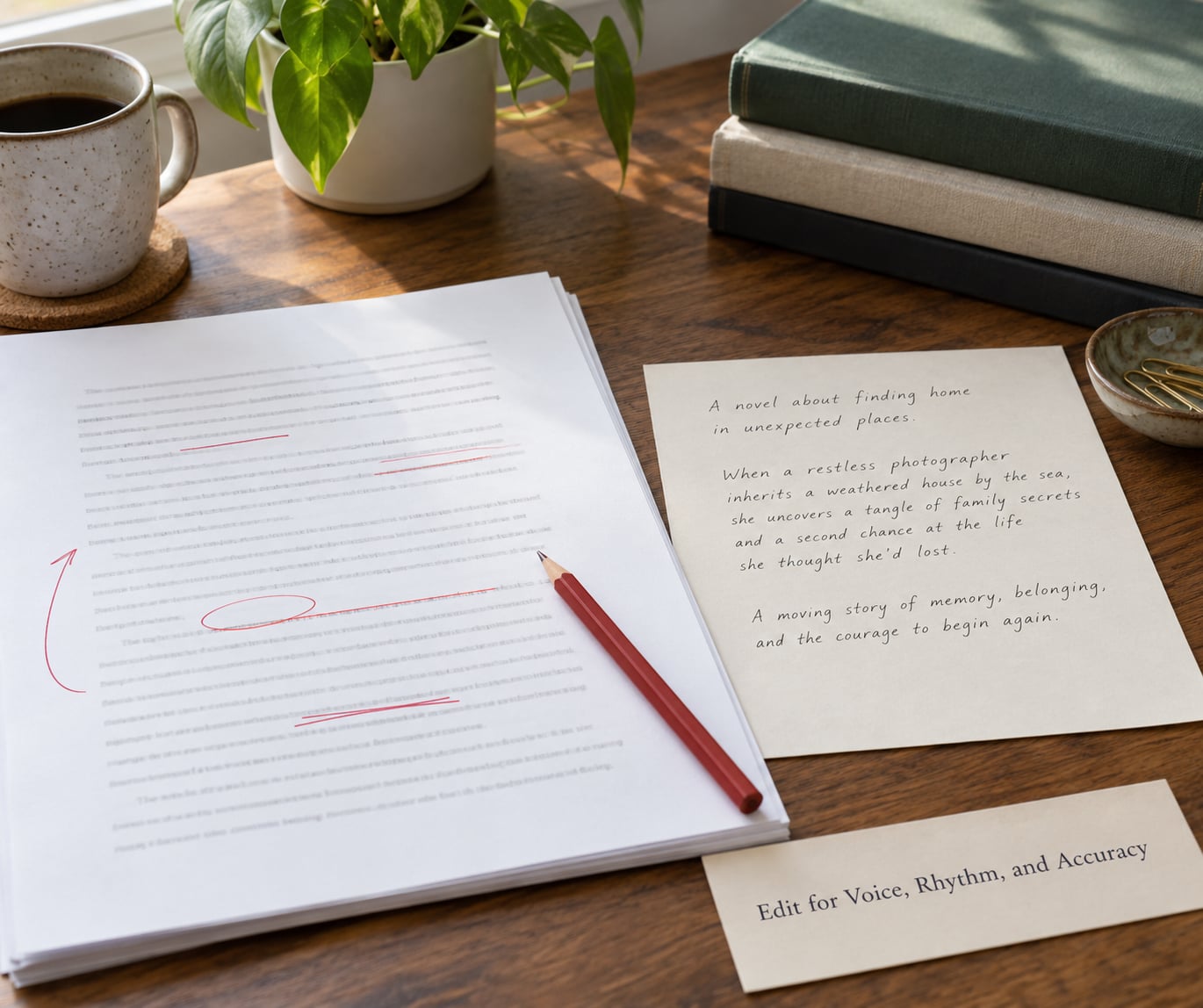
The last pass is subtraction. Read the draft against the manuscript and fix three things: any sentence that does not earn its place, any detail the book does not support, and any rhythm problem.
Readability matters because you are writing for someone scrolling. Short sentences, plain words, no more than one comma per sentence before you reread it aloud. Check it in a plain-language score tool if you have one; anything under the standard-school range and you are writing above your target reader.
Then check voice. A description written by someone who loves the book reads as a sales pitch; one written by someone who knows the reader reads as advice. Cut your own enthusiasm and keep the facts.
Last, check accuracy. Third person, present tense, no time-sensitive language, no promises about awards or reviews you do not have, no links or clever formatting that some retailers strip out. Then send it to three people who have not read the book and ask which one made them want to start it.
Common Mistakes
Seven failures show up again and again, each with a fix you can apply before publishing.
- Opening with the author’s biography. Nobody browsing a crime novel needs your publishing history in sentence one. Correction: move credentials to the author field, and open with the reader’s problem.
- Relying on vague superlatives. A gripping, unforgettable, breathtaking thriller tells a reader nothing they could not guess. Correction: replace every adjective with a concrete detail from the book.
- Stacking back-cover cliches. Once you have used one, they stop working, and readers count. Correction: keep one at most, and only if it names something specific.
- Naming too many characters. Five names in one paragraph is a cast sheet, not a promise. Correction: name the protagonist and at most one other; leave everyone else as roles.
- Revealing the ending. Correction: describe the pressure and the cost instead. If the reader can narrate the last chapter, you gave away the book.
- Making claims the book does not support. Correction: every promise in the description must be collectible by the final page.
- Writing the query of other books. If your opening line is the kind of string other listings are already ranking for, you will disappear. Correction: use the words readers actually type for your subgenre, once, and make the rest specific to you.
One more worth naming, because it is the most common: first person. Writing your own blurb in your own voice feels honest and usually reads as amateur. Third person, present tense, unless your book is genuinely a memoir told in the first person.
Frequently Asked Questions
How long should a book description be for a crime novel?
For crime and thriller, aim for 150 to 200 words. Literary and noir can sit tighter at 120 to 180. The opening two sentences matter most because retailers often truncate the rest behind a read-more link, so put your hook and your central promise in the first 50 words and treat anything after that as support.
Should a book description include spoilers or reveal the ending?
No. Describe the question the book is asking rather than the answer it arrives at. You can name the pressure, the cost and the moral problem without revealing who did it or why. A good test: hand the draft to someone who has not read the book and ask what they think happens. If they can guess the ending, cut more.
What is the difference between a book blurb and a book description?
A book description is the sales copy on an online listing, written to be scanned on a screen. A blurb, or back-cover copy, is the printed version and can be a little shorter and a little bolder. The author bio is separate from both and belongs in its own field. Traditionally published authors rarely write either, which is why the copy often feels generic.
How do I write a book description for a series without confusing readers?
Write each book as its own standalone promise, then add one line of series context: the position in the order, and the standing question the series keeps asking. For the first book, explain the world and the question. For later entries, assume the world and describe only what this volume adds. Recurring characters can be named; new ones cannot be stacked.
Should I use the same book description everywhere I sell my novel?
Use the same core copy everywhere, then adapt the packaging. The hook, premise and stakes should not change between retailers, because readers compare listings. What you can change is length, formatting and the call to action. Where a series box is available, use it for the surrounding books and give the reader an obvious next click.
How can I make a noir book description sound compelling without cliches?
Show the world instead of naming the mood. A precinct, a corrupt city council, a cold case reopened by someone who owes money, a narrator whose account of one night keeps changing. Words like dark, gritty and haunting tell a reader nothing specific, while a concrete detail tells them the register and tells search engines who you want. Specificity is what noir copy is made of.
Write the Reader-Facing Version
Take one book you know well and try this on it. Name its central promise in one sentence, choose one dominant emotion, and write fifteen hooks to keep the one that makes someone flinch. Draft the four parts, then read it against the manuscript and cut anything that spoils, overstates or could belong to a different book.
The usual advice for self-published authors is to spend most of your effort writing and a small share on promotion. A description is the highest-leverage piece of that smaller share, because it is the last thing between a reader’s interest and their first page. Write it yourself, in the publisher’s hat, and revise it three times.
Then rewrite it after launch once you have reviews. Real reader language tells you which hook worked, and one sentence from a review is worth more than any adjective you invented.