
Every first draft of a crime novel breaks in the same handful of ways. The plot runs on a premise instead of a problem, the suspects feel like props, the clues never reach the page, the forensic timing is impossible, and the whole thing gets edited while it is still being written. All of it is fixable, and almost none of it has to be fixed in draft one.
This is the list I give writers who come to me with a manuscript they think is broken. Twelve entries in the crime writing mistakes to avoid in a first draft, each with a low-friction fix. If you recognise six or seven of them in your own pages, you are in normal territory, not in trouble.
Table of Contents
- Crime Writing Mistakes to Avoid in a First Draft at a Glance
- 1. Starting With a Plan Instead of a Narrative Problem
- 2. Giving the Detective an Easy Case
- 3. Building the Criminal Around a Genre Stereotype
- 4. Making the Victim a Plot Device
- 5. Forcing Every Character to Sound Intelligent
- 6. Explaining the Crime Twice
- Crime Writing Mistakes to Avoid in a First Draft Begin With Exposition
- 7. Burying the Central Mystery
- 8. Using Atmosphere Instead of Specific Detail
- 9. Making the Investigation Unrealistically Efficient
- 10. Escalating Stakes Without Escalating Pressure
- 11. Letting the First Draft Try to Be Perfect
- 12. Treating the Twist as the Story
- Frequently Asked Questions
- Should a first draft of a crime novel be revised immediately?
- How do I know whether my mystery has enough clues?
- Is it okay to change the killer or solution while drafting?
- How much darkness or violence is appropriate in crime fiction?
- When should a crime writer worry about sentence-level style?
- Conclusion: What to Fix First
Crime Writing Mistakes to Avoid in a First Draft at a Glance
Crime drafts fail for a small number of repeatable reasons: no narrative problem, an easy case, a flat suspect, a victim used as furniture, robotic dialogue, repeated exposition, a mystery buried too deep, vague atmosphere, frictionless investigation, stakes that rise without pressure, perfectionism mid-draft, and a twist doing the work a story should do. All twelve are structural, and all twelve are far cheaper to fix than to diagnose.
| Mistake | Why it weakens the story | First-draft fix |
|---|---|---|
| Starting with a plan, not a problem | The plot runs, but nothing is at stake | Write the protagonist’s urgent choice in one sentence |
| An easy case for the detective | No resistance means no suspense | Break the evidence chain with unreliable testimony |
| Genre-stereotype criminals | Nobody has to be reasoned about | Give the culprit a practical want and a cost |
| Victim as plot device | The crime stops mattering emotionally | Establish a relationship before the death |
| Everyone sounds intelligent | Dialogue loses subtext and voice | Interrupt, evade and use knowledge gaps |
| Explaining the crime twice | Pace collapses into a lecture | Keep only what changes a decision |
| Burying the central mystery | Withholding reads as manipulation | Ask the question in chapter one, then vary the answers |
| Atmosphere instead of detail | Every city reads the same | Replace mood words with physical specifics |
| Efficient investigation | Procedure breaks the reader’s trust | Add cost, jurisdiction and incomplete records |
| Bigger stakes, same pressure | Another victim is not more tension | Tighten the deadline and the choice each time |
| Drafting perfectly | Stalling, blocked, no second draft | Premise, cause, choice, reveal, prose — in that order |
| Twist as the story | The ending can’t rescue weak logic | Plant fair clues and real motives before the reveal |
One note before we start. Not every item on this list is a mistake in every book. Noir tolerates a flatter plot than cozy does, and a procedural earns procedural latitude that a psychological thriller does not. Break these knowingly and the book still works. Break them by accident and it won’t.
1. Starting With a Plan Instead of a Narrative Problem
Starting with a plan instead of a narrative problem is the single most common failure in a first-draft whodunit. The writer has a plot premise — a casino heist, a poisoned inheritance, a body in a locked archive — and assumes the tension will arrive on its own once the outline is finished.
It won’t. Premises are settings for decisions. What creates pull in crime fiction is a character with an urgent, difficult choice and a deadline attached to it.
Take the casino heist. The premise version says: four thieves, one vault, one night, one alarm. The problem version says: Maya has ninety minutes to empty a vault she cannot leave empty, because the man who sent her is holding her brother’s medical bills and the money in that vault is the only way to clear them. She has to choose between the two men she loves, and both of them are waiting by the exit.
That second version tells you what every scene is for. Write your protagonist’s urgent choice in one sentence before you write another page. If you cannot finish the sentence, you have a premise and not yet a story.
2. Giving the Detective an Easy Case
Giving the detective an easy case means the investigation has no resistance in it. The missing CCTV file arrives in the same chapter. Every witness answers on the first question. The suspect breaks down within a page of the interview.
Crime readers feel that as drag, even when they cannot name it. The case stops being a problem to solve and becomes an admin task.
The fix is to obstruct the evidence itself. Make one witness unreliable in a specific, checkable way — she gives a time that is forty minutes off because she was meeting a man she has not admitted to. Let two suspects have motives that point in opposite directions and neither of them is lying. Put the first physical clue somewhere that supports the wrong conclusion and let the detective act on it properly.
Resistance does not need to be obstruction of the plot. It just needs to be somebody wanting something other than the truth.
3. Building the Criminal Around a Genre Stereotype
A criminal built from a genre stereotype — the silent mastermind, the frantic young man, the patient institution, the figure in gloves — arrives with no interior life at all. Readers can predict the behaviour from the description, so nothing the culprit does creates surprise.
Stereotypes also flatten the investigation, because a predictable suspect only ever functions as a container for clues about somebody else.
Build from a practical want instead. Not evil, not trauma. A want: the money is for a specific bill, the silence protects a specific person, the obsession is about finishing something an uncle started. Then put that want against a real moral conflict — something the culprit genuinely does not want to do, and does anyway, and would give a lot to have not done.
The cost is what separates a character from a costume. Ask what the culprit loses by being found out, and make it bigger than prison. Then the reader has to weigh an understandable motive against an unforgivable act, which is exactly the tension a detective story is built on.
4. Making the Victim a Plot Device
Making the victim a plot device is what happens when a body exists only to be discovered and to point at a motive. The victim gets a name, an occupation, a cause of death and nothing else, and the story treats grief as atmosphere rather than as something a person experiences.
Two things fix it. First, give the investigator a relationship to the victim before the crime — a favour owed, an argument unfinished, a promise nobody kept. That relationship is what makes the case personal and what makes the reader care about the answer.
Second, revise backwards. Put the victim in two scenes that happen before the murder, in which they want something, refuse something, and are stubborn about it. Those scenes cost you nothing in structure and change how the death reads on the page.
A short flashback does the same work, provided it contains a choice rather than a summary of a life.
5. Forcing Every Character to Sound Intelligent
Forcing every character to sound intelligent produces dialogue in which every speaker is articulate, complete, and equally clever. Interrogation scenes end up reading like transcripts from a seminar. Subtext disappears, because characters now say the thing they mean.
Real people in police rooms talk around the question. They interrupt, they answer the question next to the one asked, they repeat a word the interrogator used in a slightly wrong tone, they go quiet for four lines.
Four fixes do most of the work. Interrupt, so the least important line of dialogue sometimes gets cut off by the most important. Evade, so the person avoiding the question reveals something by the shape of the dodge. Give characters different regional vocabulary and different levels of education in their word choices. And use knowledge gaps, so the detective asks about something the reader has not been told yet and the witness asks what that means.
Read your interrogation scenes aloud. Anywhere you would not say it to another person, it needs work.
6. Explaining the Crime Twice
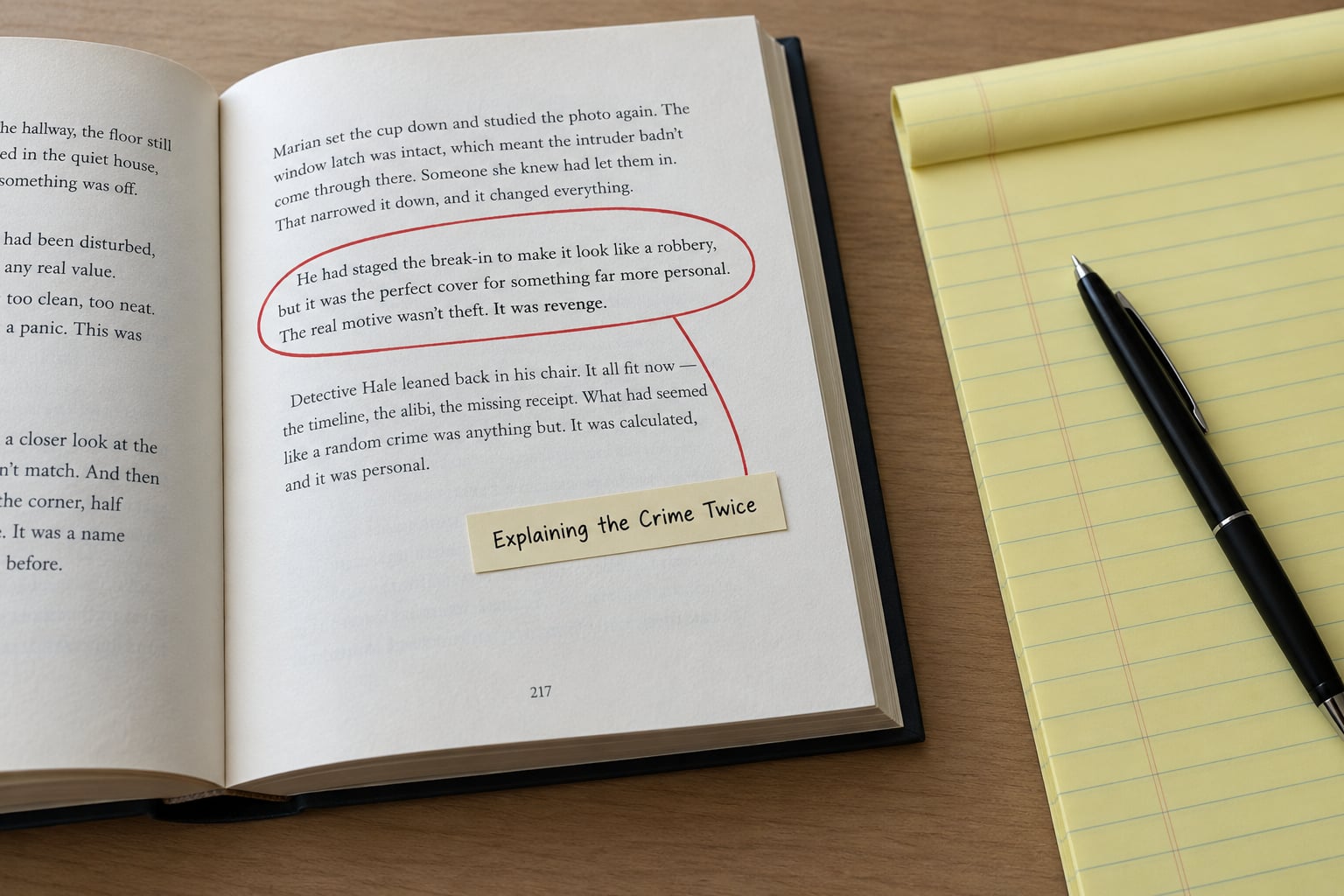
Explaining the crime twice is the habit of telling the reader how a case works and then telling them again through dialogue. Some of the crime writing mistakes to avoid in a first draft are just this, wearing a different hat: the narration explains the evidence, then two characters discuss the same evidence, then the detective thinks it through a third time.
Here is a clean test. Take every explanatory passage and ask two questions: does this change what a character decides, or does it reveal something the reader did not have? If the answer to both is no, cut it.
Mechanism is the exception. A reader will accept a technical explanation if it is the thing standing between them and the solution. Nobody needs the history of the evidence locker.
Crime Writing Mistakes to Avoid in a First Draft Begin With Exposition
Exposition placed at the front is where new writers lose readers fastest, and it is one of the most common crime writing mistakes to avoid in a first draft. Background on the city, the department, the case history, the protagonist’s career — all before anybody has done anything.
The conversion is mechanical. Take each block and ask: can a character deliver this while doing something else? Department history becomes an interview where the detective needs the file. City geography becomes a car ride with the wrong turn. Backstory becomes the third page of an argument between two people who already know it.
What you lose by moving it is nothing the reader was missing. What you gain is a first chapter that starts doing instead of briefing.
7. Burying the Central Mystery
Burying the central mystery is done with good intentions. The writer wants the reader to feel the same disorientation the detective feels, so the actual question goes unasked for sixty pages.
Disorientation is not suspense. When the reader cannot state what is being hidden, they stop being curious and start being patient. Most people will be patient for about a chapter.
Ask the central question in chapter one, out loud, in plain terms. Who killed Marguerite Vance. Then keep varying the answers. Chapter three offers a theory. Chapter five offers a better theory that complicates the first. Chapter nine proves the second theory impossible, and the question gets harder rather than answered.
Also make sure the culprit appears early enough for suspicion to gather. A culprit who surfaces in the final act gives the reader no chance to suspect them, and no chance to enjoy having suspected them. Introduce them with a want, a secret and a reason to be in the building.
8. Using Atmosphere Instead of Specific Detail
Using atmosphere instead of specific detail is how a crime novel ends up set in every city at once. Rain on glass. Sodium streetlights through the window. A city that never sleeps. Corruption in the upper reaches.
That is mood, and mood is cheap because it is interchangeable. Specific detail is what makes a reader believe it has been somewhere.
Compare two versions of the same moment. The atmospheric version: she stepped into the alley and the city closed around her like a fist, wet and hostile and indifferent. The specific version: the alley ended at a brick wall six feet high, and beyond it she could hear the bowling alley’s automatic lane sweeper, which meant someone was still in there at eleven on a Tuesday.
The second version tells the reader where she is, what time it is, and that somebody is about to appear. It also happens to be atmosphere, but it is atmosphere doing a job. Choose details that a character would notice because of what they want. A detective notices exits. A fleeing suspect notices cameras.
9. Making the Investigation Unrealistically Efficient
Making the investigation unrealistically efficient means the case moves at a speed no real institution moves at. One phone call produces a name. A database returns the answer in under a minute. The forensic team is in and out with a result before the detective has finished his coffee, and nobody explains what that result means for the case.
This is one of the crime writing mistakes to avoid in a first draft that readers punish hardest, because crime readers are genre-literate. A single procedural inaccuracy can end someone’s willingness to turn pages, and they will not tell you they left.
Institutional friction is free suspense. Make records incomplete and let somebody explain why. Make jurisdiction a problem, so the case gets handed between two forces who dislike each other. Make the cheap test come back before the expensive one. Make a lab result a range rather than an answer.
Timelines deserve the same attention. A time-of-death window that leaves eight hours for a sequence of actions the suspect could not physically complete is a hole every reader will find. Build the timeline backward from the window, not forward from the discovery.
You do not need a research library for this. You need one accurate scene you can pattern from.
10. Escalating Stakes Without Escalating Pressure
Escalating stakes without escalating pressure is the habit of adding a second murder, then a kidnapped teenager, then a bomb, while the protagonist’s situation stays exactly as tight as it was in chapter two. The story gets darker. The tension does not move.
Pressure comes from deadlines, limited options and shrinking margins, not from body counts.
A kidnapping example. Before: the detective has unlimited time and one useful option, which is to find the girl. After, in three steps. She has six hours before the drop-off, which she learned from a ransom note with the wrong zip code. She has one asset she trusts, a mechanic who owes her. And she now has to choose between the man she can trust and the man who actually knows the harbour.
Every step costs her an option. That is what makes it escalate. You can add the second murder afterwards and it will land hard, because the reader already knows what she is choosing between.
11. Letting the First Draft Try to Be Perfect
Letting the first draft try to be perfect is the mistake that ends projects. You stop at paragraph two to fix a verb, go back to change a character’s age, reread chapter one, and three weeks later you have four thousand words and no forward momentum.
Forum threads on writing advice boards keep circling the same reassurance: the first draft only has to get the story out of your head. Structure, prose and pacing all need a second pass. That is not permission to be careless. It is a reason to stop fiddling.
Work through draft one in this order and nothing gets blocked:
- The premise — is this a story, or a situation?
- The causal chain — does each event cause the next?
- Character choices — is anyone choosing under pressure?
- The reveal structure — is the question asked early?
- The prose — last, and never during.
If you only have an hour, work at the top of that list. Structure is cheap to fix in draft two and impossible to fix in draft one.
12. Treating the Twist as the Story

Treating the twist as the story happens when the whole manuscript is built to service a surprise, and the surprise is doing the work the plot should be doing. The characters are thin because nobody cared whether they were interesting until the last page.
No twist rescues a missing motive or a broken timeline. Readers forgive being surprised. They do not forgive being cheated.
The fair-play contract is simple: every clue the reader needs to solve the case must exist on the page, in the reader’s hands, before the reveal. You are allowed to mislead. You are not allowed to withhold the answer’s components.
Three habits make reveals land. Plant clues in plain view while the reader is looking elsewhere, so they register as furniture rather than signal. Give the culprit a motive that was visible from their first scene, even if you hid the meaning. And make the final revelation something the reader can trace backwards to, so the ending feels inevitable in retrospect rather than random on the page.
Then do the test that catches almost everything: hand the manuscript to someone, show them only the clue scenes, and ask whether they can name the culprit. If they cannot, the twist was a trick. If they can, you have a mystery.
Frequently Asked Questions
Should a first draft of a crime novel be revised immediately?
No. Leave a first draft alone for at least a few weeks if you can stand it, because the distance lets you read what you wrote instead of what you meant. Draft one exists to prove the story exists: premise, cause-and-effect chain, character choices and reveal structure. Sentence polish, trimming and clue placement all belong to draft two. The one exception is a continuity error that will change the ending you are about to write, and even then, note it and keep moving.
How do I know whether my mystery has enough clues?
Collect every scene where the reader learns something about any suspect, then check whether the solution depends only on facts they had. If your reveal needs a fact nobody was given, the case is unsolvable rather than hard. The practical test is to hand a reader just the clue scenes, in order, and ask them to name the culprit. If they get close, the clue budget is working. If they are lost, plant earlier rather than explaining later.
Is it okay to change the killer or solution while drafting?
Yes, and it is often the right call. Changing the solution mid-draft is cheap while the pages are still moving; changing it after revision is expensive. Two guards keep it safe. First, write down why you changed, because the new culprit needs a motive visible from their first scene. Second, list what the old solution explained, and check whether the new one explains those same details better. If it explains less, revert without guilt.
How much darkness or violence is appropriate in crime fiction?
There is no fixed ceiling, but there is a fair-play version of the rule: the reader should never be shocked by something they could not have anticipated. Violence that exists to develop the crime, the victim’s life or the investigator’s response usually earns its place. Violence that exists only to signal that the book is dark gets cut in revision. Genre sets the tolerance differently too, with noir built for brutality and cozy operating under stricter expectations of consequence.
When should a crime writer worry about sentence-level style?
After the structure is sound, and never during the first pass. If prose level problems are masking a structural problem, polishing sentences will only make a broken story look better dressed. One useful split: fix anything that interrupts comprehension during drafting, then leave all rhythm, word choice and imagery until draft two. Writers who police their prose in draft one tend to stall on paragraph two and never reach the ending that would tell them what to fix.
Conclusion: What to Fix First
If you do nothing else with this list, do these four things in order. First, write your protagonist’s urgent choice in a single sentence and confirm it still exists on the page. Second, walk the causal chain backwards from the reveal and mark any gap where an event does not cause the next.
Third, run the clue test: does the solution depend only on facts the reader was given, and was the culprit in the story early enough to be suspected. Fourth, and only then, start polishing prose.
Most of the crime writing mistakes to avoid in a first draft live in that first pass, and none of them need you to write a better sentence. They need you to look at what you already built and decide what it is actually about.