If you want the short version: how long should a crime novel be? Most crime and mystery manuscripts land somewhere between 70,000 and 90,000 words, and 80,000 is the number most agents and editors treat as unremarkable. Cozy runs shorter, usually 60,000 to 75,000. Noir and hardboiled run longer, often 85,000 to 95,000. Past 100,000 words, a debut starts raising eyebrows.
Those numbers are conventions, not rules. A 62,000-word book with an airtight structure will beat a 105,000-word book that runs on atmosphere alone, and the crime novels readers argue about twenty years from now will not care what your word count was. What matters is that the length fits the story, the format, and the market you are writing into.
Table of Contents
- Crime Novel Length at a Glance
- What Affects the Ideal Crime Novel Length?
- Crime Novel Word Counts by Subgenre and Format
- How Long Should a Crime Novel Be for a Debut?
- How to Choose a Length Before You Start Writing
- When a Shorter Crime Novel Is Better
- When a Longer Crime Novel Is Better
- How to Trim or Expand a Draft Without Losing the Story
- Frequently Asked Questions
- What is the average length of a crime novel?
- How many pages is 80,000 words in a printed book?
- Is 60,000 words too short for a crime novel?
- Should a debut crime novel be under 80,000 words?
- How long should a noir novel be?
- Does an editor care about my crime novel’s word count?
- Conclusion
Crime Novel Length at a Glance
Here are the working ranges that come up most often in editorial offices and writing forums. Treat the recommended column as where to aim and the acceptable column as the boundary where you should have a reason for going.
| Crime subgenre | Recommended words | Acceptable range | Chapter range |
|---|---|---|---|
| Cozy mystery | 60,000-75,000 | 55,000-85,000 | 2,000-3,000 |
| Police procedural | 80,000-90,000 | 75,000-100,000 | 2,500-3,500 |
| Detective / PI | 75,000-85,000 | 70,000-95,000 | 2,500-3,500 |
| Hardboiled / noir | 85,000-95,000 | 80,000-105,000 | 3,000-4,500 |
| Suspense / thriller | 75,000-90,000 | 70,000-100,000 | 2,000-3,500 |
| Domestic suspense | 75,000-85,000 | 70,000-90,000 | 2,500-3,000 |
| Historical mystery | 85,000-95,000 | 80,000-105,000 | 3,000-4,000 |
| Caper / heist | 80,000-90,000 | 75,000-100,000 | 2,500-3,500 |
One conversion worth keeping in your head: a typeset page in a standard trade paperback holds roughly 250 words. That makes 80,000 words about 320 printed pages, 100,000 words about 400 pages, and a 60,000-word cozy a brisk 240 pages. Double-spaced manuscript pages run a different math entirely, about 250 to 280 words per page, so never hand an editor a page count without saying which one you mean.
What Affects the Ideal Crime Novel Length?
The word count is a symptom, not the cause. Seven things actually determine how long your crime novel should be, and only one of them is genre convention.
Premise complexity. A missing diamond in a locked room needs one location, one night and four suspects. A serial killer hunting across three states needs interviews, forensics, a false suspect and a subplot about the investigator’s marriage. The second story genuinely takes more pages. If you are trying to force premise two into a premise one structure, the length problem is really a scope problem.
Number of protagonists. Every viewpoint you add multiplies your scene count, because each one needs its own version of events. Two protagonists means you are writing two books and stapling them together, and readers feel the seam in the middle third. Many writers are better off staying in one head and letting another character stay mysterious.
Investigation structure. Fair-play mysteries demand that readers can follow every clue, which needs breathing room for interviews and reconstructions. Noir barely needs plot mechanics at all, because the mood is doing the work. That is why a fair-play book can sit at 85,000 words while a noir of the same premise runs to 95,000 with no extra story.
Atmosphere. Noir and gothic-leaning crime lean on place, weather, interiors and the specific quality of light in a laundromat at four in the morning. Prose like that runs long by design. Thriller and cozy lean on pace instead, and pace punishes length.
Action load. Chase sequences, shootouts and escapes take a lot of words to do well, and they are the least compressible material in the book. Two well-built set pieces add 6,000 to 10,000 words. Six add a novel’s worth, and by then you have a different book.
Series position. Book one of a series carries world-building and character introduction that books four through nine do not. Established series readers also expect a consistent length, because a book nine that runs 40,000 words shorter than book eight feels like a betrayal even when the plot justifies it.
Intended format. A novella is a real publishing category with its own economics, often 25,000 to 40,000 words, and it can be the right home for a tight two-suspect puzzle. Audiobook length matters too, since roughly 10,000 words translates into about an hour of narration and some publishers are reluctant to fund a nine-hour reading.
Crime Novel Word Counts by Subgenre and Format
Tables compress badly, so here is what those ranges actually mean when you sit down to write them.
Hardboiled and noir: 85,000 to 95,000 words. Crime fiction writers routinely report getting away with 90,000 to 95,000 words in noir because the voice carries the extra weight. Chandler, Hammett and the generation after them all wrote in this band. Below 80,000 you often lose the room to make the city feel dangerous, which is the whole point of the form.
Police procedural: 80,000 to 90,000 words. This subgenre earns its length from procedure. Interview logs, chain of custody, jurisdictional arguments, shifts and paperwork all need space, and readers who bought a procedural expect that texture. Forum advice from writers in this lane is consistent: 75,000 to 95,000 is defensible as long as the procedure is doing story work rather than padding the middle.
Detective and private eye: 75,000 to 85,000 words. Tighter than a procedural and tighter than noir, because the focus is on one investigation and one damaged protagonist. Chapters here tend to be shorter, 2,500 to 3,500 words, which keeps the book feeling quick.
Suspense and thriller: 75,000 to 90,000 words. Thriller runs short when the tension is constant. If your book has three quiet stretches for breathing, expect to land near 90,000. If it is one long chase, 70,000 is plenty and readers will thank you.
Cozy mystery: 60,000 to 75,000 words. Cozy writers regularly publish in the 60,000 to 75,000 band, the lowest range in crime fiction. The amateur sleuth solves a small problem in a bounded community, so there is rarely enough plot to justify more. Cozy readers also buy in series, and a consistent short length keeps the shelf tidy.
Domestic suspense, historical mystery and caper. Domestic suspense sits at 75,000 to 85,000 because the pressure is psychological rather than physical. Historical mystery needs room for period texture, so 85,000 to 95,000 is fair. Caper stories sit at 80,000 to 90,000, built around plans, rehearsals and reversals, all of which expand naturally.
Then there are format bands that cut across every subgenre: a novella at 25,000 to 40,000 words, a standard debut at 75,000 to 90,000, and a long standalone or series book that can reach 95,000 without comment.
How Long Should a Crime Novel Be for a Debut?
A debut crime novel should land between 75,000 and 90,000 words, and here is why that range is narrower than the general one. An unknown writer has to prove two things at once: that the story works, and that the writer can control a full manuscript. Length eats into both proofs.
Writers on Absolute Write and the larger writing forums report the same pattern repeatedly. Debuts at 115,000 words get passed on, and not usually because the story was bad, but because the length signalled inexperience to a reader who has no other evidence to go on. A first novel at 80,000 reads as controlled. The same manuscript at 115,000 reads as one that did not know how to end.
Debut length also follows format rather than ambition. If your private eye story is genuinely a 65,000-word book, stretching it to 90,000 to look serious will damage it. Pitch it as a tight debut in the right range instead. Agents read hundreds of queries a week and they notice precision.
Series installments relax the ceiling. Once you have two or three books out, 95,000 words reads as confidence rather than indecision, because the reader has already decided to trust your pacing.
How to Choose a Length Before You Start Writing
Pick your number in the planning stage, not in revision. The people who hit their target usually chose a range before they wrote a word, then adjusted as the story grew.
Step one: benchmark against comp titles. Find ten to fifteen books published in the last three years in your exact subgenre. Note the word count of each, then look at the range rather than the average. A spread from 68,000 to 94,000 tells you your 82,000 sits comfortably inside the market. A cluster from 61,000 to 66,000 tells you the form has tightened and you should aim low.
Step two: write the ending first. A two-page summary of your final chapter tells you what you have to earn and roughly how long the road is. If your ending arrives in chapter twenty-two, you are writing a short book whether you planned it or not.
Step three: count your scenes. Estimate average scene length in your draft so far, multiply by the scenes the outline requires, and you have a defensible number. Twelve scenes at 3,000 words is 36,000. Thirty scenes at 3,000 words is 90,000.
Step four: do the chapter math. Take your target and divide by your preferred chapter range. An 82,000-word novel at 2,800 words a chapter gives you 29 chapters. At 3,500 words a chapter it gives you 23. Crime fiction often works better with odd chapter counts and a short first chapter, so round down rather than up.
Step five: set a floor and a ceiling. Write two sentences: “This book is finished at 78,000 words and never goes past 92,000.” Now you have something firmer than a vague intention. If your draft lands at 105,000, you know exactly how much cutting a structural revision has to find.
When a Shorter Crime Novel Is Better
A lean crime novel is usually a better crime novel, up to a point. Shorter manuscripts pace faster, dilute fewer clues, and let atmosphere do its work in fewer, better-chosen rooms.
When you cut length, you also tighten motive. Every extra interview is another chance to explain something the reader could infer. Every third red herring costs you a little belief in the fair-play contract. Repetitive scene types are the usual culprit: writers often run three interviews in a row with the same emotional register, or stage two separate stakeout sequences that could be one.
Here is the diagnostic table I come back to. Symptom, what it usually means, and what to do about it.
| Symptom | Diagnosis | Fix |
|---|---|---|
| Middle chapters that feel samey | Repeated scene type | Merge two into one, keep the sharper beat |
| Suspects who blur together | Too many, too briefly drawn | Cut to four or five and give each a distinct want |
| Investigator keeps re-checking the same clue | Clue explained twice | Let the reader hold it; delete the second pass |
| A subplot that goes nowhere | Started for character, not plot | Either connect it to the case or remove it |
| Chapters you skipped while drafting | Filler written to hit a target | Delete outright; nothing downstream depends on it |
| A slow first fifty pages | Atmosphere before any question is asked | Move the inciting incident forward, keep the mood later |
| Denouement overrunning | Explaining instead of showing | Let one character state the solution and exit |
Brevity suits stories with a bounded setting, a small cast and one clean solution. A locked-room puzzle, a cozy set over a long weekend, a single-night thriller. These are all stronger at 65,000 words than 95,000.
When a Longer Crime Novel Is Better
Length earns its place when the story needs space to breathe rather than when a writer needed more scenes. These are the situations where 90,000 to 100,000 words is the right answer.
Multiple viewpoints. When the reader sees the crime and its aftermath from both the investigator and the perpetrator, you need roughly double the material. Split POV doubles your scene budget, so plan for it instead of discovering it at 70,000 words.
Layered investigations. A case that opens officially and turns out to be connected to a twenty-year-old disappearance needs room for two timelines and the collision between them.
Social and historical context. When the crime exists because of something structural, a housing scandal, a police corruption era, an epidemic, you are obliged to show the structure. Readers detect that obligation being skipped.
Series mythology. Book four can afford to assume reader familiarity, which frees pages, but it cannot afford to feel thin. Consistency across a series usually means holding to whatever length you established.
There is also a market difference worth knowing. UK and Commonwealth editors have historically been more comfortable with longer manuscripts than US ones, and the expectation gap is real enough that transatlantic writers should query it rather than assume. Meanwhile, publisher preferences in 2026 continue to move toward shorter books, driven by production costs and how readers consume audio. That is why the safe zone for crime, mystery and thriller has settled at 80,000 to 90,000 rather than the 90,000 to 110,000 that used to be common advice.
For audio specifically, divide by roughly 10,000 words per hour. A 95,000-word book is a nine-and-a-half-hour narration, which is a lot of money and a lot of dropped listening sessions. A 75,000-word book is seven and a half hours and a far better chance of being finished.
How to Trim or Expand a Draft Without Losing the Story
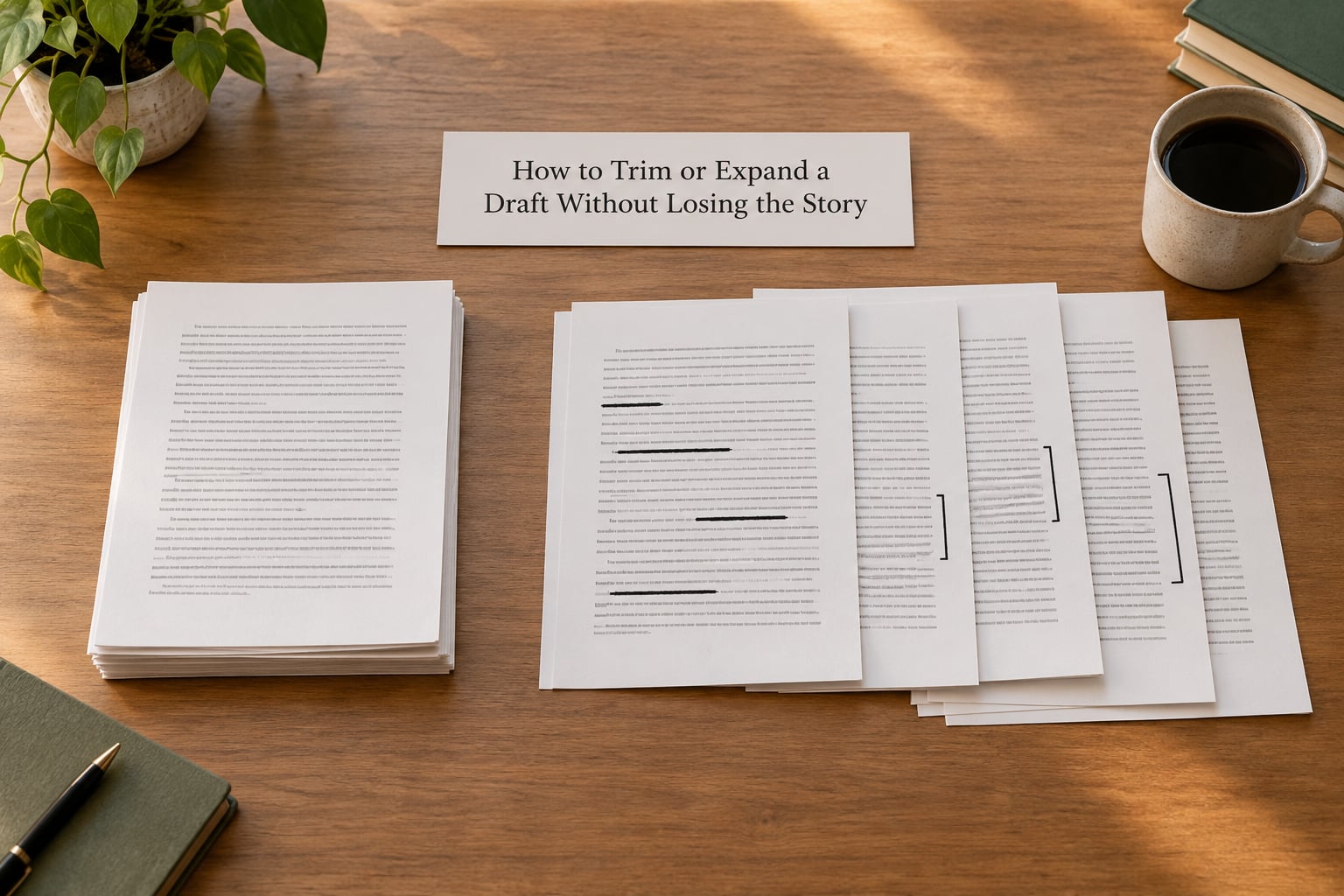
Cutting is a structural exercise, not a trimming one. You are not shaving sentences off the outside, you are removing the load-bearing walls the story no longer needs.
Five methods work on almost any crime manuscript. First, read only the dialogue scenes. If a stretch of dialogue could open with “we already knew that”, cut it. Second, list every scene that could be summarised in one line, then ask which of those summaries would cost the reader something. Delete the ones where the answer is nothing. Third, map your clues on a single page. Any clue the reader never registers as a clue has wasted its pages, and any clue planted twice has wasted them twice.
Fourth, cut the character’s internal monologue that explains a reaction the prose already showed. Noir suffers most from this, because noir voice is so seductive that writers protect sentences they should have cut. Fifth, check your scene ratio. If you have forty scenes and the story has twenty turns, you have twenty scenes doing background work. That is where the extra 20,000 words live.
Expanding is harder, and adding length for its own sake is how manuscripts reach 120,000 words without anyone noticing the crime. Substance comes from complication, not from slower scenes.
You can extend by raising a suspect’s stakes so they resist longer. You can add a consequence: who is hurt if the investigator is wrong. You can widen a location by one room and one person, giving the detective someone who lies for personal reasons rather than criminal ones. You can complicate the reveal by making the correct answer change the meaning of an earlier scene, then rewrite that earlier scene so the change lands. And you can deepen the single most important relationship in the book, which is usually investigator and suspect, because that is where readers are already leaning.
After any revision, reread the whole thing at speed and mark anywhere you drifted. Those marks are your real word count.
Frequently Asked Questions
What is the average length of a crime novel?
Most crime and mystery novels fall between 70,000 and 90,000 words, with 80,000 as the typical centre. Cozy mysteries sit lower at 60,000 to 75,000, while noir and hardboiled titles run higher at 85,000 to 95,000. Police procedurals land around 80,000 to 90,000. Treat these as market conventions rather than rules: a tight story at 65,000 words is more marketable than a padded one at 100,000.
How many pages is 80,000 words in a printed book?
In a standard trade paperback, a typeset page holds roughly 250 words, so 80,000 words comes to about 320 printed pages. The same manuscript runs closer to 300 pages double-spaced at standard manuscript format. Trim size changes the figure, since larger books hold fewer words per page. Authors who quote page counts to agents should always say whether they mean typeset pages or manuscript pages.
Is 60,000 words too short for a crime novel?
Not for most crime fiction. Sixty thousand words is right at the bottom of the range and suits cozy mysteries, locked-room puzzles and tight standalone thrillers where the cast and setting are deliberately small. It becomes a problem when a book needs multiple timelines, several suspects with real motives or a large amount of procedural detail. If your ending arrives at 60,000, do not pad it.
Should a debut crime novel be under 80,000 words?
A debut works best between 75,000 and 90,000 words. Under 75,000 can read as thin unless the tightness is clearly deliberate, and above 100,000 signals inexperience to an agent who has no other evidence about you. Writers report being passed on for debut manuscripts at 115,000 words not because the story was weak but because the length suggested the writer had not yet learned to end a book.
How long should a noir novel be?
Noir usually runs 85,000 to 95,000 words, with an acceptable ceiling around 105,000 when the prose earns it. The form depends on atmosphere, place and interior detail, all of which expand naturally, so cutting noir below 80,000 often strips away the sense of environment that makes the genre work. Noir writers get away with the longer range because the voice supports the extra pages.
Does an editor care about my crime novel’s word count?
Yes, but as a signal rather than a verdict. Agents use it as one quick check on whether you understand your genre, and editors look for whether the length matches the story’s scope. Word count alone does not get a manuscript rejected. A 68,000-word book with a loose middle and an 88,000-word book with a tight one are not equally likely to sell, and the difference is structure.
Conclusion
So, how long should a crime novel be? Decide the format first, pick a working range from the subgenre table, and write the ending before you write the middle. Treat that range as a planning tool and a revision diagnostic, not as a law you have to obey at the end.
Most manuscripts land best in the 75,000 to 90,000 band, with shorter for cozy and longer for noir. If your draft sits well outside that, the fix is almost always structural rather than cosmetic, and the work of changing it will improve the book whether the number moves or not.