If you’re wondering why your thriller has no tension, the answer is usually not a missing plot. It’s that the reader can see the danger coming, can see the protagonist handling it sensibly, and never has to choose between two bad outcomes. Tension lives in uncertainty plus consequence, and almost every flat thriller has one without the other.
Most drafts I read aren’t badly plotted. They’re just readable. The investigator finds the file, the detective knocks on the door, the prosecutor makes the call. Everything works, which is exactly the problem.
Below is a diagnostic order of operations: what tension actually is, the seven failure modes that account for nearly every flat thriller, the scene-level moves that put it back, and a checklist you can run on your own pages.
Table of Contents
- What Creates Tension in a Thriller?
- Why Your Thriller Has No Tension: Seven Common Causes
- The Stakes Are Abstract
- The Protagonist Has No Difficult Choice
- The Opposition Is Inactive or Obvious
- The Story Tells Us What Will Happen
- The Consequences Never Change
- Pacing Creates Distance Instead of Pressure
- The Emotional Response Stays Flat
- How to Rebuild Tension Without Adding More Twists
- Make the Objective Immediate and Measurable
- Put Two Bad Choices in the Room
- Let the Opposition Change the Plan
- Escalate Cost, Not Just Volume
- Use Withholding and Information Control
- A Quick Thriller Tension Revision Checklist
- Frequently Asked Questions
- Does a thriller need tension in every scene?
- Is action the same as tension?
- How do I add tension without using twists?
- Should I open a crime thriller with a shocking scene?
- How can I fix a thriller that feels slow?
- Conclusion: Strengthen the Choice Before the Twist
What Creates Tension in a Thriller?
Tension is the pressure created when a protagonist wants something important, meets obstacles that can genuinely stop them, and has to choose with incomplete information. The reader knows a loss is coming and cannot work out when or how it arrives. That gap is the whole engine.
Action is what characters physically do. Tension is what they stand to lose. A car crash is action; a character realizing the airbag didn’t deploy and the other car is still coming is tension.
Surprise is a shock the reader didn’t see coming. Tension survives surprise and often outlasts it, because surprise resolves in a second and dread keeps working for forty pages.
Pacing is how quickly you move through the material. Emotional pace is how fast the reader’s situation degrades. You can write a fast book with no tension and a slow, talky one that pins the reader to the chair.
Mystery is a question the reader wants answered. Suspense is the fear of what the answer will bring. Thrillers lean on suspense, so if your book is built like a puzzle with the danger pushed to the margins, readers will solve your plot without ever worrying about your characters.
Why Your Thriller Has No Tension: Seven Common Causes
Below is the symptom-to-cause lookup most writers need. Find the row that matches what your beta readers described, then work on that row alone. Fixing all seven at once is how manuscripts turn muddy.
| Symptom your readers describe | What is actually happening | The corrective move |
|---|---|---|
| “The danger sounds huge but I never felt worried.” | Theoretical stakes, announced once and never tested | Put the threatened thing in play in a scene where it can actually be lost |
| “Nothing bad ever happens to anyone.” | The protagonist keeps a safe option available | Remove the clean choice and leave two imperfect ones |
| “The villain felt harmless.” | Inactive opposition with a fixed plan | Give the opposition a competing objective and adaptivity |
| “I knew exactly what was coming.” | Advance narration of events still ahead | Establish danger without confirming its timing or shape |
| “The stakes stopped mattering halfway.” | Consequences that never alter anything | Make each escalation consume a resource or damage a relationship |
| “It dragged in the middle.” | Recap and repeated beats with no new cost | Cut summary, enter scenes after the door has opened |
| “I knew how she felt because it said so.” | Told emotion instead of staged reaction | Delete the feeling word and show the physical or tactical result |
The Stakes Are Abstract
Theoretical stakes are stakes the author declares and never tests. The manuscript says a witness is in danger; the witness is never contacted, never threatened, never left alone in a house with a broken lock.
Abstract danger reads as set dressing. Convert it into an immediate objective with a clock on it. Instead of “she had to find the ledger before the hitmen did,” give her a laptop with a drive that erases itself at six in the morning and a landlord who has already changed the locks. Now she is carrying something, and the reader is doing arithmetic.
The Protagonist Has No Difficult Choice
The safe option is what kills tension in competent, well-liked protagonists. Competence feels safe. Every scene where the investigator handles the problem cleanly teaches the reader that the book is under control.
The fix is constrained choice: two options, both costly, no third door. Hand your protagonist an option that protects the innocent and an option that protects themselves, and let the character pick one and live inside the loss for the rest of the act. The choice, not the reasoning, is what readers feel.
The Opposition Is Inactive or Obvious
The polite antagonist announces itself. Villains who monologue, who explain the plan, who wait in the same room at the same time every night give the protagonist room to prepare, and preparation is the opposite of tension.
Threatening opposition is not the same as effective opposition. Effective opposition conceals, wants something unrelated to your protagonist’s project, and changes tactics when blocked. If your antagonist’s only goal is to be caught by this particular protagonist, the whole chase has a fixed ending and the reader knows it.
The Story Tells Us What Will Happen
Advance narration kills uncertainty before the scene starts. A line about how the meeting would go badly, a repeated worry about a name you keep mentioning, a plan the protagonist explains in full: all of these convert a scene into a formality.
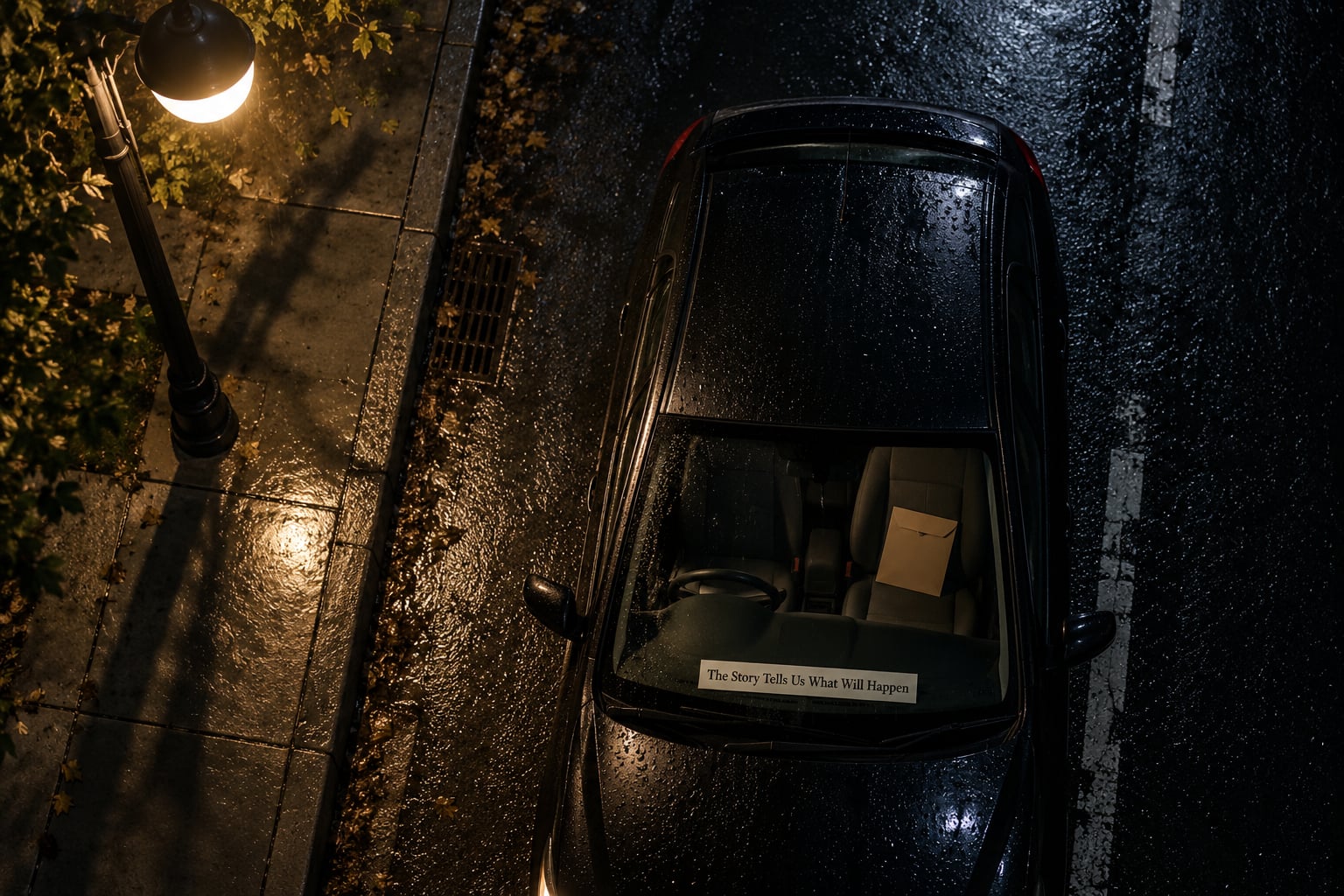
Contrast two ways of staging the same ten minutes. One version confirms that the envelope is a threat and tells us what happens when it’s opened. The other version puts an unopened envelope on a passenger seat, a car that has been sitting too long, and a character who decides not to read it yet. Same event, opposite effect.
The Consequences Never Change
Flat stakes mean the cost stays theoretical. Every escalation raises the volume of the danger without spending anything. A near miss in chapter ten leaves the character exactly where chapter one left them.
Escalation should consume. A resource is used up and not replaced. A relationship cracks and stays cracked. Something irreversible happens that the character cannot undo even if they win. If a reader can imagine the protagonist in the same emotional position at the end as at the start, your cost structure isn’t working.
Pacing Creates Distance Instead of Pressure
The recap seam is where a scene slows down to re-explain what happened last chapter. Readers feel the seam as a small drop in interest, and a chapter full of them reads as a slow book even if every sentence is tight.
Notice that faster prose cannot fix this. Tightening sentences on a scene with no conflict, no consequence and no decision produces a short, breathless scene that’s still inert. Fix the content of the scene first, then tighten the sentences.
The Emotional Response Stays Flat
Told emotion is the fastest way to drain a scene. Writing that a character felt terrified hands the reader a conclusion and asks them to skip the experience. When the response is withheld or generic, the reader has nowhere to put their own fear.
Stage it instead. Fear shows up as hand behaviour, as a decision made too fast, as the wrong question asked at the wrong moment. Guilt usually appears as an unnecessary apology to a living person. Once you delete the feeling words, most drafts get tense almost by accident, because the reader fills in the emotion themselves.
How to Rebuild Tension Without Adding More Twists
Twists are not the source of tension; they’re punctuation. Rebuild a flat scene in six moves: define the objective, name the cost of delay, restrict the options, intensify the opposition, force a choice, and vary the rhythm. Nothing on that list requires a surprise.
Make the Objective Immediate and Measurable
Broad goals produce wandering scenes. “Stop the crime” sends a protagonist anywhere. “Recover the drive before it’s erased” sends them to one door, one person, one clock. Measurable objectives are checkable, which means scenes can end when they’re done instead of trailing off.
Put Two Bad Choices in the Room
Give the reader both options and their different costs before the character picks. In a noir setup, calling the police will protect the witness in the room tonight, but the address on the file traces back to an accomplice the protagonist is protecting. Calling means safety for one person and exposure of the other.
Then let the character choose on incomplete information, and let the wrong cost land. The reader’s discomfort comes from having watched both options and still not being able to fix it.
Let the Opposition Change the Plan
An antagonist, an investigator or an institutional order should invalidate the protagonist’s approach, not merely respond to it. Opposition that adapts produces a harder second decision, which is more useful than any additional danger.
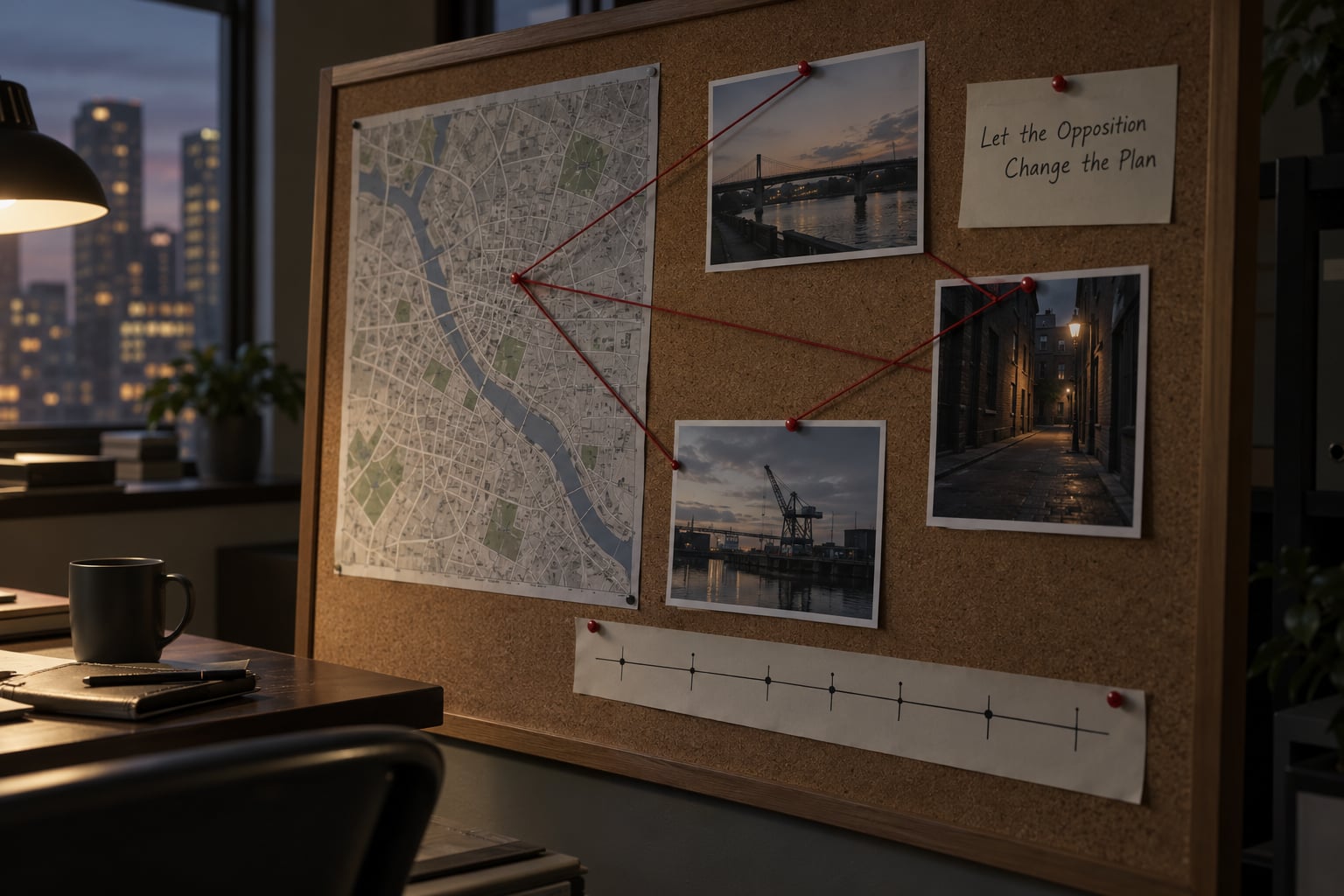
A raid on the storage unit is a good example. The protagonist planned a slow, careful approach; the raid burns the cover and forces a decision tonight instead of next week. The plan didn’t fail because of a mistake. It failed because the other side had a schedule of its own.
Escalate Cost, Not Just Volume
Louder danger and greater stakes are different things. A second gunshot is louder. A protagonist who spends their last ally, whose cover identity is burned, whose daughter has now watched them lie: that’s cost, and it changes what every later scene can cost.
Run an escalation check on each act: what did this section spend that the character can’t get back? If the answer is nothing new, your middle will sag no matter how many threats you add.
Use Withholding and Information Control
Track three lists for every scene: what the viewpoint character knows, what they suspect, and what they have wrong. Tension grows in the gap between those lists, especially when the character acts on a belief the reader can see is shaky.
Withhold what the character would notice, not what you’d have to work to hide. A viewpoint character who fails to notice a second set of tyres in the snow is a broken clue, not a fair one. Misdirection works because the reader can find the planted detail in retrospect.
A Quick Thriller Tension Revision Checklist
Run this per scene. One question answered no is a warning; three or more is a scene that needs rebuilding rather than line editing.
- Does the scene open with an urgent, specific objective?
- Is there credible resistance, from a person or an institution, that could genuinely block it?
- Does the protagonist face a choice where one option costs something specific?
- Does something change by the end that cannot be changed back?
- Does the reader learn one new thing that alters the situation?
- Is the emotional response shown through behaviour rather than named?
- Is there a reason to keep reading after this scene ends?
- Does the scene end on a turn rather than a summary?
To find the first weak scene, don’t read from chapter one. Read the last paragraph of each chapter and ask whether anything in it would hurt to lose. The first chapter that answers no is where your tension problem starts, and often the fix cascades forward.
Frequently Asked Questions
Does a thriller need tension in every scene?
No, but tension needs to be continuous somewhere. Chase scenes can run hot while quieter scenes carry dread through information and choice. The failure pattern is fifty pages where the protagonist is safe, informed and unpressured, usually in the middle. Alternate squeeze and release deliberately, and make sure the release never becomes a vacuum.
Is action the same as tension?
No. Action is physical event; tension is the cost of that event landing. A fistfight where nobody stands to lose anything is noise. A conversation across a kitchen table where the protagonist knows the lie has been noticed is tense and nearly still. If you removed the action beats from your chapter and the tension survived, your chapter was never tense to begin with.
How do I add tension without using twists?
Constrain the protagonist instead of surprising them. Give them a deadline, cut their resources, force two imperfect options and let the opposition adapt. Then withhold the timing of the danger so the reader cannot predict the shape of the scene. Most flat thrillers have enough twists and not enough pressure, so adding another twist usually makes the problem louder.
Should I open a crime thriller with a shocking scene?
Not necessarily. A shocking opening earns attention once and spends it, and the rest of the book has to earn attention again. A strong alternative is in medias res: open inside a decision already in progress, with the reader missing something the character has already decided. The test is whether your first scene contains a choice, not whether it contains a corpse.
How can I fix a thriller that feels slow?
Diagnose before you trim. Most slow-feeling thrillers are not wordy; they are scenes without consequence, entered too early and summarised at the end. Enter after the door has opened, cut the recap, and end each scene on a turn that replaces the current problem with a harder one. If the slow stretch has no choice in it, adding sentence-level pace changes nothing.
Conclusion: Strengthen the Choice Before the Twist
Why your thriller has no tension almost always comes down to one missing element: a decision the protagonist cannot take back, made while the reader is left uncertain about what it will cost. Everything else, including the twists, is scaffolding around that decision.
Open your manuscript at the first scene where your protagonist can act but cannot act safely, easily or without consequences. That scene is almost always weaker than you think, because it was written as setup. Rewrite it as a choice, let the cost land inside the chapter rather than later, and the rest of the book gets easier to revise from there.