Knowing how to price an indie crime novel means setting one list price per format and then checking what that price actually pays you after Amazon takes its cut and the printer takes its cut. Most US authors spend between 1500 and 9000 dollars getting an 80000-word novel from manuscript to finished paperback and ebook, and most crime fiction sells as an ebook between 2.99 and 5.99 dollars with a paperback between 12.99 and 18.99 dollars.
The trap is that these two numbers are not the same decision. A 3.99 dollar ebook earns you about 2.79 dollars and takes no other risk, while a 16.99 dollar paperback earns you roughly 7 dollars after print costs, but only on copies a reader actually orders. Work out both before you commit, because the format mix decides which numbers matter.
Table of Contents
- In this guide
- What Does an Indie Crime Novel Cost to Produce?
- How to Price an Indie Crime Novel for Print
- How to Price the Ebook Edition
- Pricing a series, book by book
- What Affects the Price of an Indie Crime Novel?
- How to price an indie crime novel with no platform at all
- How to Set a Price That Still Pays You
- Ways to Save on Indie Crime Novel Costs
- Frequently Asked Questions
- How much should an indie crime novel cost to produce?
- How do I calculate the royalty on a self-published crime novel?
- Should the paperback and ebook editions have the same price?
- What print-on-demand profit margin is reasonable for an indie author?
- Is it cheaper to print 100 books or use print-on-demand?
- Start With Your Break-Even Number
In this guide
This guide walks through four things: what a crime novel costs to produce before a single copy sells, how the print and ebook pricing math works on Amazon KDP, which variables move your price up or down, and how to set a price that still leaves money in your account at the end of the year.
The genre-specific part matters. Crime and noir readers are among the stickiest readers in genre fiction, which makes underpricing more expensive for you than it would be in a category that lives on discount traffic.
What Does an Indie Crime Novel Cost to Produce?
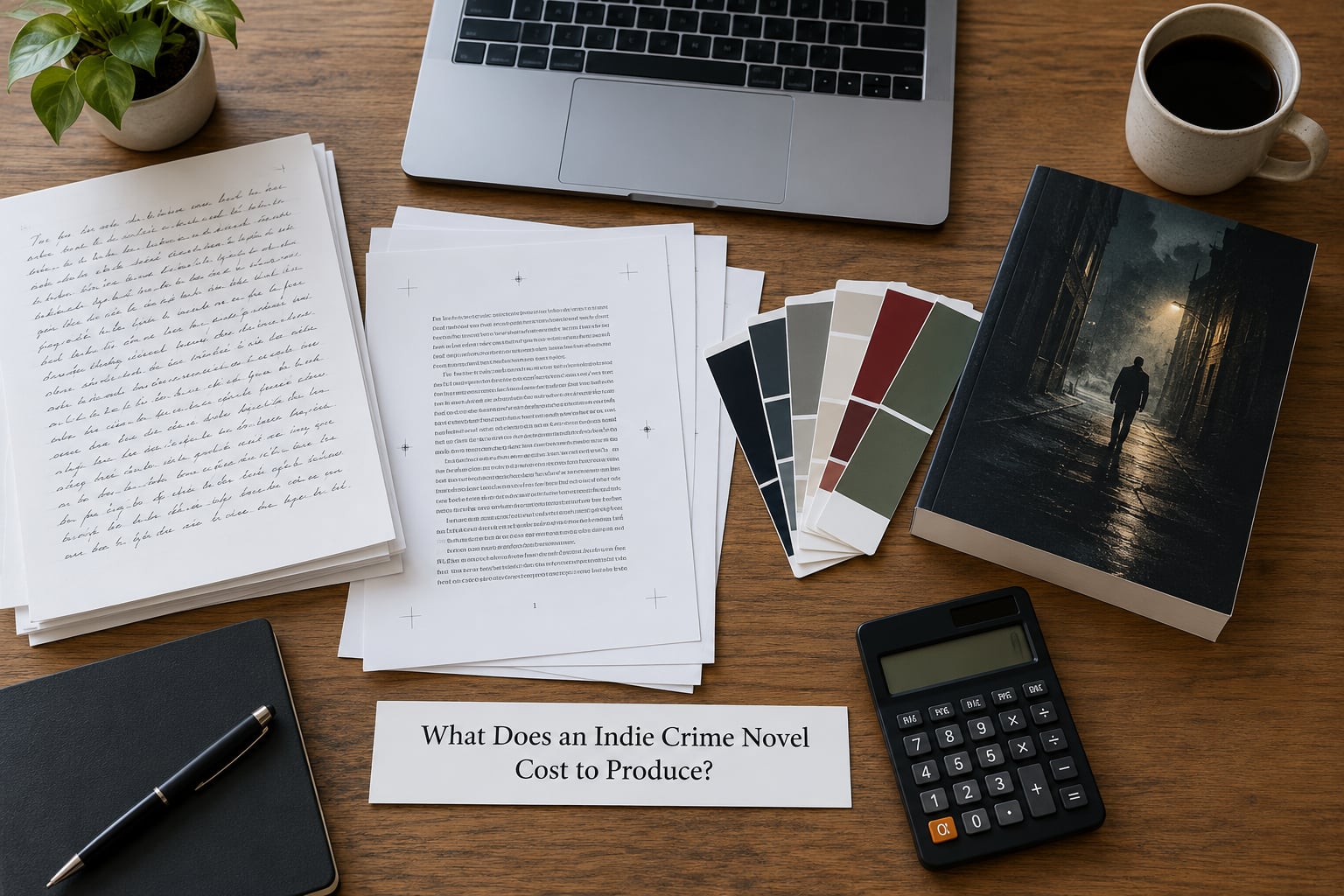
Add up every line item before you publish, because the number you divide by is the number that matters later. These are typical US ranges for a self-published novel; rates vary by region and by editor, and they change over time, so treat them as planning figures rather than quotes.
| Line item | Typical low | Typical high |
|---|---|---|
| Developmental, line and copy editing | 800 | 4500 |
| Cover design | 100 | 2500 |
| Interior formatting | 0 | 1000 |
| ISBN and setup fees | 0 | 450 |
| Proofing and advance review copies | 50 | 300 |
| Launch advertising and promotion | 100 | 1500 |
| Audiobook, if you record one | 0 | 2500 |
Here is a real mid-range budget for an 85000-word noir debut: 900 dollars for developmental editing, 1200 for line and copyediting, 600 for a commissioned cover, 150 for interior formatting, 125 for an owned ISBN, 250 for proofs and advance copies, and 600 for launch ads. That comes to 3825 dollars before you have read a single review.
Authors who skip this step usually end up guessing at the price later and finding out they cannot afford the discount they wanted. Numbers written down at the start are numbers you can argue with.
How to Price an Indie Crime Novel for Print
Paperback pricing starts with print cost, which Amazon calculates from your trim size, paper type and page count. Every one of those three is a lever you control before upload, and a 6 by 9 inch trade paperback on cream paper is the cheapest common configuration for a novel.
Take an 85000-word crime novel that lands at 320 pages. At 6 by 9 inches on cream paper, the print cost is usually somewhere around 5.10 dollars a copy. KDP pays you 60 percent of the difference between your list price and that print cost, so a 16.99 dollar list price returns about 7.07 dollars before delivery fees.
Three discounts sit between you and that money. Retailers take roughly 40 percent, distributors take their cut on top of that, and you should hold back a returns reserve of about 5 percent for books that come back. Price the paperback as though it pays you a few dollars less than the calculator says it will.
One change worth knowing about: Amazon has adjusted print royalty rates for paperbacks and hardcovers priced below its minimum list price thresholds, which reduces the percentage on cheap print editions. Check the current terms in your own royalty calculator rather than trusting a blog that quoted the old rate, and set your print price comfortably above the current minimum.
The community rule of thumb that a paperback should sit near three times the ebook price holds up fine. It keeps the formats from cannibalising each other and signals that the paperback is the artefact people gift.
How to Price the Ebook Edition
Amazon pays 70 percent on ebooks priced between 2.99 and 9.99 dollars, and 35 percent outside that band. Those are the only two ebook tiers, and falling outside the band by accident is the most common pricing mistake new authors make.
| Ebook list price | Royalty tier | Take-home per copy |
|---|---|---|
| 1.99 | 35 percent | about 0.70 |
| 2.99 | 70 percent | about 2.09 |
| 3.99 | 70 percent | about 2.79 |
| 4.99 | 70 percent | about 3.49 |
| 6.99 | 70 percent | about 4.89 |
| 9.99 | 70 percent | about 6.99 |
| 12.99 | 35 percent | about 4.55 |
Look at the bottom row. Twelve dollars and ninety-nine cents is more money to the reader and less money to you. For most crime and thriller titles, the 2.99 to 4.99 dollar range is where the volume sits, and 4.99 dollars is a defensible ceiling for a debut with no reviews yet.
Kindle Unlimited is a pricing decision as much as a distribution one. Going exclusive trades your per-copy royalty for a page-count payout that depends on how many subscribers read your pages, which helps a serial procedural with a long backlist more than it helps a standalone debut. Authors weighing the tradeoff usually point at the same worry: locking a series into exclusivity removes the direct sale you can see.
Run both numbers. A 3.99 dollar wide ebook that sells 200 copies a month pays about 558 dollars. If those same readers are reading through KU at a rate that would have earned 600 dollars in page-count payout, exclusivity wins that month, and you should recheck the comparison each quarter because the payout moves.
Pricing a series, book by book
Readers who finish book one will buy book four at full price. Use that, because it is the single clearest advantage crime fiction has over discount-driven categories.
| Position | Ebook price | Reason |
|---|---|---|
| Book one | 2.99 dollars | Lowest barrier to the read-through that pays later |
| Books two and three | 3.99 to 4.99 dollars | Your core backlist price |
| Book four onward | 4.99 to 6.99 dollars | Returning readers tolerate more |
| Box set of one to three | About 40 percent off | Sells to binge readers and to gift buyers |
Keep the box set discount under half. Anything deeper teaches readers to wait for the bundle, and a bundle that costs 80 percent of the separate books makes the individual volumes look overpriced on the same product page.
What Affects the Price of an Indie Crime Novel?
Length is the biggest variable, and it hits print harder than ebook. A 95000-word thriller runs past 380 pages at 6 by 9 inches, and every extra page adds to the print cost the paperback has to recover. Trimming the manuscript by 40 pages at the edit stage can save real money per copy without readers noticing.
Then there are the choices that shape perceived value rather than production cost. A commissioned cover for a noir title costs several times what a template does, and buyers use cover quality as a speed signal. A book with heavy formatting, chapter breaks and a map or timeline inside reads as more expensive than a plain interior at the same page count.
Your platform changes what the same title can charge. A debut with no email list and no reviews has less room to ask for 5.99 dollars than an author with a newsletter of two thousand crime readers. A series finale with an established read-through can sit higher than book one because the audience already decided to buy it.
How to price an indie crime novel with no platform at all
Set book one at 2.99 dollars and buy yourself the read-through instead of the margin. Give the first 30 percent away on a clean release day, spend the difference you would have earned on two weeks of targeted ads aimed at readers of your comp titles, and go back to 3.99 dollars once you have reviews and a rank worth advertising to.
That plan has a deadline. If the book is not moving after six weeks, the price is not your problem and the blurb is, so fix the cover and the hook before you discount further.
How to Set a Price That Still Pays You
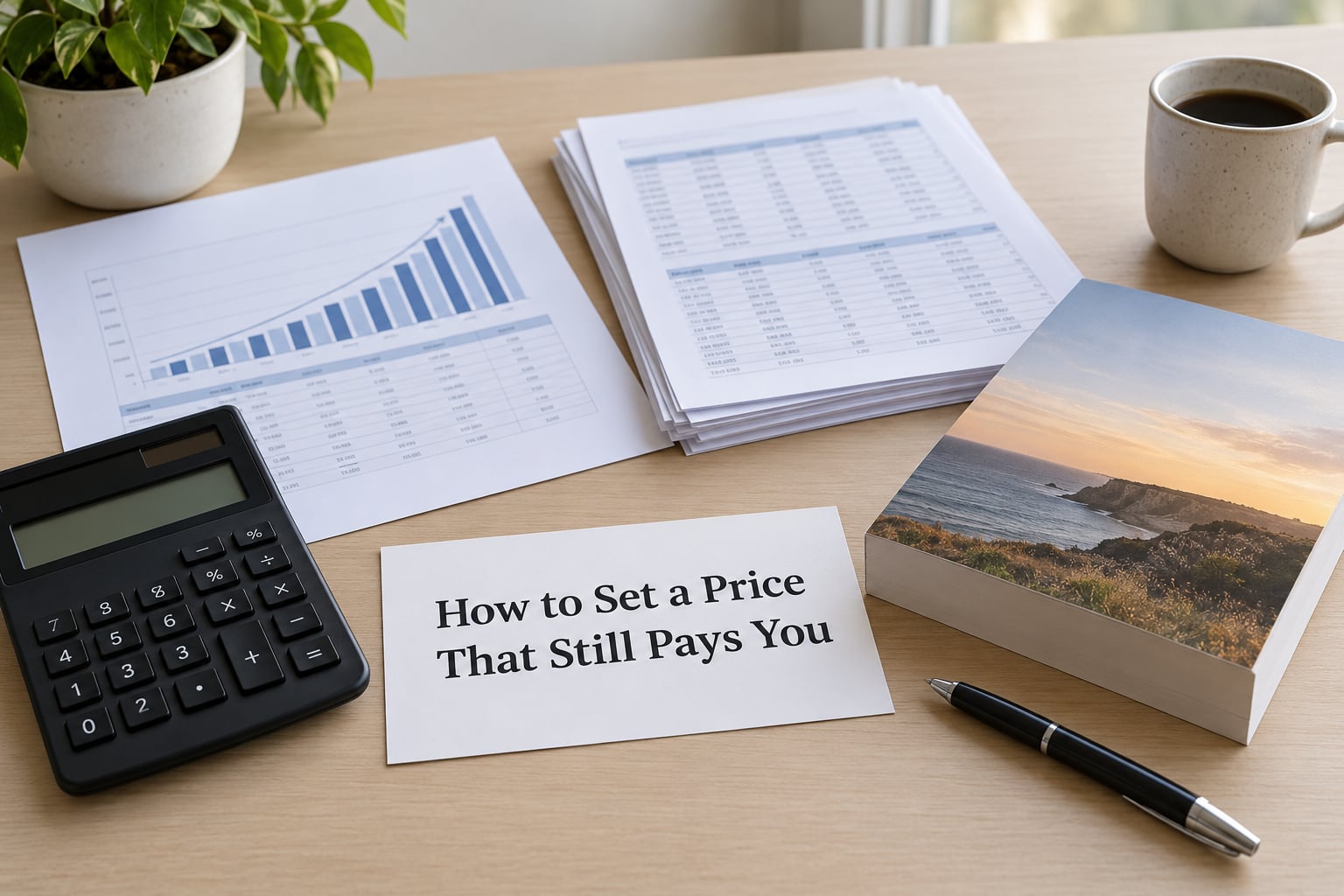
Work backward from what you need, not forward from what rivals charge. Total your production budget, divide by the take-home per copy at your candidate price, and you have the number of sales that covers the project.
Take the 3825 dollar noir budget above. At 3.49 dollars per ebook copy, you need 1096 sales to cover production. At 7.07 dollars per paperback, you need 541. Add any ad spend to the budget before dividing, because launch cost belongs in the break-even figure rather than in a separate guilt account.
Set a per-copy floor and refuse to cross it. For paperbacks, three to four dollars of profit per copy is the number indie authors repeatedly land on, since anything below that turns a busy sales month into a loss once returns come out of it. For ebooks, a floor of two dollars keeps the format worth selling.
The 90/10 rule explains why the price should not chase the bargain crowd. A small share of your titles produces most of your income over a career, and those are usually the ones readers found once and followed. Discounting everything to reach the other ninety percent lowers your income on the ten that mattered.
For a bigger target, run the same division. At 3.49 dollars per copy, roughly 28700 ebook sales is a six-figure gross royalty year before print, ad spend or taxes. Hearing that number out loud is usually what pushes a debut from 0.99 dollars to something sensible.
Ways to Save on Indie Crime Novel Costs
Cutting cost changes the math but rarely the outcome, as long as you cut the right line.
- Bundle the editing. One developmental editor who also line edits and copyedits costs less than three specialists and produces a more consistent manuscript.
- Use print-on-demand instead of a small first run. 100 copies sitting in a closet is 100 dollars of print cost per copy returned slowly, and print-on-demand charges nothing until a reader orders.
- Buy the template, not the custom cover, until book two. A professionally evaluated template can carry a debut; the revenue saved buys ads, which move sales more than a second cover revision.
- Format the interior yourself with a vetted template. Most 6 by 9 crime novels need nothing more than clean margins and consistent chapter breaks.
- Use the free Kindle ISBN. It only works on Amazon, but it removes a line item entirely while you find out whether the book has an audience.
- Buy marketing assets once and reuse them. A single set of channel images sized for every ad slot and social post serves book one and the rest of the series.
- Skip the deluxe hardcover for the debut. Hardcover costs more to make, sells slower and competes with a paperback that is already working.
Frequently Asked Questions
How much should an indie crime novel cost to produce?
Plan for 1500 to 9000 dollars for a US indie crime novel, with most debuts landing between 3000 and 5000 dollars. That covers developmental and line editing, cover design, formatting, an ISBN, proofing, and launch promotion. A budget built before you publish tells you the sales number you need, and that number is what stops you setting a price you cannot afford to discount.
How do I calculate the royalty on a self-published crime novel?
Multiply your ebook list price by your royalty tier, which is 70 percent between 2.99 and 9.99 dollars and 35 percent outside that band. For paperbacks, take the difference between list price and print cost, then multiply by 60 percent. At 3.99 dollars you keep about 2.79, and at 16.99 dollars on a paperback with a 5.10 dollar print cost you keep about 7.07.
Should the paperback and ebook editions have the same price?
No. Setting them the same price removes the reason a reader would choose the cheaper one and gives up most of the ebook margin. Indie crime authors generally land near three times the ebook price for paperback, so a 3.99 dollar ebook pairs with a 13.99 to 16.99 dollar paperback. The paperback carries the print cost; the ebook carries the royalty.
What print-on-demand profit margin is reasonable for an indie author?
Three to four dollars of profit per paperback copy is the working floor most indie crime authors aim for, after print costs and Amazon’s 60 percent print royalty are accounted for. On a 320-page 6 by 9 title that usually means a list price of 15.99 to 17.99 dollars. Prices under the current minimum list price threshold earn a reduced royalty, so check the terms before going low.
Is it cheaper to print 100 books or use print-on-demand?
Print-on-demand is cheaper in total until you sell roughly 100 to 200 copies. A 100-copy run locks your print cost per book in advance and uses cash up front, while print-on-demand charges only when a reader orders. The exception is a signed or event edition where the physical copies are the point. Otherwise, let the printer hold the inventory.
Start With Your Break-Even Number
Total every dollar the project cost, including launch ads, then divide that number by the take-home you would keep at your candidate price. That figure, not a competitor’s cover, is what should set your list price.
For a debut with no platform, book one at 2.99 dollars with a short introductory discount is a reasonable opening. Once you have reviews and a backlist, move to the 3.99 to 4.99 dollar band and let the series carry the rest.