If you have ever tried to keep six suspects, four crime scenes and a pile of clues straight in a spreadsheet, you already know how that ends. Learning how to use index cards to plot a mystery puts every clue on its own card, every suspect on its own card, and lets you move them around until the trail actually reads like a story.
The method takes an afternoon to set up and about three weeks of evenings to build properly for an 80,000-word novel, and it needs no software at all. That matters for crime writing, because a mystery is a machine for controlling what the reader knows and when they know it, and moving physical cards makes gaps and premature reveals obvious in a way scrolling a document never does.
Table of Contents
- What You Need
- Step-by-Step: How to Use Index Cards to Plot a Mystery
- 1. Define the central mystery and question
- 2. Map character motives and pressure points
- 3. Build the clue chain with index cards
- 4. Arrange discoveries, reversals, and the reveal
- 5. Test the logic and repair weak links
- Common Mistakes to Avoid
- Frequently Asked Questions
- How many index cards should I use to plot a mystery?
- Should every scene have its own index card?
- How do I organize mystery clues on index cards?
- What color should I use for different types of plot cards?
- Can index cards work for a short mystery story?
- How do I test whether my mystery clues are fair?
- Conclusion
What You Need
The materials list is short, and every item is cheap. You need a stack of blank index cards, four or five coloured markers, something to stick them up with, and a wall, corkboard or large sheet of paper you can clear for a few weeks.
Add three optional extras that pay for themselves on the first afternoon. A long piece of string or a ruler lets you lay out a chronological timeline as a line rather than a cluster. A second colour of card stock gives you a visual split between plot beats and clues. And a cheap camera or phone stands in for the backup you will want once the wall is covered.
On card count, a full-length mystery usually lands somewhere between 60 and 120 cards. A simple whodunit with four suspects and two crime scenes tends to need 50 to 70. Add a red herring subplot, a second timeline or a serial-killer structure and you can pass 120 without trying.
On wall space, budget one metre of width per 20 scene cards and a second strip of wall roughly half that size for the chronological timeline. That is why the two-wall setup below matters.
Step-by-Step: How to Use Index Cards to Plot a Mystery
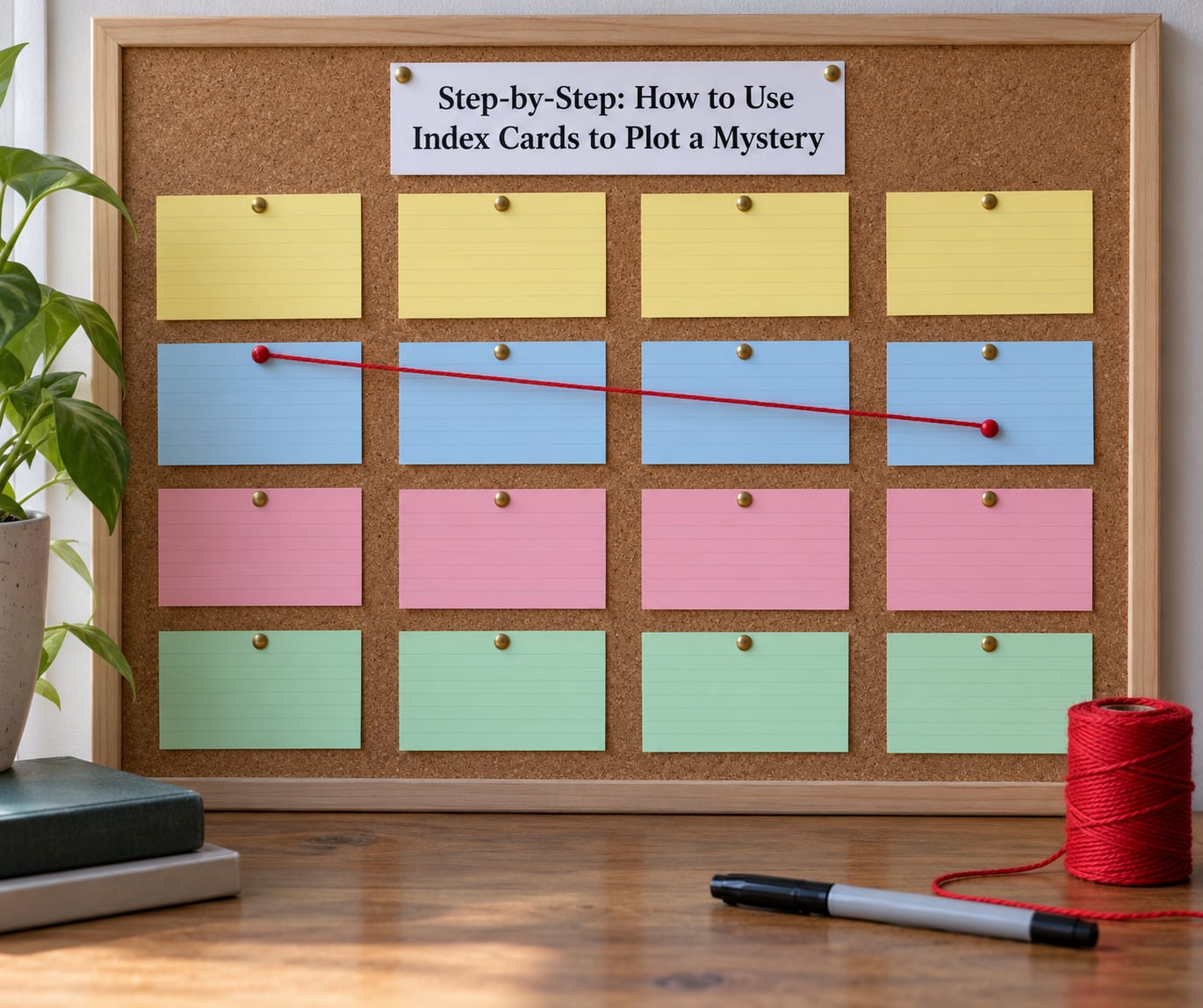
The system has five stages, and each one produces a different kind of card. The rule underneath all of them: one card holds one plot movement, clue, decision or reveal, never a vague idea about a scene you might one day write.
1. Define the central mystery and question
Write the question your book is built to answer on a single card, in the reader’s own words. Something like why a body was found in a locked studio at 11 p.m. is better than an abstract theme, because you can test every other card against it.
On a second card, write the answer, then put it somewhere out of sight. Sealing the solution early is what stops you writing a mystery where the detective figures it out by accident on page 40.
You know the system works when every card you write later either serves that question or provably misleads the reader about it. Anything that does neither comes off the wall.
2. Map character motives and pressure points
Give each important character one card with five fields: what they want, what they are hiding, what they fear, what they know that the reader does not, and what pressure forces them to act.
That last field is the one most writers skip, and it is usually the reason a suspect sits in a chair doing nothing for sixty pages. A character with a secret but no pressure has no reason to lie.
Test each character card with one question: if this person were removed from the story, what would break? If the honest answer is nothing but atmosphere, the card needs an upgrade or the character needs cutting.
3. Build the clue chain with index cards
This is the step that makes card plotting different from ordinary outlining, so it is worth doing properly. Work backwards from your sealed answer card and write out every piece of evidence that proves it, one clue per card, each with three lines: what the reader sees, who could have planted or hidden it, and which characters can access it.
Then order those clue cards from least revealing to most decisive. If a clue only makes sense after the reveal has landed, it belongs earlier in the pile or it needs rewriting.
Anchor every clue card to a person, a location or an open question using a small tag in the corner. A clue nobody can connect to anybody is set dressing, not evidence.
Six card types cover most plots, and you build them in this order:
| Card type | What it holds | Fill it when |
|---|---|---|
| Mystery card | The question and the sealed solution | First, before anything else |
| Character card | Goal, secret, fear, access, pressure | After the mystery card, before clues |
| Clue card | Evidence, who planted it, who can reach it | Working backwards from the solution |
| Suspect card | Means, motive, opportunity, alibi source | Once the real culprit is fixed |
| Red herring card | A false lead plus its honest explanation | After the real clue trail exists |
| Reveal card | The moment the reader connects two clues | Last, once the sequence is stable |
4. Arrange discoveries, reversals, and the reveal
Lay the scene and clue cards out on the wall in the order the reader will meet them, starting at one end and running to the other. Read the row aloud as a summary of the book. Where a discovery answers one question without raising a sharper one, add a card behind it.
Here is how a single clue travels. A muddy boot print by the studio door appears in chapter two as a detail nobody remarks on. In chapter nine it reappears as the thing that puts a character at the scene. In the final chapter the sleuth matches the tread to boots the culprit is wearing. Three cards, one plant, one echo, one payoff, and a reader who could have caught it early.
Finish by putting the reversals and red herrings into the same row, not a side pile. A false lead that sits outside the sequence reads as an authorial aside; one that sits inside the sequence misleads properly.
5. Test the logic and repair weak links
Now read the wall as a reader who cannot see the cards. Read across the row in order and ask at each turn whether the reader had enough information to make the inference you require.
Then read down the columns. If two clue cards carry the same information, one is redundant. If a suspect card lists an opportunity that nobody could verify, you have either written a gap or an unfair clue.
Finally, cover the clue cards with your hand and read only the character cards. Any character who acts on knowledge they were never given has just shown you the fix: add the scene where they learn it.
Common Mistakes to Avoid
Almost every failed mystery wall I have seen comes from one of six habits. Each has a simple correction you can apply in a single evening.
Vague clues. A card reading something ominous is not a clue, it is a mood. Rewrite it as a specific observation a character could act on: the cut is on the inside edge of the strap, which only happens if the bag was cut while being worn.
Too many twists. Five reversals in 70,000 words turns a mystery into a series of strangers. Most plots survive on one real reveal plus two or three reversals, and the rest belong in a sequel.
Confusing character knowledge with your knowledge. You know the culprit from card one, so it is easy to write a scene where the detective behaves as if they do too. The character-card read-through in step five exists for exactly this.
Passive suspects. Every character sitting in an interview room waiting for the sleuth to be clever is a stalled chapter. Give each suspect card a pressure point, then put a scene card where that pressure erupts.
Clues added only to support the ending. When you discover a gap, do not drop in a clue that makes the reveal work. Go back and plant an earlier, less obvious version of it instead.
Red herrings with no honest explanation. Every false lead must be true in some sense. The suspect really did lie about the time, the weapon really was there, the person really had a motive. Ask yourself what the false lead is genuinely hiding, and note it on the card.
One habit worth keeping is the halfway reordering pass. Once the cards are up, shuffle the middle third and put them back in the order that feels most natural rather than the order you planned. That instinct usually finds the sag before your outline does.
Frequently Asked Questions
How many index cards should I use to plot a mystery?
For a straightforward whodunit with four suspects and two crime scenes, expect 50 to 70 cards: one mystery card, one per character, one per clue, one per red herring and one per scene. A tighter, cleverer plot often needs fewer because each card carries more. A serial or multi-victim structure can run past 120. If you are running out of wall space, your plot has probably grown into two books.
Should every scene have its own index card?
Not every scene, but every plot movement should have one. A card is justified when something changes: a discovery, a reversal, a decision that closes off an option. Use a smaller sticky note for atmosphere and setting you plan to carry in a paragraph. If two consecutive cards read identically, you have two halves of a scene and can merge them.
How do I organize mystery clues on index cards?
Write one clue per card and put three lines on it: what the reader sees, who could have planted it, and which characters can access it. Tag the corner with the character or location it connects to, then order the cards from least revealing to most decisive. Lay them out separately from your scene cards so the evidence chain stays readable on its own.
What color should I use for different types of plot cards?
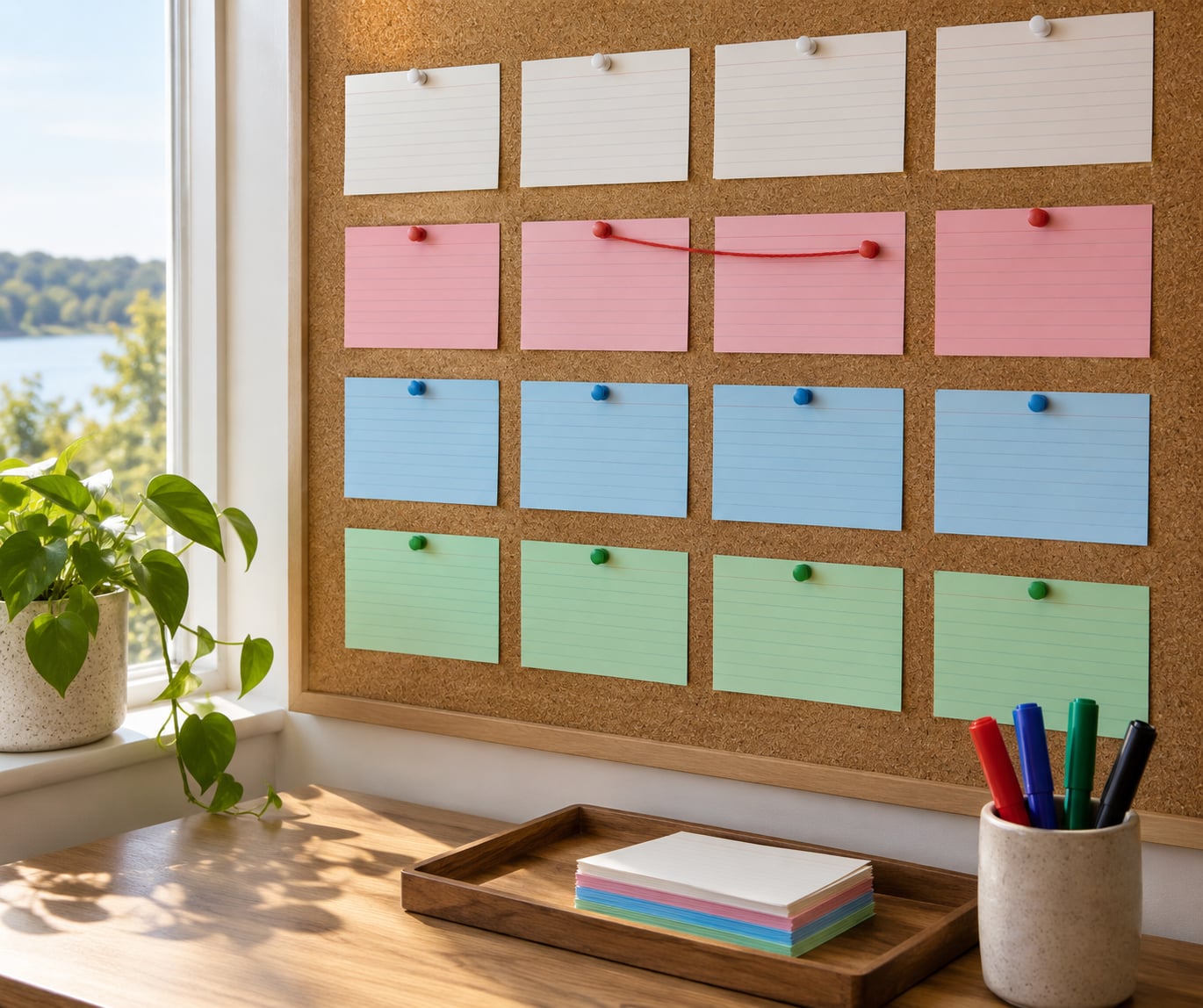
Pick one colour per card type and write the legend on the wall before you start. A workable scheme uses one colour for scene beats, one for clue cards, one for suspect and alibi cards, one for red herrings and one for reveals. Consistency matters more than the specific colours: the goal is that you can find every clue on the wall with one glance, even from across the room.
Can index cards work for a short mystery story?
Yes, and short stories actually benefit most. A 15,000-word mystery often needs only 25 to 40 cards, which is a single afternoon’s work and a much easier audit than 120. Keep all six card types even when the cast is small, because a short story has no room for a red herring that cannot be explained. The fair-play test at the end takes ten minutes.
How do I test whether my mystery clues are fair?
Cover the clue cards and read only the scene cards in order, noting what the reader knows at each point. Then reveal the clues and check that every inference the sleuth makes was possible from what was already on the table. Any turn that requires information the reader never had is unfair, and the fix is almost always an earlier, quieter plant rather than a new clue.
Conclusion
The whole system collapses into one sitting if you start small. Write the central mystery on one card, the investigator’s goal on a second, and three clues on three more, then pin them up and read them in order.
Once those four cards exist, the rest is just repetition: more clues working back from your solution, one card per suspect, and a final pass that asks whether a reader could have solved it fairly. Start tonight, before the plot grows another subplot you cannot hold in your head. Paper still does this job better than a screen, in 2026 or any other year, and the wall is bigger than any screen you own.