How to revise a mystery novel draft: run eight passes in a fixed order — story structure, plot causality, clue visibility, red herrings, suspect validity, reveal order, then character, prose and proofing — instead of rereading the manuscript hoping problems surface. Budget four to eight weeks for an 80,000-word book, and never start with sentence-level fixes.
That order matters more than any individual technique. A line edit you make in week two will be thrown away in week five, because the scene it sits in has been cut, moved or rewritten from the ground up. Mystery fiction is unusually unforgiving about this, since the whole pleasure of the book depends on a chain of logic the reader could have followed.
If you are starting from scratch rather than from a finished draft, here is the compact answer to how do I revise my first draft of a novel?
- Put the manuscript away for at least a month before you open it.
- Read it straight through without editing, marking only where you felt bored, confused or unconvinced.
- Build a scene map and mark what each scene does for the investigation.
- Fix structure before anything else.
- Audit the clues for fair-play visibility and the red herrings for fairness.
- Test the solution: motive, means and opportunity must survive your cuts.
- Send to two to four readers with specific questions.
- Line edit, copyedit and proofread last, in that sequence.
The rest of this guide walks through each pass, what to look for, and how you can tell the pass is working.
Table of Contents
- What You Need
- How to Revise a Mystery Novel Draft Step by Step
- 1. Cool Off and Make a Diagnostic Plan
- 2. Rebuild the Mystery at the Sentence Level
- 3. Audit the Plot Chain and Causality
- 4. Check Every Clue, Reveal, and Red Herring
- 5. Strengthen Character Motive and Investigation Scenes
- 6. Rework Suspense, Pacing, and Scene Energy
- How to Revise a Mystery Novel Draft Without Losing the Mystery
- 7. Revise the Prose for Clarity, Voice, and Genre Impact
- 8. Run Independent Read-Throughs and Final Proofing
- Common Mistakes
- Revision Tips for Mystery Writers
- Frequently Asked Questions
- How long should I wait before revising my first draft?
- How do I know if my mystery clues are fair?
- How do I fix red herrings that feel like cheating?
- How many rounds of revision does a novel need?
- Should I use beta readers or hire a developmental editor?
- How do I cut a mystery draft that is too long without breaking the solution?
- Start With One Diagnostic Pass
What You Need
You need five things, and only one of them is the manuscript itself. A synopsis or scene map, so you can see the book’s shape without reading the prose. A change log, so you remember what you cut in week three while you are tempted to reinstate it in week six. Reference notes for anything factual you checked while drafting — forensic procedure, police procedure, historical detail, medical timelines.
You also need a revision method. This guide is one, but any named, numbered pass system beats “just read it and fix what feels off.” And you need a preserved copy of the original draft. Once structural work starts, you will lose track of what was always there versus what you added at 2am, and the original is your only reference for that.
A full printout helps but is not essential. Most writers end up mixing formats anyway: paper for structural work, because marking up margins beats scrolling, and screen for line edits, because you can search and find-replace. Read aloud for dialogue, always. The format is a tool, not a rule.
How to Revise a Mystery Novel Draft Step by Step
Each of the eight passes below has a job, a set of checks, and a signal that tells you it is finished. Resist the urge to run two at once. The temptation to fix a comma because you noticed it is the single most common reason drafts stall — you finish a “session” having corrected forty small things and nothing structural, then feel oddly deflated.
1. Cool Off and Make a Diagnostic Plan
Set the manuscript down for four to six weeks. The point is not to forget it but to stop being able to read the sentences you wrote. Fresh eyes are mostly the absence of memory for your own choices; when you remember why you wrote that line, you tend to defend it, and defense is the opposite of revision.
Before you start, answer five questions in writing: What is the premise, in one sentence? What is the ending, and is it the ending I want? Where did I get bored or confused while rereading? Whose motivation is weakest? Where did the pacing sag? Writing the answers down converts a vague sense that something is wrong into a diagnosable problem, and a diagnosable problem is the only thing a revision plan can act on.
Set a schedule with real dates. Four to eight weeks is typical for an 80,000-word book, longer if you are also restructuring. The pass is working when you have a one-paragraph statement of the book’s biggest problem and a written answer to each of the five questions.
2. Rebuild the Mystery at the Sentence Level
Write the central mystery in a single sentence: “Who killed X, and why does Y need it hidden?” If you cannot, your draft does not have one yet, and no amount of line editing will create it. Then define the protagonist’s objective, the obstacle standing between them and that objective, and the stakes if they fail.
The useful test: could a competent reader, working only from what you put on the page, understand the solution? Walk backwards from your ending and list every fact the reader needs to reach it. Anything in that list you never showed them is a cheat, and it belongs on your revision list under Pass 4.
3. Audit the Plot Chain and Causality
Make a scene map: one card per scene, listing the viewpoint character, the location, the day or time, and one line on what changes. Line them up and trace the chain from the inciting incident through the investigation, the discoveries, the reversals and the resolution. Check that your inciting incident lands within the first thirty pages, which is the benchmark most of the craft advice uses.
Now flag the four classic problems. Gaps: events that happen without cause. Coincidences: the right person appearing in the right place for no reason the characters can act on. Unexplained decisions: characters who do something odd because the plot needs them to. And events that exist only to serve the plot, which you usually find by asking what the scene would cost if it were deleted.
The fix is surgical. Add a motive for the coincidence, delete the scene, or cut the one line that made the character look unreasonable. The pass is working when you can trace any reveal back through two or three earlier scenes without hitting a hole.
4. Check Every Clue, Reveal, and Red Herring
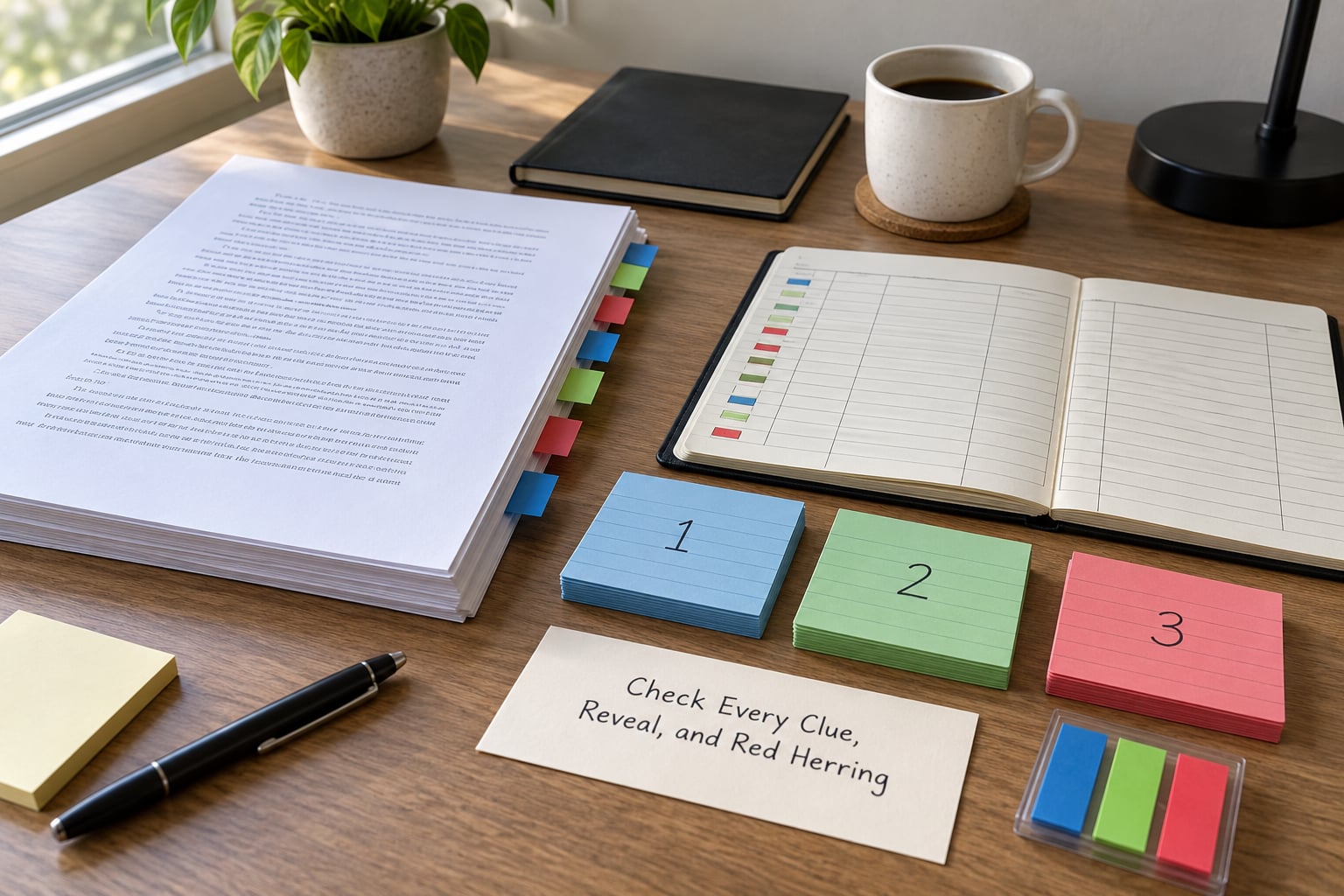
This is the pass that separates a mystery revision from a generic one, and almost nobody runs it as a discrete step. Build a clue ledger with five columns: the planted detail, where it appears, what each character concludes from it, the reveal it supports, and any false lead it feeds.
Then run four questions across every row. Is it visible? Did the reader see it before the reveal, in a form they could recognise, unhidden behind clever description. Is it fair? Could an attentive reader have connected it without guessing wildly. Is it timely? Did it arrive early enough to be useful and late enough not to be obvious.
The fourth question catches clues missed for the wrong reason. If a reader could not have noticed a clue because it was buried in an interior monologue three pages after its subject left the room, you have a placement problem, not a puzzle problem. The fix is almost always moving the detail earlier and letting the characters ignore it, which reads as natural and fixes the fairness problem in one move.
Red herrings get the same audit. A fair red herring comes from a believable source — a character’s genuine suspicion, a piece of evidence that points somewhere false for an understandable reason — and it reveals character on its way past. A cheat red herring is one the author invented and the reader can see is invented.
5. Strengthen Character Motive and Investigation Scenes
For every investigator, ask why they act, lie, miss evidence or change direction. Vague motivations produce passive investigators who happen to find things, and readers clock that instantly even if they cannot name it.
Replace the vague with specific: a goal the character wants in the next hour, an impulse that conflicts with that goal, a visible choice that shows which one won, and a consequence that carries into the next scene. If a scene can be summarized as “they investigated and then knew more,” it needs a specific discovery, a specific cost, or both.
Test the cast at the same time. Three to five suspects is the range most crime fiction lands on, and cutting below three usually leaves you with a solution the reader already guessed from the first chapter. Cutting above five dilutes rather than complicates. The pass is working when you can state each suspect’s motive for lying, and at least three of them have motives that survive to the last chapter.
6. Rework Suspense, Pacing, and Scene Energy
Plot your tension across chapters and look at the shape. A mystery should escalate in steps, with a genuine trough between the inciting incident and the midpoint reversal and a rising line through the second half. A curve that flatlines after chapter ten is the usual explanation for a book readers call slow even when they cannot say why.
Fixes that work: enter scenes later, since most scenes open with two paragraphs of arrival; tighten repeated beats, because characters often explain the same discovery twice from different angles; and raise the cost of each revelation, so the tenth major reveal costs the protagonist something rather than only confirming what the reader already assumed.
Alternate pressure with reflection. Sustained tension exhausts readers and blunts it. If your draft is 90,000 words and every scene is at full volume, you are not writing a thriller, you are writing a wall. Cutting word count is usually a pacing problem before it is a length problem, and the order of cuts should be: stalled scenes first, repeated information second, single repeated words last.
How to Revise a Mystery Novel Draft Without Losing the Mystery
When a draft has lost its mystery, the instinct is to add confusion. Resist it. You cannot manufacture suspense by withholding information the fair-play contract requires you to give, and adding clues at random is the most common way to make a mystery worse rather than tighter.
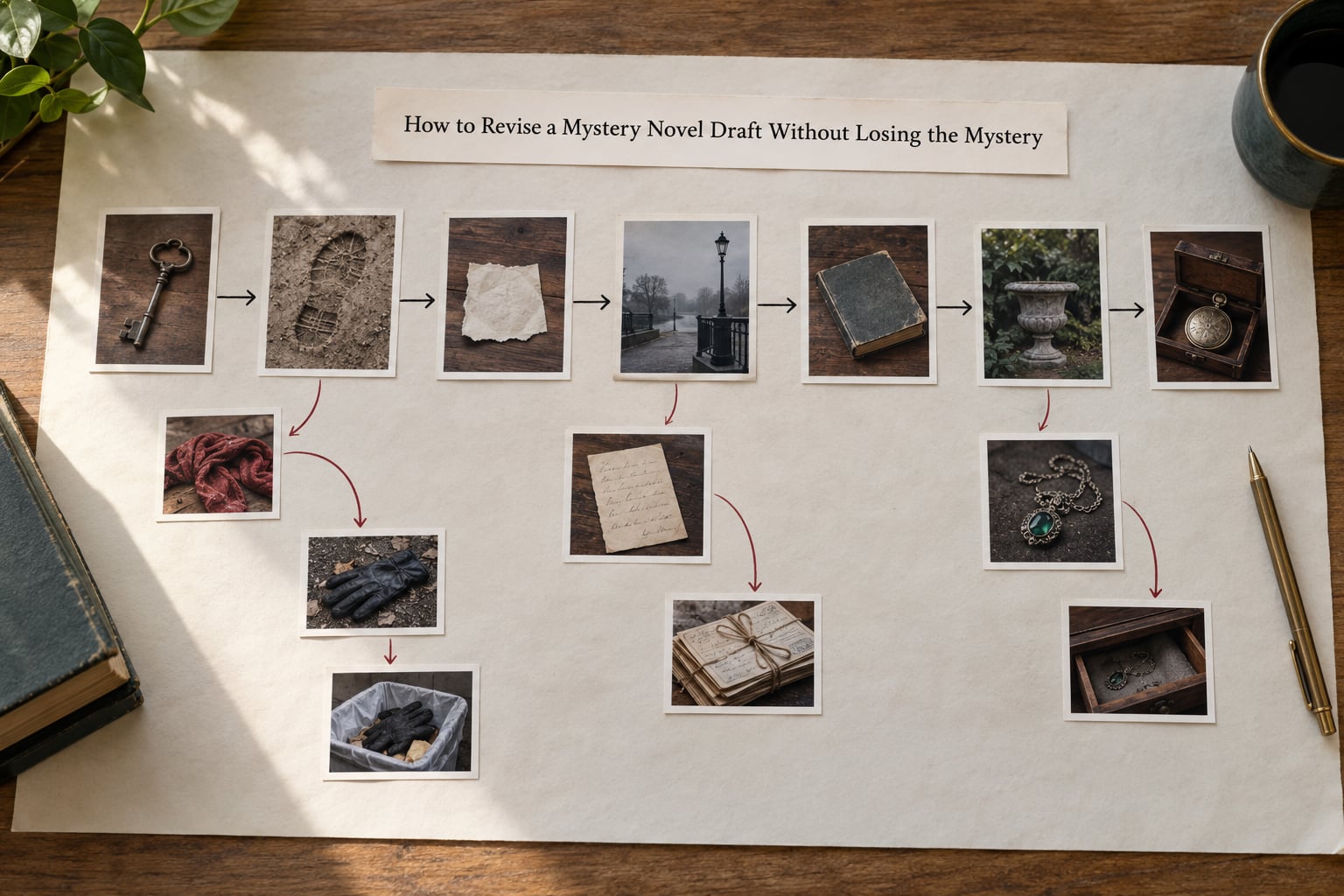
Run a reveal-order test instead. At each major turn, write four lines: what the reader knows, what they suspect, what they misunderstand, and what they could fairly infer from what they already have. The fourth line is the one that matters. If a reader could not have inferred the coming twist from the pages preceding it, the twist is arbitrary, and the fix is almost always a move rather than an addition.
Worked example: a draft where the reveal depends on a character having seen a distinctive car in a car park on the night in question. The scene carrying that detail sits on page 240; the reveal lands on page 265. Twenty-five pages is too long when the detail is incidental at the time. Moving the sighting to page 90, where the character dismisses it as unremarkable, keeps every word of the original reveal intact and turns an unfair surprise into an earned one.
The second test is the unreliable narrator. Unreliable narration is fair when the text gives signals a reader can pick up in retrospect: contradictions, gaps in memory, a detail noticed too precisely. It is unfair when the author simply lies. If your narrator’s unreliability is not planted at least twice before it pays off, that is a structural problem, and it belongs back at Pass 3 rather than in a line edit.
7. Revise the Prose for Clarity, Voice, and Genre Impact
Separate essential line edits from optional polish, or you will spend a month on the optional ones. Essential: unclear pronouns, repeated diction, adverbs that duplicate the verb, dialogue tags doing work the dialogue already did, exposition dumps, and any sentence a reader might need to read twice.
Exposition deserves particular attention in this genre. Mystery readers have been trained to accept facts arriving in packages, so a character briefing the protagonist on coroner procedure gets a pass most prose would not. Convert it into discovery: let the information arrive because someone is looking for it, and let something go slightly wrong while they look.
Then protect the voice. Noir, cold case and cozy mystery have distinct registers, and revision is where they get sanded into a generic middle. Read a paragraph of your book aloud, then read a paragraph of the genre you are actually writing, and notice what the second one does with rhythm and sentence length that yours has stopped doing. Keep the strongest version of every scene rather than averaging it toward the middle of the book.
8. Run Independent Read-Throughs and Final Proofing
Three reads, three purposes. First, a fresh-eyes read at speed, noticing only where your attention wanders. Second, a mystery-logic audit against your clue ledger, checking that names, times, locations and alibi arithmetic hold across 80,000 words. Third, a synopsis test — hand someone your scene map with no opinion attached and ask them to describe your book back to you.
Independent readers matter most, and two to four is a workable number. Mix in-genre readers with one out-of-genre reader: the genre reader checks whether the puzzle works, the outsider checks whether it can be followed at all. Brief them with questions rather than “what did you think.” Ask when they suspected the killer, which clue they found first, where they got bored, and which character they cared least about.
Triage what comes back. Majority rules on anything structural. Ignore praise, because praise is not a note you can act on, and one reader loving a character you were unsure about is real information. Separate pet peeves from craft notes by asking whether the comment would apply to any book, in which case it is taste. And never accept feedback that arrives as a rewrite request; keep your instinct about your own book and use the notes to check it.
Copyediting and proofreading come last, on a manuscript that is otherwise finished. Grammar errors in a scene you are about to cut are wasted effort, and this is the stage where a hired proofreader earns their fee cheaply.
Common Mistakes
Editing sentence by sentence first. This is the default failure, and it is why so many drafts feel stuck. The fix is a rule: no line edits until the structure pass is done and written down.
Changing the story without naming the problem. Cutting a chapter to see what happens feels like progress but produces a different book with the same flaw. Write the problem down first, in one sentence, and only then decide what to do about it.
Adding clues as a cure-all. If the solution does not land, more clues rarely fix it. Usually the issue is a missing motive or an alibi that does not hold up, and adding detail only makes the book longer and busier.
Forcing an unreliable narrator without signals. Readers forgive a lot. They do not forgive being lied to. Plant at least two retrospective signals before the payoff, or switch to a straightforward narrator and find your tension elsewhere.
Rewriting every scene that feels imperfect. A draft has imperfect scenes. So does every published novel. Keep a few rough edges; a book where nothing glistens has no texture.
Ignoring how the solution feels. The logic can be airtight and the ending still land flat, because the reader wanted a particular outcome and did not get it. Decide whether you are writing justice or revenge, and make the ending deliver one of them deliberately.
Revision Tips for Mystery Writers
- Keep a change log. One line per cut, move or addition, with the reason. When the temptation to restore a scene arrives in week six, the log is your referee.
- Read everything aloud. Dialogue problems, repetitive phrasing and missing beats in a sequence all become obvious when you hear them, and mystery readers notice pacing long before they can articulate why.
- Test from the reader’s chair. After each chapter, stop and write down what a reader now knows and suspects. Do this at ten intervals and you will find your clue timing problems before the reveal.
- Track the timeline separately. A dated chronology of the crime, kept apart from the manuscript, catches the errors that prose hides — mostly around times of death and alibis.
- Preserve the strongest version of each scene. When you rewrite something that almost worked, keep a copy of the near-miss. The best line in your book is often in the version you replaced.
- Schedule a cooling-off period before the final read. Two weeks is enough to make the last read genuinely fresh, and it is the cheapest quality gain available to you.
Frequently Asked Questions
How long should I wait before revising my first draft?
At least one month, and six weeks is better. The gap is not about forgetting the plot, which you will remember perfectly. It is about losing the emotional attachment to sentences you wrote at midnight, so you can read them as a stranger would. If you have already revised several times, take the longer rest and use the time to write a scene map instead, since a map built from a distance exposes structural problems that repeated reading has stopped registering.
How do I know if my mystery clues are fair?
Four checks. Is the clue visible to the reader before the reveal, in a form they could recognise? Could an attentive reader connect it without wild guessing? Did it arrive early enough to be useful? And was it overlooked for a believable reason rather than because you buried it? Build a clue ledger with one row per planted detail and walk each row through those four questions. If a clue fails the visibility check, move it earlier and let a character dismiss it.
How do I fix red herrings that feel like cheating?
Trace each false trail back to its source. A fair red herring grows from a character’s genuine suspicion, from evidence that points somewhere false for a reason the text supports, or from a lie the suspect tells for reasons that hold up under later scrutiny. A cheat red herring is one the author invented. When a trail has no source, either plant the source earlier in the book or remove the trail and its associated scenes entirely.
How many rounds of revision does a novel need?
Three full passes is a realistic minimum, and the number matters less than the sequence. First the structural pass on structure, then a full revision including character, clue logic and prose, then a copyedit and proofread on a manuscript you consider finished. Writers several drafts in often describe a fourth round that only exists to fix problems the third round introduced. If your revisions still feel unsatisfying at round three, the issue is usually the plan rather than the count.
Should I use beta readers or hire a developmental editor?
They solve different problems. Two to four beta readers are better at voice, pacing and whether they personally stayed engaged, and they cost nothing but your time. A developmental editor is better at structure, logic holes and the gap between what you meant and what you wrote. Self-edit structurally first, then decide. A developmental editor working on a draft you have not yet diagnosed wastes your money, because you cannot tell whether their notes were useful or simply stylistic preference.
How do I cut a mystery draft that is too long without breaking the solution?
Cut in a defined order: stalled scenes first, repeated information second, redundant characters and subplots third, individual repeated words last. After every round of cuts, re-run the clue and suspect checks. Cutting scenes routinely strips the culprit of opportunity or a suspect of motive, which is exactly how a trimmed draft ends up with an ending that makes no sense. Length is a symptom of pacing, so a draft that is too long usually needs fewer scenes rather than shorter ones.
Start With One Diagnostic Pass
Do one thing this week: move the manuscript to a folder you are not working in, set a date four to six weeks out, and write down the single biggest reader-facing problem in one sentence. Then start with the pass that problem belongs to — structure for a plot that does not add up, the clue audit for a reveal that lands flat, suspect validity for an ending that makes no sense.
That is how to revise a mystery novel draft. Diagnose before fixing, run the passes in order, and keep the fair-play promises you made to your reader at every stage.