Learning how to use a journal or found document in a mystery comes down to a single decision: what truth that document must prove. Give it one job, plant fair clues in its pages, and make every silence as deliberate as every sentence, and the artifact stops being an exposition dump and starts doing detective work for you.
A found document is a story told through an artifact someone discovered and assembled — a journal, a bundle of letters, a police file, a court transcript, a run of text messages — wrapped in a short frame explaining who found it and why. The frame is what lets the document stay honest without vouching for it.
The device works because it hands the reader evidence instead of narration. Wilkie Collins’s The Moonstone (1868) is still the cleanest demonstration: the reader receives a stack of differently-angled accounts and has to assemble the truth the same way the detective does. The trouble starts when a document is asked to carry too much, or when its author withholds things a first-person writer would obviously have written down.
Below is the process I use, in the order I use it.
Table of Contents
- What You Need
- Step-by-Step: How to Use a Journal or Found Document in a Mystery
- Step 1: Decide What the Journal or Found Document Reveals
- Step 2: Choose Who Wrote or Found It
- Step 3: Build Fair Clues Into the Pages
- Step 4: Use Silence, Contradiction and Omission
- Step 5: Connect the Document to the Crime
- Step 6: Reveal It in the Right Sequence
- Common Mistakes
- Frequently Asked Questions
- What is a found document in fiction?
- Is a found document novel the same as an epistolary novel?
- How do you make a diary entry believable?
- How do I use a journal or found document in a mystery without it becoming an exposition dump?
- How do you end a novel told through documents?
- How much of a mystery can be told through documents before readers lose interest?
- Conclusion
What You Need
Before drafting a single entry, settle these seven things. Each one changes how you write every line that follows.
- Its source. Where did it come from, and why does it exist in the present tense of your story?
- Its intended reader. A diary written for nobody reads differently from a letter written to one specific person who will remember it.
- Point of view. Whose eyes produce these words, and what can that person physically see, hear, or misunderstand?
- Reliability. Honest, frightened, lying, or simply mistaken? Decide this now, because you will need to plant the signals later.
- Connection to the mystery. Which suspect, which timeline, or which unanswered question does it touch?
- The single truth it must reveal. One. If it could give away two things, it will muddle both.
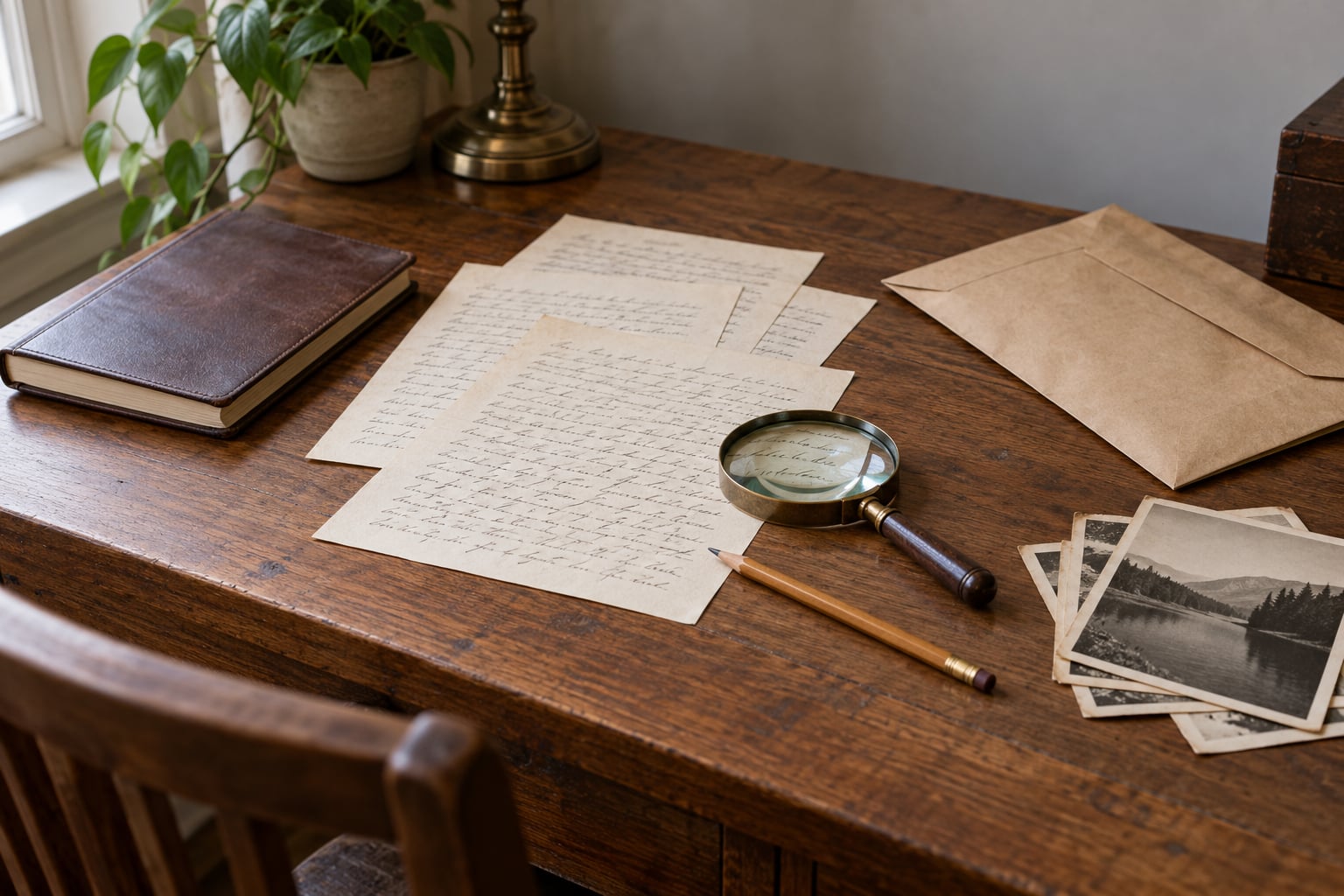
- Its physical condition. Length, medium, handwriting, and damage: torn pages, redactions, water marks, missing dates.
The physical condition deserves more attention than writers usually give it. A gap in a journal is only interesting if it looks like a gap, and a crossed-out line only works if the page shows the crossing-out. If you have not decided what the artifact physically looks like, you cannot write the entry inside it.
Step-by-Step: How to Use a Journal or Found Document in a Mystery
Step 1: Decide What the Journal or Found Document Reveals
Give the document exactly one primary function. It introduces a clue. It exposes a motive. It fixes a timeline. It reveals a history nobody else knows. Or it disguises the true order of events so the reader initially reads the past backwards.
Choosing early matters because it decides what you leave out. If the document’s job is to establish a timeline, then a page that solves the crime is a page you do not write, however tempting it feels.
The safeguard against a document that solves your mystery by itself is simple: the artifact knows something, but it cannot see everything. A journal records what its writer noticed. A police file records what a witness admitted. A letter records what one person wanted another to believe. None of those is the truth itself, and the reader should be able to feel that gap without yet being able to name it.
Step 2: Choose Who Wrote or Found It
Two people matter here: whoever produced the words, and whoever discovered them. The finder is your framing device, and the finder is where your credibility comes from.
A retired detective cleaning out a deceased relative’s attic brings sympathetic weight. A law firm cataloguing an estate brings procedural weight. A teenager who found the notebook on a bus and is posting the entries online brings immediate danger and immediate risk of the wrong person reading them first. Bram Stoker understood this in Dracula (1897), where the documents are repeatedly handled, argued over and criticised by the characters who receive them, so the reader never has to take them on faith.
Then shape the writer’s reason for keeping the record. Guilt produces careful self-justification. Fear produces omissions and false starts. A writer who believed they would be believed produces long explanatory passages that a more guarded person would never commit to paper. That last one is worth studying, because over-explaining is the most recognisable mark of an unreliable narrator and it reads as authentic.
Step 3: Build Fair Clues Into the Pages
A fair clue is an observable detail: a date, a name, a place, a routine, a nickname the writer uses without explaining it. It is not a mood, an atmosphere, or a paragraph of ominous weather.
Separate your clues from your texture by asking a blunt question. Could this detail appear unchanged in any chapter of the book? If yes, it is atmosphere. A clue is a detail that would be wrong if the reader understood it correctly.
One clue can travel through three formats without losing its power. In a diary it arrives as a line about a Wednesday errand that a reader takes for routine. In a police report it arrives as an interview answer that contradicts a witness statement. In a letter it arrives as a half-finished sentence about who else knew about the schedule. Same fact, three different vocabularies, three different places to hide it.
Write your clue list separately from the document itself. Then reread the finished entries against that list, and confirm that every clue the solution depends on is visible to a reader who is paying ordinary attention.
Step 4: Use Silence, Contradiction and Omission
The strongest thing in a found document is often the part that is not there. A missing page. A date written and then altered. A nickname nobody in the story explains. The same location named in four consecutive entries. An entry that flatly contradicts the official timeline.
Omission only counts when the reader can perceive the absence. If a page is missing, someone must find the loose thread in the binding. If a date is altered, the alteration must be visible in the document, not merely absent from it.
There is a second kind of silence worth using: the thing the writer would certainly have mentioned but did not. A bridegroom’s diary that never mentions his wife on the night she disappeared tells the reader more than a page of anxiety about her would. The omission is the evidence, and it is only fair if the surrounding entries establish that the subject would normally have been mentioned.
Step 5: Connect the Document to the Crime
Now wire the artifact into the central question. Four connections work reliably: it proves someone lied, it redirects suspicion toward the wrong person, it explains an action that otherwise made no sense, or it exposes a relationship nobody admitted to.
Pick one. A document that does all four reads as a machine built to rescue the plot, and readers spot that instantly.
Test the connection by asking what happens if the document never turns up. If the answer is that the mystery still solves itself in the same shape, the document is decorative and needs a job, or a smaller role than you planned.
Step 6: Reveal It in the Right Sequence
Plan three moments: when the reader first sees the document, when the detective understands what context it belongs to, and when its final meaning becomes clear.
Those three moments should not collapse into one. Showing the whole document in chapter four and explaining it in chapter twenty leaves the reader holding a completed puzzle they cannot yet solve. Staged excerpts, a partial entry, a document rediscovered under new circumstances, or a sentence the reader has already read turning out to mean something else — these keep the artifact live.
The hardest part is withholding inside a first-person account. A third-person narrator can simply decline to mention a fact; a diarist cannot, because diarists cannot resist mentioning things. The solution is physical: torn pages, redaction, water damage, a closing sentence that trails off, a document written by someone who was interrupted.
Common Mistakes
Using it as an exposition dump. The most common failure, and the reason some document-heavy novels get abandoned. Fix: every entry must change something — a suspicion, a plan, a relationship. If an entry only recaps what the reader knows, cut it.
Withholding things the writer would obviously have included. Readers forgive limited knowledge; they do not forgive author convenience. Fix: run the of-course-they-would-have-written-it test on every gap. If the absence is artificial, give it a material reason.
Hiding clues in generic prose. A moody paragraph about weather is not a clue. Fix: put the clue in a specific, quotable detail that would be wrong if understood correctly.
Contradictory dates. Document form magnifies timeline errors, because readers hold the dates in their head and compare them constantly. Fix: keep a chronology sheet beside the draft and reconcile every date against every entry before you revise.
An unreliable narrator with no signals. If the reveal depends on the narrator lying, the reader must have been given evidence of it. Fix: selective detail, self-corrections, a passage in a noticeably different mood, references to things no one else can confirm.
A document that exists only to be a plot device. Fix: give the artifact a life outside the case. Someone loved it, hid it, argued over it. Small human stakes around the object make the object land.
Telling and never showing. Writers on writing forums describe this as the it-makes-you-tell problem, and they are right: entries have no dialogue, no action, no scene. Fix: cap the run of document-form chapters and stage entries around the gaps, so something happened off-page that the reader wants to see.
Worrying the device is used up. Every fake-diary twist gets compared to Gone Girl (2012). Fix: move the device away from the reader’s expectation — a police file nobody asked for, a document that turns out to have been written by the wrong person, a set of pages whose finder is the suspect.
Frequently Asked Questions
What is a found document in fiction?
A found document is a story presented through an artifact someone discovered and assembled – a journal, a bundle of letters, a police file, a court transcript, a text thread – with a short outer frame explaining who found it and why. The frame lets the reader treat the artifact as evidence without treating it as truth, which is why the form suits mysteries.
Is a found document novel the same as an epistolary novel?
No, though writers and readers constantly merge the two. An epistolary novel is narrated through documents the author chose to publish, with a clear design behind the selection. A found document is framed as something uncovered by accident or circumstance, assembled afterwards from material the finder did not plan. The framing conceit is the difference, and it changes who seems responsible for what the reader is reading.
How do you make a diary entry believable?
Write to one reader, not to the audience. Real diarists explain, justify, repeat themselves, and return to the same worry three days running. Entries are uneven in length, and the important ones are often short and flat. Fix a physical habit for the writer – a clock, a weather report, a phrase they overuse – and let it recur so the voice stays consistent across pages.
How do I use a journal or found document in a mystery without it becoming an exposition dump?
Give it one job and cut everything that serves only the backstory. Each entry should change a suspicion, a plan, or a relationship; entries that merely recap what the reader already knows are the ones to delete. Anchor the artifact physically as well – torn pages, water damage, redactions – so gaps read as features of the object rather than convenient omissions by the writer.
How do you end a novel told through documents?
Close the frame, not just the file. The last document should be read by someone who now understands what the earlier ones meant, and it should hand the reader a final piece of evidence that recontextualises at least one earlier entry. Then show the finder closing the book. Dracula ends this way, with the assembled papers handed to a reader who can finally judge them.
How much of a mystery can be told through documents before readers lose interest?
Most readers will accept document form for a long stretch if something is changing inside it. The complaint writers hear is not length but flatness – consecutive dated entries with no escalation. Keep stretches of document form short, break them with a scene in another voice, and make sure each block of entries ends on a new question rather than a settled one.
Conclusion
The technique is not really about documents. It is about deciding what the reader is allowed to know, when, and in whose words. Start by naming the one truth your found document must reveal, then design at least one fair clue and one meaningful omission to serve it. Everything else in the artifact – the voice, the paper, the damage, the finder – exists to make that single job land.