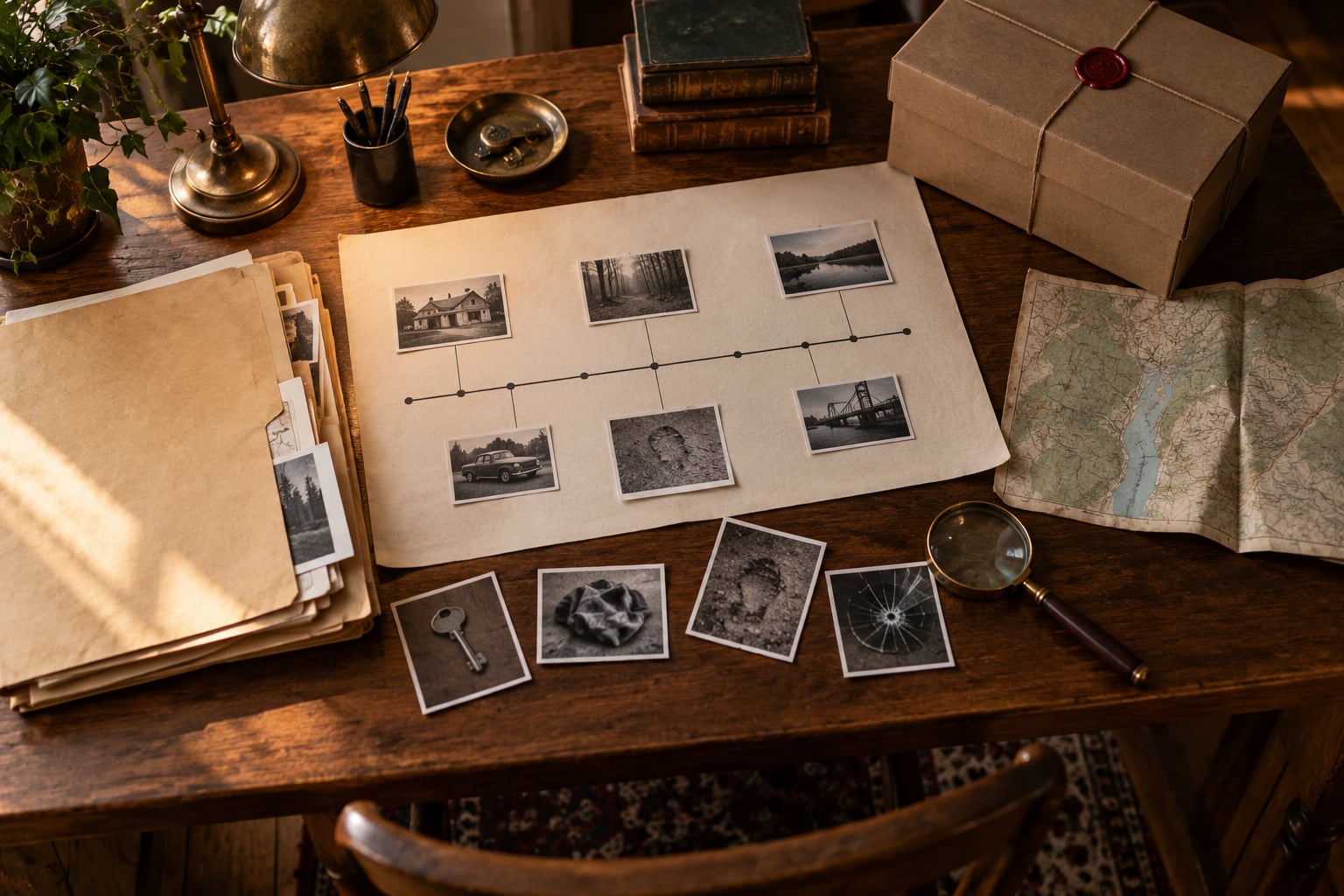
Learning how to write a cold case mystery comes down to one unglamorous habit: build the entire case on paper before you draft a single scene of the modern investigation. The crime happened years or decades ago, the first investigation failed, and the plot follows what a present-day team can prove using evidence and methods that did not exist the first time round. Budget two to four weeks of planning for a novel-length book — once the chronology, clue grid and private solution exist, the drafting goes fast.
The eight-stage process below is the order I use. Each stage produces a document you actually use later, not just notes to feel busy about: a case foundation, a timeline, a team sheet, a clue grid, a suspect chart, a knowledge chart, a crime chronology and a reveal sequence. Skip a stage and you will find the fix somewhere around chapter twenty.
Table of Contents
- What You Need
- Step-by-Step
- How to Write a Cold Case Mystery Foundation
- Choose the Right Point in the Timeline
- Build a Believable Investigation Team
- Plant Fair Clues Without Making the Solution Obvious
- Give Every Suspect a Plausible Motive
- Separate What the Characters Know
- Reconstruct the Night of the Crime
- Reveal the Solution in a Causally Fair Sequence
- Common Mistakes
- Solving it only at the end
- Evidence that behaves like magic
- Convenient access to old records
- Characters who all know the same things
- Motives that arrive with the twist
- A procedural with no pulse
- Breaking the reader’s trust with the private facts
- Frequently Asked Questions
- How realistic does a cold case mystery need to be?
- How do I plant clues without revealing the killer too early?
- Can I write a mystery based on a real unsolved case?
- How should I handle a story set years after the crime?
- How long should a cold case mystery novel be?
- Conclusion
What You Need
You need four written documents and a set of decisions before you write anything, and none of them are prose. If you start drafting prose first, you are writing a story around a mystery instead of building a mystery with a story in it.
- The private solution. Who did it, why, and which single physical fact proves it. Written for you alone, never for the reader.
- The crime chronology. Every movement, decision and accident between the last confirmed sighting and the moment the case broke.
- The evidence register. What was found, by whom, when, and what has happened to it since — degraded, lost, unlogged, mislabelled.
- The knowledge chart. For each major character: what they saw, what they were told, what they hid, what they misremember, and when.
- A gap decision. How many years between the crime and the present-day opening. Twenty-five years gives you weathered physical evidence and living suspects. Sixty gives you witnesses who are dead and a town that has rewritten itself.
- A modern trigger. The event that puts the case back on a desk: a body found, a name cleared by a DNA database, a witness dying, a child asking questions, a cold case unit review.
- Research notes on the era. What the 1990s investigators could not do, so the modern team has something to bring.
- A motive chart. One line per suspect: reason, means, opportunity, and the cover story they gave the first time.
You also need one decision most writers avoid: why the original investigation failed. Not that the killer was clever — that the detective who got it wrong was competent, working with limited methods, under time pressure, and made a reasonable error with the information available. That failure is the engine of your book.
Step-by-Step
Each of these eight stages ends with a finished document. Move to the next stage only when you could hand your document to another writer and have them understand the case.
How to Write a Cold Case Mystery Foundation
Start by defining five things on one page: what happened, what was known at the time, what stayed uncertain, why the case went cold, and what makes it active now. Then write your final answer privately, including the moment the perpetrator realised they had been seen.
Keep the original crime and the present-day question separate. The original question was usually “who did this”. The present-day question is sharper and more human: “whose body is this, and what happened to the person the first team decided was not a victim at all”. A case reopened because a misidentified body finally gets a name carries far more weight than one reopened by a lucky forensic breakthrough.
Test the foundation with one question: if the modern team got nothing, would the book still be worth reading? If the answer is no, you have a plot device, not a cold case.
Choose the Right Point in the Timeline
The opening point of the present day is a craft decision with hard limits, so pick it before you write and write down what the gap makes impossible. Map five blocks: the original incident, the first investigation, the major false leads, the years the case sat untouched, and the modern trigger.
Elapsed time is a pressure you can use rather than a problem to hide. Photographs fade and get mislabelled. Witness memory degrades in well-documented ways — confidence drops faster than accuracy, and confident witnesses are frequently wrong. Paperwork migrates between storage units. Suspects who were twenty-five become fifty-five, and their fear changes shape. Neighbours who protected someone in 1994 are now protecting a grandchild.
Take a rough guide. Fifteen years or less gives you phones, digital cameras and social media, so the original investigation was not blind. Twenty-five to forty years gives you the richest material: fibre evidence that still exists somewhere, a taped statement nobody re-read, a relative who was nine years old and is now a hairdresser. Beyond sixty, keep only what survives: human bones, land, buildings, tattoos someone described badly in 1961, and a few very stubborn people.
Write your gap into the plot, not into the setup. A thirty-year gap should cost the team something in every scene.
Build a Believable Investigation Team
A cold case team is small, tired and specific, so give each member a distinct reading of the old case rather than a personality trait. The detective who thinks the first team was incompetent, the analyst who thinks they got the right answer for the wrong reasons, the family liaison who has read every file four times.
Each character needs four things: a skill that earns their place, a limitation that creates friction, a reason the case is personal, and one thing they believe about the original investigation that turns out to be wrong. That last one is the engine of their arc.
Grant access through role. A detective can pull the original case file. A civilian cannot, and that obstacle should shape the first third of the book rather than being solved by a friendly phone call. Cold case units are also politically awkward by nature — they exist to prove the current investigation was wrong, which makes enemies inside the building.
Plant Fair Clues Without Making the Solution Obvious
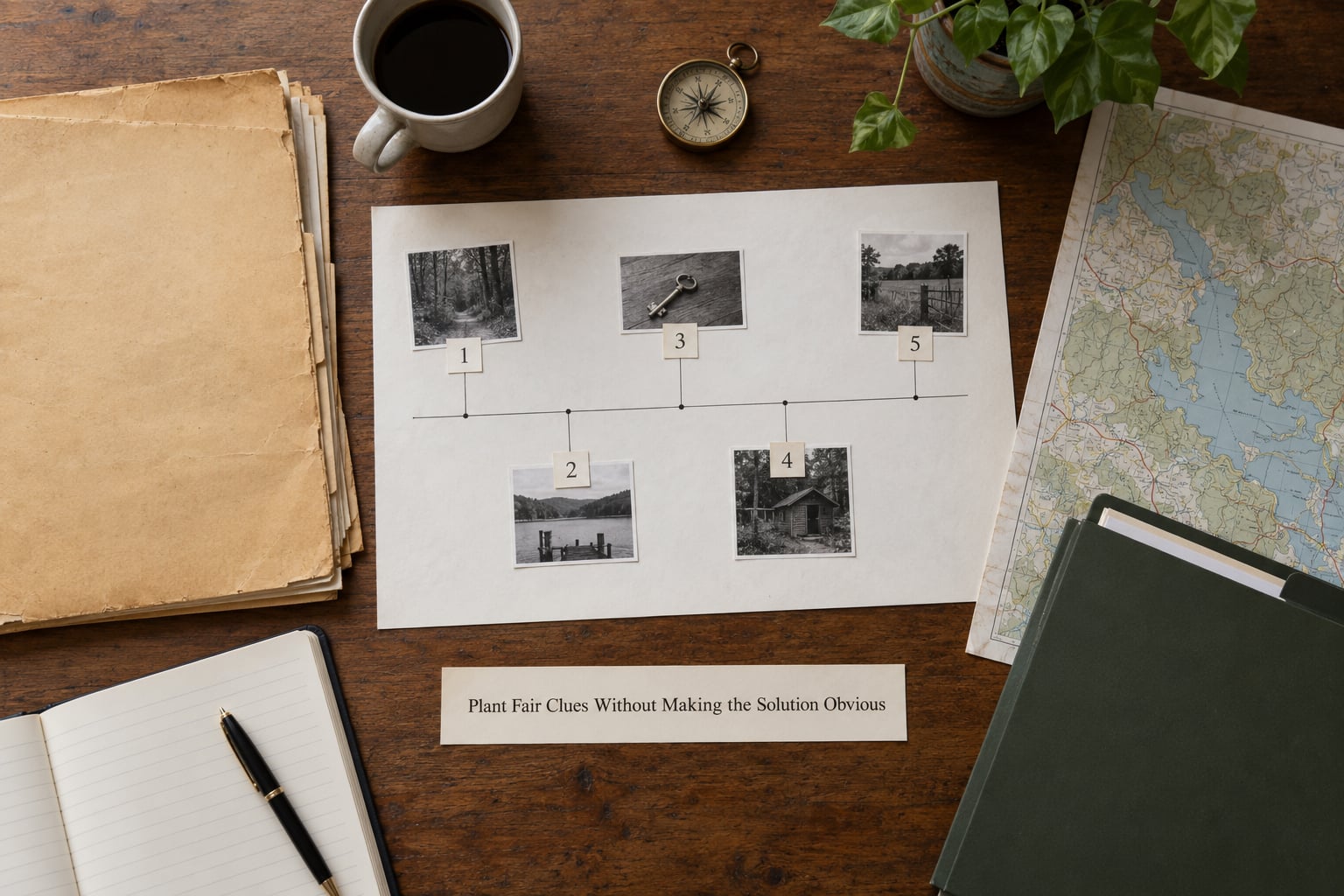
A fair clue is one the reader had, whether or not they noticed, and the fix for an obvious mystery is depth rather than concealment. Layer three or four clues into every major scene and let only one of them matter to the solution; the rest carry texture or misdirection.
Build the clue system from five sources: physical evidence, testimony, records, behavioural detail, and contradictions between two of those. Physical evidence decays, so give it a life story. Testimony is the most fragile and the most useful, because witnesses contradict themselves without anyone noticing. Records fail quietly — a date transcribed wrongly, a vehicle registered to someone else, a shift that ended twenty minutes earlier than the log says.
Separate your clues from your red herrings before you draft. A clue answers the question you end up asking. A herring answers a question you deliberately abandon, and it must be genuinely true, or alert readers will feel cheated.
Hide in plain sight. One detail among twenty ordinary ones disappears; a lone strange detail gets flagged immediately. Then test fairness the way working writers do: write the whole thing as a short story, give it to five readers who have not seen your outline, and ask who they suspected and on what page. Solve it too early and you add texture to the false suspects. Never solve it and add a second twist — that is a different book.
Give Every Suspect a Plausible Motive
Every suspect needs a motive, an opportunity, and a version of events that survives one hard question. Three is the working minimum for a cold case, because a cold case is about re-testing old assumptions rather than introducing new faces.
Give each suspect a different relationship to the crime: someone who benefited, someone who covered for someone else, someone the original team was certain about for the wrong reason, someone whose motive only became a motive once the modern team understood the victim’s life better. Then decide why each one was suspected, cleared, ignored, protected or assumed dead.
The most useful assumption is the one the original investigation made and never revisited — that the disappearance was voluntary, that the victim ran away from an unhappy marriage, that there was no body because there was no crime. An assumption like that is not a red herring. It is the locked door your book opens.
Separate What the Characters Know
Make a knowledge chart with one row per character and one column per fact, marking when each person learns it. This prevents the classic failure where a detective reacts to something they could not have known, or a witness volunteers a detail they had no way of seeing.
Give each character a second column of secrets, and put at least one damaging secret in it that is not about the crime. People hide ordinary things constantly, and those small concealments are what make a witness believable when the big lie finally surfaces.
Timeline discipline matters most during a dual structure, where a past scene and a present scene can sit two chapters apart. If you switch back to the old case and a character now knows something from the present-day investigation, the reader notices even if they cannot name the problem.
Reconstruct the Night of the Crime
Write the complete private chronology of the night as a continuous document: who was where, what they decided, what went wrong by accident, and what they did to cover it. Include the boring parts — the bus that was late, the door that stuck, the phone box out of order. Those details are what a modern team eventually reconstructs.
Then find the smallest decisive action. In most cold cases it is not the crime itself but something trivial nearby: a switch left on, a name mentioned aloud, a habit of locking a door a certain way, a route home somebody always took. Clue your proof to that action, not to the act of violence.
Decide what stays ambiguous. Two or three details should support more than one reading until the final chapters, so the reader can argue about the case in reviews.
Reveal the Solution in a Causally Fair Sequence
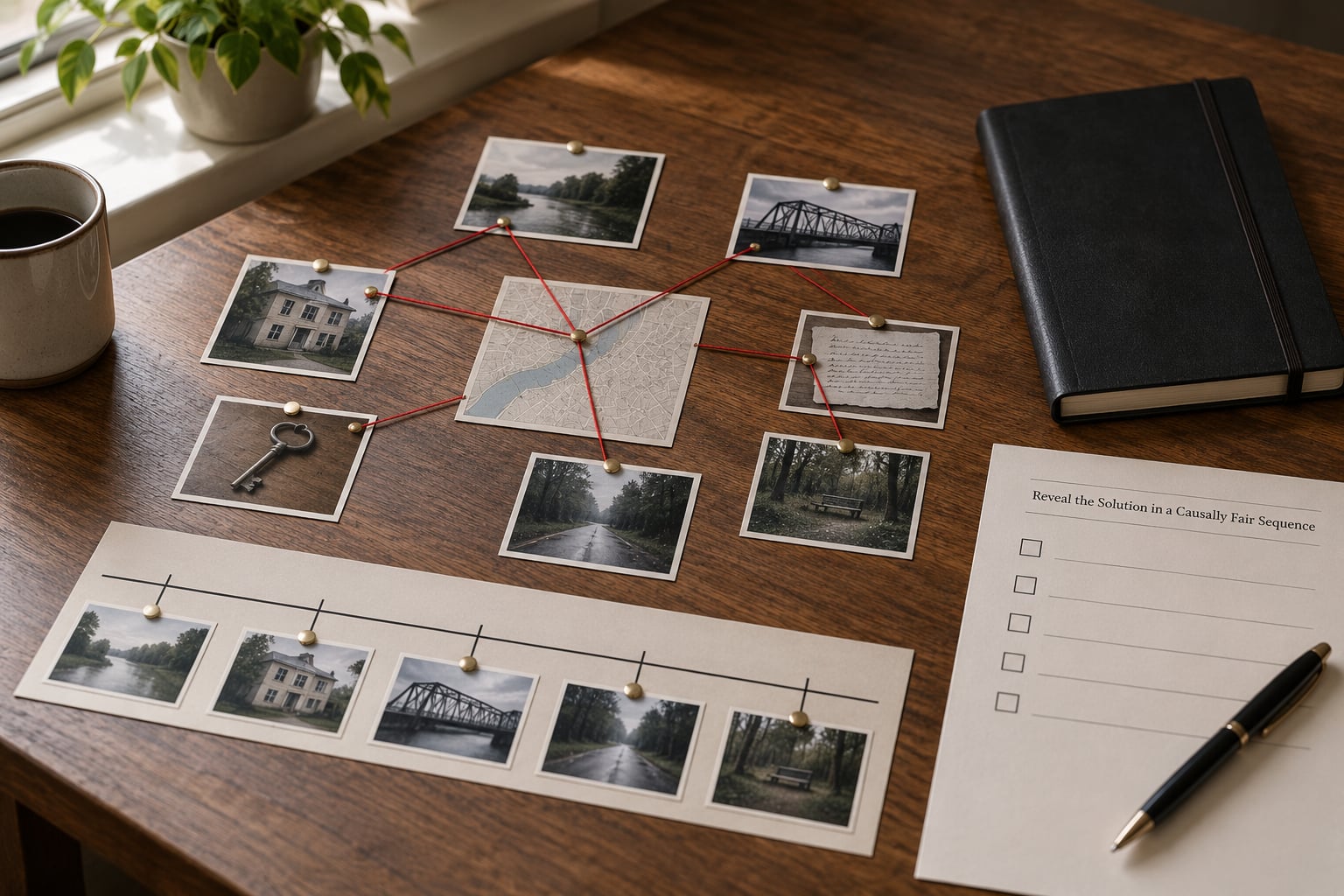
The final act should be a sequence of questions and discoveries, not a confession or a document found in an attic. Each major reveal should answer a question the reader already asked, using a clue the reader already had.
Work backwards from your solution and write the discovery chain: what question the team asks, what they do to answer it, what they find, and which earlier clue that finding activates. Aim for five to seven links. If one link requires a coincidence, replace it. Coincidence is the standard by which fair-play mysteries fail.
Make the old investigation part of the answer. The most satisfying cold case reveals not only who did it but why the first team could not have seen it — a method that did not exist, a record nobody thought to pull, an assumption the era made for them.
Then keep one turn after the facts land. The who is answered; the why, and what it costs the people who waited, should stay open into the final pages. Do not close on the arrest.
Common Mistakes
Most failed cold case mysteries share seven problems, and each has a specific fix.
Solving it only at the end
The mistake: the culprit appears in the last chapter and the reader learns nothing until then.
The fix: write three clue chains that converge on the answer. Before-and-after: instead of “she had always been suspicious”, show her returning to the same laundrette three times, and let the reader draw the wrong conclusion themselves.
Evidence that behaves like magic
The mistake: a lab returns a perfect result from a sample that would have degraded long ago.
The fix: track the physical life of each item. If something survived, say what preserved it — a sealed envelope, a dry climate, a lab that never processed the box.
Convenient access to old records
The mistake: a character pulls a thirty-year-old file in five minutes because the plot needs it.
The fix: name the obstacle. Stored offsite, archived in another county, digitised last month, held under a different case number because the victim was reclassified.
Characters who all know the same things
The mistake: everyone behaves as though fluent in every detail of the case.
The fix: use the knowledge chart and let characters be genuinely ignorant. A scene where one person realises something the others already said is a scene you can cut.
Motives that arrive with the twist
The mistake: a reason invented at the reveal that could not have existed earlier.
The fix: give the motive a physical trace in the past timeline — a letter, a debt, a habit, an insurance policy. If the reader cannot see the motive early, it is not a motive, it is a patch.
A procedural with no pulse
The mistake: chapter after chapter of procedure, and nobody in the book wants anything.
The fix: attach every procedural step to a person with a stake. A re-interview matters because of who is being asked and what it costs them, not because it advances the case.
Breaking the reader’s trust with the private facts
The mistake: a narrator reveals something they could not know in an aside nobody requested.
The fix: delete it. If the fact matters, it goes in the chronology where a character can learn it properly.
A practical revision routine: read the whole thing once without the outline beside you and mark every place you guessed. Read the past timeline alone and ask whether the original detectives were being unfair. Then read the clue grid and tick each item you actually planted — the ones you did not plant are the ones readers will call a cheat.
Frequently Asked Questions
How realistic does a cold case mystery need to be?
Realistic enough that a working investigator would not put the book down. Get the procedure broadly right — chain of custody, what a body can and cannot tell you, how an interview actually runs — and invent the rest. Readers forgive a fictional county; they do not forgive a detective who behaves like a private eye.
How do I plant clues without revealing the killer too early?
Layer several clues per scene so only one matters, and put the important detail inside a busy description rather than standing alone. Test it by writing the story as a short piece and asking five readers who they suspected and on what page. If they guess by the midpoint, add texture to the innocent suspects instead of hiding the real clue.
Can I write a mystery based on a real unsolved case?
Take the shape of a case, not the case itself. Real unsolved murders have living victims’ families who did not choose to be read about, and published theories can contaminate a genuine investigation. Change the location, the victim, the era, the geography and the solution, and check whether anyone alive is identifiable in what you wrote.
How should I handle a story set years after the crime?
Make time an active force rather than a backdrop. Records get misfiled, witnesses misremember with real confidence, suspects age into different people, and the town’s version of events hardens into fact. Alternate between the two eras by subject rather than by clock, so a present-day question triggers the past scene that answers it.
How long should a cold case mystery novel be?
Most sell between 70,000 and 90,000 words. The length is driven by how many past scenes you need and how much forensic detail you enjoy writing, not by how much research you collected. Keep the past timeline to what changes the present-day case, cut the rest, and let the old investigation grow through memory and file reviews rather than full scenes.
Conclusion
Knowing how to write a cold case mystery is mostly about doing the work before the drafting starts: a private solution, a full chronology, a clue grid and a knowledge chart, plus a clear reason the first investigation failed. Eight stages get you there, and each one leaves you with a document you will use again in revision.
Open a new page tonight and write a one-page timeline covering four things: the crime, the cold years, the modern trigger, and the answer you are keeping to yourself. Everything else in the book grows out of that page.