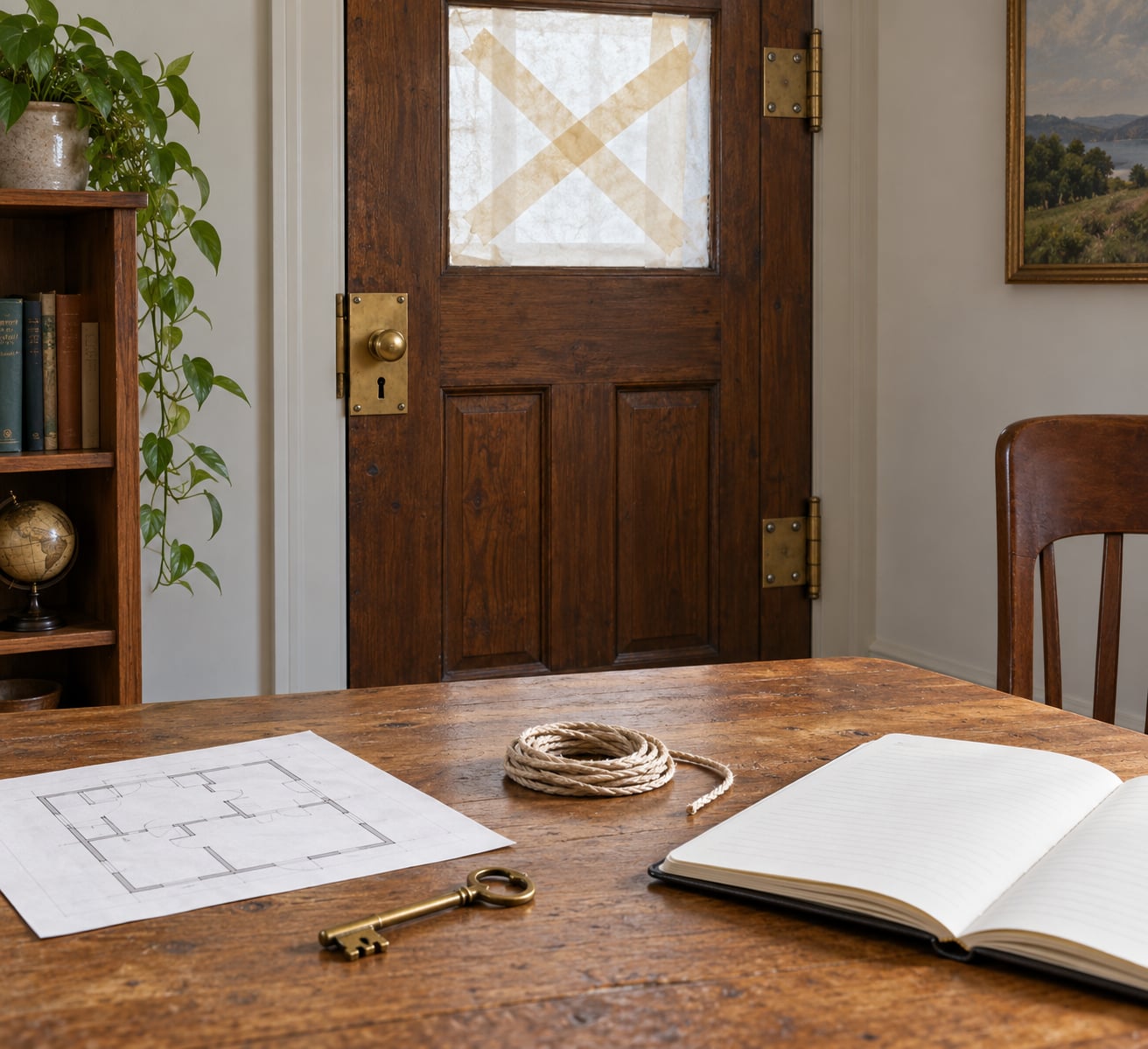
A locked-room mystery works when the solution is fully decided before the first sentence gets written. You choose the room, map every physical constraint, design the mechanism, plant the clues that prove it was possible, and only then draft the investigation. That backwards approach is the whole craft.
The format has carried a heavy burden since Edgar Allan Poe’s “Murders in the Rue Morgue” in 1841, and it is still the strictest test in crime fiction, because an impossible crime is only satisfying when the reader could have solved it. People on r/writing describe the alternative as driving at night in the fog: keep the doors locked, set markers at the roadside, and wait for the light. Planning is the marker.
Here is the full process, from a blank page to a reveal that explains rather than announces.
Table of Contents
- What You Need to Write a Locked Room Mystery
- How to Write a Locked Room Mystery Step by Step
- 1. Choose What Makes the Room Locked
- 2. Decide the Crime or Disappearance
- 3. Build a Credible Mechanism
- 4. Give Every Suspect a Motive and Opportunity
- 5. Plant the Clues in the Right Order
- 6. Let the Investigator Misread the Evidence
- 7. Reveal the Solution and Test the Fairness of Your Locked-Room Mystery
- Common Mistakes in Locked-Room Fiction
- Frequently Asked Questions
- What are the key elements of a locked room mystery?
- How many clues do I need to make the puzzle fair?
- Does the room have to be physically impossible?
- How long should a locked room mystery be?
- Can a locked room mystery work as a short story?
- What is the difference between a locked room mystery and a closed circle mystery?
- Conclusion
What You Need to Write a Locked Room Mystery
You need six things nailed down before drafting, and none of them is prose. A locked-room mystery is a crime committed in a space sealed from the inside, later explained by a rational solution, so every planning material serves that definition.
First, get the vocabulary straight, because beginners routinely build a closed circle and label it a locked room.
| Term | What it means | Typical example |
|---|---|---|
| Locked-room mystery | A crime in a space physically sealed from the inside, with no way in or out | A study locked from within, windows painted shut, a body on the floor |
| Impossible crime | The wider category, also called the miracle problem, where the evidence seems to break the rules of cause and effect | A murder that appears to have happened in a moving car with the doors closed |
| Closed circle | A suspect list with no outside access, but no physical sealing required | Eight guests stranded at a country house, all with motives, none able to leave |
| Fair play | The contract that every clue needed for the solution appears in the text, in time for the reader | Any solution a careful reader can reconstruct without guessing author intent |
Here is your working kit.
- A floor plan. Draw the room before you write a word about it. Mark doors, windows, locks, hinges, vents, drains, skirting boards, and the exact position of the key at every moment of the story. The Quora question writers keep asking, how much world-building is really needed, has a blunt answer: this much.
- The event. A death, a disappearance, a wound, or a body that was never in the room at all. Decide which before you decide anything else.
- A constraint list. Every physical fact the reader will hold against you: the bolt type, the state of the windows, the heating, the soundproofing, the time of year.
- A suspect set with motives. Four to six people, each with a different reason to want the outcome, each with a plausible route to the room.
- One mechanism. The physical trick that resolves the impossibility. One. Layering two usually reads as hedging.
- A clue ledger. A running list of every clue, what the reader will assume about it, and where the reveal pays it off.
Mechanisms fall into four families, and every one of them can be traced back to John Dickson Carr, Agatha Christie, or Ellery Queen, who worked these variations for three decades. The vocabulary is worth borrowing because readers already know it.
| Family | How it works | What the reader notices instead |
|---|---|---|
| Physical trick | Something in the room does the work: a cord, a hidden panel, a block of ice, a rigged chair | An odd object left behind that seems irrelevant |
| Timing trick | The event happened earlier than believed, or a recorded time misleads about when | A gap in the timeline nobody accounted for |
| Witness illusion | Someone heard, saw, or assumed something that was not actually there | Testimony that sounds confident and specific |
| Accomplice | A second person made the impossible possible, then left the circle | A small unexplained absence in someone’s account |
John Dickson Carr, Agatha Christie, and Ellery Queen all worked variations of these, and studying The Three Coffins is still the fastest education in a family of tricks.
How to Write a Locked Room Mystery Step by Step
1. Choose What Makes the Room Locked
Choose one specific physical fact that creates the mystery, and let everything else stay ordinary. A sealed room works because of a single stubborn detail, not because it is stuffed with puzzles.
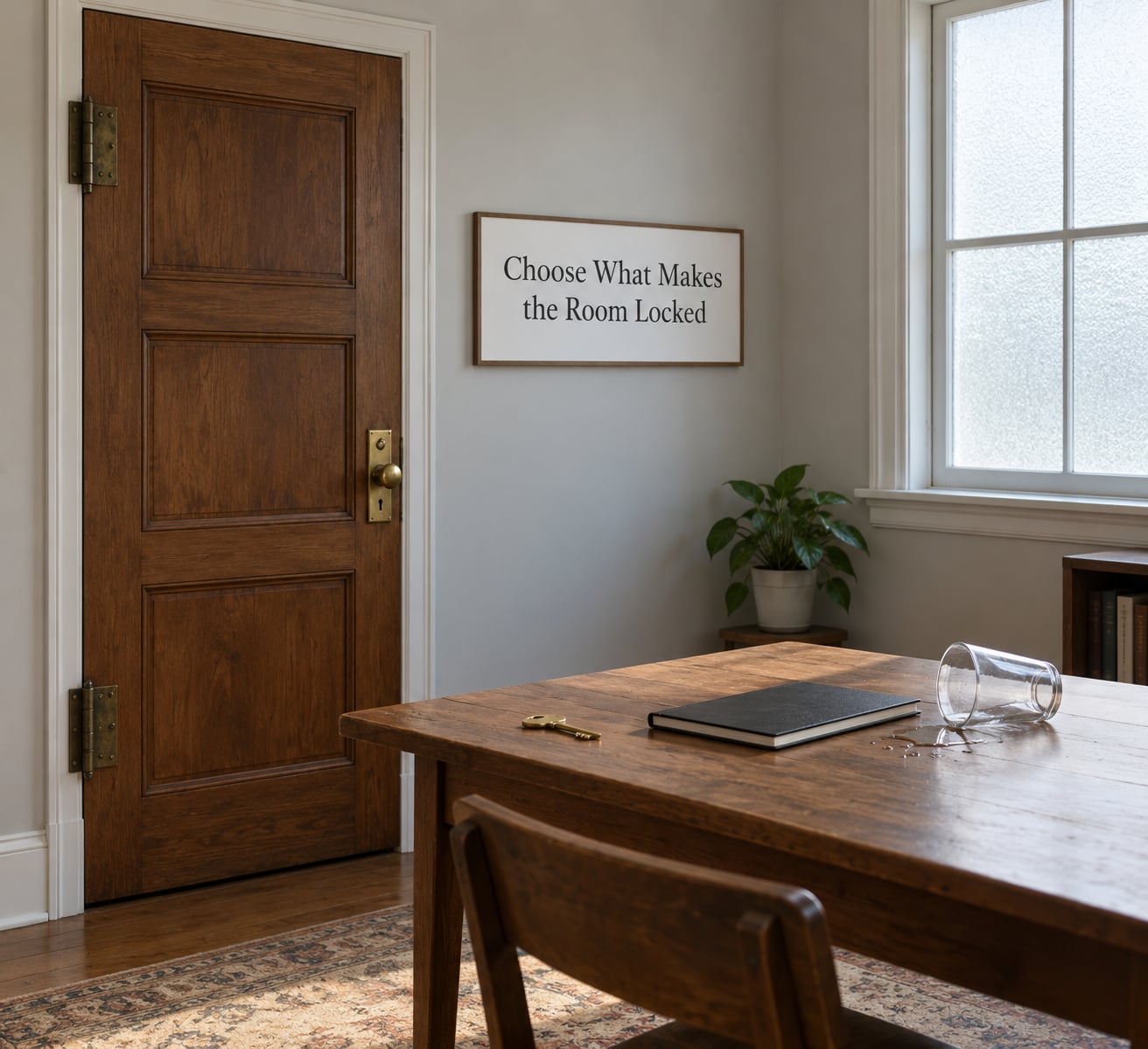
Decide which of three conditions you are writing. The room is sealed from the inside, so the culprit had to leave without opening it. The room is guarded from the outside, so someone got in without anyone seeing. Or the room is inaccessible by a route the reader never knew existed, a concealed passage, a dumbwaiter shaft, a ceiling hatch.
The third option is the most overused and the easiest to get wrong, since an unmentioned hatch is a cheat rather than a trick. If a passage exists, plant its evidence early and let the reader notice it only in retrospect.
You will know the choice worked when you can state the impossibility in one sentence. “The door was bolted from inside, the windows were sealed, and no one was near the building between nine and eleven.”
2. Decide the Crime or Disappearance
Decide what the protagonist is trying to explain, in one sentence, before you decide how it happened.
Is the victim dead, missing, wounded but alive, or believed to have escaped? Each gives a different book. A body in a sealed room forces you to explain the body. A disappearance forces you to explain the absence. A wounded survivor in a locked room forces you to explain both the wounding and the silence, which is often the richest option because the victim cannot be cross-examined.
Underneath the physical puzzle there is an emotional question, and finding it early keeps your suspects from sounding like a list of motives. Is it about a marriage, an inheritance, a friendship that ended badly? The room is the argument you are making about the world; the question decides what the room means.
Also fix the timing now. When was the room last open to a normal visitor? When was the body last seen alive by a reliable person? The gap between those two moments is the engine of the plot.
3. Build a Credible Mechanism
Build one mechanism that explains the crime, the disappearance, and the evidence using only materials that exist in the room, with no unexplained miracle anywhere in the chain.
Then test the sequence from two viewpoints. From the victim’s side, walk through every second between the moment they became helpless and the moment the door was found locked, and check that nothing requires a hand they could not use or a strength they did not have. From the investigator’s side, walk through the same span and list what they would have noticed, because each thing they would have noticed is a clue you must plant.
This step catches most of the timing errors that sink manuscripts. A mechanism that needs four uninterrupted minutes fails in a room with a thin wall and a passing train. A mechanism that needs the heating off fails if the boiler is serviced in October, which is a small boring detail that readers love catching.
You will know it worked when you can explain the mechanism out loud in under a minute using only household objects.
4. Give Every Suspect a Motive and Opportunity
Give every suspect a motive, a window of access, and one distinguishing fact, then distribute opportunity fairly across at least three of them.
Fair distribution means the reader cannot eliminate anyone on physical grounds alone. If only one person had a key, your puzzle is a lookup, not a mystery. The culprit should stand out for the combination of motive, method, and timing rather than for a capability the others lack.
Decide now what you withhold and what you misdirect. Withhold the mechanism, always. Misdirect the interpretation, meaning you show clues that support a wrong reading. Red herrings are not lies, so a red herring must be a true fact pushed toward a false conclusion, such as a boot print in the wrong place that genuinely points somewhere before the floor plan corrects it.
Three to five suspects is usually right for a novel. More than that and the reader stops tracking; fewer and the solution is a guess rather than a deduction.
5. Plant the Clues in the Right Order
Convert your solution map into clues, then sort every clue into one of four buckets before you place a single one.
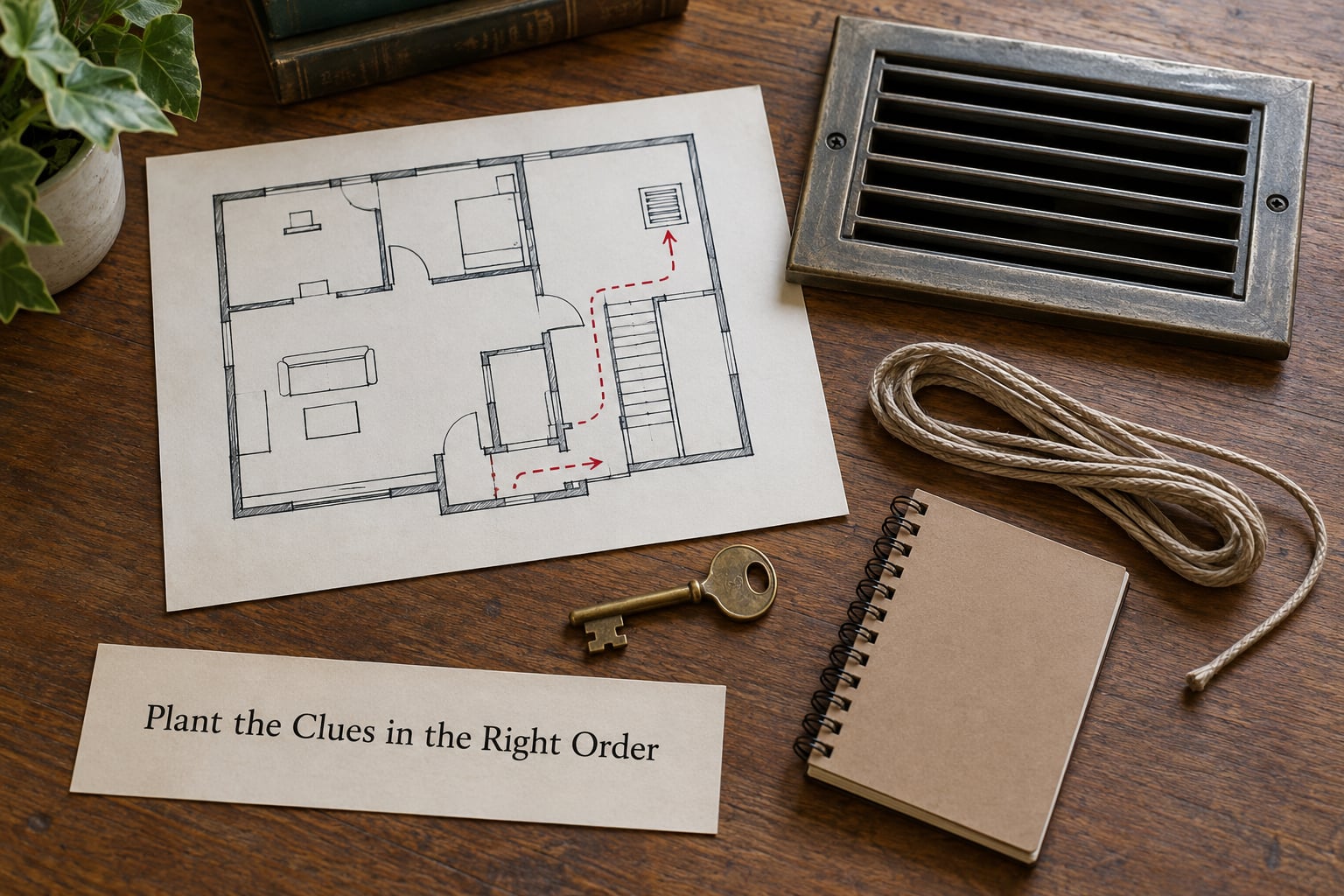
Essential clues are the minimum set that proves the solution. If the reader has these, they can solve the book, and you need no more than four or five. Red herrings push toward a wrong answer. Sensory details, a draft, a smell, a particular sound, carry atmosphere and quietly do clue work. Behavioral hints are moments where a character reacts wrongly rather than says something revealing.
Place decisive information early enough to be recognizable on rereading. A clue that lands in the final chapter is not a fair clue, no matter how legitimate it is, and this is the single most common complaint in writing forums. A good plant sits in plain view while the reader is looking elsewhere.
Run the plot on a clue ledger, and this is the one tool that turns a clever idea into a finished book.
| Clue | What the reader assumes | The truth | Planted | Paid off |
|---|---|---|---|---|
| Key found in the lock from outside | Someone unlocked the door and left | The key was returned to the lock from the far side | Chapter 4 | Reveal |
| Overturned glass, no spill | A struggle | Placed to hide a damp cord mark | Chapter 2 | Midpoint |
| No dust on the window sill | The window was not used | Confirms the room was never opened, narrowing the families | Chapter 3 | Reveal |
6. Let the Investigator Misread the Evidence
Build a wrong interpretation that is reasonable given what is visible, then let the solution overturn it without rewriting a single clue.
The best misinterpretations come from a gap in knowledge, not from an author’s omission. If your sleuth concludes the door was never opened because the dust on the sill is undisturbed, the reader accepts that reasoning because it is sound physics. The later reveal does not contradict the dust; it explains that the door was opened and closed by something the sleuth had ruled out.
Run your wrong theory through a plausibility test. Ask five questions: could a person physically do this, could they do it in the time available, would this tool leave the marks found, would the noise be audible where the witnesses were, and does the evidence still fit if the reader assumes the obvious explanation is false. If you cannot answer all five plainly, the trick is too clever, which is the word readers use when they feel cheated.
Aim for a mechanism a reader could not have deduced on their first read, but should feel they could have found on a careful one. Surprise and fairness are not opposites, and the best locked-room solutions manage both.
7. Reveal the Solution and Test the Fairness of Your Locked-Room Mystery
Stage the reveal as an explanation that returns to the clues, rather than a speech that announces a solution nobody saw coming.
The structure that works best is a short reconstruction. The detective restates the wrong theory, shows the single fact that breaks it, then walks the reader through the mechanism in the order the reader met the evidence, naming each clue as it comes up. Carr’s Dr. Gideon Fell lecture is the model: long, delighted, and entirely dependent on clues already delivered.
Then audit it before you revise anything else. Reconstruct the room yourself from your own manuscript, using only what a reader could have read, and check where the key is at each scene, where the door is bolted, what time it was, and what the weather was doing. Any fact the solution needs that the manuscript never states is a cheat, and it has to go in or the solution has to change.
Hand the draft to two readers who did not know the solution. Ask one question: could you have solved it from what was on the page? If they say no, and cannot say which line failed them, you have a fairness problem. Most of the time it is a clue buried too deep in a chapter, which is a fix rather than a rewrite.
Common Mistakes in Locked-Room Fiction
Most failed locked-room mysteries fail in the same seven ways, and every one of them has a practical fix.
The secret door nobody foreshadowed. A panel behind the bookcase is a deus ex machina if the bookcase is never mentioned before the reveal. Fix: plant the panel, the dust line, or the draught in chapter one, and let the reader disregard it.
Continuity drift on locks and keys. The manuscript has the door bolted in chapter two and unbolted in chapter nine, and nobody noticed. Fix: keep a running state log for every door, window, and key, the way a continuity editor would for a TV production.
Timing that does not add up. The mechanism needs six minutes in a corridor where a witness passes every four. Fix: build a timeline grid with the witness movements in one column and the mechanism in another, then cut the mechanism down to what fits.
The too-clever trick. The solution works on paper and would require a person to do something absurd in daylight. Fix: run the five-question plausibility test from step six and simplify until the answer is boring.
Characters who withhold information for no reason. A suspect refuses to explain a two-minute phone call that would clear her. Fix: give the silence a motive, such as shame, protection, or a contract, and state that motive on the page.
Clues that exist only on rereading. The decisive detail appears once, in passing, four hundred pages before the reveal. Fix: state it plainly, twice, in different registers, at least forty pages before the solution needs it.
A solution that rests on a new fact. The reveal introduces a second key nobody has seen, a phone call nobody heard, a relative nobody mentioned. Fix: introduce every element the solution needs before the midpoint.
On revision, read the whole book three ways. First, forward, marking only what the reader can know. Second, backward from your reveal, listing every fact it depends on and confirming each one is in the text. Third, with the floor plan beside you, tracking every state change of every physical object. If your solution survives all three passes, the book is tight.
One last practical note: the format is nearly two centuries old and writers still fear it feels worn out. A fresh angle usually comes from the location or the era rather than the trick, so a Victorian study has had a century of use while a locked-in server room, a hospital isolation suite, or a moving freight lift has not. Pick a room that produces a constraint you have never had to solve before, and the format stops feeling tired.
Frequently Asked Questions
What are the key elements of a locked room mystery?
Seven elements carry the format: a genuinely sealed space, a rational explanation, fair-play clues the reader can reconstruct, red herrings that mislead without lying, a short suspect list, a consistent floor plan, and a reveal that explains rather than announces. Miss any one of them and the puzzle stops feeling satisfying. The floor plan is the one beginners skip, and it is the one that causes the most trouble later.
How many clues do I need to make the puzzle fair?
Four or five essential clues. Those are the minimum set that proves your solution, and if a reader has only those, they can solve the book. Everything else is supporting texture, red herrings, or atmosphere. More clues are not fairer, because a crowded page makes the decisive detail harder to notice, not easier. Test the set by asking a reader who did not know the solution whether they could have solved it.
Does the room have to be physically impossible?
No. Many excellent locked-room stories only appear impossible because of a wrong assumption or a misleading time. What matters is that the reader believes no one could have entered or left, and that the eventual explanation shows the belief was mistaken. A door that is only guarded from outside still works, as does a room sealed from within by a mechanism the investigator dismisses too early.
How long should a locked room mystery be?
For a novel, 80,000 to 100,000 words gives you room for a full investigation and a substantial suspect list without padding. Shorter is workable when the suspect cast is small and the mechanism is simple. Length is not the constraint; the number of state changes in your floor plan is. If you are counting doors and keys instead of scenes, the plot is probably too complex for its own good.
Can a locked room mystery work as a short story?
Yes, but the clue budget is radically tighter. A short story can afford two essential clues and one red herring, and it needs a single location and a small cast. The advantage is that you can withhold the room’s full layout and pay it off in one clean final scene. The disadvantage is that you get no second chances, so the mechanism must be airtight before you write a word.
What is the difference between a locked room mystery and a closed circle mystery?
A locked room is defined by physical sealing: the space itself prevented entry or exit. A closed circle is defined by the suspect list: nobody in the group could have left or contacted anyone outside, but nothing is physically sealed. Closed circle stories are easier to write and far more numerous, which is why writers often build one and call it a locked room. The reader notices the difference immediately.
Conclusion
Start with one decision: name the specific physical fact that makes your room impossible, in a single sentence. Map the complete solution to that fact, pick the minimum set of four or five clues that proves it, plant them early, and let the investigator reach a reasonable wrong answer on the way. Everything else in how to write a locked room mystery is revision of details you can change in a sentence, except the mechanism, so get that right first.
Updated for 2026.