To interview an author well, you arrive having read the work, ask questions specific enough that the author cannot answer generically, and follow the answer rather than the script. That combination is what separates an interview a reader finishes from one they skim.
A good author interview takes two to five hours of preparation for twenty minutes of conversation. The conversation itself is the easy part. Most weak interviews fail before anyone presses record, and they fail in the same three ways: no reading, a long generic question list, and no attention to what actually happened.
Writers know the difference. On writing forums and author communities, the complaint about author interviews is almost never that there are not enough of them. It is that they are shallow, intrusive, or both. This guide covers the full process, from choosing an angle through to publishing, with the etiquette and ethics that make authors willing to answer a second time.
Table of Contents
- What You Need
- Step-by-Step
- Research the author and choose a distinct angle
- Build questions that invite stories
- Set expectations and confirm details
- Create a respectful interview structure
- Listen actively and follow the interesting thread
- Check quotations and verify the record
- Shape the final piece without flattening the voice
- Common Mistakes to Avoid in the Room
- Common Mistakes
- Frequently Asked Questions
- How many questions should I ask an author in an interview?
- How do I get an author to agree to be interviewed?
- Should I read the whole book before interviewing the author?
- Is an email interview acceptable?
- Do I need permission to quote an author?
- What should I do when an author gives a short or surprising answer?
- Conclusion
What You Need
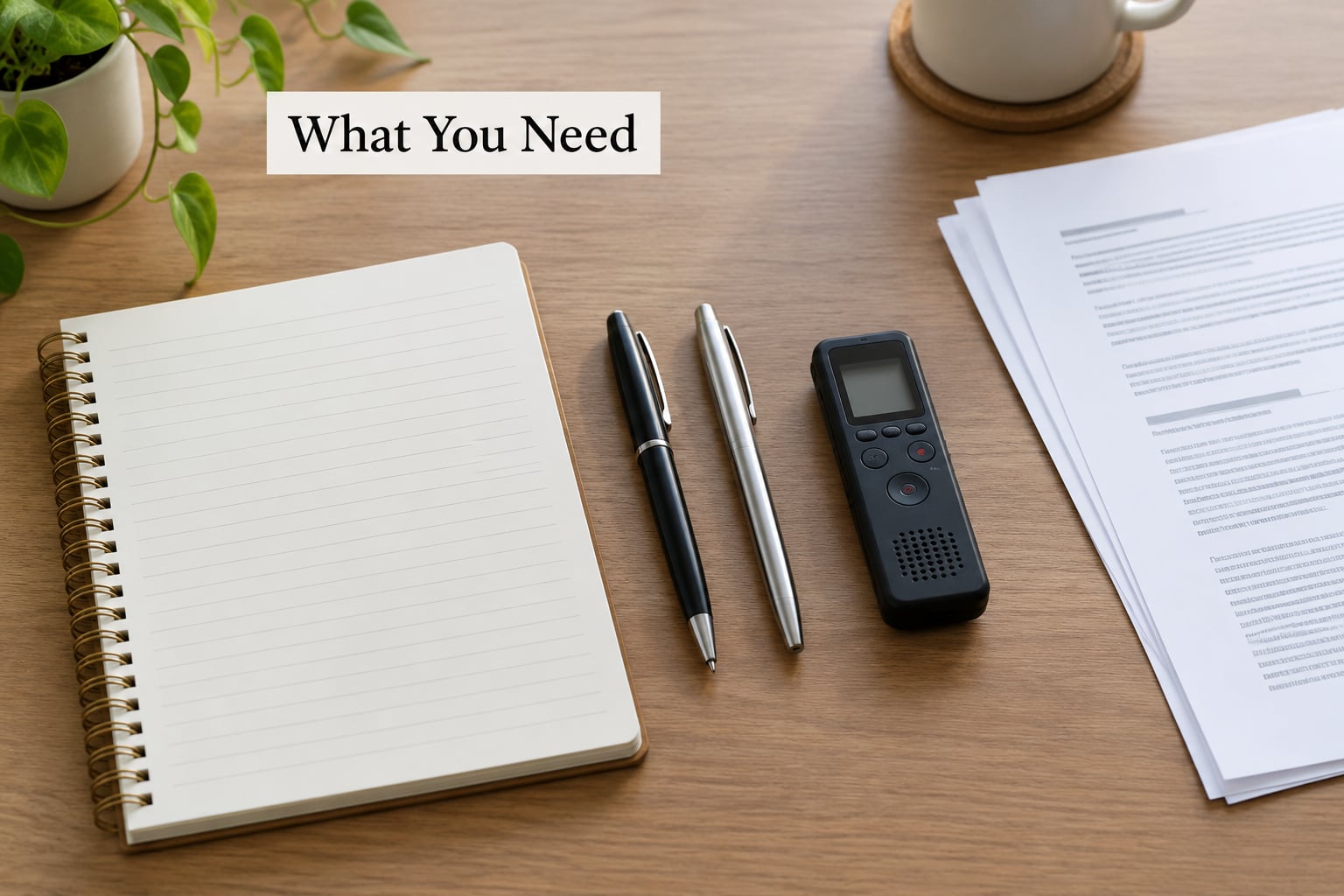
You need four things: a finished reading of at least part of the author’s work, a written angle, a way to record or capture answers, and a permission slip.
The work itself. Read it, not the jacket. Review pages on the author’s website, in interviews elsewhere, and in their newsletter archive so you know what has already been said. Every interview you pitch should carry one detail that proves you read something specific, a scene, a line of dialogue, a recurring image, a chapter that annoyed you. That detail is your opening question.
Prior interviews. Two or three, at minimum. You are looking for repeats. If three different outlets asked about the author’s difficult second book, that story is spent, and asking again produces the same paragraph everyone else has.
A recording setup. For voice, a recorder or a solid call connection with a backup local recording. For written exchanges, a document with your questions at the top and plenty of blank space below the author to type into.
Permissions in writing. Consent to record, consent to quote, the deadline for approval, and the length you need answers by. Authors who are asked for a favour without a stated scope will treat the request as a demand.
Before you make contact, check three things: whether the author has an agent or publicist who handles this, whether a publication date or embargo is in play, and how long the piece needs to be. Crime and noir writers in particular tend to have research stories worth waiting for, so a longer turnaround is easier to agree to than a thin piece is to publish.
Step-by-Step
Research the author and choose a distinct angle
Pick one thing you genuinely want to know and build everything around it. Research narrows to an angle; an angle narrows to questions.
Background research comes from interviews, lectures, podcast appearances, and the author’s own writing. Watch for contradictions between what an author said early in a career and what the new book argues. That gap is usually the most interesting thing you can ask about, and it is never a gotcha if you phrase it as curiosity.
The test for an angle: could you explain in one sentence why a reader who has not read the book would still care? “What is it like” fails. “How a detective who has stopped trusting the system handles a case that requires it” passes.
Build questions that invite stories
Strong questions are open, anchored to something real, and aimed at process rather than summary. Weak questions invite the answer already printed on the back cover.
A double-barreled question, one that stacks two asks into a single sentence, reliably produces a half-answer. “What was the book about and how long did it take?” gets you one sentence about a plot you could have read elsewhere. Ask one thing, then wait.
| Weak question | Stronger version | Why it works |
|---|---|---|
| Tell us about your new book. | What was happening in your head when you decided where the first chapter should end? | Asks for a decision, not a summary. |
| What inspired it? | Which case or scene made you pick up a notebook that week? | Points at a moment instead of an influence list. |
| What was it like to write? | What did your desk look like at six in the morning during the rough stretch? | Concrete detail produces concrete detail back. |
| How did you research it? | Who did you talk to that changed your mind about something? | Names a person, so the answer must be specific. |
| What are your influences? | Whose prose do you reread when your own sentences stop satisfying you? | Behaves like a reader, which is what authors enjoy. |
| What does the book mean to you? | Was there a scene you wrote for yourself that never made the final draft? | Invites a story with stakes, not a thesis. |
| Where do you see yourself in five years? | What are you drafting now, and what part of it still scares you? | Same format, far more useful answer. |
| Any advice for writers? | What did someone tell you early on that you ignored, and then learned the hard way? | Turns advice into a narrative. |
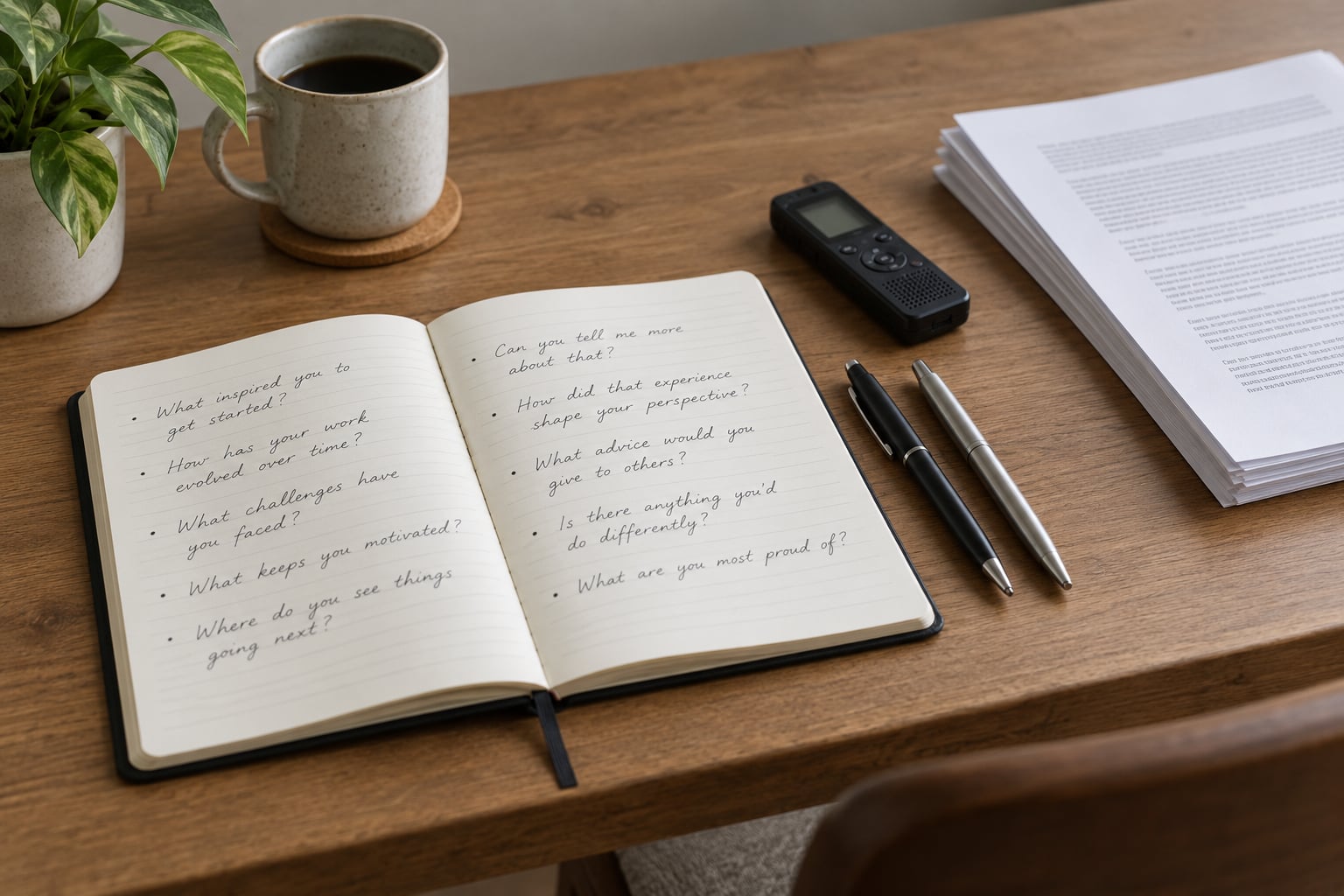
Write eight to fifteen questions. Fifteen is the ceiling for a written exchange, and five to eight is plenty for anything live. Then mark three as droppable, because something better will turn up mid-conversation and you will want the room for it.
Set expectations and confirm details
Confirmation prevents most of the friction that makes authors wary of writers. Send a short note covering format, length, recording, deadline, publication date, and how quotes will be handled. “Written answers of any length are fine, quotes will be checked with you, published the week of the 14th” removes four potential worries in one line.
State the recording permission before you start, not after. Ask whether anything is off limits, whether there is unpublished work you should avoid, and whether they would rather answer a sensitive question in writing.
A basic pitch is short: who you are, what you have read, the angle in one sentence, the format and length, the date you need it, and where it runs. Authors say yes to clarity far more often than to flattery.
Create a respectful interview structure
Three parts work for almost every length. Open with something easy that isn’t trivial, roughly five minutes that gets the conversation moving without spending your best material. Spend the middle on the core questions, in no particular order, letting the conversation move as it wants. Close with a forward-looking question and a genuine thank you.
Order matters less than you think. Asking your strongest question second is a waste; the second question of any interview is the one authors answer worst, because everyone starts with the warm-up.
Listen actively and follow the interesting thread
This is where interviews are won or lost, and where most hosts fail. Someone asks about the research and gets an answer about a specific interview with a detective in a county office, and instead of staying there, they move to the next question on the list.
Stay. Ask what made that conversation surprising, or whether the real procedure differed from what she had written. Then stop talking and let two seconds of silence sit. Authors consistently say the best lines arrive after a pause, because the pause is where the thought finishes forming, and filling it is how hosts talk over the real answer.
Paraphrasing works too. Summarise what you heard in one sentence and ask if you have it right. Corrections and elaborations in the reply are usually better material than the first answer.
Check quotations and verify the record
Send the draft, or at least every quotation, back to the author with a clear deadline, and say what you will do if you hear nothing. Silence is permission only if you said so in advance.
Verification is not censorship. Authors should not be able to remove an accurate answer that reads badly for them, but they absolutely should be able to fix a misquote, name a place wrongly, or supply the context that changes the meaning. Say that in your confirmation note and nobody has to wonder where the line is.
Two habits keep you honest. Never trim a sentence so it ends on a different word than the author chose, and keep the recording or transcript until the piece is published so you can check anything disputed later.
Shape the final piece without flattening the voice
Read the transcript and highlight every sentence worth quoting, then build the piece from those. Cut repetition, filler, and the throat-clearing at the start of an answer. Where a long answer contains three separate ideas, split it and use the best one as your pull quote.
Your narration and the author’s words should never blur. If you describe the room or add context, make it clearly yours. If it is the author, keep it in quotation marks and near-verbatim, fixing only grammar, not voice.
A short thank-you note after publication, with a link, costs you ninety seconds and is the reason authors give a second interview. You are building a relationship, not extracting a quote.
Common Mistakes to Avoid in the Room
Six failures account for most bad author interviews. The first is asking an author to summarise a book the interviewer has not read. The second is treating a sensitive subject, a death in the family, an illness, a difficult period in a career, as content, with no warning and no route out. The third is asking about sales figures, platform size, or follower counts, which writers consider gauche and which make the conversation smaller. The fourth is overquoting, so the author’s personality survives only in fragments. The fifth is interrupting to point out a nice phrase, which teaches the author to speak more carefully for the rest of the conversation. The sixth is asking an author to promote the book for the entire length of the interview, which turns a conversation into an advert and leaves you with a feature nobody wants to finish.
Common Mistakes
The in-room failures above have quieter counterparts across the rest of the process, and these are the ones that cost you the follow-up booking.
Sending a wall of questions. Twenty-two items reads as twenty-two minutes of someone else’s typing. Send ten, offer to build the rest around what they want to talk about.
Tight deadlines. A writer with a launch week is not available for your Tuesday deadline. Offer a date range and respect any embargo.
Asking what the author has already answered. Do the reading first. Repeating a question every outlet has asked produces the same stock paragraph, which readers will recognise.
Editing quotes for tidiness. Cutting a hedge, a repetition, or an awkward start can change what the author meant. Quote the sentence, not the summary of it.
Vanishing after publication. A link and a line about what worked in the interview costs nothing.
Three habits do most of the work. Read the work. Ask one question at a time. Follow the answer instead of the list. Everything above is a consequence of those three, or of ignoring them.
Frequently Asked Questions
How many questions should I ask an author in an interview?
For a 30-minute podcast or video, plan eight to ten prepared questions and expect to use six. For a written blog exchange, ten to fifteen works, since the author types at their own pace and you can trim later. For a five-minute social clip, three or four. Whatever the format, mark a third of your list as droppable so the conversation has room to breathe.
How do I get an author to agree to be interviewed?
Show that you read the book, give one specific detail that proves it, and state the scope clearly: format, length, recording, deadline and publication date. Authors decline requests that feel like demands because they come with no context and no time estimate. If the author has a publicist, email the publicist first and copy the author.
Should I read the whole book before interviewing the author?
At minimum, read enough to describe the story accurately and quote a scene or two. Finishing is better, because it stops you asking a question the book already answers. For a long or difficult read, skim the middle third carefully and read the opening and closing chapters closely. If you have not finished, say so when you pitch.
Is an email interview acceptable?
It is, and plenty of working writers prefer it. Written exchanges are the only realistic option when schedules collide, and they give the author thinking time that produces better answers. The trade-off is that follow-ups are weaker, so ask questions that work without a room to bounce them off. Offer a short call as an alternative rather than assuming the exchange is second best.
Do I need permission to quote an author?
Yes, and get it in writing before the interview. Ask whether you may record, whether you may quote directly, and whether the author wants to see quotations before publication. Set a response deadline and say in advance what silence means. Authors are usually relaxed about accuracy and sensitive about tone, so draw that line openly rather than guessing.
What should I do when an author gives a short or surprising answer?
Do not rescue them and do not abandon the thread. A short answer is often a door, so ask a gentle follow-up: what happened next, or who else was in the room. A surprising answer deserves two seconds of silence before you react, then a check that you understood it correctly. Write it down at once, because surprising answers rarely come twice.
Conclusion
Knowing how to interview an author well comes down to three habits applied at the right moments: read closely enough that your questions cannot be generic, prepare few enough that the conversation can breathe, and follow the answer rather than the list. Add consent, attribution and a thank-you note, and you have the process most hosts never bother to learn.
Start this week by reading two or three of the author’s works properly, writing down one research question you cannot answer from the jacket copy, and drafting six prepared questions with three flexible follow-ups attached. That is enough to book a first interview, and it is enough to make the second one easy to get.