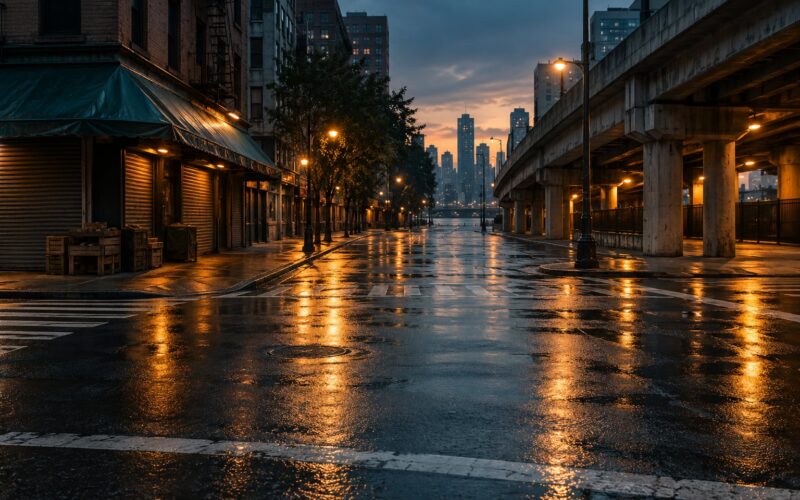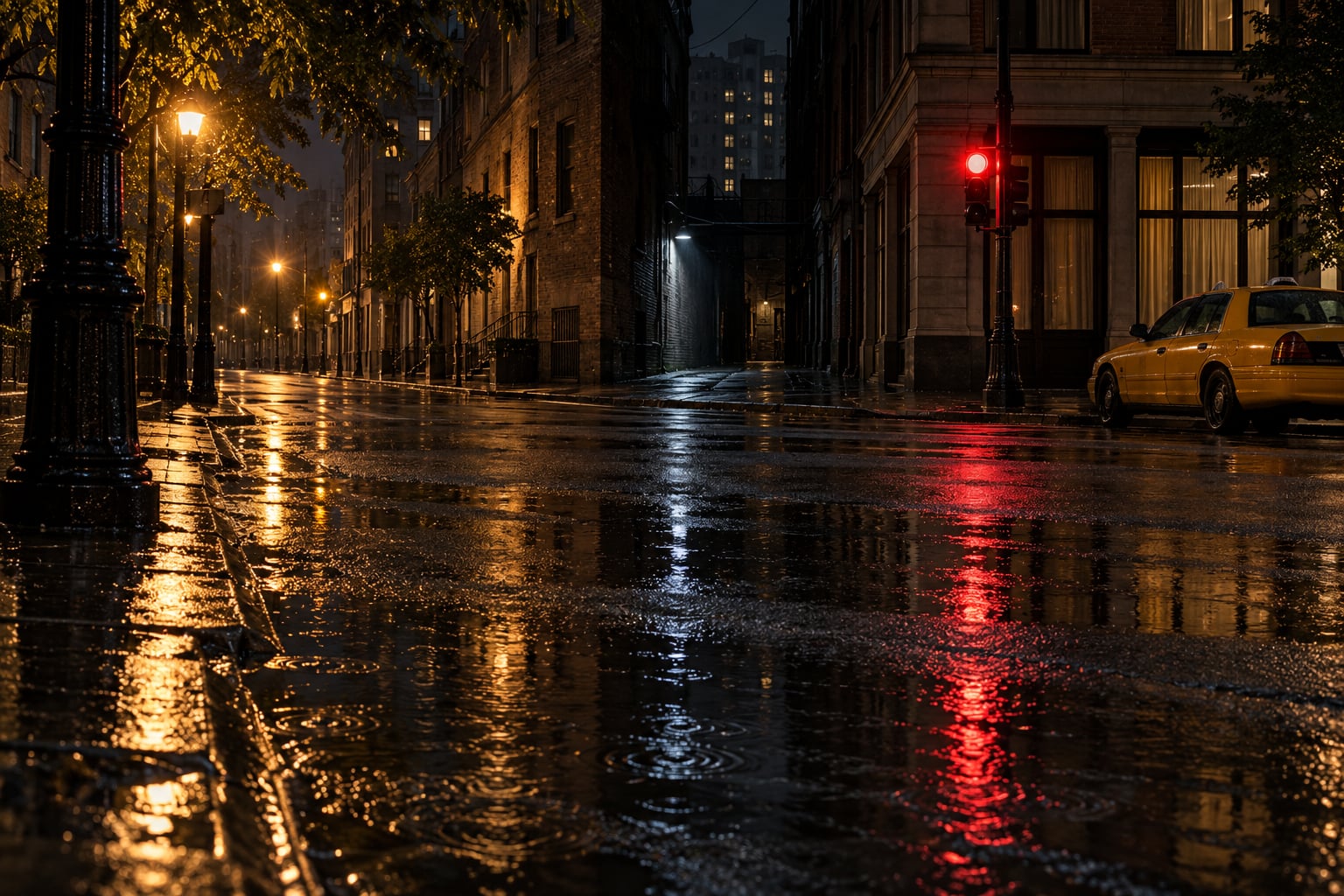
To use rain and night in crime fiction well, treat both as working parts of the plot rather than decoration. Rain changes what a scene sounds like, what the ground holds, and how a body moves through it. Night strips away ambient visibility so every detail has to be attached to a light source. Used together, they narrow a detective’s options, hide or distort evidence, and force characters into isolation, which is where noir tension comes from. This guide walks through the craft in six steps, then the mistakes that flatten it.
One warning before we start. Writers on r/writingfeedback keep posting rain-and-night openings asking whether the moody start actually works, and the honest answer is that mood on its own earns you nothing. The scene has to change because of the weather.
Table of Contents
- What You Need Before You Plan a Rain-and-Night Scene
- Step-by-Step: How to Use Rain and Night in Crime Fiction
- Choose the setting and time of night
- Use rain to alter the scene
- Make darkness useful
- Connect weather and night to the investigation
- Use sensory detail to build noir atmosphere, not a weather report
- Use rain and night in crime fiction without losing the reader in the dark
- Vary the effect across the story
- Matching the treatment to your sub-genre
- Common Mistakes When You Use Rain and Night in Crime Fiction
- Frequently Asked Questions
- Is rain always necessary for a noir crime scene?
- How can nighttime scenes remain readable without losing their darkness?
- What are common rain and night clichés in crime fiction?
- Should rain conceal evidence or reveal it in a mystery?
- How much should weather influence the plot of a crime story?
- Can a story open with the line u0022It was a dark and stormy nightu0022?
- Conclusion
What You Need Before You Plan a Rain-and-Night Scene
Before you write a word, settle six things. Skipping this is why most rainy scenes read as wallpaper: nothing in the scene was designed, so nothing in it matters.
- Setting. What kind of place is it, and what does that place usually look like at that hour? A city block with sodium streetlights behaves differently from a rural farm track with no lighting at all.
- Time. Pick a specific hour and stay in it. Two in the morning and eleven at night produce different crowds, different traffic, different noise.
- Light sources. List every source available: streetlamps, a torch beam, a phone screen, car headlights, a lit window, a shop sign. Your darkness is only as good as your lighting plan.
- Sound. What is audible at this spot? Traffic on a main road masks footsteps. An alley off a residential street amplifies them.
- Character knowledge. What does each person know that the others do not? Uneven knowledge creates unease faster than any weather description.
- Central tension. Know what the scene is trying to force a character to do. The weather should complicate that decision.
Setting as character means the place pushes back on the people in it. A flooded underpass, a car park with four working lamps out of nine, a stairwell with a broken sensor. Decide which, then let it interfere.
Step-by-Step: How to Use Rain and Night in Crime Fiction
Choose the setting and time of night
Start with the architecture, because buildings decide what a person can do in the dark. A blind corner, a lit stairwell, an alley with one working lamp, a flat roof one storey above the road. Each creates a different problem for whoever is crossing it.
Season and hour matter as much. A coastal town in November at three in the afternoon has failing light and horizontal rain. The same street at midnight is dark in a way the afternoon never was. If you want darkness to hide something, the reader needs to feel the hour was chosen for that purpose.
Use rain to alter the scene
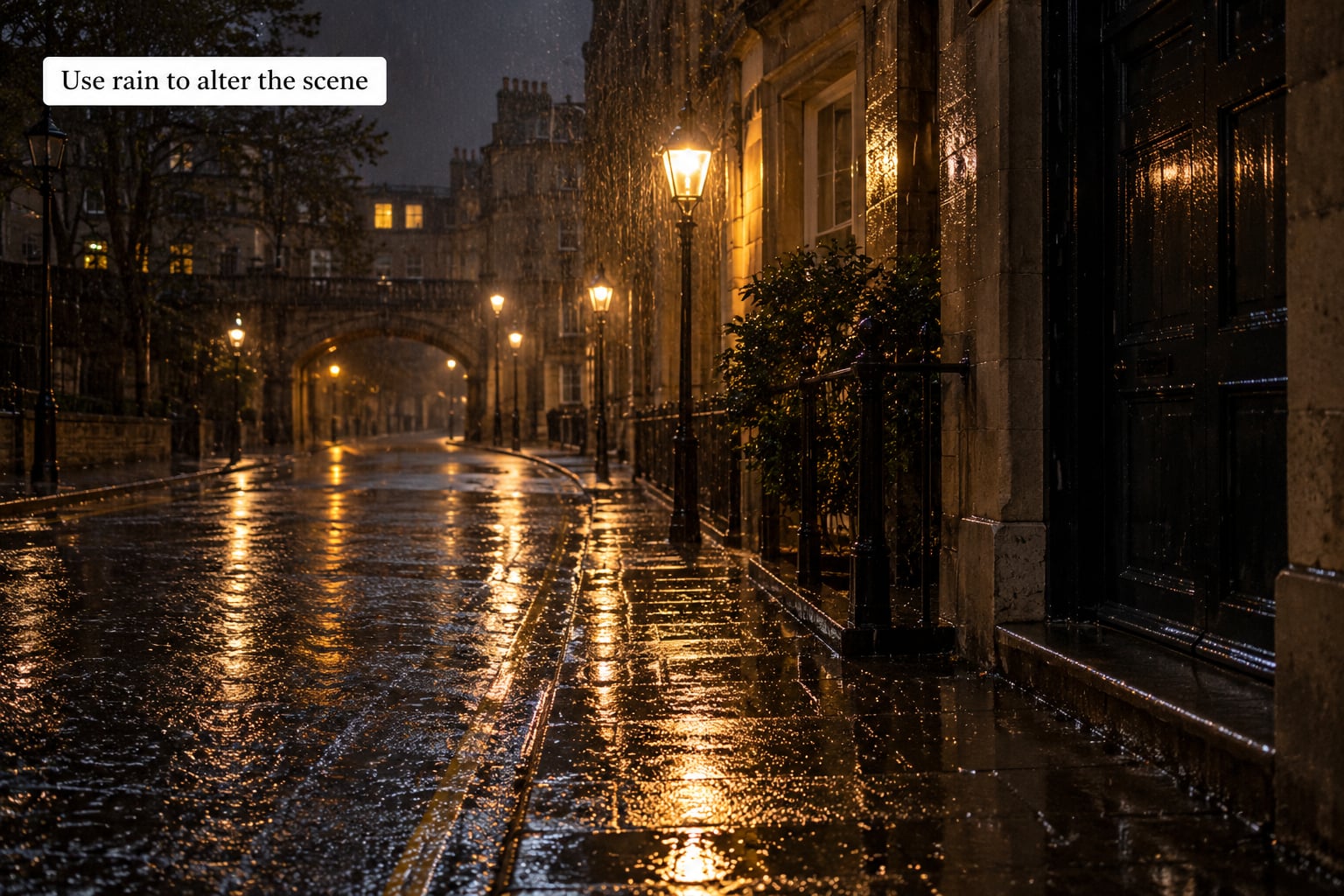
Rain is not a mood. It is a set of physical facts a character has to cope with, and each fact can break a scene open if you use it deliberately.
- It erases. Running water lifts silt, breaks a mud print, and dilutes. Trace evidence at the scene has a clock on it now.
- It masks. Heavy rain covers footfalls and traffic. A witness who says they heard nothing has told you something.
- It blurs. A shape fifty metres off is a shape, nothing more. Distance plus weather equals no identification.
- It slicks. Wet pavement turns a car park into a mirror. Look at what the ground reflects, not just what stands on it.
- It soaks. Wet clothing holds water and smell for hours. Forensics readers notice clothing far more often than writers expect.
- It drowns. A drain that cannot cope closes a road, a cellar, or an escape route. Weather becomes an obstacle with consequences.
The useful test: if you removed the rain, would the scene still work exactly the same way? If yes, the rain is decoration and the scene needs rewriting.
Make darkness useful
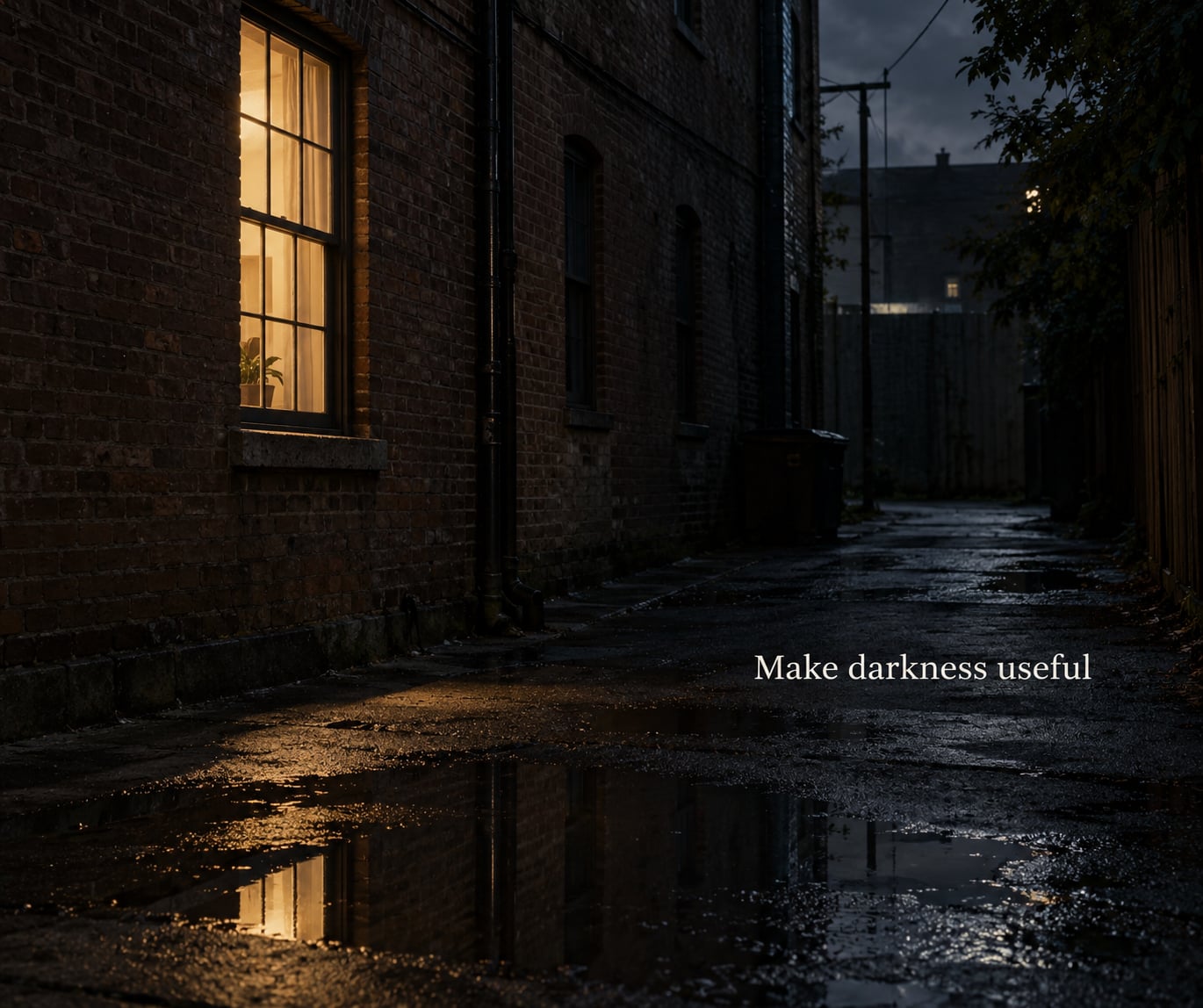
Useful darkness is specific. Gloom is just an adjective. For each dark scene, decide what the darkness conceals, what it misleads, and what it reveals at one chosen moment.
Conceal: a doorway, a figure, a vehicle at the kerb. Mislead: someone hears a car door that is actually a bin lid, or sees a shape that a passing headlight throws onto a wall. Reveal: the moment a torch sweeps an alley and puts a face in the light for two seconds.
Night also shifts which sense carries the scene. With most visible detail removed, sound and touch take over. A wrist on a wet railing, the click of a torch switch, water running off a fire escape. That sensory substitution is what noir actually is, not a coat and a saxophone.
A practical light-source budget helps. Give a scene no more than three distinct light sources and one clear dark mass. Readers can hold that in their head. Readers cannot hold an unlit city that is somehow fully described.
Connect weather and night to the investigation
Weather earns its place when it changes what the investigators can prove. Footprints survive or fail depending on the ground and the hour of the call. Blood diluted in running water behaves differently from blood in a dry room, which changes the shape of the question the detective is asking.
Witnesses get less reliable in bad weather. Someone who watched from a bus shelter at a distance in a downpour is a poor identifier. So is anyone who waited twenty minutes in the cold before police arrived and has spent that time composing a story for themselves.
Then there is movement and access. A suspect’s route changes when streets flood and footpaths close. A neighbourhood that is quiet on a dry Tuesday is not the same place at three in the morning in heavy rain. The weather selects who can be where, and that is a plot device rather than a mood.
Sequencing helps too. Put the discovery in good weather and the chase in bad. The reader feels the loss of options because they remember how easy the first part was.
Use sensory detail to build noir atmosphere, not a weather report
Atmosphere is a literary technique: the deliberate shaping of a reader’s senses and expectations to produce a feeling. Sense of place is the specific local texture that carries it, the smells and surfaces and sounds that belong to one street rather than any street.
Pick two or three senses per scene and go deep on those. Rain gives you smell more reliably than sight, which surprises people. Petrichor, wet concrete, the metallic edge of cold air, a soaked sleeve that stays cold an hour after you go inside. Readers on r/DestructiveReaders respond to precise anchors like the smell of rain far more than to a general statement that it was grim.
Sound is the strongest night-time tool because rain supplies it. Water off a fire escape. A car idling two streets over. Thunder arriving late, which tells you the storm is moving away. Silence is useful too, and specific: not quiet, but the particular hush of a district with everyone indoors.
Then cut. Half a page to say it looked like rain is the most common failure in this genre, and readers reliably notice it.
Use rain and night in crime fiction without losing the reader in the dark
The fear that dark scenes are unreadable is legitimate, and the fix is structural rather than descriptive. Give the reader one fixed point of orientation per scene: a lit shopfront, a parked car with an interior light on, a fence line they can follow.
Then make your verbs short and your objects concrete. Characters should touch things in the dark, which tells the reader what is there. A hand finds a rail. A sleeve catches on a nail.
Summarise the walk, spend the scene on the moment. Readers do not want the twenty minutes between the car park and the door described step by step. They want the four seconds at the door.
A short anchor at the top of the scene also helps: what the rain is doing, how dark it is, where the light is coming from. Three sentences, then move on. Most drafts need a word budget more than they need more adjectives.
Vary the effect across the story
A storm that never changes intensity becomes furniture. Give the book a weather arc and put each chapter on it.
- Setup: light drizzle, drizzle that soaks shoulders slowly. Nothing alarming, which is the point.
- Suspense: steady rain plus fewer people outdoors. The world narrows.
- Revelation: the storm breaks mid-scene. Sudden visibility, headlights on a wet road, a face clearly seen for the first time.
- Escape: rain that turns a route unpassable. The suspect is caught by a flooded underpass.
- Confrontation: the worst weather you have saved for the end. Nobody can hear them. Nobody else can hear them either.
- Aftermath: rain easing into a dripping quiet. The chapter ends with the sound of water off a roof and nothing else moving.
Elmore Leonard is widely credited with the rule never to open a book with weather, and plenty of writers take it as gospel. It is a fine instinct about openings, not about weather itself. Open with a person making a decision and let the rain arrive on the second page, where it can start costing them something.
Matching the treatment to your sub-genre
The same rain does different jobs depending on the kind of book you are writing, and mixing up the signals misreads the genre.
| Sub-genre | What the weather signals | Typical tone | Plot use | Common pitfall |
|---|---|---|---|---|
| Hard-boiled noir | A city that does not care | Hard, cynical, weary | Isolates the detective, hides the body | Rain on every surface for half a chapter |
| Nordic noir | Long daylight shortage, cold | Slow, procedural, bleak | Traps people, removes escape options | Treating snow and rain as the same texture |
| Domestic noir | Danger indoors while it is safe outside | Tense, claustrophobic | Keeps characters inside with a suspect | Weather only ever outside the window |
| Police procedural | Evidence decaying in real time | Methodical, plain | Creates forensic deadlines | Ignoring what rain does to a scene in progress |
| Psychological thriller | A mind losing its footing | Uncertain, subjective | Makes the narrator unreliable | Unreliable narration that reads as sloppy prose |
| Cozy crime | Rain that clears a schedule | Warm, restorative | Forces characters indoors to talk | Importing noir dread into a gentle book |
The published examples worth studying are specific rather than generic. Raymond Chandler leans on a hot dry wind that closes a city down rather than rain. Jo Nesbo’s northern winters do the isolation work that rain does elsewhere. Ragnar Jonasson builds a whole novel around a storm’s aftermath. Tana French builds a city’s mood into its geography. Read how the setting works in the ones you love, then write your own version rather than borrowing their weather.
Common Mistakes When You Use Rain and Night in Crime Fiction
Weather that only changes mood. Fix: give it a job. It washes evidence, cancels a meeting, closes a road, or ruins a plan. If nothing happens because of the rain, cut the rain.
Every scene is identical. A novel where all eleven rain scenes feel the same loses its weather by chapter three. Fix: vary intensity and function, following the arc above.
Darkness with no lighting plan. Readers get lost when they cannot picture the geometry. Fix: three light sources, one dark mass, one orientation anchor.
Cliches doing the work you should be doing. Cold and rainy night. Neon reflected in puddles. A shadow that might be a person. Fix: replace each with something specific to your street, your season and your case.
Rain that changes nothing. A storm that lasts forty pages and affects no decision is a mood board. Fix: ask what the rain destroys, delays or misleads, and write that instead.
Narration no one would think. A detective should not notice the smell of rain unless they have reason to. Fix: filter everything through the point of view. A tired officer registers cold and headlights; a frightened witness registers shadows and the sound of her own coat.
Opening with the forecast. Fix: begin with the person and the problem. Weather arrives once it can complicate something.
A useful discipline is the reverse test. Take any rainy night scene and rewrite it in clear daylight. Whatever plot, character or tension survives is what the scene actually contains. Often it is thinner than you thought.
Frequently Asked Questions
Is rain always necessary for a noir crime scene?
No. Noir is about restricted information, uneven power and isolation, not precipitation. A dry night with one working streetlight can do the same job, and readers notice when a book reaches for rain every time it wants atmosphere. Choose the weather that creates the specific problem your scene has.
How can nighttime scenes remain readable without losing their darkness?
Keep a fixed orientation point in every scene, such as a lit shopfront or a parked car with an interior light on. Limit the scene to about three light sources and one large dark mass, and let characters touch surfaces in the dark so the reader learns what is there. Summarise the walk, spend the words on the moment.
What are common rain and night clichés in crime fiction?
The usual offenders are cold and rainy night openings, neon lights reflected in puddles, rain hammering every surface at once, and a shadow in the background that might be a person. They read as inherited phrasing rather than observation. Replace them with details specific to your location, season and hour.
Should rain conceal evidence or reveal it in a mystery?
Both, at different points. Rain dilutes and erases early, which raises the stakes on how fast the detectives work. Later, a break in the storm can give sudden visibility and hand your detective the clue that closes the case. Timing the change is what makes it feel designed rather than decorative.
How much should weather influence the plot of a crime story?
Enough that a character makes a different decision because of it. That can be small, such as taking a covered route instead of the short one, or large, such as a flooded underpass ending a chase. If you removed the weather and every choice stayed identical, the influence is mood rather than plot.
Can a story open with the line u0022It was a dark and stormy nightu0022?
You can, but it spends the reader’s goodwill on a sentence that carries no character or problem. Elmore Leonard is widely credited with the rule never to open a book with weather. If you want a rainy opening, start with a person making a choice in the rain and let the weather start costing them something on the second page.
Conclusion
Take your next rain-and-night scene and write one sentence about what the weather destroys, delays or misleads in it. Then add one light source, one orientation anchor and one sensory detail no narrator would notice unless they were there. The rest is description, and description is where most drafts get padded.