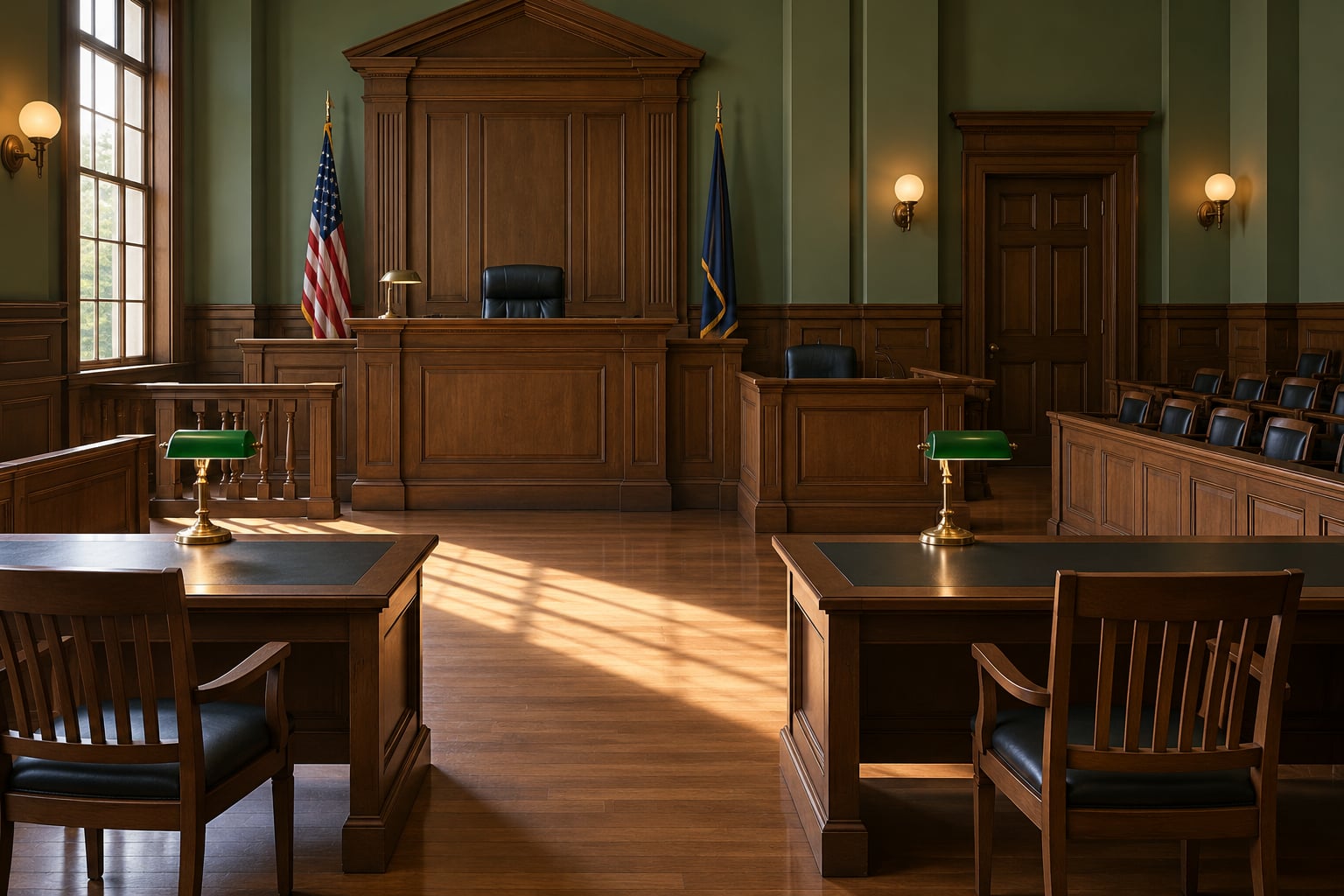
A courtroom scene works when it changes something. Not when the judge bangs a gavel for the fourth time, and not when the prosecutor delivers a speech about justice. It works when your protagonist walks in with one understanding of who they are and walks out with a different one, and the reader feels the difference in their chest.
Knowing how to write a courtroom scene in fiction comes down to seven decisions, made before you type a word of dialogue. Decide what the room must change. Pick the eyes that carry it. Research only the procedure you will actually put on the page. Map who holds the power. Give every character an objective. Write every line of dialogue as an attempt to get something. End on the consequence, not the summary.
Most courtroom scenes that fall flat are not wrong about the law. They are just doing nothing. The gavel is accurate and the scene still dies, because accuracy is texture, not plot. If you are writing crime fiction or a legal thriller, the courtroom is usually the only public stage where your central conflict gets a verdict, so it is worth treating as the real climax it is.
Here is what to gather before you start, then the seven steps in order.
Table of Contents
- What You Need
- The immediate objective of the scene
- The legal or emotional question at stake
- What each character privately wants
- A basic understanding of the proceeding you are depicting
- A clear reason the reader must care about the outcome
- How to Write a Courtroom Scene in Fiction: Step-by-Step
- 1. Decide What the Courtroom Must Change
- 2. Choose the Point of View and Narrative Distance
- 3. Research Only the Procedures You Will Use
- 4. Map the Power Dynamic
- 5. Give Every Character a Courtroom Objective
- 6. Write Dialogue as Pressure, Not Information
- 7. End on a Consequence
- Common Mistakes
- Legal-information overload
- Interchangeable voices
- Unexplained procedure
- Excessive description
- Unrealistic victories
- Recap conversations
- Endings that resolve too much
- The movie courtroom versus the real one
- A note on accuracy worth keeping
- Frequently Asked Questions
- How much legal accuracy does a fictional courtroom scene need?
- How long should a courtroom scene be in a short story?
- Should I write courtroom dialogue in first person or third person?
- How do you make courtroom dialogue sound tense rather than expository?
- Do I need to include evidence, objections, and procedural details?
- How do I end a courtroom scene without giving away the whole outcome?
- Conclusion
What You Need
You need five things, and none of them is a law degree. Get these settled on paper first and the drafting gets dramatically easier, because you will know what every line of dialogue is trying to accomplish.
The immediate objective of the scene
What is happening in this room, in one sentence, that could not happen anywhere else? A witness takes the stand. An objection is sustained and evidence disappears. A deal is offered in a hallway that the reader is not cleared to see.
The legal or emotional question at stake
Guilty or not guilty is the obvious one, but it is rarely the interesting one. Is this witness lying? Will the judge allow the photograph into evidence? Is the defendant going to crack and confess to a crime she did not commit?
What each character privately wants
Their courtroom objective and their private motive are different things, and the gap between them is where tension lives. The prosecutor needs a conviction to keep her job. The defense lawyer needs the truth because his client is his daughter. The defendant wants the witness to look at her.
A basic understanding of the proceeding you are depicting
You do not need the whole system. You need to know what a jury selection sounds like, roughly how long direct examination runs before cross begins, and that in most jurisdictions there is a bailiff and a court reporter present. Anything more specific, you can verify later.
A clear reason the reader must care about the outcome
If the verdict does not cost anybody anything, the reader will skim to the last page and skip it. Give the outcome a price. A career, a marriage, a child, a freedom. Stakes do not have to be stated; they have to be load-bearing somewhere else in the book.
Procedural claims in this article describe United States criminal and civil courts as a general reference point. Rules differ by state and by country, and some of the vocabulary changes meaning once your story moves to a historical or invented court system.
How to Write a Courtroom Scene in Fiction: Step-by-Step
1. Decide What the Courtroom Must Change
Before you research anything, write the scene’s job in one sentence: “By the end of this scene, [character] will [change, learn, lose, decide].” That is your dramatic job. The courtroom is a delivery mechanism for it, not the point.
Common jobs include revealing a secret the reader already suspected but the characters do not, shifting a character’s loyalty, landing a shock that recontextualises the case, blocking a plan one character was depending on, or forcing two people into a public confrontation neither wanted.
Then define the beginning state and the end state explicitly. The defendant walks in believing her alibi holds. She walks out with a jury that has already decided, or a deal, or a verdict that names the man she came to protect. If you cannot write those two sentences, you do not have a scene yet.
How do you know this step is working? You can pitch the scene in one breath without using the word courtroom.
2. Choose the Point of View and Narrative Distance
The viewpoint is the single biggest craft decision in the room, and getting it wrong flattens everything else. There are four that work.
- Close third on the defendant. Best for suspense and dread. She cannot see the strategy, only the machinery closing around her. The reader knows the verdict is coming and cannot stop it.
- First person from the lawyer. Gives you performance as a natural fit, because lawyers talk for a living. The scene becomes a contest of controlled readings, and the reader can watch you lie.
- Limited third on a juror. The best choice when the outcome should genuinely surprise you. A juror hears only what is admitted, notices what everyone avoids, and misreads the evidence plausibly.
- Close third on the judge. Underused and superb for a cold, watchful voice. The judge is the only person in the room who has heard all of it before.
An observer viewpoint works too, but only if you give that observer a reason to be there and a private stake in the result. A floating camera sees everything and feels nothing, which is why so many courtroom scenes read like stage directions.
Narrative distance matters as much as whose eyes they are. A close third inside the defendant means you render the courtroom in fragments: a cracked nail on her left hand, the smell of floor polish, the sound of her own pulse during a pause. An observer at arm’s length gives you the whole room, and the whole room is exactly as interesting as wallpaper.
You will know this step worked when you can name three details your viewpoint character notices that nobody else in the room would.
3. Research Only the Procedures You Will Use
Research is where most writers either stall or drown. The fix is to decide your beat sheet first, then research only the mechanics behind those beats. You are not learning the law. You are checking a shopping list.
Three sources do most of the work. Public court transcripts and recorded proceedings, which show you real rhythm and real vocabulary. General references on court procedure, which give you the order of a trial day and who is required to be present. And one actual proceeding, if your courthouse allows observers, because ten minutes of watching a bailiff work teaches more than an afternoon of reading.
Record what matters: how counsel address the judge, what an objection sounds like with a stated ground, how long a witness’s direct examination runs before the other side stands up, where the jury sits relative to counsel tables, and what the room sounds like from the back row.
Skip anything you will not put on the page. Nobody has ever noticed that the writer knew what a motion in limine was.
The most useful realism rule in the genre is short: if it is not on the record, it did not happen. In a real courtroom, out-of-court conversations are largely worthless as evidence. In fiction, that rule is a gift, because it means anything a character says in a hallway has no power, and only what is said in front of the reporter moves the case.
4. Map the Power Dynamic
Draw the room before you write it, then annotate the drawing. Who controls the proceedings right now? The judge always does, formally, and that is worth remembering when a defence lawyer talks over a ruling.
On your map, mark four things for each character: what they want, what they can block, what they are afraid of, and which unspoken fact would change everything if it came out.
Power in a courtroom is not evenly held even when authority looks even. The prosecution holds the evidence. The defence holds a fact the prosecution has not discovered. The judge holds the ruling. The witness holds the room, sometimes without knowing it, and a good scene knows that the person speaking softly has the most to lose.
Then build the exchanges so authority shifts. Every time a character gains ground, something else is lost. That is what stops five people talking at the same volume with the same confidence, which is the single clearest sign of a scene written without a map.
5. Give Every Character a Courtroom Objective
Assign each speaking character one concrete objective for the scene. Not a theme. An action. Delay the cross. Protect your client. Discredit the witness before she finishes. Comfort your sister without being seen doing it. Win over one juror who is already looking at you. Get the confession on the record.
Objectives make dialogue move. When you know that the defence lawyer’s only goal in this exchange is to move the witness away from the timeline, you write the question, the evasion, and the retreat, and you cut the two sentences of context in between.
Contrast that with a speech that only explains the plot: the defence stands and tells the jury what a reasonable doubt is, and reminds them of a burden that has already been explained twice. That paragraph exists because the writer needed the reader informed, not because a character needed to say it.
Check each one. If a line of dialogue would read the same if the speaker were a different person, cut it or give the speaker an objective that makes only them say it.
6. Write Dialogue as Pressure, Not Information
Every exchange in a courtroom is an attempt. One side is trying to establish a fact, evade a question, change the subject, or reclaim authority. The other side is doing the same in reverse.
Weak version, exposition:
“So you were at the house that evening.” “Yes, from about eight until nine.” “And you saw the defendant leave.” “I saw her car in the driveway, yes.”
It is accurate, it is readable, and it does nothing. Notice what is missing: nobody wants anything.
Sharper version, same facts:
“You saw her car.” “I saw a car.” “A blue car.” “Dark, in that light.” “Registered to my client.” “You didn’t see who was driving.” “I was in the kitchen.” “You were in the kitchen for an hour.” “I would like to answer the question that was asked.”
Now both speakers have leverage, and the flat facts carry pressure because the defence lawyer is paying for every word the witness does not spend. Nothing was explained to the reader, and the reader now knows exactly where the case stands.
A few techniques that help. Keep courtroom register flat and procedural, because flatness under pressure reads as controlled. Short questions get short answers; long questions get objected to. Use the judge’s interruptions as pressure valves, since a “sustained” cuts a witness off mid-sentence. And remember that a lawyer who answers a question instead of asking one has just lost a round, so make your characters lose rounds visibly.
7. End on a Consequence
Close the scene on what the outcome does, not on what the outcome was. The gavel and the jury filing out is the least interesting possible final beat.
A consequence alters the case, damages a relationship, exposes a motive, or forces a decision that cannot be taken back. The jury returns. The defence lawyer does not call his client, because calling her would be an admission. She walks out into the parking structure and finds someone waiting. The verdict is not guilty on two counts and guilty on a third nobody expected, and the sentence is a number that changes every remaining scene in the book.
Do not resolve more than the story needs. A courtroom scene that hands the reader the whole outcome usually ends the tension instead of converting it into the next scene’s problem.
Common Mistakes
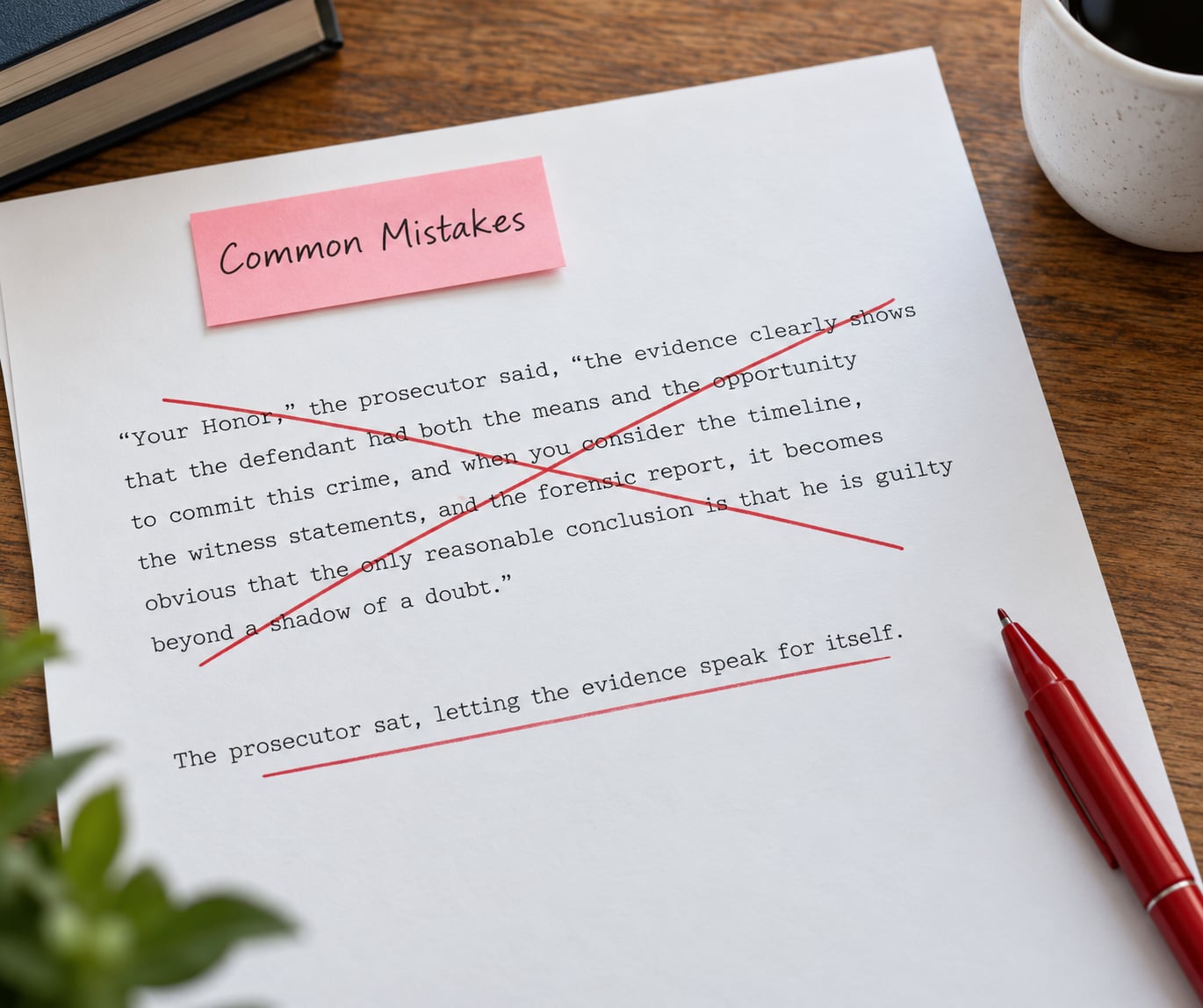
Almost every failed courtroom scene I have read fails in one of the same seven ways. Each has a direct fix, and none of the fixes require more legal knowledge.
Legal-information overload
The problem: the writer explains the case so thoroughly that the reader’s eyes glaze over and the tension leaks out.
The fix: delete every fact the reader can infer from the action. They do not need to know what a motion in limine is; they need to see the defence lawyer killed before she spoke. Cut the paragraph, keep the moment.
Interchangeable voices
The problem: the prosecutor, the defence lawyer and the defendant all speak in the same register, so nobody feels distinct.
The fix: give each character a different relationship to language. One is theatrical, one is literal, one has stopped trusting words entirely. Then cut all dialogue tags for that character and see whether you can still tell them apart.
Unexplained procedure
The problem: a witness sits down, a lawyer asks about an objection, and a ruling lands, but the reader has no idea what just happened or why it mattered.
The fix: stage the reaction, not the rule. When the judge sustains something, show the defence lawyer’s hand stopping halfway to the table. The reader learns what sustained means from what it costs.
Excessive description
The problem: a page of oak panelling, stained glass and pressed suits before anybody says anything.
The fix: one establishing image, then dialogue. Courts are visually consistent, which means the third description of the room adds nothing the first one did not.
Unrealistic victories
The problem: the defence lawyer wins an objection every time, or the prosecutor collapses on the first hard question.
The fix: decide who wins and who loses before you start. Then make the losing side competent, because a professional who gets outplayed reads better than a professional who makes amateur mistakes.
Recap conversations
The problem: two characters in a hallway restate things the reader already knows.
The fix: delete it, and see whether you lost anything. If the conversation exists only to catch a reader who skimmed, it is not earning its place.
Endings that resolve too much
The problem: verdict, sentence, and the emotional resolution all land in the same scene, and the book has nowhere to go afterwards.
The fix: end on one change. Save the rest for the scene after, which will be quieter and stranger than you expect.
The movie courtroom versus the real one
These tropes come from screen, and screen courts are not the same institution. Use the table as a check before you send the draft.
| What fiction usually shows | What actually happens |
|---|---|
| A gavel slammed for emphasis | Many courts have no gavel at all, and where one exists it is used to restore order, not to punctuate speeches |
| Shouting “Objection!” | Objections are stated, not shouted, and a stated ground is required. A bare objection with no basis is simply wrong |
| Applause or a cheering gallery | Public reaction is restrained, and reacting to testimony can draw an instruction to the jury |
| A surprise witness who wrecks the case | Discovery exists precisely to prevent this. The other side gets time to prepare and cross-examine |
| A secret lover revealed on the stand | Practical problems of court scheduling and evidence rules make this rarer than fiction implies |
| Speaking over the judge’s ruling | Talks over the bench and can incur sanctions, and exchange may be struck from the record |
| A verdict and a sentence in one scene | In a criminal case the sentence usually comes later, at a separate hearing |
A note on accuracy worth keeping
You do not need to be a lawyer to write a courtroom scene, and no reader will expect expertise. What readers notice is rhythm, authority, and whether the consequences make sense. Be accurate about the beats you actually use, be vaguer everywhere else, and trust that a scene with a clear objective in every line can survive a fair amount of invention.
Frequently Asked Questions
How much legal accuracy does a fictional courtroom scene need?
Enough that no beat confuses the reader or irritates a lawyer reader. Get right the procedure you actually put on the page: who speaks, in what order, what an objection needs, what a ruling sounds like. Stay vague about everything else. Readers spot inflated legalese far faster than they spot a well-paced scene with lightly fictionalised procedure.
How long should a courtroom scene be in a short story?
For a short story, aim for 800 to 1,800 words for a single scene, which usually covers opening statements through one cross-examination or the verdict. If you want to carry a whole trial, dramatise two or three moments and summarise the rest in a sentence or two of aftermath. Length should follow the change the scene produces, not the length of a real proceeding.
Should I write courtroom dialogue in first person or third person?
First person suits a lawyer or a defendant because the character performs for a living, so dialogue sits naturally in their voice. Close third suits suspense, because the reader sees the machinery closing and cannot intervene. A juror viewpoint suits a story where the outcome should genuinely surprise you. Pick based on what the reader should know, not on habit.
How do you make courtroom dialogue sound tense rather than expository?
Give every speaker an objective for the specific exchange, then make each line attempt something: establish a fact, evade a question, shift the subject, reclaim authority. Cut anything the reader can infer from the action. When both sides are working to get and avoid the same fact, the dialogue carries pressure without anybody explaining the plot.
Do I need to include evidence, objections, and procedural details?
Include whatever creates a turn. An objection that gets sustained can remove the evidence your protagonist needed, which makes it dramatic. Skip details that only sound impressive. After drafting, run one check on each element you kept: if nothing changes because of it, cut it. Procedure earns its place by causing a problem.
How do I end a courtroom scene without giving away the whole outcome?
End on a consequence rather than a verdict: a relationship damaged, a motive exposed, a deal accepted, a person walking into a parking structure and finding someone waiting. You can deliver the verdict itself if you want, as long as it creates the next problem instead of closing the case. Usually one change per scene is plenty.
Conclusion
Start with one sentence: by the end of this scene, my protagonist will have lost something specific. Write it down before you open a transcript, because that sentence is the scene, and everything else is staging.
Your first draft should worry about conflict, objectives, and consequence. Procedure, vocabulary and the layout of the room come second, and they only matter where they change what a character can do. When you revise, read the scene twice: once for whether anybody achieves anything, and once for whether the reader learns anything they could not have inferred from watching the exchange.
Pick your viewpoint, give the room a power map, and let the tedium carry the interiority. The rest is just dialogue that wants something.